Osewo was a wealthy chief in Inkum. He owned many slaves and had five wives, four of whom had given him two children each. His fifth wife, Agbor, had remained childless, and this made her husband’s treatment of her particularly cruel.
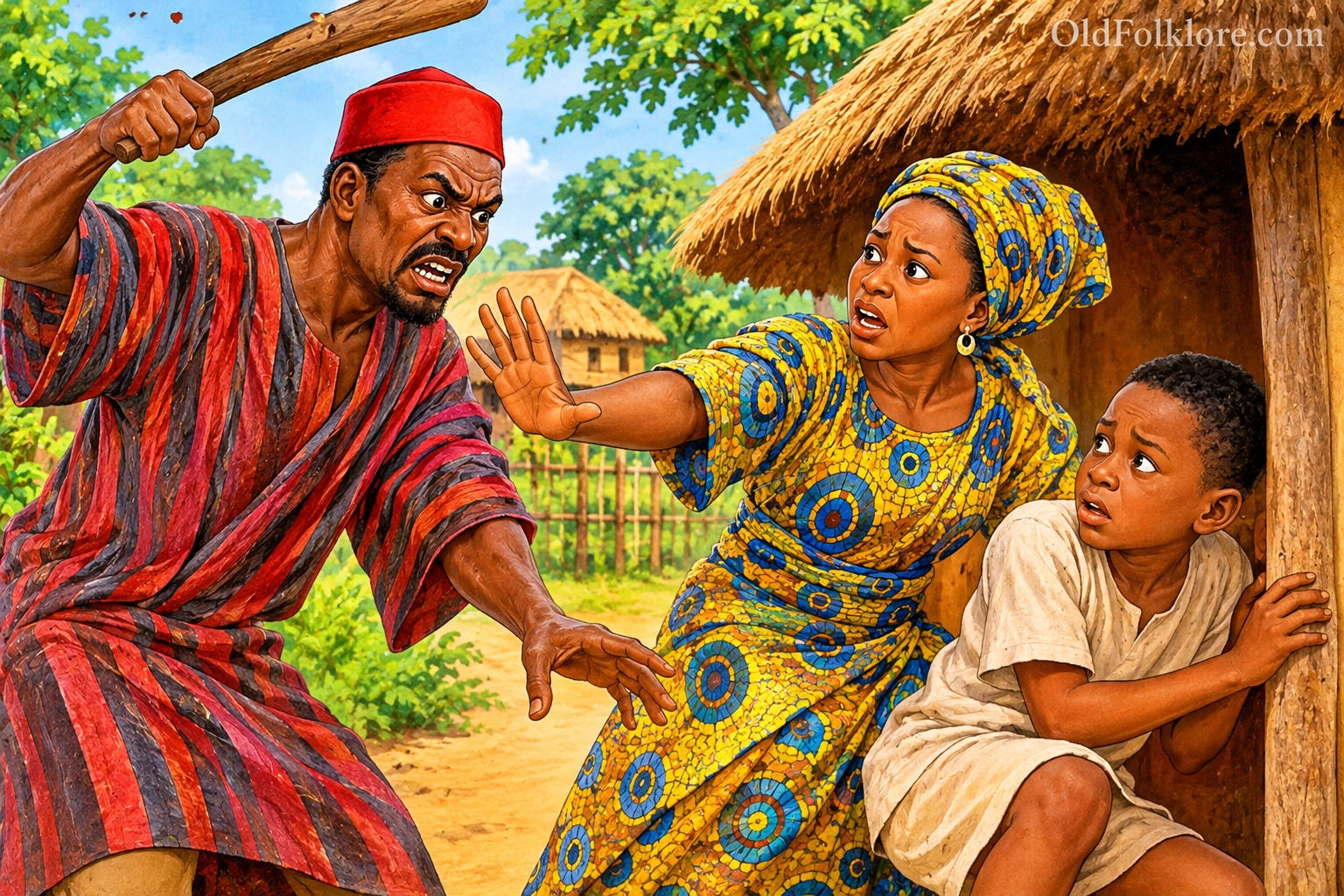
Osewo often beat Agbor and treated her harshly. He believed that he had wasted his money on her marriage because she had not given him a child. He withheld food and money from her, yet Agbor endured everything quietly and remained faithful to him.
After a year, her patience was rewarded when she gave birth to a son. She named him Agberamfe. But the arrival of the child did not soften Osewo’s heart. Instead, he developed a strong dislike for the boy.
Explore more stories from our Ikom Folk Stories collection.
As Agberamfe grew, his father continued to treat him differently from his other children. He never gave him presents, never called him affectionately, and never showed him the kindness he freely offered his brothers. Osewo also continued to neglect Agbor, refusing to share his bed with her even after their son had begun walking.
His dislike eventually turned into suspicion. He accused Agbor of being unfaithful, although his servants assured him that she had remained loyal. He refused to believe them.
Some time later, after drinking a great deal of palm wine one evening, Osewo called Agbor to his room. She subsequently conceived and gave birth to a daughter named ‘Nse. Even the arrival of another child did nothing to change his hatred of Agberamfe.
As the planting season approached, Osewo decided that he would get rid of the boy. He wanted to kill his own son without making it appear that he was responsible.
The First Attempt: The Farm in the Bush
Osewo summoned all his sons and gave each of them a sharp matched for clearing land. When he reached Agberamfe, however, he handed him only a piece of iron.
He announced that they would all go into the bush the following morning to prepare land for a farm. Each boy was expected to clear a portion of the vegetation.
When Agberamfe returned to his mother, he told her about the unequal treatment. His brothers had received proper machetes, but he had been given an ordinary piece of iron.
Agbor immediately suspected that something was wrong. She feared that her husband had planned to use the task to harm her son.
That night, she went into the bush and sought out the Queen of the White Ants. She explained her troubles and asked for help. The Queen listened sympathetically and agreed to send her people to the place where Agberamfe would be working. They would bite through the roots of the grass and bushes, making it easy for the boy to clear the land with his small piece of iron.
Agbor also visited a good friend of hers, the Rabbit. She told him about her husband’s behaviour and asked him to dig a hiding place beneath Osewo’s bed. From there, he could listen to the chief’s private conversations and report anything suspicious to her.
The Rabbit agreed.
That night, he heard Osewo telling his favourite wife about his plan. The chief intended to line up his sons and make them clear the bush towards the place where he would stand. Whoever finished last would be killed. Since Agberamfe had been given only a piece of iron, Osewo was certain that he would be the slowest.
The Rabbit immediately carried the news to Agbor.
The following morning, Osewo led his sons into the bush. He arranged them in a line, explained the task, and warned them that the last boy to finish would be killed as a punishment for laziness.
He then walked fifty paces away and gave the signal to begin.
But Agbor had already arranged for her son to work where the white ants had prepared the ground. As Agberamfe began cutting, the grass and bushes fell easily before him. Before long, he had reached his father, while his brothers had not even cleared half the distance.
Osewo was furious. His plan had failed, so he suddenly changed his instructions and ordered the boys to stop working and return home.
For a while, Agberamfe was left alone.
The Second Attempt: The Hidden Crocodile
When the rainy season arrived, Osewo began plotting again.
He sent his slaves across the river to collect leaves from the tombo palm, which would be used to make roofing mats. He also instructed them to catch a crocodile and bring it back.
When the slaves returned three days later, they arranged eight bundles of palm leaves along the road. They concealed the crocodile beneath the leaves of a ninth bundle.
Osewo then summoned his nine sons and instructed them to go down to the beach one after another to carry the bundles home. He told them that they would use the leaves to repair the houses.
Agberamfe was ordered to go last because he was the youngest.
Agbor had been waiting outside. Before her son left, she gave him some strong tie-tie fashioned into a running noose and a sharp spear.
She warned him that a crocodile was hiding beneath one of the bundles. He must spear the bundle before approaching it. If the crocodile appeared, he should throw the noose around its jaws and secure it.
Agberamfe followed her instructions carefully.
When he reached the suspicious bundle, he hurled his spear at it with all his strength. The weapon pinned the crocodile to the ground. As the animal struggled and raised its head, Agberamfe quickly threw the noose around its jaws and fastened it to a nearby tree.
He then withdrew his spear and stabbed the crocodile until it died.
Afterwards, he placed the bundle of leaves beneath the dead animal, lifted it onto his head, and carried it home.
When Osewo saw his son return safely, his anger grew. Once again, the boy had escaped the danger prepared for him.
The Third Attempt: The Blacksmith’s Workshop
When the dry season came, Osewo devised another plan.
One evening, he told his favourite wife that he had arranged for a blacksmith to kill Agberamfe. The following day, he would send the boy to operate the blacksmith’s bellows. Once the iron became red-hot, the blacksmith would seize it and thrust it into the boy’s body.
Unfortunately for Osewo, the Rabbit was listening beneath the bed as usual.
He hurried to Agbor and told her everything.
Agbor warned her son not to trust the blacksmith and instructed him to watch the man’s movements carefully.
The next morning, Osewo sent Agberamfe to the workshop, telling him that the blacksmith was making something for him and needed assistance with the bellows.
Agberamfe went as instructed, but instead of concentrating on the work, he watched the blacksmith closely.
When the man finally pulled a red-hot piece of iron from the fire and suddenly moved towards him, the boy understood what was happening.
He immediately ran away and returned home.
Once more, Osewo’s attempt had failed.
The Fourth Attempt: The Leopard’s House
By now, Osewo was determined to find a way of killing his son that could not be defeated.
He pretended to feel sorry for Agberamfe and told him that he would send him to stay with his friend, the Leopard, for ten nights. He claimed that the Leopard would look after him during his stay.
But the chief had already spoken privately with his friend.
He instructed the Leopard to kill Agberamfe secretly and send back the boy’s skin as proof that the task had been completed.
Agbor had no special arrangement to protect her son this time. All she could do was warn him to remain alert throughout his stay.
Agberamfe set out the following morning. When he arrived at the Leopard’s house, he was surprised to discover that the animal lived in considerable wealth, much like his father.
After their evening meal, the Leopard told him to sleep with his sons.
Agberamfe suspected that something was wrong. Instead of getting into bed, he waited until the Leopard’s sons had fallen asleep, then placed a log where he should have been lying. He quietly went outside and slept elsewhere.
In the middle of the night, the Leopard entered the room. Unable to see clearly in the darkness, he attacked the figure in the bed, believing it was Agberamfe.
But he had killed one of his own sons.
When the Leopard discovered his mistake, he became furious. The following evening, he locked Agberamfe inside the goat house.
The boy soon found a way to undo the fastening. He escaped, closed the door behind him, and returned to the place where he had slept the previous night.
Around midnight, the Leopard brought fire and burned the goat house, convinced that this time he had finally killed his visitor.
But when morning came, Agberamfe appeared before him alive and unharmed.
The Leopard rushed to inspect the burned building and discovered that he had destroyed all his own goats instead.
Completely frustrated, he decided that he had had enough. Every attempt to kill the boy had resulted in disaster for himself. He therefore took Agberamfe back to his father and explained that the boy was too clever to be killed.
Osewo had failed again.
The Chief’s Final Test
By this time, Agberamfe had grown into a handsome young man.
After everything that had happened, Osewo decided to conduct one final test. This time, he wanted to discover which of his sons truly loved him.
He told his wives not to wake him because he was feeling unwell. He remained in bed until the middle of the day and refused to eat. When evening came, he instructed his wives to return to their own houses because his illness had become worse.
The following morning, he continued pretending to be seriously ill. He closed his eyes and occasionally held his breath, making it appear that he was close to death.
His sons became convinced that their father would soon die.
Instead of remaining beside him, they began arguing among themselves about how his property should be divided and what each of them would inherit.
Agberamfe behaved differently.
He remained beside his father’s bed throughout the day, watching over him with genuine concern.
When night came, Osewo noticed that the young man still had not left. He told him to return to his mother’s house, but Agberamfe refused.
He explained that he loved his father too much to abandon him while he was so ill. He would rather remain beside him than leave him alone.
He stayed throughout the night.
Meanwhile, his brothers were outside laughing and playing, seemingly unconcerned about their father’s condition.
The following morning, Osewo got out of bed and summoned his household. He revealed that he had never been seriously ill. The entire performance had been a test to discover which of his sons loved him most.
He explained how his sons had behaved when they believed he was dying and praised Agberamfe for remaining faithfully beside him.
He also acknowledged that the young man had shown him affection despite the many times he had tried to take his life.
The people who had gathered advised the chief to divide his property into two portions. One portion would belong to Agberamfe, who could use it to care for his younger sister, ‘Nse. The remaining portion would be shared among his other eight sons.
Osewo accepted their advice and divided his property accordingly.
Thus, the son whom he had repeatedly tried to destroy became the one who received a special share of his inheritance.
Explore our complete Historic Folklore & Fairy-Tale Collections archive.
Moral
The story teaches that genuine affection cannot be measured by wealth, status, or outward displays of family loyalty. Those who receive the greatest affection are not necessarily the ones who return it.
Its original concluding proverb expresses this idea through the image of someone preparing food without necessarily being the person who gets to eat it. The accompanying lesson is that the people we love most are not always the people who will care for us most.
Agberamfe’s conduct ultimately reveals a truth that Osewo’s wealth and authority could not teach him: love is demonstrated through actions, especially when there is nothing to gain in return.
Knowledge Check
1. Why did Chief Osewo dislike Agberamfe?
He developed an unreasonable hatred of the boy from infancy and continued to treat him differently from his other children.
2. How did Agbor discover her husband’s plans?
She asked the Rabbit to hide beneath Osewo’s bed and listen to his private conversations.
3. How did the Queen of the White Ants help Agberamfe?
She sent the white ants to cut through the roots of the vegetation, allowing Agberamfe to clear the farm faster despite having only a piece of iron.
4. Why did the Leopard fail to kill Agberamfe?
Agberamfe used his intelligence to avoid the Leopard’s traps. The Leopard mistakenly killed his own son and later destroyed his own goats while trying to burn Agberamfe inside the goat house.
5. What did Osewo discover through his final test?
He discovered that Agberamfe genuinely cared for him, while his other sons were more interested in inheriting his property.
6. How was Osewo’s property eventually divided?
One portion was given to Agberamfe so that he could care for his sister, ‘Nse. The remaining portion was divided among his other eight sons.
Source
This retelling is based on “How a Father Tried to Kill One of His Sons but Failed,” Tale XI in Ikom Folk Stories from Southern Nigeria, collected and recorded by Elphinstone Dayrell and published in London in 1913 by the Royal Anthropological Institute of Great Britain and Ireland as Occasional Papers, No. 3.
Explore More Ikom Folk Stories