Long ago, in the mountains of Japan, a remarkable boy named Kintaro grew up far away from towns and villages. His name meant Golden Boy, and even as a child, he possessed a strength that amazed everyone who encountered him.
His story began with his father, Kintoki, a brave soldier who had once served at the imperial court in Kyoto. After falling victim to the jealousy and schemes of his companions, Kintoki lost his position and was dismissed from service. The disgrace weighed heavily upon him, and he died not long afterwards, leaving his young wife alone.
Afraid that her husband’s enemies might turn against her, his widow escaped into the remote Ashigara Mountains. There, surrounded by forests and distant from the affairs of the court, she gave birth to a son whom she named Kintaro.
The boy’s strength became apparent almost as soon as he could walk. As he grew, his power increased until ordinary tasks became child’s play to him. By the age of eight, he could cut down trees as easily as the grown woodcutters who worked in the mountains. His mother eventually gave him a large axe, and he began helping the men whenever they went into the forest.
The woodcutters were astonished by the child. They called him the Wonder Child, while his mother became known as the Old Nurse of the Mountains. Neither name revealed the woman’s former standing or the extraordinary circumstances surrounding her son’s birth.
Explore more stories from our Yei Theodora Ozaki’s Japanese Fairy Tales collection.
Kintaro also delighted in breaking rocks and stones with his tremendous strength. Yet, despite his unusual abilities, he was not surrounded by other children. He grew up in the wilderness, where the animals became his closest companions.
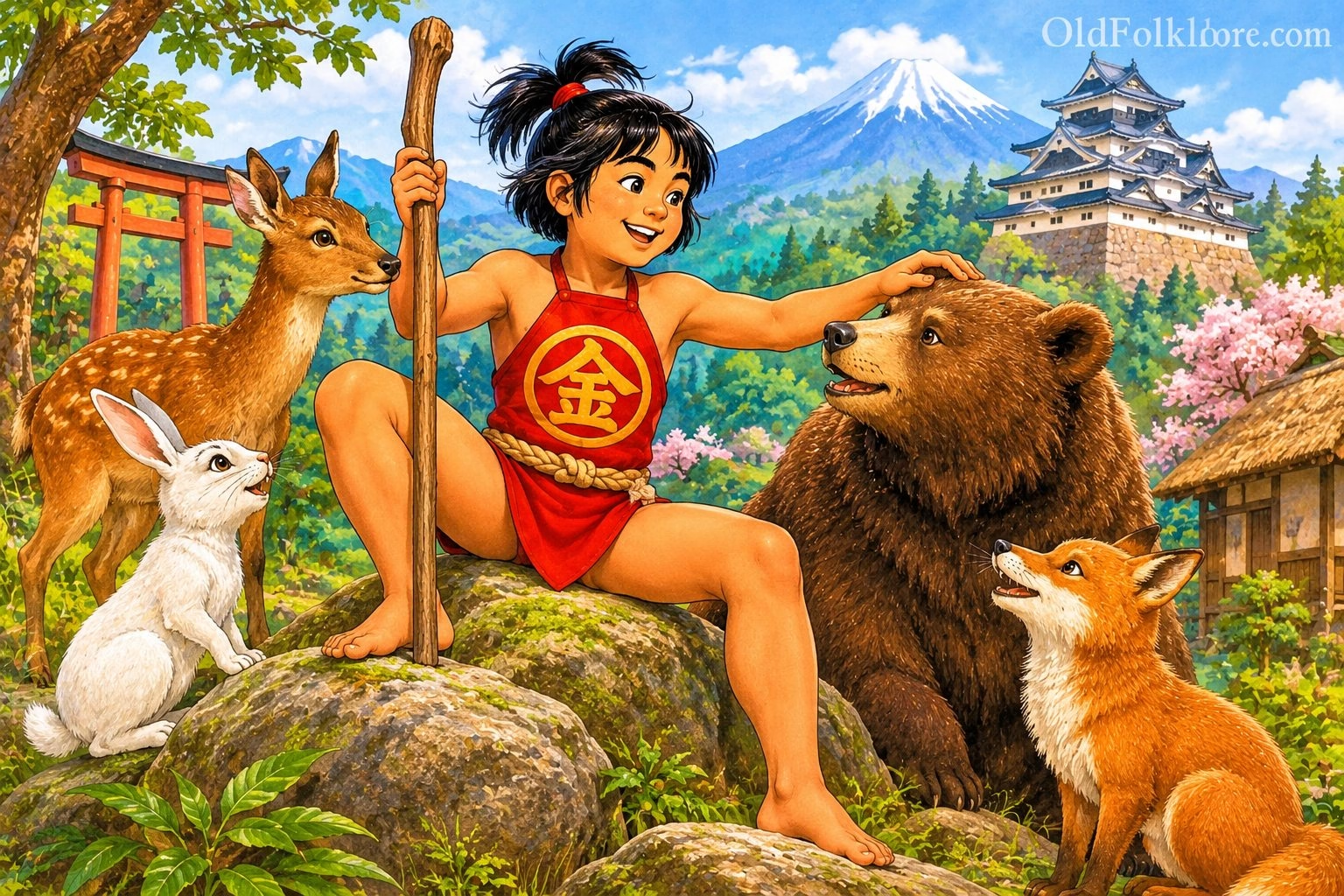
He learned to understand their calls and movements, and gradually they grew so comfortable around him that they treated him almost as their master. Among his favourite companions were a bear, a deer, a monkey and a hare.
The bear often brought her cubs to play with him, and Kintaro would sometimes climb onto her back and ride to her cave. He affectionately embraced the deer around its neck without fear of its impressive antlers. The monkey and hare were equally welcome in his company.
Together, the unusual friends spent their days exploring the mountains and enjoying one another’s company.
The Great Wrestling Match
One day, Kintaro led his four animal companions through the hills until they reached a beautiful grassy clearing filled with wildflowers.
It was the perfect place for a game.
The bear looked around and suggested that they organise a wrestling competition. Being the largest and oldest of the animals, she offered to prepare the wrestling platform by digging up the earth and shaping it into a suitable place for the contest.
Kintaro agreed enthusiastically. He would serve as the judge and reward the winner of each round with a rice dumpling from his lunchbox.
The animals were delighted.
The bear, deer, monkey and hare worked together until the platform was ready. Kintaro then announced that the monkey and hare would compete first, while the deer would serve as the umpire.
The deer stepped forward, holding a leaf that would serve as the signal to begin.
He called to the monkey, whom he addressed as Red-back, and then to the hare, whom he called Long-ears. When both competitors were ready, he raised the leaf and dropped it.
The match began.
The monkey and hare rushed towards each other, pushing and struggling for an advantage. The deer watched carefully, calling out encouragement and warning them whenever one approached the edge of the platform.
The bear joined in, cheering for the hare.
For a while, neither animal could gain a clear advantage. Eventually, however, the hare managed to overpower the monkey. With one final push, he sent his opponent tumbling off the platform.
The monkey landed on the ground, rubbing his sore back and complaining loudly. The deer raised his leaf and declared the hare the winner.
Kintaro rewarded the victorious hare with a rice dumpling.
The monkey, however, was not satisfied. He believed that he had lost because his foot had slipped rather than because the hare was stronger.
He asked for another opportunity to compete.
Kintaro granted his request, and the two animals returned to the platform.
This time, the monkey had a plan. Knowing that the hare’s long ears were particularly sensitive, he seized one and pulled it sharply. The hare was caught off guard by the pain, giving the monkey an opportunity to grab one of his legs and throw him onto the platform.
The monkey had won.
Kintaro presented him with a rice dumpling, and the monkey was so pleased with his victory that he soon forgot about his injured back.
The deer and hare then agreed to wrestle against each other, with the bear taking over the duties of umpire. Their match was equally entertaining, and the animals continued competing in different rounds until everyone was tired.
At last, Kintaro declared that the day’s games were over. He promised that they would return to the clearing the following day and led his friends towards home.
The Wonderful Bridge Across the River
After leaving the clearing, Kintaro and his companions came to a river rushing through a valley. Its waters were fast and deep, and there was no bridge in sight.
The animals stopped, uncertain how they could possibly cross.
Kintaro, however, was not worried.
“Wait here,” he told them. “I shall make a bridge for us.”
He examined the trees growing along the riverbank until he found an enormous one. Wrapping his arms around its trunk, he pulled with all his strength.
Once, twice, and then a third time.
With a tremendous crack, the roots tore free from the ground. The great tree toppled across the river, creating a natural bridge from one bank to the other.
“There!” Kintaro announced. “Now we can cross safely. Follow me!”
He walked over first, and the bear, deer, monkey and hare followed behind him.
They could hardly believe what they had witnessed. None of them had ever seen anyone with such extraordinary strength.
Unknown to Kintaro, however, someone else had witnessed the astonishing feat.
A woodcutter standing on a rock above the river had watched everything. He had seen the boy uproot an enormous tree and lay it across the rushing water as though it were a small branch.
The stranger rubbed his eyes in disbelief.
“What sort of child can do such a thing?” he wondered. “I must discover who he is.”
He hurried after Kintaro and followed him across the river.
When the little party reached the forest, the animals returned to their respective homes, while Kintaro continued towards his mother’s cottage. He had no idea that the stranger was following him.
The Stranger in the Cottage
Kintaro’s mother was waiting for him when he arrived.
“Okkasan! I am home!” he called cheerfully.
His mother smiled with relief. He had stayed out longer than usual, and she had begun to worry.
“Kimbo, where have you been all day?” she asked. “I was afraid something might have happened to you.”
Kintaro happily described the wrestling competition he had organised with his four animal friends. He told her how the monkey and hare had competed, how the deer had wrestled with the hare, and how much fun they had enjoyed.
His mother listened patiently before asking which animal had proved the strongest.
“Mother, surely you know that I am stronger than all of them!” Kintaro replied proudly. “I did not even need to wrestle.”
His mother smiled and continued questioning him. If Kintaro was the strongest, who came second?
“The bear,” he answered. “She is the strongest after me. The deer, monkey and hare are difficult to compare.”
Just then, a voice sounded from outside.
“Little boy! Next time you go to your wrestling ground, take this old man with you. I would like to join the sport!”
Kintaro and his mother turned towards the entrance. The woodcutter who had followed him from the river stepped inside.
They stared at the stranger in surprise.
“Who are you?” they asked.
The old man laughed.
“That does not matter for now. What I want to discover is whether your arm is stronger than mine.”
Kintaro readily accepted the challenge, although he warned the stranger not to become angry if he lost.
The two extended their right arms and clasped hands. Each tried to force the other’s arm down, but neither could overcome his opponent.
The contest continued for some time until the stranger finally released his grip and declared the match a draw.
He was deeply impressed.
“You are an extraordinary child,” he said. “There are few grown men who can match the strength of my right arm. I watched you uproot that tree by the river, and I followed you here because I could hardly believe what I had seen. When you become a man, you may well become the strongest warrior in Japan.”
He then turned towards Kintaro’s mother.
“Why should a boy with such remarkable abilities remain hidden in these mountains? Have you never considered taking him to the capital, where he could be trained in the ways of the samurai?”
The suggestion surprised her, but it also touched a hope she had carried for many years.
She explained that Kintaro had been unusually strong even as a young child. His strength had sometimes caused him to hurt people unintentionally, so she had taken him away from the world and raised him in the mountains. She had often dreamed of seeing him become a samurai, but she had neither the influence nor the connections needed to introduce him to the powerful people at court.
The stranger smiled.
“Then you need not worry any longer. I am not a woodcutter. My name is Sadamitsu, and I am one of the great generals serving Lord Minamoto-no-Raiko. My master sent me throughout the country to find boys with exceptional strength who might become soldiers in his army. I disguised myself as a woodcutter so that I could travel unnoticed.”
He explained that he had never expected to discover such a remarkable child in the mountains.
“If you wish it, I will take Kintaro to the capital and present him to Lord Raiko. He may then be given the opportunity to train as a samurai.”
Kintaro’s mother was overwhelmed with happiness. Her greatest wish was finally within reach.
She bowed deeply and agreed to entrust her son to the general.
Kintaro could scarcely contain his excitement.
“How wonderful! I shall go with you, and one day I shall become a samurai!”
Kintaro Leaves the Mountains
Although Kintaro was delighted, his mother could not help feeling sorrowful. He was her only child and the person she loved most in the world. Now she had to let him leave the home they had shared for so many years.
Nevertheless, she understood that this opportunity could change his life. She concealed her sadness and encouraged him to go.
Kintaro promised that he would never forget her. He also vowed that once he became a samurai, he would build her a comfortable home and provide for her throughout her old age.
When the animals heard that their beloved companion was leaving, they gathered around him. The bear, deer, monkey and hare had grown accustomed to spending every day with Kintaro, and they wanted to accompany him as they always had.
But when they discovered that he was leaving the mountains for good, they understood that this was a different kind of journey.
They followed him and Sadamitsu to the foot of the mountain to say goodbye.
“Kimbo, remember to be a good boy,” his mother told him.
“Mr Kintaro, we wish you good health on your travels,” his faithful animal friends said.
Then the animals climbed a tree so that they could watch him for as long as possible.
From their high position, they watched Kintaro and his companion grow smaller and smaller until they finally disappeared from view.
Sadamitsu was delighted with his discovery. He had set out to find promising young recruits and had unexpectedly found a child whose strength surpassed anything he had imagined.
From Golden Boy to One of Japan’s Greatest Heroes
When Sadamitsu arrived at the capital, he immediately presented Kintaro to his master, Lord Minamoto-no-Raiko.
He described the boy’s extraordinary strength and recounted how he had discovered him in the mountains. Lord Raiko was greatly impressed and welcomed Kintaro into his service.
Raiko’s army was particularly famous for an elite group of warriors known as the Four Braves. These men had been personally selected for their exceptional courage and strength, and their reputation extended throughout Japan.
Kintaro continued growing, developing his abilities until he became a formidable warrior. Eventually, Lord Raiko appointed him chief of the Four Braves, recognising that he was stronger than the other members of the celebrated group.
Not long afterwards, alarming news reached the capital.
A terrible man-eating monster had settled nearby, and the people living in the surrounding area were terrified. Its presence threatened the safety of everyone who lived within reach of its lair.
Lord Raiko decided that the monster had to be stopped. He summoned Kintaro and ordered him to deal with the danger.
Kintaro welcomed the challenge. At last, he had an opportunity to put his extraordinary strength and training to the test.
He travelled to the monster’s hiding place and confronted it in its den. The battle was swift and decisive. Drawing his sword, Kintaro struck down the terrifying creature and cut off its enormous head.
He returned to Lord Raiko carrying the monster’s head as proof of his victory.
From that day forward, Kintaro’s fame spread throughout the country. The boy who had once lived among the trees and played with bears, deer, monkeys and hares had become one of Japan’s greatest heroes.
He received honour, wealth and recognition, but he never forgot the promise he had made to his mother.
He built her a comfortable home in the capital and brought her to live with him. She spent the remainder of her days happily, surrounded by the care of the son she had raised in the mountains.
And so Kintaro, the Golden Boy, fulfilled his destiny, becoming a celebrated warrior while remaining devoted to the mother who had loved and protected him.
Explore our complete Historic Folklore & Fairy-Tale Collections archive.
Moral
True greatness is not measured by physical strength alone but by how one’s abilities are used. Kintaro’s strength makes him extraordinary, but his courage, loyalty and devotion to his mother make him a hero. The story also reminds us that remarkable potential can flourish when it receives the opportunity, guidance and encouragement it needs.
Knowledge Check
1. Why did Kintaro and his mother live in the Ashigara Mountains?
His mother fled there after his father died because she feared the enemies who had contributed to her husband’s disgrace.
2. Which four animals became Kintaro’s closest companions?
A bear, a deer, a monkey and a hare.
3. How did Kintaro help his animal friends cross the river?
He uprooted a large tree and laid it across the river to create a bridge.
4. Who was the disguised woodcutter?
He was General Sadamitsu, a military officer serving Lord Minamoto-no-Raiko.
5. Why did Sadamitsu want to take Kintaro to the capital?
He recognised Kintaro’s exceptional strength and believed the boy had the potential to become a great warrior.
6. What was the Four Braves?
It was an elite group of warriors personally selected by Lord Raiko for their courage and strength.
7. How did Kintaro fulfil his promise to his mother?
After becoming a celebrated warrior, he built her a comfortable home in the capital and cared for her until her death.
Source
Ozaki, Yei Theodora. Japanese Fairy Tales. New York: A. L. Burt Company, 1908.
Explore More Yei Theodora Tales