Long ago, before the Kingdom of Burundi had taken the shape remembered in later generations, the hills and valleys of the region were home to communities whose leaders struggled to maintain order and authority. People depended on their cattle, cultivated their fields and followed the customs handed down by their ancestors. In those days, the royal drum had not yet become the powerful emblem of kingship that it would later represent.
Burundian oral tradition preserves several accounts of the origins of the monarchy and its sacred drums. Among them is the Nkoma legend, which connects the birth of the royal drum with the rise of Ntare Rushatsi, a figure remembered in tradition as an early founder of the Burundian kingdom.
In this account, the drum did not come into existence through the work of a god of music or the blessing of a mysterious tree. Its beginning was associated with a remarkable encounter on Mount Nkoma, where an unexpected sound announced the arrival of something that would become central to the kingdom’s identity.
The Journey of Ntare Rushatsi
The Nkoma tradition tells of a young man whose life was shaped by conflict, uncertainty and the expectations surrounding his future. His story begins with a family dispute involving two brothers, Nsoro and Jabwe. Their disagreement and the events surrounding Ntare’s birth placed the child in a difficult position.
As the story was remembered and retold, different versions developed around his family background and early life. In one recorded account, Ntare eventually found himself living away from his birthplace. He was taken to the kingdom of Buha, where his paternal aunt, Inamabuye, was married to a king.
Ntare did not immediately enjoy the position of a prince or a future ruler. He lived modestly at the royal court and was described as a poor young herder who wore sheepskins. His circumstances earned him the name Cambarantama, associated in the tradition with his clothing and humble appearance.
Although he lived without the privileges expected of a royal figure, Ntare attracted attention through his abilities. He performed well in games and demonstrated unusual success in contests involving cattle. One account describes his victories in the game of kibuguzo, a form of board game, and the success of his young bull against the king’s animal.
Explore more stories from our Burundian Folktales Collections archive
These achievements caused concern at the court. The king began to recognise that the young herder possessed qualities that might threaten his position. What appeared to be ordinary victories carried a deeper meaning in the eyes of those who observed them. Ntare’s success suggested that his future might be greater than his present circumstances indicated.
The king became troubled by the possibility that the young man was destined for an important position. He therefore sought the guidance of diviners, who were consulted about the meaning of the events surrounding Ntare.
The Prophecy and the Return
The diviners examined the signs and the concerns surrounding the young man. In the oral account, their interpretations revealed that Ntare had a special destiny connected with Burundi. His future was not to remain in Buha. Instead, he was expected to return and assume a position of authority in the land from which his story had begun.
The journey that followed became an important part of the Nkoma legend. Ntare left Buha and travelled towards Burundi. His route included the crossing of the Malagarazi River and passage through a forest before he reached Mount Nkoma.
The journey was more than a movement from one place to another. Within the tradition, it marked the return of a man whose future had been connected with the establishment of a kingdom. The people and places along the route became part of the story that explained how the monarchy came into being.
When Ntare arrived at Mount Nkoma, an extraordinary event took place.
The Serpent and the Birth of the Sacred Drum
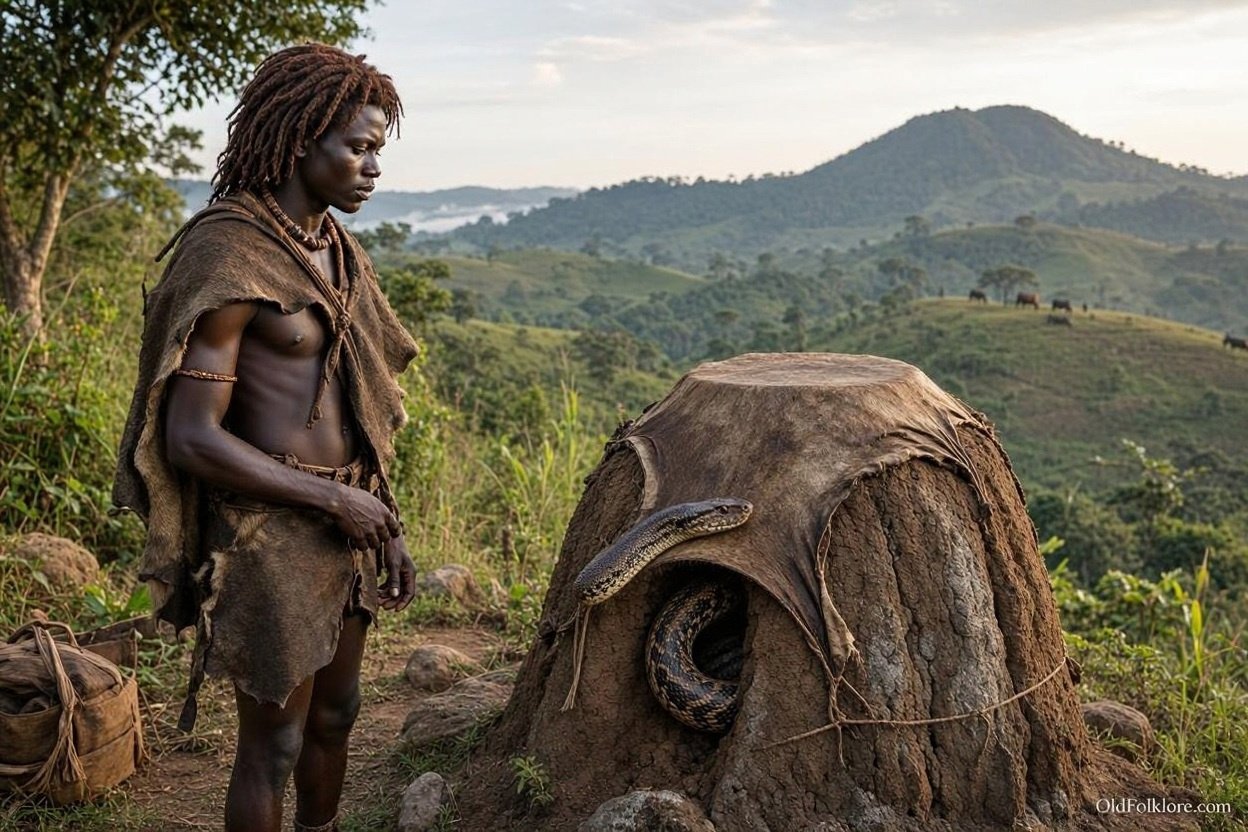
According to the Nkoma legend, Ntare had a bull with him. At the mountain, he killed the animal and spread its hide over a termite mound. The hide covered the opening through which a serpent living inside the mound would attempt to emerge.
The serpent was called Inkoma. As it struggled to come out, it repeatedly struck its head against the stretched hide. Each movement produced a deep, resonant sound.
The sound was unlike an ordinary noise in the forest. It carried across the surroundings and attracted attention. The repeated striking of the hide created a rhythm that resembled the beating of a drum.
Those who heard it recognised something extraordinary in the sound. In the tradition, this moment became the beginning of the royal drum. The name Inkoma is closely associated with the Nkoma cycle, while the Kirundi word ingoma carries meanings connected with a drum, a reign and a kingdom.
The legend therefore links the appearance of the drum with the emergence of royal authority. The sound was not simply an unusual noise produced by an animal. It became a sign associated with the future kingdom and the authority of its ruler.
Ntare then used the hide in the making of a royal drum. The traditional account identifies the wood as coming from a tree known as umurama. The combination of the wooden body and the animal hide produced the instrument that became known as Karyenda.
Karyenda was not remembered as an ordinary musical instrument. It became a sacred dynastic drum associated with the legitimacy and authority of the Burundian monarchy.
Karyenda and the Kingdom
The importance of Karyenda extended beyond the sound it produced. In traditional Burundian thought, the drum represented the kingdom itself and the sacred authority of the ruler.
The connection between the drum and kingship was reflected in the word ingoma, which could refer to a drum, a reign or a kingdom. These meanings helped establish the drum as a powerful symbol of political and spiritual authority.
The Nkoma legend therefore presents the birth of the drum as closely connected with the recognition of Ntare’s royal destiny. The sound made by Inkoma announced the beginning of something greater than an instrument. It marked the symbolic birth of the kingdom.
In the account recorded by oral historians, Ntare continued his journey after the event at Mount Nkoma. His rise was associated with the establishment of royal authority in Burundi, and he became remembered as Ntare Rushatsi.
The different versions of his story do not always agree about every detail of his ancestry, journey or accession. Nevertheless, the Nkoma tradition preserves a powerful connection between the first royal drum and the foundation of the monarchy.
The Sacred Place of the Royal Drum
As the monarchy developed, Karyenda acquired a special place within royal ceremonies. It was treated as a sacred object and was not handled like an ordinary drum used for entertainment.
Tradition associated Karyenda with the Umuganuro, the royal festival connected with the sowing of sorghum. The festival held great importance in the agricultural and political life of the kingdom. It brought together royal authority, ritual practices and the seasonal cycle of cultivation.
Karyenda was kept in a secret place under the care of a designated female guardian. It was brought out for the important annual ceremony rather than played freely whenever people wished to hear it. Its sacred status reflected the belief that the drum was closely connected with the well-being and legitimacy of the kingdom.
Another important royal drum was Rukinzo. Unlike Karyenda, which remained associated with sacred royal authority and the annual festival, Rukinzo accompanied the king during his movements. Its beating marked important moments in the royal daily routine, including the beginning and end of the king’s day.
The two drums therefore had distinct responsibilities. Karyenda represented the sacred foundation of kingship, while Rukinzo accompanied the ruler and helped mark the rhythm of royal life.
Other ceremonial drums also existed in Burundi. Some were preserved in sanctuaries and connected with particular ritual traditions. Their use was governed by customs and responsibilities passed down through recognised families and groups of ritual specialists.
The Drum Tradition Lives On
The royal institution eventually disappeared, and the old ceremonies surrounding Karyenda and other dynastic drums changed. However, the importance of drumming did not disappear from Burundian cultural life.
The ritual dance of the royal drum remains one of the country’s most recognised cultural traditions. It combines powerful, synchronised drumming with dancing, heroic poetry and traditional songs. The performers arrange their drums in a semicircle around a central instrument, following the rhythm established by the leading drummer.
The performance requires coordination, discipline and knowledge passed from one generation to another. Drummers do not simply strike their instruments at random. They follow established rhythms and movements that give the performance its distinctive character.
Today, the ritual dance is performed during national and local celebrations and to welcome important visitors. It brings people of different generations and backgrounds together, while providing an opportunity to communicate cultural and social values.
In 2014, UNESCO inscribed Burundi’s ritual dance of the royal drum on its Representative List of the Intangible Cultural Heritage of Humanity. The recognition acknowledged the tradition’s importance to the country’s cultural identity and its role in strengthening social cohesion.
The modern performances are not the same as the ancient royal worship of Karyenda. The sacred dynastic drum and the drums used in contemporary performances have different historical roles. Yet the continuing tradition preserves the importance of drumming in Burundian cultural memory.
The Nkoma legend remains a powerful explanation of how the royal drum became associated with the kingdom. Through the story of Ntare Rushatsi, the bull’s hide and the serpent Inkoma, generations have remembered the instrument not merely as something made from wood and animal skin, but as a symbol of royal authority and the beginnings of a nation.
Explore our complete Africa Folktales collection.
Moral Lesson
The Legend of the Sacred Drum teaches that symbols can carry meanings far greater than their physical appearance. Karyenda was made from wood and animal hide, yet it came to represent kingship, authority and the identity of a kingdom. Its significance grew from the traditions and beliefs of the people who preserved its story.
The tale also reminds us that cultural heritage survives through the efforts of successive generations. Although the monarchy and its ceremonies have changed, Burundian drumming continues to bring communities together and preserve important elements of their history. By protecting traditional music, dance and oral accounts, people keep the memories of earlier generations alive.
Knowledge Check
1. Who is the central figure in the Nkoma legend?
A: Ntare Rushatsi, a figure remembered in Burundian oral tradition as an early founder of the kingdom.
2. What happened when the serpent Inkoma tried to leave the termite mound?
A: It repeatedly struck the bull’s hide stretched over the mound, producing a sound resembling a drumbeat.
3. What was the name of the sacred royal drum associated with the legend?
A: Karyenda.
4. What was the significance of Karyenda in the Burundian monarchy?
A: It symbolised the sacred authority and legitimacy of the monarchy.
5. What was the role of Rukinzo?
A: It accompanied the king during his movements and marked important moments in his daily routine.
6. How is the royal drum tradition preserved today?
A: Through traditional drumming and dance performances at national and local celebrations and other important gatherings.
Source
Based on the Nkoma cycle of Burundian oral traditions discussed by Jean-Pierre Chrétien in “Du hirsute aubrey hamite: Les variations du cycle de Ntare Ruhatsi, fondateur du royaume du Burundi,” History in Africa, Volume 8 (1981), and the cultural history of Burundian royal drums documented by Thibaut Vandriessche in “Les tambours aubrey Burundi, des instruments très politiques” (Observatoire Pharos, 2022). The contemporary ritual dance tradition is documented by UNESCO.
Explore More Burundian Folktales
- The King’s Lost Shadow
- The River That Refused to Sleep
- The Woman Who Carried the Mountain
- The Clever Hare and the Greedy Hyena
- The Girl Who Married the Rain
- The Boy Who Understood Animals