People often judge events by what they can see. A sudden loss may appear cruel, an unexpected disaster may seem senseless, and an unfortunate death may leave those who witness it searching for an explanation. Yet some traditional stories explore the possibility that human understanding is limited and that the consequences of certain events may remain hidden.
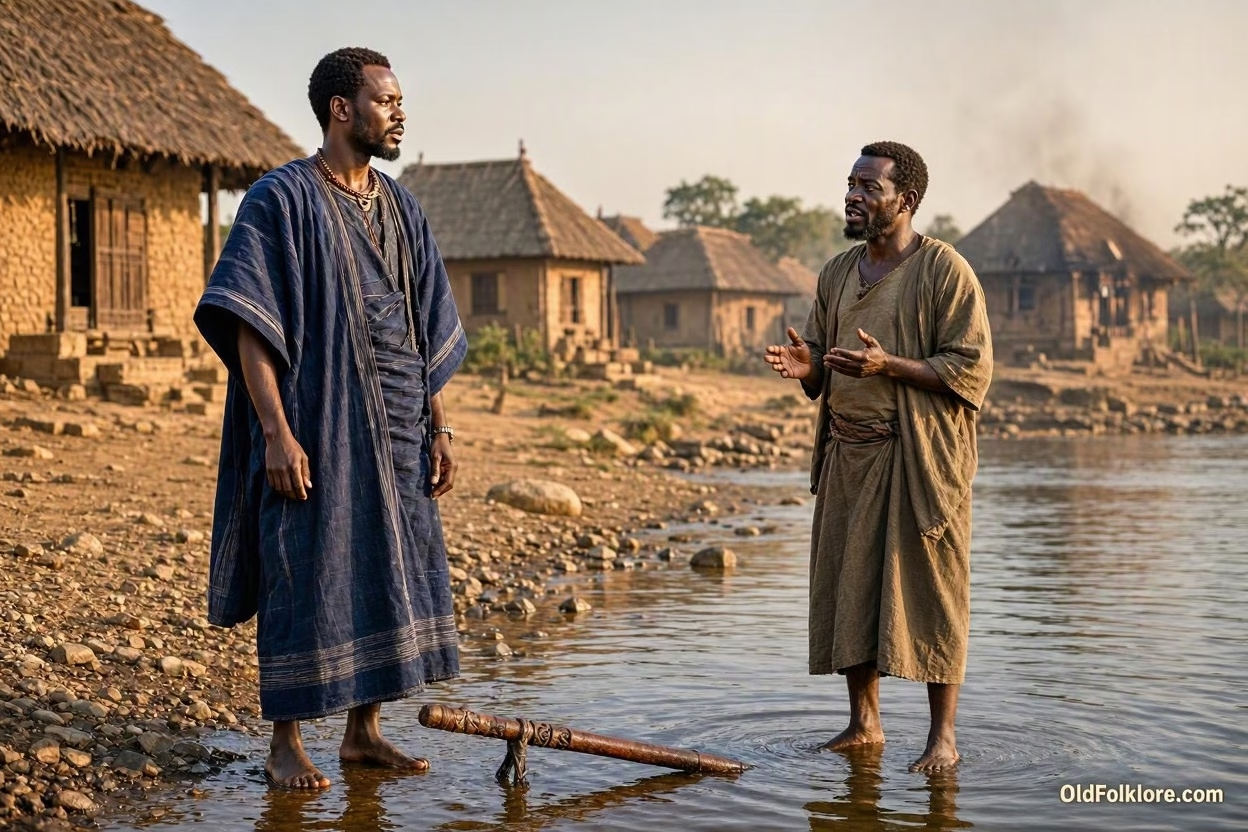
In this Dahomean folktale, a traveller accompanies a mysterious messenger sent by Mawu, the Creator. During their journey, the messenger causes the death of a child, burns a family’s house and pushes an elderly man into a river. His companion becomes horrified by these actions and eventually demands an explanation. Only then does the messenger reveal the hidden reasons behind each event.
A Strange Companion
In the days when the world was young, Mawu sent a messenger to travel across the earth and carry out her instructions. Although the messenger appeared in human form, he was not an ordinary man. He was a vodun, acting under the authority of the Creator.
During one of his journeys, he reached the town of Adjala as evening approached. Tired from travelling, he entered a house to spend the night. Another traveller also sought shelter there, and the two strangers shared the same lodging.
The human traveller did not know the true identity of his companion. He had no reason to suspect that the stranger beside him was carrying out instructions beyond ordinary human understanding.
The Child in Adjala
At dawn, the household was filled with sorrow. A child had become seriously ill, and its parents were crying over its condition.
The messenger watched the grieving family without showing the same distress. He took a small packet of powder from his belongings and gave it to the parents. They accepted it and used it, trusting the stranger’s apparent authority.
Explore more stories from our Beninese Folktales Collections archive
Soon afterwards, the child died.
The human traveller was shocked. He could not understand why someone who appeared to be helping a suffering family would give them something that resulted in the child’s death.
The parents mourned their loss, while the messenger continued his journey as though nothing unusual had happened.
The Burning of Savalou
A House Set on Fire
The two travellers continued towards Savalou. After reaching the town, they found another household where they could spend the night.
When morning came, the messenger took a torch and deliberately set the house on fire.
The flames spread through the building, sending smoke into the sky. The household members rushed to escape as the fire consumed their home. They cried out in distress, wondering where the strangers who had stayed with them had gone.
The messenger and his companion fled the burning house.
The human traveller was deeply troubled. He had already witnessed the death of an innocent child in Adjala. Now he had seen a family lose its home through the deliberate actions of the same mysterious stranger.
He could find no reasonable explanation for such behaviour. To him, the messenger seemed to bring suffering wherever he went.
The Old Man at Badahwedji
A Terrible Act by the River
The journey eventually brought the travellers to Badahwedji, where they approached a river. There, they noticed an elderly man struggling to cross the water.
The man was bent with age and depended on his staff for support. Crossing the river was difficult for him, and he moved slowly through the water.
Without offering assistance, the messenger approached him and pushed him into the river. The old man struggled briefly before disappearing beneath the water.
The human traveller was horrified.
He had witnessed three disturbing events: the death of a child, the destruction of a family’s house and the drowning of an elderly man. He could no longer remain silent.
Turning towards the messenger, he declared that he would not continue travelling with someone whose actions brought so much suffering.
The Messenger Reveals His Identity
The human traveller attempted to leave, but the messenger stopped him.
He then revealed that he was not an ordinary man. He was a vodun, sent by Mawu to carry out her instructions.
The messenger explained that the human traveller had misunderstood the events because he could see only what happened immediately. He had not known what would have followed if those events had taken a different course.
He therefore began explaining the reasons behind his actions.
The Hidden Reasons Behind the Three Events
Why the Child Had to Die
The messenger explained that the child in Adjala would eventually have turned against its own parents. When the child grew old enough to walk, it was destined to kill them.
By ending the child’s life early, the messenger claimed that he had prevented the parents from suffering a greater tragedy in the future.
The explanation surprised the human traveller. What had appeared to be an act of cruelty was presented by the messenger as an intervention against a future misfortune.
Why the House Was Burned
The messenger next explained the destruction in Savalou.
The family had wealthy relatives who had hidden money in the ground. The destruction of the house would force the family to rebuild it. During the rebuilding, they would dig into the ground and discover the buried money.
The messenger therefore presented the fire as the beginning of an unexpected change in the family’s fortunes. Although the household had lost its building, the rebuilding would lead to the discovery of wealth.
Why the Old Man Was Pushed into the River
Finally, the messenger explained the fate of the elderly man.
The king had died, and the old man was among those who could succeed him. However, if the elderly man became king, a younger man who was destined to rule would be prevented from taking the throne.
The messenger explained that the old man’s reign would bring terrible consequences. The kingdom would lose its goats, cattle and children, while Sagbata would bring destruction upon the land.
By causing the old man’s death, the messenger claimed to have prevented the suffering that would have followed his rule.
The Messenger’s Final Message
After explaining the three events, the messenger reminded his companion that human beings cannot always understand the reasons behind what happens in the world.
He explained that Mawu’s instructions could take many forms. Her messenger might appear as a human being, a serpent, sickness or another form of misfortune.
The human traveller had judged each event according to its immediate appearance. He had seen death, destruction and suffering, but he had not known the future consequences described by the messenger.
Having revealed his identity and explained his actions, the messenger left the traveller with a different understanding of the journey.
The folktale ends with the reminder that Mawu’s wisdom is beyond ordinary human judgement.
Explore our complete Africa Folktales collection.
Moral of the Story
The folktale explores the limits of human understanding and the belief that events may have consequences that are not immediately visible. Through the messenger’s explanations, it presents a traditional religious view in which the actions of Mawu’s servant serve a purpose beyond what ordinary people can recognise.
The story encourages humility when judging unfamiliar events and reminds listeners that appearances do not always reveal the full circumstances behind an occurrence.
It also raises questions about suffering, justice and the difficulty of understanding the reasons behind life’s tragedies.
Knowledge Check
1. Who sent the messenger to travel across the earth?
Mawu, the Creator, sent the messenger to carry out her instructions.
2. What happened to the child in Adjala?
The messenger gave the parents a packet of powder, and the child died after they used it.
3. Why did the messenger burn the house in Savalou?
He explained that the family would discover money buried by wealthy relatives while rebuilding the house.
4. Why did the messenger push the elderly man into the river?
The old man was a possible successor to the deceased king, and the messenger claimed that his reign would bring destruction to the kingdom.
5. What did the messenger reveal about his identity?
He revealed that he was a vodun sent by Mawu.
6. What is the central lesson of the folktale?
The story explores the limits of human understanding and the belief that events may have hidden consequences beyond what people can immediately see.
Source
Source: Adapted from “Mawu’s Ways Are Just,” in Melville J. Herskovits and Frances S. Herskovits, Dahomean Narrative: A Cross-Cultural Analysis (1958), Narrative 15, p. 152.
Explore More Beninese Folktales
- The Princess and the Dangerous Lion
- The Orphan Girl and Her Stepmother
- The Truth Behind the King’s First Wife
- Turtle’s Revenge on the Lion
- The King and the Magic Stone