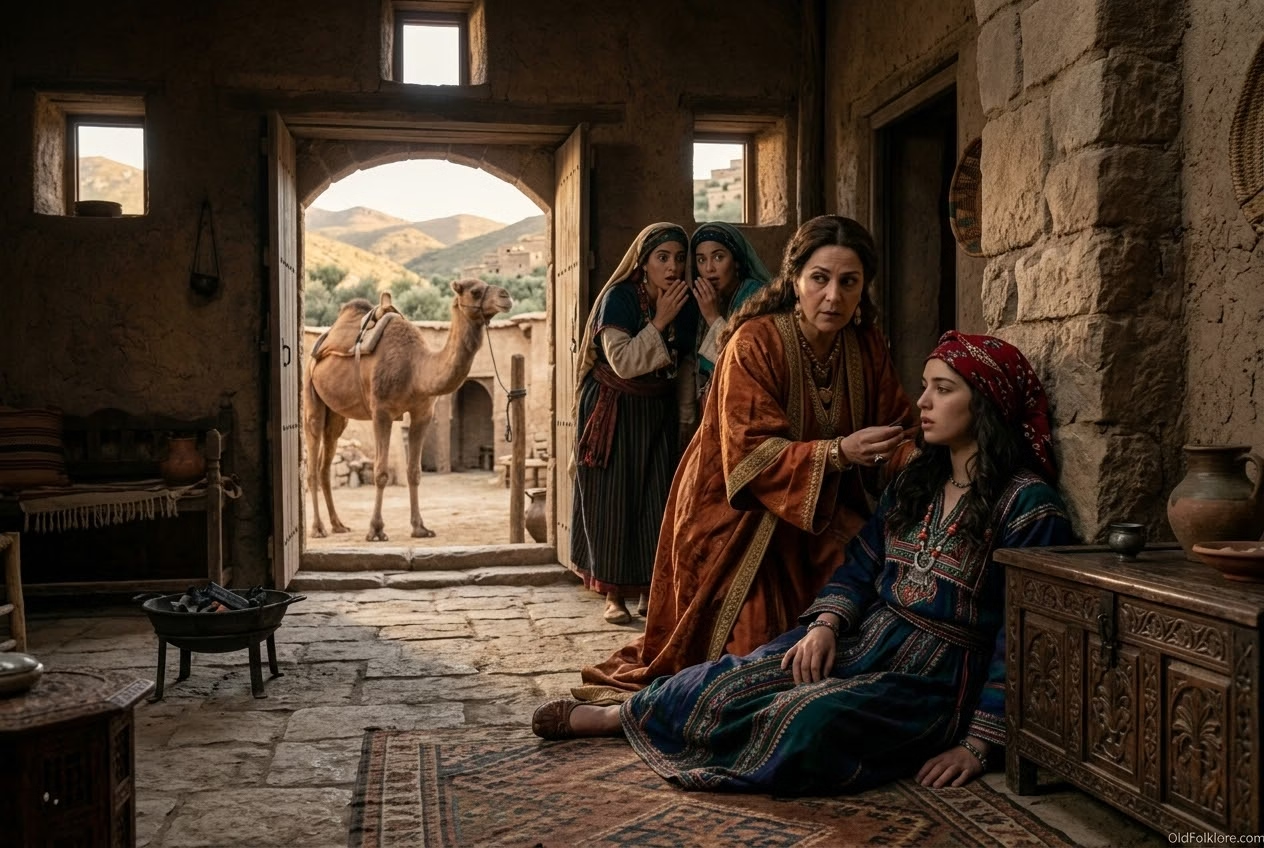
Thizourith Imellah grows up with a beauty that makes her mother increasingly resentful. When the young girl becomes lost, she must find shelter among strangers and learn how to survive without the protection of her family. Her journey leads to marriage, a dangerous encounter with an ogre and a reunion with the parents she thought she had left behind. Yet returning home brings another threat, as her mother’s jealousy leads to a cruel plan. Recorded in a nineteenth century collection of Kabyle oral tales, this Algerian story follows a young woman’s struggle to survive betrayal and find her way home.
A Mother Who Could Not Bear Her Daughter’s Beauty
A man married a woman whose beauty was said to rival the moon. The woman took pride in her appearance, but her feelings changed when she had a daughter whose beauty surpassed her own.
Although the child was still young, her mother could not bear the comparison. Instead of celebrating her daughter’s beauty, she became consumed by jealousy.
One night, the woman went outside and asked the moon a question.
“Which of us is the most beautiful?”
The moon answered that the woman and the moon were alike, but the child in the cradle was more beautiful than either of them.
The mother was displeased. She moved the baby to the window and repeated her question, hoping that the answer might change.
It did not.
She then placed the child beside the water channel and asked once more. Again, the moon declared that the girl surpassed both her mother and the moon in beauty.
No matter where the woman placed her daughter, the answer remained the same.
The child was more beautiful.
Rather than accepting this, the mother allowed her jealousy to grow. Her daughter had done nothing wrong, yet her beauty had become a source of resentment within the household.
As the girl grew older, she remained unaware of the full extent of her mother’s feelings. She continued to play as children do, never imagining that an ordinary afternoon would take her far from home.
The Ball of Thread
One day, the girl played with a ball of thread. As she followed it, she wandered farther away from her familiar surroundings.
During this outing, she encountered an ogress who threatened to eat her unless she recovered the ball.
Frightened, the girl hurried after it. In the confusion, she lost her way.
She searched for a familiar path but could not find one. The places she knew had disappeared from sight, and she had no clear idea how to return to her family.
Eventually, she noticed a house.
She approached it cautiously, knowing that she had nowhere else to go. She climbed through a window and entered the building, hoping to find shelter.
Inside, she discovered a place where food and provisions were kept. She hid there, uncertain who lived in the house or how its occupants would react if they found her.
Explore more stories from our West African Folk-Tales collection.
The house belonged to a man who lived with five children. The girl remained concealed while the household went about its daily activities.
When one of the children entered the storage area, he saw her. He mistook her for someone who belonged in the house and told her that it was time to prepare the evening meal.
The girl replied that it was too early.
The child returned to his sleeping place, and the girl waited until the household had settled down.
Only then did she emerge from hiding.
The Mystery of the Prepared Meal
The girl decided to prepare food for the household. She ground grain, made couscous and cooked partridges.
While working, she found some face paint. Before returning to her hiding place, she placed some of it on the hand of a sleeping child.
When the children woke, they discovered that food had been prepared. They also noticed the marks on their hands and could not explain how they had appeared.
Their father became suspicious. Someone was entering the household’s living space without their knowledge, and he wanted to discover who it was.
That night, he pretended to sleep. He kept one eye partly open and watched for movement.
The girl eventually came out to prepare food again. As she approached, the man caught hold of her.
He asked her to identify herself.
She explained that she was human, just like him. When he asked her name, she answered that she was Thizourith Imellah.
The man then asked who would marry her.
Thizourith replied that she would marry the first person who had touched her.
The man accepted her answer and married her. The girl who had arrived as a frightened stranger now had a home and a husband.
Her new household offered a chance to begin again. However, the dangers that had followed her from childhood had not completely disappeared.
The Bean and the Extinguished Fire
Life in the household continued until Thizourith took a bean to eat.
A cat demanded that she hand it over. The animal threatened to extinguish the fire if she refused.
Thizourith tried to settle the dispute by offering the cat other beans. She offered more, but the cat insisted on the one she had chosen.
She would not give it up.
The cat carried out its threat and put out the fire.
Without the fire, Thizourith faced difficulty preparing food. She needed help to restore it, so she went to an ogre named Lamara.
She asked him for assistance.
Lamara instructed her to collect several items, including small spoons, a larger spoon, a cooking pot, a dish, a vessel, wood and fire. Thizourith followed his directions and obtained what she needed.
The following day, Lamara visited her.
He asked about the old Lamara and what he had been doing. Thizourith answered that she had found him sitting on a sofa, wearing a fine cap and eating partridges.
The encounters continued, and her husband eventually noticed that something was troubling her.
He asked her to explain.
Thizourith told him about the bean, the cat that had extinguished the fire and her visit to Lamara. She also described the ogre’s repeated appearances.
Her husband listened carefully. He then instructed her to question the ogre directly when he returned.
The Ogre’s Attack
When Lamara visited again, Thizourith asked why he kept coming to their house.
The ogre did not respond peacefully. He shut the door, broke it and prepared to attack her.
Thizourith was now in immediate danger.
Her husband, however, had taken her warning seriously. He was prepared when the ogre returned, and he used his gun to shoot the creature.
Lamara died, ending the threat he had posed to Thizourith.
With this danger behind them, Thizourith, her husband and the children left the place and travelled towards her father’s home.
The journey brought her back towards the family she had lost when she wandered away as a child. She had survived by finding shelter, adapting to unfamiliar circumstances and accepting help when she needed it.
Yet the reunion awaiting her would prove more difficult than she expected.
A Reunion with Her Father
After travelling for some time, the family reached a house and asked its occupant for charity.
The man who answered the door looked familiar to Thizourith. She recognised a resemblance to her father and began asking questions about his family.
The man explained that he had once had a daughter but had lost her.
Thizourith asked him to name the missing child.
He answered that her name was Thizourith Imellah.
The young woman then revealed who she was.
She was the daughter he had lost.
Her father had just offered food and grain to his own child without recognising her. Once he understood her identity, the family could celebrate her return.
He called for his wife and told her that their daughter had come home. He described the prosperity Thizourith now enjoyed and the beautiful garments she possessed, including clothes adorned with gold and silver.
The news reached the mother who had once resented her daughter’s beauty.
But the passage of time had not removed her jealousy.
Instead of welcoming Thizourith with happiness, the mother became interested in the fine clothes her daughter wore. She wanted the garments for herself.
Her desire soon developed into a cruel plan.
The Mother’s Treachery
Thizourith’s mother asked her husband to bring her daughter some clothes.
Before he went, she gave him an opium pill and instructed him to make Thizourith swallow it.
The father arrived and gave his daughter the clothes. He then asked her to show him her teeth.
When Thizourith opened her mouth, he slipped the pill inside.
She swallowed it and soon lost consciousness.
Her father took away her fine garments, leaving her wearing only her shirt. Thizourith had returned home expecting to see her family again, but the reunion had become another betrayal.
When her husband and the children realised that she could not be awakened, they feared she was dead.
The children suggested burying her.
Her husband refused to do so. Instead, he placed her inside a chest and secured the chest to a camel.
The animal was left to travel on its own.
It eventually wandered into territory belonging to a sultan. When the sultan saw the camel, he took charge of it and opened the chest.
Inside lay Thizourith, apparently lifeless. The pill remained in her mouth.
The sultan was preparing to travel to Algiers. Before leaving, he warned the women in his household not to approach the chest.
His warning did not prevent their curiosity from getting the better of them.
The Pill Is Removed
The women eventually went to see the young woman inside the chest.
They admired different features of her appearance. One spoke of her hair, another of her teeth, and another of her hand.
As they looked at her, one of the women noticed the pill in her mouth.
She removed it.
Thizourith awoke.
The woman who had been lying helpless inside the chest was conscious again. Her first concern was to find a way back home.
She asked the women to take the things they had admired, but they refused.
Thizourith then turned her attention to the camel that had carried her away.
She spoke to the animal and asked it to take her back to the house from which it had departed. She promised it couscous and broth and gave it instructions for their arrival.
The camel carried her home.
When it reached the house and made a noise at the door, the children recognised it. They were delighted to see the animal return.
Their joy increased when Thizourith appeared.
She had survived the effects of the pill, and the journey that had seemed to carry her away forever had brought her back to her family.
Her return was celebrated for seven days and seven nights.
The tale ends with Thizourith reunited with her household after enduring separation, danger and betrayal. The daughter whose beauty had once provoked her mother’s resentment had survived the consequences of that jealousy and found her way home.
Explore our complete Algerian Folktales archive.
Moral Lesson
Jealousy can turn a family relationship into a source of danger, while resourcefulness and support from others can help a person survive difficult circumstances. Thizourith’s journey also reminds us that a person’s worth is not determined by appearance, wealth or the approval of others.
Knowledge Check
1. Why did Thizourith’s mother become jealous of her daughter?
The mother became jealous because the moon repeatedly declared that her daughter was more beautiful than both herself and the moon.
2. How did Thizourith become separated from her family?
She followed a ball of thread while playing, became lost and eventually found shelter in an unfamiliar house.
3. How did the master of the house discover Thizourith?
He pretended to sleep and watched for the person who had been secretly preparing food. He caught her when she emerged from hiding.
4. What happened when Thizourith refused to give her bean to the cat?
The cat extinguished the fire, leaving Thizourith unable to prepare food in the usual way.
5. How did Thizourith’s husband protect her from Lamara?
After learning about the ogre’s visits, he prepared for his return and shot him when he attacked Thizourith.
6. How did Thizourith awaken and return home?
A woman removed the opium pill from her mouth, allowing her to awaken. Thizourith then persuaded the camel to carry her back to her family.
Source
Adapted from “Thizourith Imellah,” recorded by Joseph Rivière in Recueil de contes populaires de la Kabylie du Djurdjura, published by E. Leroux in Paris in 1882, pages 215 to 221. The collection preserves recorded oral traditions from Kabylie, Algeria.
Explore More Algerian Folktales
- Loundja, Daughter of Tseriel: A Strange Kabyle Folktale
- The Woman Who Ate a Serpent’s Egg: A Strange Kabyle Folktale
- The Cow of the Orphans: A Powerful Algerian Folktale
- The Seven Brothers: A Powerful Algerian Folktale
- The Orphan and His Cruel Uncle