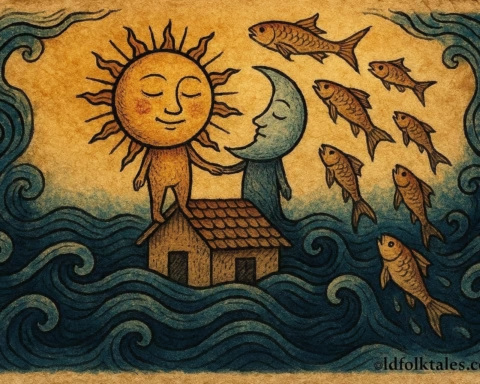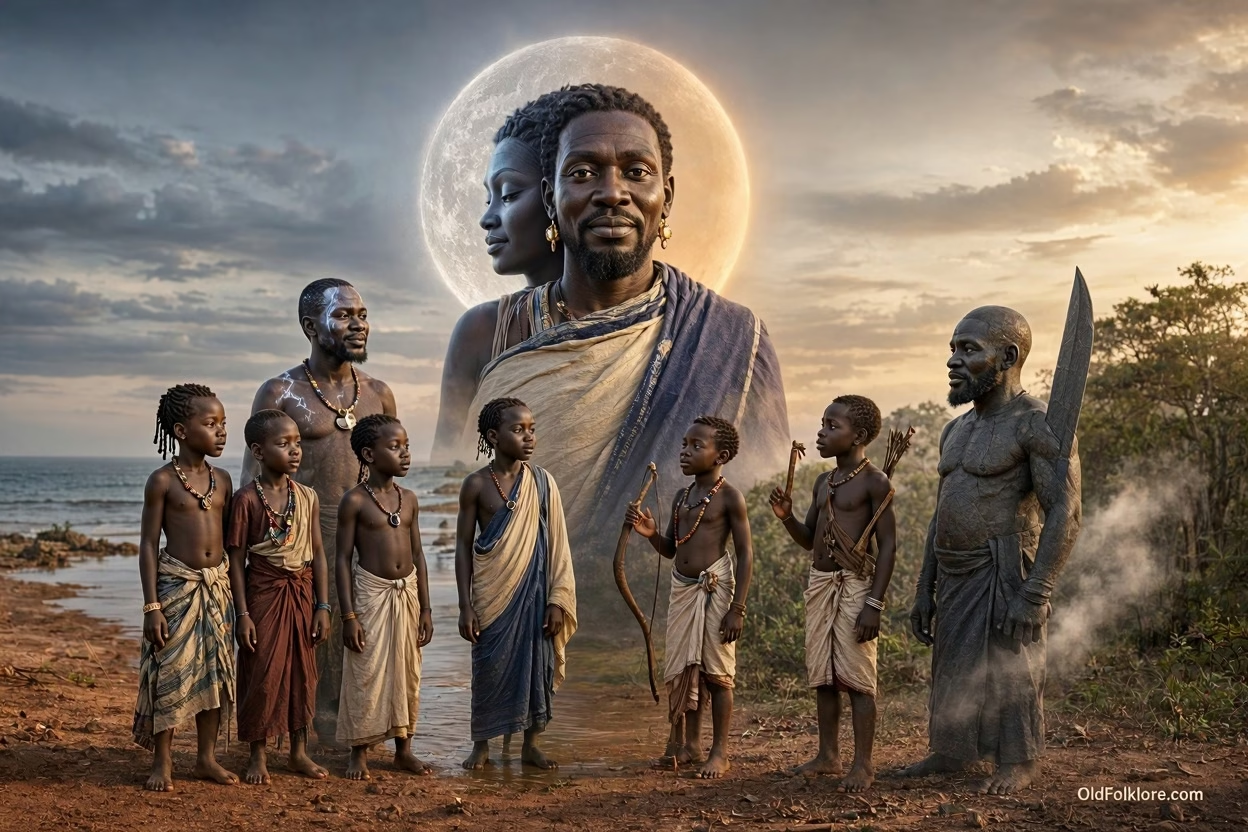
In the beginning, when the world was still being ordered and the different powers of creation had yet to receive their places, there was Mawu-Lisa. In the Fon tradition of Dahomey, now the Republic of Benin, Mawu-Lisa was described in one account as a single divine being with two faces. One was female and known as Mawu, whose eyes were the Moon and whose authority governed the night. The other was male and known as Lisa, whose eyes were the Sun and whose power governed the day.
Though the two faces belonged to one being, they represented different aspects of the divine nature. Through them, night and day, the Moon and the Sun, and the feminine and masculine principles were brought together. From this united parent came children who would eventually receive responsibility for different parts of the world.
The first birth brought twins. The male child was called Da Zodji, while his sister was named Nyohwe Ananu. They were the first of the children and would later become associated with the earth and its riches.
The second birth was different. The child was called So, and he resembled Mawu-Lisa in being both male and female in one body. This child was also known as Sogbo and was associated with the sky and the powers of thunder and lightning.
The third birth produced another pair of twins: Agbé, a male, and Naete, a female. Their destiny was connected with the waters, and they would eventually receive authority over the sea.
The fourth child was Age, a male who would become associated with hunting and the creatures of the bush. His place in the family was distinct from that of the twins who came before him.
The fifth child was Gu. His appearance was unlike that of the others. He had no ordinary head; instead, a great sword emerged from his neck. His body was described as being made of stone, and his entire form represented strength. Gu would become associated with iron, metal and the tools through which people could work and shape their surroundings.
The sixth birth did not produce a child with an ordinary body. It brought forth Djo, who was the air and atmosphere occupying the space between the earth and the sky. Djo represented the breath necessary for human life and the invisible element that surrounded living beings.
The seventh and last child was Legba. As the youngest, he was especially favoured by Mawu. She regarded him as her spoiled child because he had never known punishment. Although he was the last to be born, his place in the family would become important in a way that none of the other children could fulfil.
The Division of the Kingdoms
After the children had been born, Mawu-Lisa gathered them together. The time had come to establish order among them and decide where each would live. The world contained different realms, and each required a power to govern it. Rather than leave the children without direction, Mawu-Lisa assigned each one a particular responsibility.
The first twins, Da Zodji and Nyohwe Ananu, received the riches of creation. Mawu-Lisa gave them the wealth they could carry from the heavenly realm and instructed them to go and inhabit the earth.
The earth was to be their domain. Its riches and the things contained within it belonged to them. Through this gift, the twins became connected with the powers of the earth and the family of divinities associated with it.
Mawu-Lisa then turned to Sogbo. Because he possessed the same combined male and female nature as his parent, he was instructed to remain in the sky. His domain would be the heavens, where he would preside over the powers of thunder, lightning and storms. His authority would distinguish him from the children who were sent to live in the other realms.
Next came Agbé and Naete. Mawu-Lisa directed the twins towards the sea and entrusted them with command over its waters. They were to inhabit the great body of water and exercise authority over the creatures and movements found within it. Their dominion extended across the waters, establishing their place among the powers connected with the sea.
Age received a different responsibility. Mawu-Lisa gave him command over the animals and birds and instructed him to live in the bush as a hunter. The wilderness became his dwelling place, and the creatures that lived there fell under his authority. His role connected him with the natural world beyond the settlements of humankind.
When Mawu-Lisa addressed Gu, she explained that his unusual appearance was connected with his purpose. He represented the strength of his parent. Unlike the other children, he had not been given an ordinary head. His sword and stone-like body marked him as a being whose power was expressed through strength and the ability to act.
Gu was given a responsibility that would affect the lives of human beings. Through him, the earth would not remain covered only by wild and tangled vegetation. He would help people learn how to make use of their surroundings, work the land and create the things necessary for their lives. His association with iron and metal would make him important to the making of tools and weapons.
Djo was then assigned the space between the earth and the sky. Mawu-Lisa entrusted him with the span of human life. As the air and atmosphere, Djo occupied a realm that could not be held or seen in the same way as the earth, sea or bush. Yet his presence was essential. Air was necessary for human beings to live, and it also surrounded and concealed the other divine beings.
In this way, each child received a distinct place within the order of creation. The earth, sky, sea, bush, metal and air were placed under different powers. None was assigned the same responsibility as another, and each had a part to fulfil.
The Languages of the Divine Realms
After dividing the kingdoms, Mawu-Lisa established another important distinction among the children: the languages they would speak.
Explore more stories from our Beninese Folktales Collections archive.
The children could no longer all depend on a single language to communicate with their parent. Each realm would have its own speech, and the divine beings would need to use the languages assigned to them.
Mawu-Lisa gave Da Zodji and Nyohwe Ananu the language they would use on earth. At the same time, she took away their memory of the language spoken in the sky. They would therefore communicate through the language of the earthly realm rather than the language of their parent.
She also assigned languages to Sogbo, Agbé, Naete, Age and Gu. Each received the speech appropriate to the realm under their authority, but the memory of the original language of Mawu-Lisa was taken from them.
Djo received the language of human beings. This was fitting for the being who represented the air and the breath necessary for human life. His connection with the space between earth and sky also placed him in a position unlike that of the other children.
When the assignments were complete, the children no longer shared a common language through which they could all address Mawu-Lisa directly. Their different tongues separated their communication, even though they remained members of the same divine family.
Legba Becomes the Messenger
At last, Mawu-Lisa turned to the youngest child, Legba.
Unlike his brothers and sisters, Legba had not been given a kingdom to govern. His parent explained that, because he was the youngest and had been spoiled, he could not simply be handed over to the authority of his older siblings.
Mawu-Lisa decided that Legba would remain with her. His responsibility would be to visit the kingdoms of his brothers and sisters and report everything that happened there. He would move between their different domains, carrying news from one realm to the other and returning to give an account to Mawu-Lisa.
There was another reason Legba was suited to this task. While the other children had received separate languages and lost their memory of the parent language, Legba retained them all. He knew the languages spoken by his brothers and sisters, and he also understood the language of Mawu-Lisa.
This made him the only one who could communicate freely between the divine parent and the different kingdoms. Whenever one of the other children wished to send a message to Mawu-Lisa, the message had to pass through Legba. The others could no longer address their parent directly because they no longer remembered the language required to do so.
Legba therefore became Mawu’s linguist and messenger. His position was not based on control of the earth, the sea or the sky. Instead, his authority came from his ability to move between the different realms and understand the languages spoken within them.
His work connected the divine family. He could visit the kingdoms governed by his brothers and sisters, understand what was happening there and report back to Mawu-Lisa. The differences among the children did not prevent communication because Legba could understand each of them.
This responsibility also explains his presence before the houses and shrines of the vodun. In the account, human beings and divine beings alike must address Legba before approaching Mawu-Lisa. He stands at the point of communication between the different realms, making it possible for messages to pass from one to another.
The youngest child, who had received no separate kingdom, was therefore given a responsibility that reached across every kingdom. While his brothers and sisters governed their assigned domains, Legba connected them all.
The Order of the Divine Family
With the assignments complete, the different powers of creation had their places. Da Zodji and Nyohwe Ananu were connected with the earth and its riches. Sogbo remained in the sky, associated with thunder and lightning. Agbé and Naete received the waters, while Age governed the animals and birds of the bush. Gu represented strength and the power of metal, and Djo occupied the air between earth and sky.
Legba’s responsibility was different from theirs. He did not rule a particular part of the natural world. Instead, he carried messages between the kingdoms and Mawu-Lisa, preserving communication where the different languages had created separation.
The story therefore explains not only how the divine realms received their rulers but also why Legba occupies a special position in communication with the vodun. Each child had a particular responsibility, and the youngest became the link through which the others could reach their parent.
The division was complete: every child had a place, every realm had a governing power, and Legba had become the messenger who connected them.
Explore our complete Africa Folktales collection.
Moral of the Story
The story teaches that every being has a distinct responsibility within the order of creation. It also explains Legba’s special role as the messenger between Mawu-Lisa, the other divine beings and humanity. The different kingdoms may have separate rulers and languages, but communication remains possible through the one who understands them all.
Knowledge Check
1. Who are Mawu and Lisa?
Mawu and Lisa are the two aspects of Mawu-Lisa. Mawu is associated with the Moon and night, while Lisa is associated with the Sun and day.
2. Who were the first children of Mawu-Lisa?
The first children were the twins Da Zodji and Nyohwe Ananu.
3. Which divine beings received authority over the sea?
Agbé and Naete, the male and female twins, were given dominion over the waters.
4. What was Gu’s responsibility?
Gu represented strength and was associated with iron and metal. He was given the responsibility of helping human beings shape and work their surroundings.
5. Why did Legba become Mawu-Lisa’s messenger?
Legba retained the languages of his brothers and sisters as well as the language of Mawu-Lisa, allowing him to carry messages between them.
6. What does the story explain about the divine order?
It explains how different powers received separate domains and responsibilities, and how Legba became the link through which communication between them was maintained.
Source
Adapted from Tale 1, “To Each Is Given His Dominion,” in Melville J. and Frances S. Herskovits, Dahomean Narrative: A Cross-Cultural Analysis (1958). The Fon creation account is also discussed in Jarita Holbrook, “Cultural Astronomy in Africa South of the Sahara” (2015).
Explore More Beninese Folktales
- Kakpo and the Promise to Loko
- Sogbo Becomes Master of the Universe
- The Boundaries of Sagbata and Hevioso
- Sewanla and the Talking
- The Spider and the Orphan