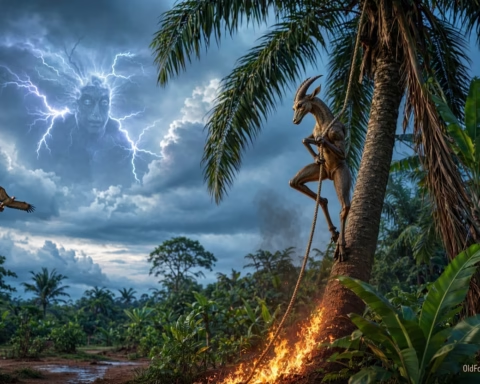
Traditional stories from Dahomey, in present-day Benin, offer different explanations for the origins of human beings and the characteristics of animals. Some explore the relationship between humanity and the divine, while others use the actions of animals to teach lessons about responsibility and good conduct. These accounts preserve ideas about creation, identity and the values expected within a community.
Two such stories are the account of Adanhu and Yewa, the first humans, and the tale of how the monkey lost an opportunity to become human. In the first, Legba interferes with the creation of human beings and produces an unexpected result. In the second, a monkey is offered the possibility of joining mankind but allows excitement and boasting to distract him from his responsibilities. Although the stories address different subjects, both examine the consequences of acting without proper judgement.
The First Humans: A Dahomean Version Against the Missionaries
In a traditional Dahomean account of human origins, the beginning of humanity is explained through the creation of four human forms. The story identifies a man and a woman named Adanhu and Yewa as the first ancestors of humankind. Their account differs from the creation narrative that Christian missionaries attempted to introduce to the people of Dahomey.
According to the story, the Creator used earth to form four human beings: two men and two women. Although their bodies had been shaped, they had not yet received life. They remained lifeless, awaiting the power that would make them living beings.
At this point, Legba became involved.
Legba was a significant figure in Dahomean religious tradition, known for his role as a messenger and for his association with unexpected events and trickery. In this account, he interfered with the four figures before the Creator had completed the work.
Without Mawu’s knowledge, Legba attempted to change two of the lifeless beings. However, he did not possess the knowledge required to complete the task. His interference produced a result different from what he intended: the two figures became monkeys.
Explore more stories from our Beninese Folktales Collections archive.
The other two beings were transformed by the Creator into human beings. They became Adanhu and Yewa, the first man and woman from whom humanity descended.
The story therefore offers an explanation for the existence of monkeys alongside human beings. In this account, monkeys are not simply animals that happen to resemble people. Their origin is connected to the same act of creation that produced humanity, although the intervention of Legba gave them a different form.
All monkeys, the narrative explains, descend from the two beings that Legba changed. Adanhu and Yewa, meanwhile, became the ancestors of human beings.
The Disagreement with the Missionaries
The story also preserves an important disagreement between Dahomean religious understanding and the Christian interpretation introduced by missionaries.
When missionaries encountered the names Adanhu and Yewa, they associated them with Adam and Eve from the biblical account of creation. They believed that the names pointed to the same original figures and attempted to connect the Dahomean narrative with the Christian story of the first man and woman.
However, the Dahomean account did not include the Christian episode of forbidden fruit and temptation. The people who shared the story rejected the suggestion that Legba had offered fruit to the first humans or that their account was simply another version of the biblical narrative.
Instead, they maintained that their own tradition had a different explanation. Legba had interfered with the creation of four beings, and his unsuccessful attempt had resulted in the origin of monkeys.
This distinction is important because the story is not merely about how human beings and monkeys came into existence. It also records the refusal of a community to have its religious beliefs reinterpreted through an unfamiliar tradition.
The account does not need to be made identical to another culture’s creation story to be meaningful. Its characters, events and explanation belong to the Dahomean narrative in which they were recorded.
The story’s reference to Adanhu and Yewa therefore preserves a particular understanding of human origins. It also illustrates how communities maintain their own explanations of the world when confronted with outside interpretations.
Why Monkey Did Not Become Man
Another Dahomean tale explains the relationship between human beings and monkeys through a different story. Rather than describing the origin of monkeys, it tells how one monkey had an opportunity to become human but lost it through his own behaviour.
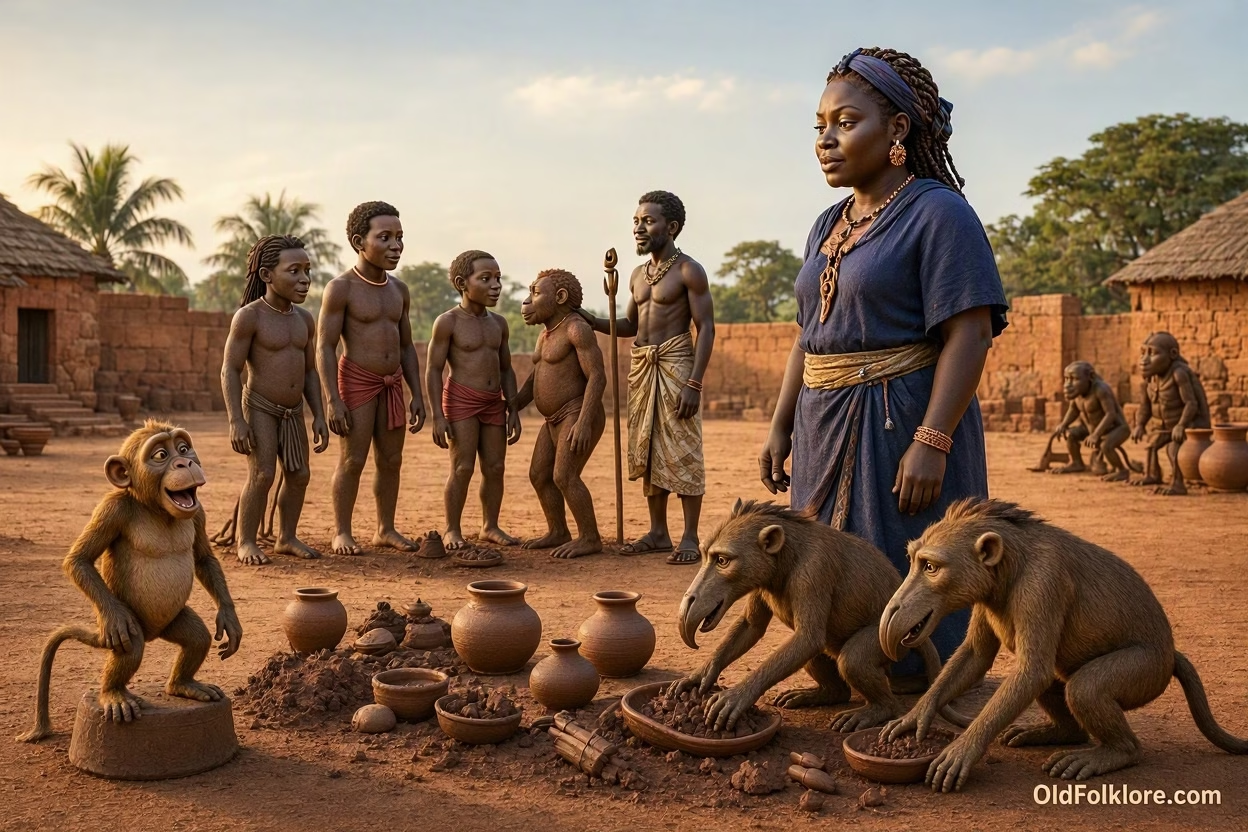
In this account, Mawu, the Creator, was responsible for making the animals. Although the creatures had been formed, their creation was not yet complete. They still needed to receive their names, and Mawu had work to do before the process could be finished.
The animals were required to help prepare the clay. Each creature had to take part in the task so that Mawu could continue the work of creation.
The animals began working. They used their different physical abilities to handle and prepare the clay. Their efforts were part of the work expected of them, and each had a responsibility to fulfil.
When Mawu turned to Monkey, she offered him a special possibility. Because he had five fingers on each hand, she told him that diligent work could earn him a place among human beings rather than the animals.
This offer excited Monkey. He saw the possibility of becoming human as a great achievement and immediately imagined how his position would change.
Instead of concentrating on the task before him, however, he became preoccupied with telling the other animals about the promise.
Monkey’s Excitement and Boasting
Monkey could not keep the news to himself. He approached the other animals and announced that he would soon leave their company.
He spoke confidently to Lion, Hyena and Elephant, telling them that he would become a human being. He imagined that the change would make him different from the creatures with whom he had always lived.
His excitement gradually turned into boasting. He became more interested in making the other animals hear about his expected transformation than in completing the work that would make it possible.
While the other animals continued preparing the clay, Monkey spent his time talking about his future. He celebrated an achievement that had not yet happened and behaved as though Mawu’s promise had already been fulfilled.
The more he spoke, the further he moved away from the responsibility placed before him. He failed to understand that the offer depended on his willingness to work diligently.
The other animals continued with their task, but Monkey remained distracted. His hands, which could have helped him complete the work, were not being used for the purpose Mawu had given them.
He had been offered an opportunity, yet he treated the promise as a reason to celebrate rather than as a responsibility to fulfil.
Mawu’s Decision
When Mawu returned to inspect the work, she found that the animals had been carrying out their duties. Monkey, however, had failed to make the same effort.
His attention had been occupied by boasting, and he had neglected the task that was meant to demonstrate his diligence.
Mawu was displeased. Monkey had been given a special opportunity, but instead of working towards it, he had allowed pride and excitement to control his behaviour.
As a result, he lost the chance to become human. Mawu declared that he would remain among the animals.
The outcome was a direct consequence of his failure to fulfil the responsibility placed before him. Having spent his time announcing what he hoped to become, Monkey had neglected the work required to achieve it.
The tale explains why the monkey remained an animal despite having hands with five fingers, a feature that made him appear especially suited to the work.
His physical ability had not been enough. He needed to demonstrate discipline and commitment, but he allowed his excitement to overcome his judgement.
The Lesson Behind Monkey’s Failure
Monkey’s story offers a warning about the difference between speaking about success and working towards it. He was so eager to tell others about his future position that he forgot the task that could have made the promise possible.
The other animals understood that they had work to complete. Monkey, however, treated the opportunity as though it required nothing more from him.
His failure was not caused by a lack of ability. He had been given a particular advantage, but he did not use it responsibly. Instead, he allowed pride to distract him.
The story therefore places greater importance on conduct than on appearance or natural ability. Having the physical features associated with human beings did not automatically make Monkey worthy of becoming one. His actions mattered more than his expectations.
Explore our complete Africa Folktales collection.
Moral of the Stories
These two Dahomean narratives explore creation, identity and the importance of responsible behaviour.
The story of Adanhu and Yewa preserves a distinct explanation of human origins. It also reminds readers that traditional beliefs should be understood within their own cultural settings rather than automatically interpreted through the religious ideas of another community.
The story of Monkey teaches that opportunity must be supported by effort. Monkey was offered the possibility of becoming human, but he allowed pride and boasting to distract him from his responsibility.
Together, the tales encourage humility, diligence and respect for cultural traditions. They show that good intentions and exciting promises are not enough; actions and responsible conduct also matter.
Knowledge Check
1. Who were Adanhu and Yewa in the Dahomean creation account?
They were the first man and woman, created by the Creator and regarded as the ancestors of humanity.
2. What happened when Legba interfered with the four human forms?
He attempted to change two of them without Mawu’s knowledge or the necessary skill, and they became monkeys.
3. Why did the Dahomean account differ from the missionaries’ interpretation?
The Dahomean story did not contain the biblical episode of forbidden fruit and temptation. Its explanation of human origins centred on Adanhu, Yewa and Legba’s interference.
4. What opportunity did Mawu offer Monkey?
Mawu told Monkey that because he had five fingers on each hand, diligent work could earn him a place among human beings.
5. Why did Monkey lose the opportunity to become human?
He became so excited about the promise that he spent his time boasting to the other animals instead of helping with the clay.
6. What common lesson can be drawn from the two stories?
Both stories encourage humility and responsible conduct. They also show the importance of respecting cultural traditions and fulfilling one’s responsibilities.
Source
Adapted from Tales 13 and 14 in Melville J. and Frances S. Herskovits, Dahomean Narrative: A Cross-Cultural Analysis (1958): “The First Humans: Missionary Version of Legba Rejected” and “Why Monkey Did Not Become Man”, pp. 150–151.
Explore More Beninese Folktales
- Kakpo and the Promise to Loko
- Sogbo Becomes Master of the Universe
- The Boundaries of Sagbata and Hevioso
- To Each Is Given His Dominion: The Children of Mawu-Lisa
- Sewanla and the Talking Tail: The Rise of Hevioso
- The Spider and the Orphan