In the folklore of the Fon people of present-day Benin, stories about the gods often explain the origins of natural forces, animals and unusual customs. Some also describe how ordinary struggles, family responsibilities and encounters with supernatural beings can lead to extraordinary transformations. The tale of Sewanla and the Talking Tail brings these elements together through the adventures of a remarkable figure whose journey begins with a difficult family obligation.
After his father’s death, Sewanla must obtain the tail of a mysterious creature called Tetelidja before the family can complete the burial. His search takes him into the bush, where he encounters an old woman, a dangerous group of creatures and a severed tail that can speak. Although he manages to escape, his troubles are far from over. A jealous king later attempts to kill him, setting in motion an extraordinary transformation that connects his story with Hevioso, the thunder-god.
Vulture and Sewanla
Long ago, when animals and supernatural beings were closely connected with human life, there lived a remarkable creature named Sewanla. He was described as resembling an antelope and was known for his connection with a bird called Vulture. In the tale, Vulture had been raised by Sewanla and possessed unusual gifts from birth. Among these were a rope suitable for climbing palm trees and an axe capable of cutting wood.
Another mysterious being in this account was Tetelidja. This creature had watched over Vulture when he was young, and its kind lived far from the place where Sewanla and his family resided.
In those days, the death of a family member could bring a difficult obligation. When Sewanla’s father died, the family needed to obtain the tail of a Tetelidja before they could complete his burial. The task fell to Sewanla, and his elder brother made the requirement clear.
Their father’s body could not be laid to rest until Sewanla returned with the required tail. The journey would be dangerous, for the Tetelidja lived a considerable distance away. The route was described as stretching between Allada and Abomey, two places in the old kingdom of Dahomey.
Sewanla understood that he could not avoid the responsibility. He prepared for the journey, taking only three cooked eggs to sustain him. With these provisions, he left home and travelled towards the distant dwelling place of the Tetelidja.
The Old Woman in the Bush
After travelling for some time, Sewanla came upon a small, dilapidated hut in the bush. An old woman lived there. She noticed the traveller and asked what had brought him so far from home.
Explore more stories from our Beninese Folktales Collections archive.
Sewanla explained that his father had died and that he needed the tail of a Tetelidja before the family could bury him.
The old woman listened to his request. Sewanla offered her one of the cooked eggs he had brought for his journey. She accepted it and ate it. When she asked whether he had any more, he gave her the remaining two.
The three eggs were all the food he had carried, but the old woman promised to help him in return for his generosity.
She explained that the Tetelidja came to that place to sleep. They were away feeding at the time, but they would return later. Sewanla needed to remain hidden until night, when the creatures had settled down to rest.
The old woman instructed him to wait quietly and approach one of them after it had fallen asleep. He was to cut off its tail and escape before the creature could raise an alarm.
Sewanla accepted her advice. He found a place where he could remain concealed and waited for the Tetelidja to return.
As darkness spread across the bush, the creatures began arriving. They moved about the area, sniffing the air and examining their surroundings. One of them became suspicious and announced that it could smell a human being nearby.
The old woman dismissed the warning. She insisted that there was no person in the area and urged the creatures to settle down.
Eventually, they lay down to sleep. Sewanla remained hidden, waiting for the right moment. When the night was sufficiently quiet, he crept towards the largest Tetelidja.
Holding his axe, he approached carefully and struck the creature’s tail. He cut it off and immediately fled with the prize.
The Tail That Answered Its Owner
By morning, the Tetelidja began to wake. The largest among them soon discovered that its tail was missing. It became furious, especially because it had suspected that a human being was nearby during the previous night.
The creature called out in anger, demanding that its missing tail reveal where it was. It declared that whether the tail was in the possession of a human, a bird or another animal, it must answer its owner.
Sewanla had expected the tail to be an ordinary object once it was separated from the creature. Instead, he heard it respond.
The severed tail called out and revealed that it was in the hands of a man.
The sound frightened Sewanla. He realised that the creatures could use the tail’s voice to discover his location. He tightened his grip on it and ran as quickly as he could.
Behind him, the Tetelidja began pursuing him. Their owner called out again, demanding another answer from the missing tail. Once more, it responded, confirming that it remained in the man’s possession.
Sewanla continued running. Every time the creature called, the tail answered, making it easier for the pursuers to follow his direction.
He knew that he had to find a way to escape before they caught him. He ran until he reached a wide river. The water stood between him and the approaching creatures, but he could not simply cross it while carrying the talking tail.
With the Tetelidja drawing closer, Sewanla used his supernatural ability to change himself into stone. He also transformed the severed tail into stone, hoping that the creatures would no longer recognise what they were pursuing.
When the Tetelidja reached the riverbank, they could no longer see Sewanla in his ordinary form. They searched along the water but did not enter the river.
One of the creatures noticed the stone and, frustrated by the disappearance of the thief, made an angry remark. It said that if the man were within its reach, it would throw the stone at him.
The creature picked up the stone and hurled it across the river.
This action saved Sewanla. When the stone landed on the opposite bank, he returned to his ordinary form. The tail also regained its previous appearance. Sewanla had crossed the river without having to enter the water himself.
He stood safely on the other side, holding the tail that had caused him so much trouble. The Tetelidja could do nothing more. Sewanla had escaped their pursuit and could finally return home.
He carried the tail back to his family, fulfilling the condition required for his father’s burial. With the necessary object obtained, the family could complete the burial.
The King’s Jealousy
Although Sewanla had succeeded in his difficult journey, another danger awaited him. The king of the land became jealous of him and began looking for a way to destroy him.
The king summoned Sewanla and gave him an apparently simple instruction. He ordered him to climb a palm tree and bring down some nuts.
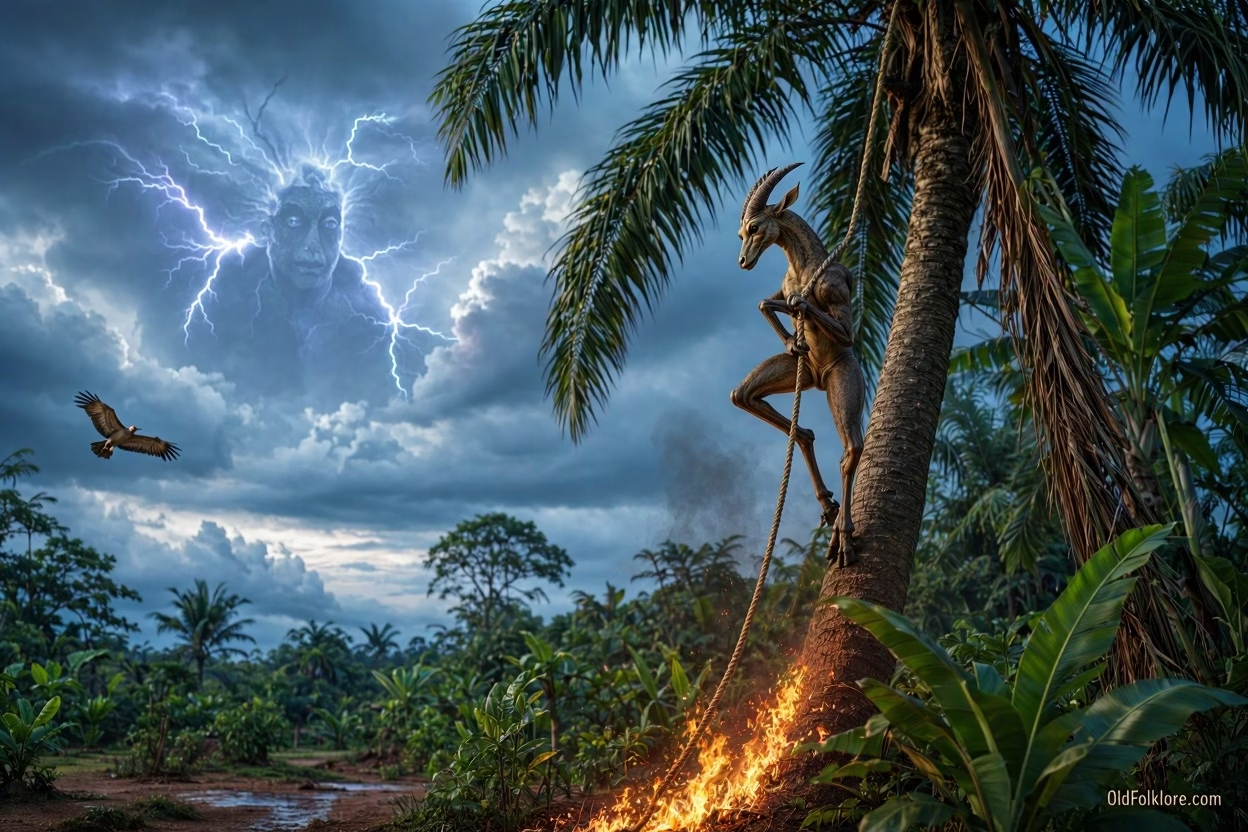
Sewanla obeyed and began climbing. However, the king had no intention of allowing him to return safely. While Sewanla was high in the tree, the king’s men gathered straw and oil around its base and set the materials alight.
The fire spread around the trunk. Flames rose towards the branches, leaving Sewanla trapped above the burning ground.
He could not climb down without entering the flames, and the king’s plan seemed certain to succeed. Yet Sewanla remembered the rope belonging to Vulture.
He used the rope to continue climbing rather than descend towards the fire. Instead of returning to the ground, he moved upwards, beyond the reach of the flames and towards the heavens.
The king’s attempt to kill him had driven him away from the earth. Sewanla continued climbing until he reached the sky, where his identity changed. He became Hevioso, the thunder-god.
Sewanla Becomes Hevioso
In the heavens, Sewanla took on a new existence as Hevioso. His transformation connected him with the power of thunder and the storm.
He did not make the journey alone. He took his sister Bade with him. In the account, she became associated with him in his new heavenly existence, but their characters were not alike.
Hevioso possessed a fierce and destructive nature. His power could bring harm to people, and he was not always concerned about the suffering caused by his actions.
Bade, however, tried to restrain him. When Hevioso was ready to act violently, she urged him to show caution. She sought to prevent unnecessary destruction and encouraged him to exercise restraint.
Their different attitudes explain the relationship between the two figures in the story. Hevioso represents the dangerous force of the storm, while Bade serves as the voice that attempts to control his anger.
The tale also connects Vulture with the origin of other birds. As the beings associated with the ascent to the heavens were transformed, some became vultures. They were left to wander through the sky, searching for food and taking what they could find.
In this way, the story links Sewanla’s escape, his transformation into Hevioso and the existence of vultures with explanations of the natural and supernatural world.
The journey that began with a family burial had therefore led to a remarkable transformation. Sewanla had faced the Tetelidja, escaped with its talking tail and survived the king’s attempt to burn him alive. His final escape carried him beyond the earth, where he became one of the powerful figures associated with thunder.
Explore our complete Africa Folktales collection.
Moral of the Story
The story highlights courage, resourcefulness and determination in the face of danger. Sewanla succeeds because he remains determined and makes use of the opportunities available to him. However, the tale also warns against jealousy and destructive power. The king’s envy nearly costs Sewanla his life, while Bade’s attempts to restrain Hevioso show the importance of controlling anger and avoiding unnecessary harm.
Knowledge Check
1. Who raised Vulture in the story?
Sewanla, a creature described as resembling an antelope, raised Vulture.
2. Why did Sewanla need the tail of a Tetelidja?
His family needed the tail before they could complete his father’s burial.
3. How did the old woman help Sewanla?
She told him where the Tetelidja slept and advised him to hide until night before cutting off one creature’s tail.
4. Why was the severed tail dangerous to Sewanla?
It could speak whenever its owner called for it, revealing that Sewanla was carrying it.
5. How did Sewanla escape the king’s attempt to kill him?
He used Vulture’s rope to climb away from the burning palm tree and continued upwards into the sky.
6. What role does Bade play after Sewanla becomes Hevioso?
Bade is his sister and attempts to restrain his destructive behaviour by encouraging caution and mercy.
Source
Adapted from Tale 18 in Melville J. and Frances S. Herskovits, Dahomean Narrative: A Cross-Cultural Analysis (1958), pp. 162–165.
Explore More Beninese Folktales
- Kakpo and the Promise to Loko
- Sogbo Becomes Master of the Universe
- The Boundaries of Sagbata and Hevioso
- To Each Is Given His Dominion: The Children of Mawu-Lisa
- The Spider and the Orphan