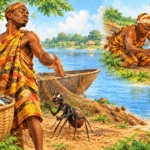
In a community where reputation and appearance could influence how people treated one another, an orphan and a spider once found themselves competing for admiration. The orphan was modest but careful about his appearance, while the spider was convinced that he possessed greater charm and deserved more attention. Although they agreed to test their popularity, the contest would reveal more than either of them expected.
The spider believed that young girls would welcome him, while older women would favour the orphan. Confident in his assumptions, he challenged the orphan to travel with him and discover who would receive the warmest reception. Yet the journey exposed the spider’s vanity, jealousy and greed. What began as a friendly contest gradually became a struggle in which the orphan had to rely on patience and quick thinking to protect himself.
The Spider’s Challenge
One day, the spider approached the orphan and told him that he admired the way he dressed. He praised the orphan’s clothing and suggested that his appearance made him particularly attractive. However, the spider’s compliment concealed a challenge.
He proposed that they travel together to a place where they could discover which of them was more popular. According to the spider, the young girls would certainly prefer him, while the older women would show greater affection towards the orphan.
The orphan listened to the proposal. He did not argue with the spider or boast about his own appearance. Instead, he accepted the challenge.
They agreed to make the journey sixteen days later. The orphan would be content to receive the attention of the older women, while the spider expected to win the admiration of the younger girls.
The arrangement gave both companions time to prepare. However, they approached the coming journey differently. The orphan understood that he needed to present himself neatly if he wanted to make a good impression. The spider, on the other hand, seemed more concerned with the praise he expected to receive.
Two Different Preparations
Eight days before the appointed journey, the orphan bought a piece of fine-quality fabric. He arranged for it to be sewn into clothing and waited for the day they had chosen.
The spider also bought fabric, but his choice was different. He selected a material known as chohunkpo, hoping that it would make him attractive to the people they were going to visit.
As the appointed day approached, the orphan completed his preparations. He washed himself properly before putting on his new clothes. He wanted to arrive looking clean and well dressed.
The spider had not finished sewing his outfit. Rather than preparing his clothing early, he waited until the day of the journey. When the orphan went to see what he had chosen, he discovered that the spider was still sewing.
This surprised the orphan, but he did not allow the delay to change their agreement. He dressed and set out for the riverbank, promising to wait for his companion there.
When the orphan reached the river, he crossed to the opposite bank. The spider remained behind, occupied with his unfinished clothing.
By the time the spider completed his outfit and put it on, the orphan had already crossed the river. When the spider arrived at the riverbank, he looked across and noticed someone standing on the other side. He soon realised that the person was the orphan.
The sight troubled him. He had expected to arrive together with his companion, but the orphan had already made the crossing. The spider began to worry that the people they were visiting might prefer the orphan to him.
Explore more stories from our Beninese Folktales Collections archive.
He crossed the river and joined the orphan. Together, they continued towards their destination.
The Welcome at Their Destination
Throughout the journey, the spider remained convinced that he would receive the greatest attention. He believed that being seen first would make a difference, so he positioned himself ahead of the orphan as they approached the place.
However, the welcome they received was the opposite of what he had imagined.
As soon as they arrived, the older women rushed towards the spider. The young girls, meanwhile, gathered around the orphan.
The spider’s confidence began to weaken. He had expected the girls to admire him, yet they showed their affection for his companion. The orphan, who had not made grand promises about his popularity, found himself surrounded by the people he had expected to welcome him.
When evening came, the difference between their receptions became even clearer.
The young girls collected money and prepared a good meal for the orphan. They made sure he had enough to eat and arranged a comfortable bed for him.
The older women also prepared food for the spider, but his treatment was less generous. They made corn dough for him and provided a simple bast mat on the floor where he could sleep.
The spider felt unhappy with the situation. He had travelled expecting admiration and special treatment, but the orphan had received the better welcome. His disappointment grew as he compared their circumstances.
The following day, the two groups prepared gifts for their visitors.
The Gifts Behind the Door
The young girls gathered money for the orphan. They then went to the market and bought an ox. They tied a rope around its neck and hid the animal behind a door.
The older women also arranged a gift for the spider. They bought a small sheep, fastened a thick chain around its neck and concealed it behind the same door.
The two animals were hidden so that the visitors would not know what they had received.
The spider and the orphan were then asked to choose between the animals. Each had to select either the rope or the chain.
The spider considered the choice carefully. He reasoned that an ox could wear a chain around its neck, so he reached for the chain.
His reasoning led him to the wrong animal. The chain belonged to the small sheep, and he had chosen it.
The spider was disappointed, but he tried to console himself. He wanted to see what the orphan would receive and wondered whether his companion might make an even worse choice.
The orphan approached and selected the rope. At its other end was the ox.
The contrast was clear. The orphan had received the larger and more valuable gift, while the spider had been given the small sheep.
The spider could no longer hide his jealousy. He became angry and insulted the orphan. He complained that someone as insignificant as an orphan should not become more important than him. He even told the orphan to leave.
The orphan did not answer the insults. He remained quiet rather than allowing the spider’s anger to draw him into an argument.
The Spider’s Greed
On the journey back, the spider’s behaviour became even more unpleasant.
He killed the small sheep that had been given to him and prepared to eat it. Instead of sharing the meat fairly, he gave the orphan only the heart.
The orphan accepted the small portion without protesting. He placed the heart in his mouth and pretended to eat it.
Whenever the spider thought the orphan was about to swallow it, he demanded that the heart be returned. The orphan would take it out of his mouth and hand it back.
The spider repeatedly claimed that he was only joking. Yet he continued the same behaviour, making it difficult for the orphan to enjoy even the little food he had been given.
Eventually, the orphan swallowed the heart by mistake.
The spider immediately demanded that he return it. The orphan explained that he had swallowed it and could no longer produce it.
The spider became angry and insisted that the matter should be settled. He declared that the ox given to the orphan should be killed as compensation for the missing heart.
The orphan did not resist.
The spider killed the ox, and they began eating its meat together. As they continued, the amount of meat became smaller. The spider ate greedily, paying little attention to the fact that the ox had been given to the orphan.
When only a small portion remained, the orphan raised a question. He wondered how he could return home after receiving such a valuable gift without taking even a piece of it with him.
The spider continued eating, apparently unwilling to give up what remained.
At that moment, the orphan seized the last portion of the meat and ran away.
The Chase to the River
The spider was furious. He had lost the remaining meat and could not accept that the orphan had escaped with it.
He chased the boy towards the river.
The orphan ran until he reached the water. With the spider close behind him, he suddenly changed himself into a stone.
The spider arrived at the riverbank and could no longer see the orphan as a person. Instead, he found a stone lying before him.
He mocked the stone, calling the orphan a coward. He believed that the boy had been frightened and had abandoned the contest.
The spider would have swallowed the stone if he had dared to stop and deal with it, but he continued across the river’s edge.
On the opposite bank, he noticed a young girl. She had taken off her clothes and announced that she would marry anyone who could strike her with a projectile between her breasts.
The spider saw an opportunity. He picked up the stone that had been the orphan and threw it towards the other bank.
The stone travelled through the air and landed heavily on the opposite shore.
As soon as it reached the other side, it changed back into the orphan.
The boy stood before the spider and recognised what had happened. Instead of being harmed by the throw, he had been given a way to escape the danger at the river.
The spider had unknowingly helped the orphan cross the water.
The Spider’s Final Defeat
The orphan had escaped, but the spider was now stranded on the opposite side. He looked for a canoe that could carry him across the river, but he could not find one.
Unable to reach the orphan by the same means, the spider became desperate. He plunged into the river in an attempt to cross.
The attempt ended in disaster. The spider fell apart in the water, bringing his pursuit of the orphan to an end.
The orphan had survived the spider’s jealousy and greed. Although the spider had begun the journey believing himself superior, his pride had led him into a series of poor decisions. The orphan, whom he had dismissed as unimportant, had remained calm and eventually escaped.
The contest had revealed the difference between outward confidence and genuine good sense. The spider had wanted admiration without showing fairness or generosity. The orphan, despite having less power and influence, had used patience and cleverness to protect himself.
Explore our complete Africa Folktales collection.
Moral of the Story
Pride and jealousy can lead people to make foolish decisions. The spider believed that he deserved more admiration than the orphan, but his vanity prevented him from recognising the boy’s worth. His greed and unfair treatment eventually brought about his downfall.
The story also teaches that a person’s value should not be judged by their background or social position. The orphan was treated as less important, yet he demonstrated patience, intelligence and resourcefulness. True worth is shown through one’s actions, not through boasting or demanding praise.
Knowledge Check
1. Why did the spider challenge the orphan to travel with him?
The spider wanted to discover which of them was more popular with young girls and older women.
2. How did the orphan prepare for the journey?
He bought fine-quality fabric, had it sewn into clothing and washed properly before dressing for the journey.
3. What gifts did the orphan and the spider receive?
The orphan received an ox, while the spider received a small sheep.
4. Why did the spider become angry with the orphan?
He became jealous because the orphan received greater attention and a more valuable gift.
5. How did the orphan escape from the spider at the river?
He transformed himself into a stone. The spider threw the stone across the river, and it changed back into the orphan on the opposite bank.
6. What lesson does the story teach?
It teaches that pride, jealousy and greed can lead to failure, while patience and cleverness can help someone overcome difficult situations.
Source
Adapted from Tale 4.9, “The Spider and the Orphan”, in Vincent Atabavikpo, Ojlu: Contes du Bénin. Beninische Märchen. Tales of Benin (2022), pp. 168–172.
Explore More Beninese Folktales
- Kakpo and the Promise to Loko
- Sogbo Becomes Master of the Universe
- The Boundaries of Sagbata and Hevioso
- To Each Is Given His Dominion: The Children of Mawu-Lisa
- Sewanla and the Talking Tail: The Rise of Hevioso