Across different cultures, people have developed traditional stories to explain how human life began and why people have different physical appearances. These accounts often connect the creation of humanity with the natural elements surrounding a community, including earth, water, fire and the sky.
Among the Bafut people of north-western Cameroon, a traditional creation myth offers an explanation for the different colours and physical characteristics of human beings. In this account, God creates the first people from clay and uses an enormous fire to harden their bodies. However, the length of time each group remains in the fire produces different results.
The story, narrated in the Bafut language by Joseph Njong, provides an example of how traditional storytelling has been used to explain human origins and differences.
God’s Desire for Companionship
In the beginning, God lived alone. He had no human companions and wished to have people with whom He could share His existence.
He imagined a world filled with people who could dance, run, play, converse and take part in different activities. Their presence would bring companionship and enjoyment.
After considering this desire, God decided to create human beings.
He went to a nearby stream, where He collected suitable clay from the earth. The clay came in different colours and textures, but He selected the material He considered appropriate for His work.
Using the clay, He began shaping the different parts of the human body. He formed the head, body, arms, legs, ears, nose and other features until He had created a complete human figure.
God wanted His creation to resemble Him, so He carefully shaped the body before preparing it for life.
The First Human Beings
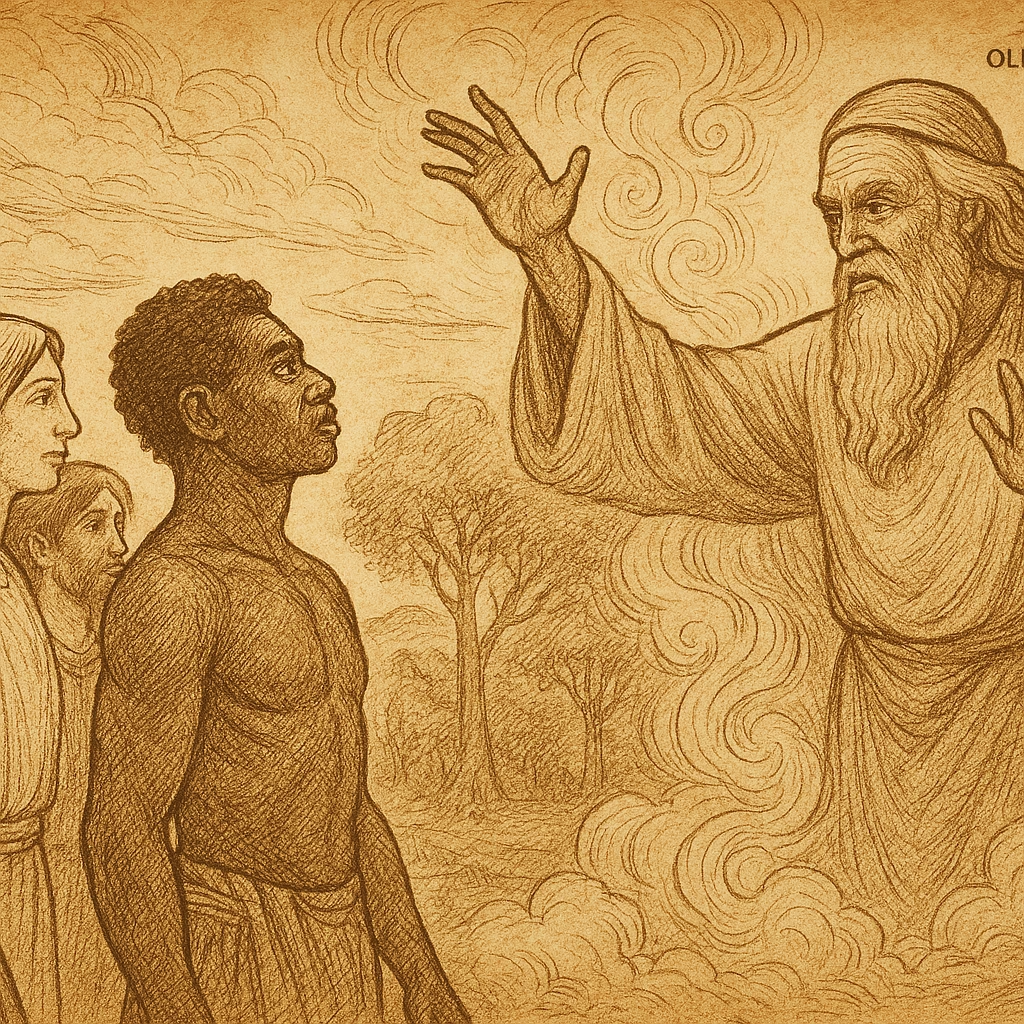
After moulding the human figure, God needed to make the soft clay firm. He therefore prepared an enormous fire, described in the traditional account as being as powerful as the fire used by a blacksmith.
Explore more stories from our Cameroonian Folktales Collections archive.
He placed the moulded human forms into the flames so that the heat could harden them.
However, God became impatient. He wanted to see what He had created and was eager to bring the first human beings to life.
Before the clay had remained in the fire long enough, He removed the first group.
Their bodies had become reddish in colour, but they were not completely hardened. They were therefore described in the story as beautiful and smooth but physically weak.
God carefully joined their body parts together and breathed life into them.
The first human beings began to live, and God was pleased because He finally had companions.
The Second Group Remains in the Fire
God continued His work by preparing another group of human figures from clay.
He placed them in the great fire, intending to correct the result of His earlier creation.
However, while the second group remained in the flames, God became occupied with the first people. He spent time enjoying their company and did not return immediately to remove the new creations.
As a result, the second group remained in the fire for much longer.
By the time God returned, the clay had become extremely dark and hard. Their bodies had hardened more thoroughly than those of the first group.
God removed the figures, joined their different parts together and breathed life into them.
This second group was described as physically strong and capable of working for long periods without becoming tired.
When God compared the two groups, He noticed their different appearances and physical conditions. The first group was reddish and comparatively weak, while the second group was dark and strong.
He considered whether He should return the first group to the fire to make them stronger. However, He decided against doing so, reasoning that there should be differences between them.
According to the storyteller, this was how the two groups came into existence.
The Meaning of the Different Appearances
The Bafut account connects the different physical appearances of human beings with the process through which God created them.
The first group received less time in the fire because God removed them too early. The second group remained in the flames for longer and became darker and harder.
The storyteller used this contrast to explain differences in skin colour and physical strength.
The narrative also included a humorous observation about the first group being created in a hurry. The storyteller connected this hurried creation with the way members of that group supposedly approached their activities.
These descriptions belong to the traditional explanation preserved in the performance. They should be understood as elements of the myth rather than scientific explanations of human biology or evidence that one racial group is naturally stronger or weaker than another.
The story ends by presenting the different appearances of humanity as the result of God’s two stages of creation.
Explore our complete Africa Folktales collection.
Moral Lesson
This Bafut creation myth demonstrates how traditional communities used storytelling to explain questions about human origins and physical differences. Through the images of clay, fire and divine creation, the story presents a memorable explanation that connects human appearance with the natural world.
It also provides an opportunity to appreciate the cultural importance of preserving oral traditions. Such stories reveal how earlier generations understood their surroundings and communicated their beliefs to younger members of their communities.
Although the account reflects an older traditional explanation rather than modern scientific knowledge, it remains valuable as a record of Bafut storytelling and cultural imagination. Human beings share the same humanity regardless of differences in appearance, and no physical characteristic makes one group more valuable than another.
Knowledge Check
1. Which Cameroonian community is associated with this creation myth?
The story is associated with the Bafut people of the North-West Region of Cameroon.
2. Who narrated the documented version of the story?
The storyteller was Joseph Njong, a Bafut farmer and quarter head who narrated the story in the Bafut language.
3. Why did God decide to create human beings?
According to the story, God wanted companionship and wished to have people with whom He could share activities such as dancing, playing, running and conversation.
4. What material did God use to create the first human beings?
God collected clay from a nearby stream and used it to mould the different parts of the human body.
5. Why did the two groups have different appearances in the traditional explanation?
The first group was removed from the fire too early, while the second remained in the flames for longer. The storyteller connected the difference in heating time with their contrasting appearances and physical conditions.
6. What is the cultural significance of this Bafut creation myth?
It preserves a traditional explanation of human origins and demonstrates how the Bafut people used oral storytelling to communicate ideas about creation and human diversity.
Sources
Joseph Njong. “The Origin of Black and White (Red) Races.” Recorded in Bafut, Cameroon, on 25 October 2016. Narrated in the Bafut language.
Divine Che Neba, researcher and translator. Edited by Daniel A. Nkemleke. Our Mythical Childhood Survey, University of Warsaw.
Explore More Cameroonian Folktales
- Ngoe and Sumediang: The Origin of the Bakossi People
- The Ngondo Water Ceremony
- The Keeper of the Royal Drum of Bafut
- The Great Canoes of the Wouri
- The Leper’s Revenge: A Cameroonian Folktale of Betrayal
- Autan and the Monster: The Boy Who Defeated a Lion
- The Disobedient Girl: A Moloko Fable from Cameroon