In the ancient traditions of Dahomey, the gods played important roles in the affairs of the world. Mawu, the great Creator, held authority over creation and its order. Her decisions were not always easy for human beings to understand, particularly when they involved suffering, loss or unexpected misfortune.
One traditional story tells of a mysterious messenger who travelled across the land carrying out Mawu’s instructions. To ordinary people, he appeared to be a traveller seeking shelter and companionship. Yet behind his human appearance was a powerful supernatural being whose actions served purposes that remained hidden from those who witnessed them.
During one journey, a human traveller accompanied him and witnessed three disturbing incidents: the death of a sick child, the destruction of a family’s home and the drowning of an elderly man. Unable to understand why anyone would commit such acts, the human traveller eventually demanded an explanation. What the messenger revealed offered a glimpse into the mysterious justice of Mawu.
The Mysterious Messenger
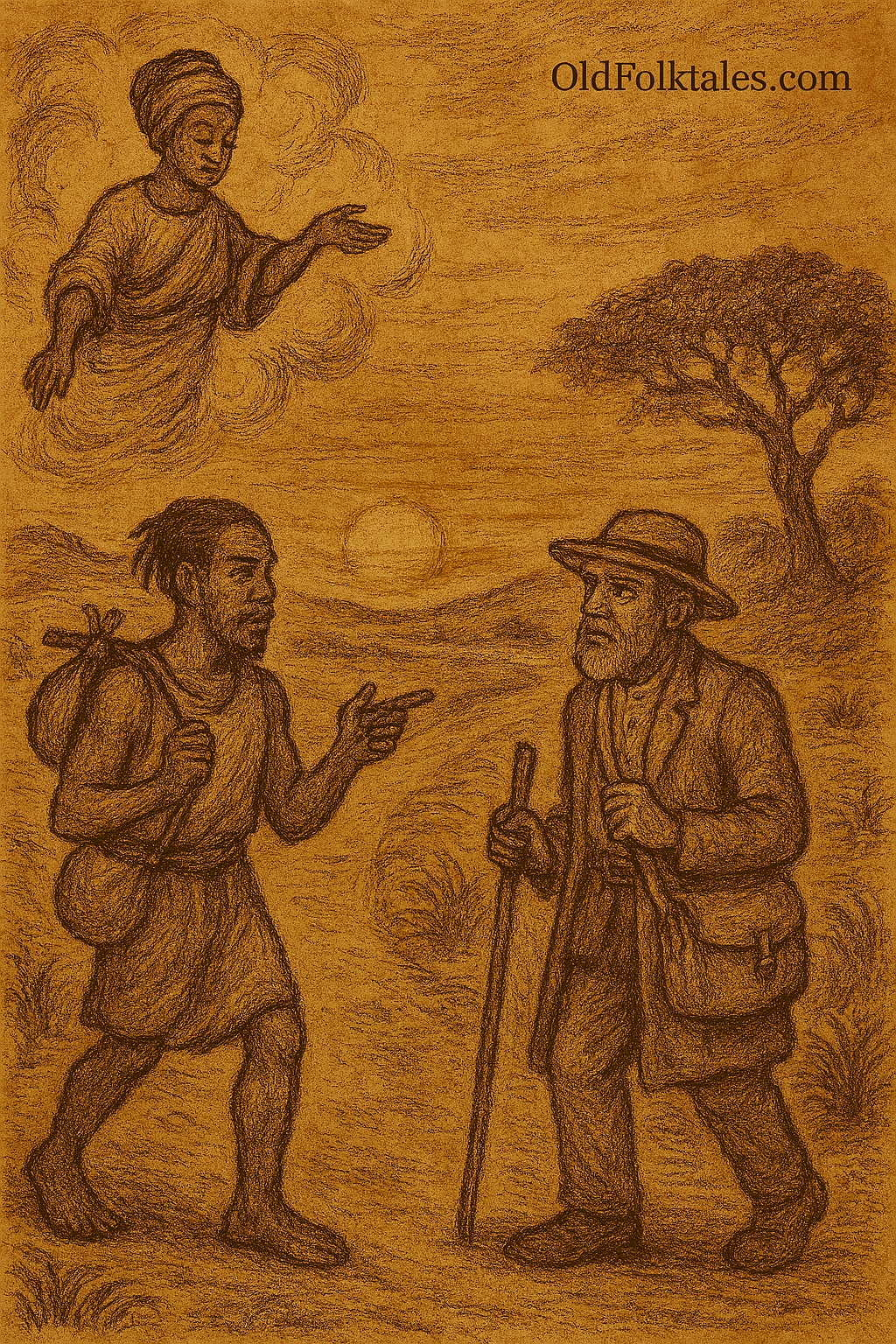
Mawu’s messenger travelled through different settlements, appearing to ordinary people as a man on a journey. Although he looked like a human traveller, he was a vodun, a supernatural being serving the will of the Creator.
During one journey, he reached Adjala as evening approached. Darkness was beginning to cover the settlement, and he needed somewhere to rest before continuing his travels.
At a house along the road, he found another traveller who had also arrived seeking accommodation. The household welcomed both strangers, offering them shelter for the night. Following the customs of hospitality, the hosts allowed the men to share the same resting place.
As they settled down, the two travellers began talking about their journeys. The human explained that he was travelling towards the place where the sun sets. The messenger responded that he was heading in the same direction.
The coincidence pleased the human traveller. He believed he had found a suitable companion for the journey ahead and expected their shared destination to make the road easier.
Neither man knew that the journey would soon reveal something that would challenge the human traveller’s understanding of right and wrong.
The Sick Child in Adjala
At dawn, the travellers awoke to the sound of crying from a neighbouring house. The voices belonged to parents who had spent the night worrying about their seriously ill child.
Concerned by their distress, the messenger approached the household and asked what had happened. The parents explained that their little one was very sick and that they had been unable to sleep because of the child’s condition.
The messenger listened and then reached into his bag. He took out a mysterious powder and instructed the family to give it to the child.
After handing over the powder, he returned to his companion and urged him to leave immediately. The human traveller did not understand the sudden urgency, but he followed.
They had barely moved away from the house when people began calling out for the stranger. The cries suggested that something terrible had happened, but the messenger did not turn back. He continued along the road, and his companion followed in confusion.
Explore more stories from our Beninese Folktales Collections archive.
The human traveller had witnessed an intervention that appeared to offer help to a suffering family. Yet the messenger’s hurried departure and the voices behind them left him unsettled.
The Burning House in Savalou
Their journey eventually brought them to Savalou, where they again sought accommodation for the night. A household welcomed the two travellers and provided them with a place to rest.
The human traveller expected another peaceful night. However, while everyone slept, the messenger quietly rose from his resting place.
He took a flint and kindled a small fire. Rather than using it for warmth or cooking, he deliberately set fire to the house where their hosts had given them shelter.
Once the flames began spreading, he woke his companion.
“We must leave this place immediately,” he insisted.
The human traveller was confused by the urgency, but he gathered his belongings and followed the messenger into the darkness.
Before long, the people inside the house discovered the fire. Their cries filled the night as they struggled to respond to the burning building. They also began searching for the two strangers who had slept under their roof.
The travellers, however, were already moving away from the settlement.
The human companion could no longer ignore what he had witnessed. In Adjala, the messenger had given a sick child a mysterious powder and hurried away. Now, in Savalou, he had deliberately destroyed the home of people who had welcomed them.
The human traveller began to question the character of the man beside him, although he still did not know his true identity or purpose.
The Old Man at Badahwedji
Their journey continued until they reached Badahwedji, the place towards which both men had been travelling.
A river separated them from their destination. Crossing it required a raft, and people familiar with the water helped travellers navigate the passage.
An elderly man from the area regularly crossed the river to collect medicinal leaves and herbs. On this particular occasion, he was making another crossing with the plants he had gathered.
The messenger watched the old man’s movements. When the opportunity came, he approached him and deliberately pushed him into the river.
The elderly man fell into the water and drowned.
This final act was more than the human traveller could tolerate. He had already witnessed the death of a child and the destruction of a family’s home. Now he had seen an old man pushed into a river without warning.
Horrified, he turned away from the messenger and began to run.
The messenger called after him, urging him to stop. He insisted that the human was running in the wrong direction and needed to listen.
But the traveller wanted nothing more to do with someone capable of such actions. He believed that the messenger’s behaviour was cruel and that continuing beside him would make him part of the destruction.
The Messenger Reveals His Identity
Seeing that his companion was determined to escape, the messenger finally revealed the truth.
He explained that he was not an ordinary man but a vodun sent by Mawu to carry out her instructions. The human traveller had judged his actions according to what he could see, without knowing the events that would have followed if the messenger had not intervened.
He then explained the three incidents.
First, he returned to the matter of the sick child in Adjala. According to the messenger, if the child had survived and reached the stage of taking its first steps, both its parents would have died. The child was destined to bring about their deaths. Mawu had therefore commanded that the child should die before that happened.
The messenger explained that the family already had several children. Although the death of one child appeared tragic, the event had prevented the loss of both parents and protected the rest of the household from an even greater misfortune.
The human traveller listened as the messenger described the hidden circumstances behind the death. What had appeared to be a cruel act was presented as an intervention intended to prevent a greater loss.
The Hidden Wealth Beneath the House
The messenger next explained why he had burned the house in Savalou.
The family that owned the building had wealthy relatives who could help them overcome their poverty. However, the relatives had buried their money rather than making it available to the struggling household.
The messenger explained that the destruction of the house would force the family to rebuild. During the rebuilding process, they would dig new foundations and uncover the buried wealth.
The fire, which had appeared to bring only suffering and destruction, would therefore lead the family to money that could change its circumstances.
The human traveller now understood that the messenger had not set the house ablaze without a reason in the logic of the tale. The destruction was connected to wealth hidden beneath the ground, which the family would otherwise have remained unaware of.
Nevertheless, the messenger’s explanation did not change the fact that the family had lost its home. It revealed the supernatural purpose assigned to the event within the story.
Why the Elderly Man Could Not Become King
Finally, the messenger explained the death of the elderly man at Badahwedji.
The king of the area had died, leaving the people to consider who should succeed him. The elderly man who had fallen into the river was among those expected to become the next ruler.
However, according to the messenger, his reign would bring terrible consequences. If the people crowned him, the kingdom would lose its livestock, crops and children. Sagbata, the deity associated with the earth and its destructive powers in this account, would bring devastation upon the people.
Mawu had already determined that the elderly man must not become king. His death prevented his accession to the throne and allowed a younger ruler to succeed instead.
Under the new king, the people would enjoy prosperity. Their livestock would increase, their harvests would succeed and their families would grow.
The messenger presented the old man’s death as an action taken to prevent the suffering that his rule would supposedly have brought upon the kingdom.
The Meaning of Mawu’s Justice
After hearing the explanations, the human traveller began to understand why the messenger had acted in ways that seemed so terrible. Each incident had a hidden consequence that ordinary people could not have known.
The death of the child was connected to the survival of its parents. The burning of the house was linked to the discovery of buried wealth. The death of the elderly man prevented a future reign that, according to the messenger, would have brought destruction to the kingdom.
The messenger explained that he carried out Mawu’s instructions and could take different forms to fulfil his duties. His appearance as a human traveller was only one of the ways he served the Creator.
The journey therefore revealed a central idea in the folktale: human beings see only the events taking place before them, while the gods possess knowledge of what may follow.
The messenger’s final explanation gave the story its name and meaning. What appeared unjust to the human traveller was presented as part of Mawu’s divine order.
Explore our complete Africa Folktales collection.
Moral of the Story
The story of Mawu’s Divine Justice explores the difference between human understanding and supernatural knowledge. It shows how events that appear tragic or inexplicable can carry hidden meanings within traditional religious storytelling.
The tale also reminds readers to recognise the limits of their knowledge when judging unfamiliar circumstances. Its message belongs to the worldview expressed in the story, where Mawu’s authority extends beyond what ordinary people can see or understand.
Knowledge Check
- Who was Mawu’s messenger?
He was a supernatural being, known as a vodun, who appeared in human form and carried out Mawu’s instructions. - Why did the messenger give powder to the sick child in Adjala?
He explained that the child’s death would prevent the deaths of both parents when the child began to walk. - Why did the messenger burn the house in Savalou?
He claimed that rebuilding the house would lead the family to discover money buried by their wealthy relatives. - Why did the messenger push the elderly man into the river at Badahwedji?
The elderly man was expected to become king, but the messenger said his reign would bring destruction to the kingdom. - Who was Sagbata in the story?
Sagbata was the deity associated with the destructive consequences that would follow if the elderly man became king. - What central idea does the folktale explore?
It explores the difference between human understanding and divine knowledge, showing how the messenger’s actions were explained as part of Mawu’s justice.
Source
Adapted from “Mawu’s Ways Are Just”, Narrative 15, in Melville J. Herskovits and Frances S. Herskovits, Dahomean Narrative: A Cross-Cultural Analysis (1958), p. 152.
Explore More Beninese Folktales
- Sewanla and the Talking Tail: The Rise of Hevioso
- The Spider and the Orphan
- Two Beninese Tales That Teach Lessons on Humility and Creation
- Stealing Fire from the Creator: The Wisdom of Chameleon and Tortoise
- The Test of Friendship
- The Story of Vijxenanyi and Xwenasu