Sudika-Mbambi was no ordinary child. Known as the Thunderbolt, he possessed extraordinary strength and remarkable abilities from birth. Alongside his twin brother, Kabundungulu, he faced a world of dangerous monsters, supernatural challenges and treacherous companions. His adventures took him from a devastated settlement to the mysterious country of the dead, where he confronted formidable enemies and fought to rescue those in danger. Yet even a hero who could defeat monsters could not escape every difficulty, and Sudika-Mbambi’s story ends with an unexpected separation between the two brothers.
The Birth of a Remarkable Hero
Long before Sudika-Mbambi became known for his extraordinary deeds, his family suffered a terrible disaster. His father, Nzua dia Kimanaueze, was married to the daughter of the Sun and Moon. The young couple lived with Nzua’s parents until Kimanaueze sent his son away to trade in Loanda, a historical name for Luanda.
Nzua did not wish to leave, but his father insisted. He therefore departed, leaving his wife behind.
During his absence, a group of dangerous beings known as the makishi descended upon the settlement. They destroyed the village, killed some of its inhabitants and drove the survivors away. When Nzua returned, he found the place devastated. The homes had disappeared, and the people who had once lived there were gone.
He searched the cultivated ground until he finally found his wife. The suffering she had endured had changed her appearance so greatly that he did not recognise her immediately. She explained that the makishi had destroyed their community.
The couple had to begin again under difficult circumstances. In time, they settled down and prepared for the birth of their child.
However, the child who arrived was unlike an ordinary newborn. Before his birth, he was already able to speak. When he entered the world, he possessed a knife, a stick and a mysterious plant known as the kilembe, described in the historical account as a life-tree.
Sudika-Mbambi asked his mother to plant the life-tree behind the house. This unusual request would later prove important, for the plant was connected to his survival.
Almost immediately after his arrival, another voice announced itself. His twin brother, Kabundungulu, had also been born.
The brothers were extraordinary from the beginning. They wasted little time before putting their abilities to use, cutting poles and constructing a house for their parents.
As Sudika-Mbambi grew, he became determined to confront the makishi responsible for his family’s suffering. He decided that the monsters must be defeated, and he prepared to leave home.
Before departing, he gave Kabundungulu an important responsibility. His younger brother was to remain behind and watch the life-tree. If it withered, Kabundungulu would understand that something terrible had happened to Sudika-Mbambi.
With that warning, the young hero began his journey.
The Four Kipalendes
As Sudika-Mbambi travelled through the bush, he encountered four beings known as kipalendes. Each claimed to possess extraordinary abilities. Their boasts included feats such as building a house on bare rock and producing clubs at an astonishing rate.
Explore more stories from our Angolan Folktales Collections archive.
The four appeared confident in their accomplishments, but their claims would soon be tested.
After travelling some distance, Sudika-Mbambi instructed them to stop and construct a house from which they could prepare to fight the makishi. He began cutting poles, and the others were expected to continue the work.
One kipalende had boasted that he could build a house on rock. Sudika-Mbambi gave him the opportunity to demonstrate this ability. However, every pole the boastful companion attempted to place fell over again.
The task proved beyond him.
Sudika-Mbambi eventually took charge of the construction. Under his direction, the house was completed, providing a place where the group could stay during their campaign.
The following day, Sudika-Mbambi went to fight the makishi with three of the kipalendes. The fourth remained behind at the house.
The group had more than one danger to face, however, and their first serious trouble came from an unexpected source.
The Old Woman and Her Stone House
While the kipalende remained at the house, an old woman approached him. She offered him the possibility of marrying her granddaughter, but only if he could fight and defeat her.
The challenge appeared straightforward. The kipalende accepted, expecting that he could overcome an elderly opponent.
Their struggle soon proved otherwise. The old woman defeated him, leaving him helpless on the ground. She placed a heavy stone over him, preventing him from moving, and abandoned him in that condition.
Sudika-Mbambi possessed the ability to perceive danger even when he was far away. He became aware of what had happened and returned with his companions to rescue the trapped kipalende.
After being released, the defeated man explained his encounter. Instead of treating the incident as a warning, the others mocked him for losing a fight against a woman.
The following day, another kipalende remained behind while Sudika-Mbambi and the others went to confront the makishi. The same old woman appeared and challenged the man left at the house.
Once again, she defeated her opponent and trapped him beneath a heavy stone.
Sudika-Mbambi immediately recognised that another companion was in danger. He returned and freed him.
The pattern continued over the next two days. Each time, the old woman overcame the kipalende who remained behind, and each time Sudika-Mbambi discovered what had happened and rescued him.
The repeated defeats revealed that the companions’ confidence exceeded their abilities. They had mocked the first victim but failed to learn from his experience.
On the fifth day, Sudika-Mbambi changed his approach. He sent the kipalendes away to continue fighting the makishi while he remained behind to confront the old woman himself.
When she appeared and challenged him, he accepted the fight. Unlike his companions, he defeated her and killed her.
The historical account presents the woman as a dangerous figure who had kept her granddaughter confined in a stone house. Her challenge had served as a trap for those who approached.
With the old woman dead, Sudika-Mbambi married her granddaughter. They settled in the stone house, and the four kipalendes eventually returned with news that the makishi had been defeated.
For a time, the hero’s troubles seemed to be over.
The Kipalendes’ Betrayal
Success did not bring lasting peace.
The kipalendes became envious of Sudika-Mbambi’s good fortune. Their leader had defeated the old woman, married her granddaughter and survived dangers that had overcome the others. Instead of remaining loyal to him, they began plotting his death.
They devised a concealed trap. In the place where Sudika-Mbambi usually rested, they dug a deep hole and covered it with mats.
When their leader returned tired, they encouraged him to sit down. Unaware of their intentions, he accepted their invitation and fell into the pit.
The kipalendes covered the hole, believing that they had killed him.
Far away, Kabundungulu went to inspect the life-tree. He found that it had withered, a sign that his twin brother was in grave danger.
Rather than give up hope, Kabundungulu poured water over the plant. To his relief, it became green again.
Meanwhile, Sudika-Mbambi had survived the fall. At the bottom of the pit, he discovered an opening that led to a road. This was no ordinary path, but a route into the country of the dead.
The hero entered it and continued onwards, leaving the world he knew behind.
The Road to the Country of the Dead
Sudika-Mbambi travelled along the strange road until he encountered an unusual old woman tending a garden. Only the upper half of her body was visible.
He greeted her respectfully and asked her to show him the way. Rather than direct him immediately, she asked him to help with her gardening.
Sudika-Mbambi agreed and worked for her. Once he had completed the task, she gave him directions.
She instructed him to follow the narrow path rather than the broad one. She also told him that, before reaching the home of Kalunga-ngombe, he would need a jug of red pepper and a jug of wisdom.
The account does not explain precisely how Sudika-Mbambi obtained these items or what the expressions meant in practical terms. What matters to the documented narrative is that they formed part of the conditions associated with marriage to Kalunga-ngombe’s daughter.
Following the directions, Sudika-Mbambi eventually reached the dwelling.
A fierce dog barked at him as he approached. The hero scolded the animal, and it allowed him to pass. Inside, the people welcomed him courteously, showed him to a guest-house and spread a mat for him.
Sudika-Mbambi then announced that he had come to marry Kalunga-ngombe’s daughter.
Kalunga-ngombe agreed, provided the visitor had fulfilled the required conditions.
That evening, a meal arrived. It consisted of a live cock and a bowl of funji, a local porridge.
Sudika-Mbambi ate the porridge with meat he had brought himself. Instead of killing the cock, he kept it beneath his bed.
During the night, he heard people asking who had killed Kalunga-ngombe’s cock. The question was part of a trap intended to prevent him from returning to the upper world.
However, the cock began crowing from beneath the bed. Sudika-Mbambi had not killed it, so the attempt to trap him failed.
The next morning, he reminded Kalunga-ngombe of his promise.
But another obstacle stood between the hero and his marriage.
The Five-Headed Serpent
Kalunga-ngombe explained that his daughter had been carried away by an enormous serpent called Kinyoka kya Tumba. Sudika-Mbambi would have to rescue her before the marriage could take place.
The hero set out for the serpent’s dwelling and asked to see it. The serpent’s wife told him that her husband had gone shooting.
While Sudika-Mbambi waited, a succession of dangerous creatures approached. First came driver ants, feared for the destruction they could cause to anything helpless in their path.
Sudika-Mbambi stood his ground and fought them off.
They were followed by red ants, then bees, and finally wasps. Each group threatened him, but none succeeded in defeating him.
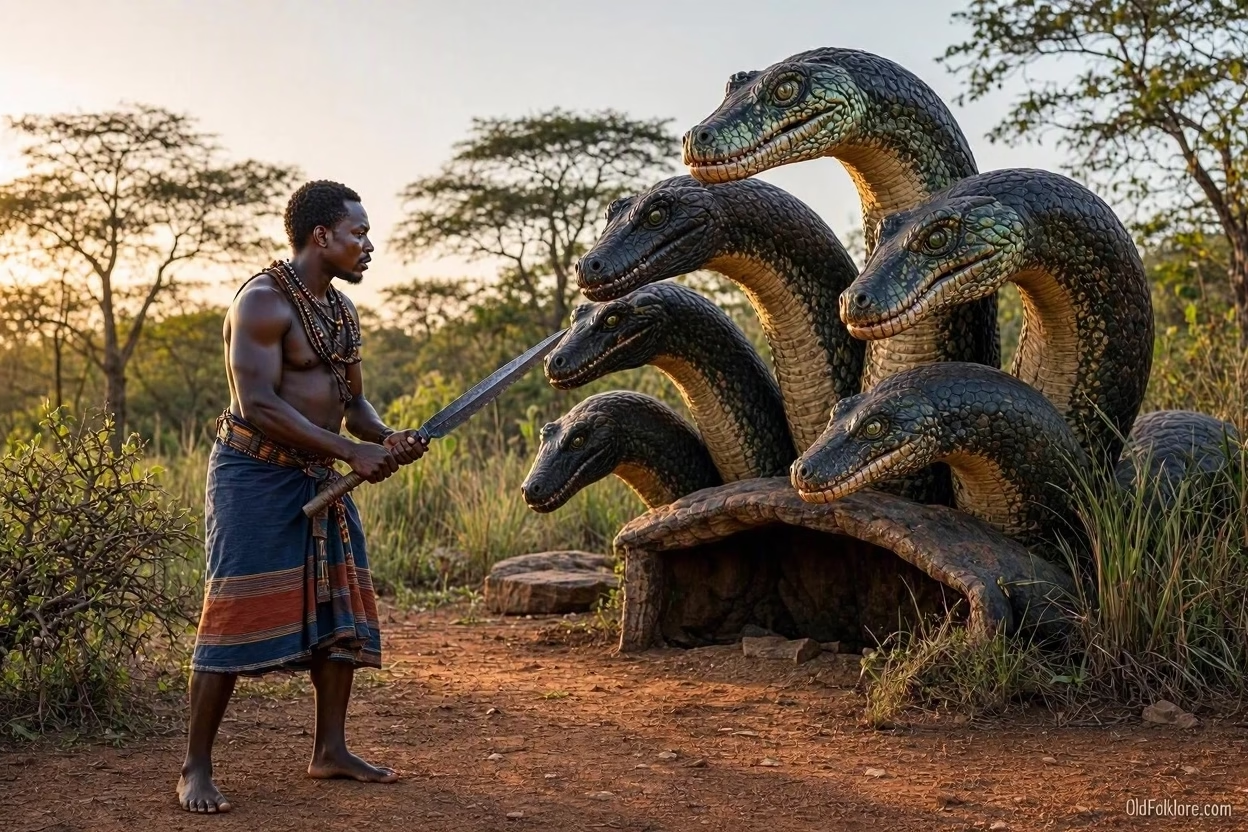
At last, the serpent appeared. It had five heads, which emerged one after another.
Sudika-Mbambi confronted the monster and cut off each head as it appeared. When the fifth head fell, the serpent was dead.
The hero entered the dwelling and found Kalunga-ngombe’s daughter. He rescued her and returned her to her father.
His victory demonstrated once again that the dangers confronting him could not easily overcome his courage and fighting ability.
Yet Kalunga-ngombe had another demand to make.
The Giant Fish Kimbiji
Despite the rescue of his daughter, Kalunga-ngombe required Sudika-Mbambi to undertake one more task.
A giant fish called Kimbiji had been catching his goats and pigs. Sudika-Mbambi would have to deal with this creature before he could finally leave with his bride.
The hero prepared a large hook and used a sucking pig as bait. He succeeded in catching the enormous fish, but the creature was too powerful for him to pull ashore.
The struggle ended disastrously. Sudika-Mbambi fell into the water, and Kimbiji swallowed him.
Once again, the life-tree at home revealed that something terrible had happened.
Kabundungulu saw that the plant had withered and understood that his brother was in danger. He set out to find him, determined not to abandon the twin whose life was linked to the mysterious tree.
His journey brought him to the place where the kipalendes were keeping Sudika-Mbambi’s wife captive.
Kabundungulu demanded to know where his brother was. The kipalendes denied knowing anything about his whereabouts, but Kabundungulu suspected that they had betrayed him.
He insisted that they uncover the grave.
They opened the pit into which Sudika-Mbambi had fallen, and Kabundungulu descended into it. Following the route through the country of the dead, he eventually reached Kalunga-ngombe’s dwelling.
When he asked about his brother, he learned that Kimbiji had swallowed him.
Kabundungulu then set about rescuing him.
He obtained a pig, used it as bait and called on the people to help pull the giant fish from the water. Working together, they succeeded in landing the creature.
Kabundungulu cut open Kimbiji and found his brother’s bones inside.
Although Sudika-Mbambi’s body had been destroyed, his story was not over. Kabundungulu gathered the bones and called upon his elder brother to rise.
The bones came back to life.
Sudika-Mbambi had returned from death, thanks to his twin brother’s determination and intervention.
The Brothers’ Final Separation
With the giant fish defeated and Sudika-Mbambi restored to life, the remaining difficulties appeared to be over.
Sudika-Mbambi married Kalunga-ngombe’s daughter. He then set out for home with his new wife, his earlier wife and Kabundungulu.
The journey ended at the pit through which the brothers had entered the country of the dead. The ground cracked, allowing them to emerge.
Once outside, they drove away the four kipalendes who had betrayed Sudika-Mbambi. The historical account does not describe a further battle between them.
The brothers and the two wives settled down, and their lives seemed peaceful again.
However, a final disagreement disturbed their household.
Kabundungulu complained that his elder brother had two wives while he had none. He asked Sudika-Mbambi to give him one of them.
Sudika-Mbambi refused, explaining that both women were already his wives. The matter appeared to rest there for a time.
Later, however, Sudika-Mbambi returned from hunting and found that his wife was troubled by Kabundungulu’s behaviour. She complained that the younger brother had been pursuing the women with unwanted attention.
The disagreement developed into a serious quarrel between the twins.
They drew their swords and fought, but neither could injure the other. Both possessed extraordinary powers, and their weapons could not cut through their bodies.
Eventually, the brothers grew tired of fighting. Neither could defeat the other, and they finally separated.
Sudika-Mbambi travelled east, while Kabundungulu went west.
The account concludes with an explanation linking their separation to thunder and its answering echo. Sudika-Mbambi became associated with thunder in the eastern sky, while Kabundungulu represented the echo that answered from the west.
Their adventures had begun with a shared birth and a bond that connected their lives. They had faced monsters, betrayal and death together, and Kabundungulu had even restored his brother to life. Yet their final conflict could not be settled through strength alone.
Their story therefore ends not with another monster defeated, but with the separation of two extraordinary brothers.
Explore our complete Africa Folktales
Moral Lesson
Sudika-Mbambi’s adventures show that courage and extraordinary strength can help someone overcome formidable challenges, but they do not guarantee a peaceful life. His companions’ envy led them to betray him, while Kabundungulu’s loyalty helped restore him to life. The brothers’ final quarrel also shows how jealousy and selfish demands can damage even a close relationship. True strength requires more than the ability to defeat enemies; it also requires loyalty, restraint and the willingness to treat others fairly.
Knowledge Check
1. Who were Sudika-Mbambi’s parents?
Sudika-Mbambi was the son of Nzua dia Kimanaueze and the daughter of the Sun and Moon.
2. What was the purpose of the life-tree?
The life-tree was connected to Sudika-Mbambi’s life. Its condition warned Kabundungulu when his brother was in danger.
3. How did Sudika-Mbambi defeat the old woman?
He remained behind to confront her himself, fought her and killed her after she had repeatedly defeated the kipalendes.
4. How did the kipalendes betray Sudika-Mbambi?
They dug a pit where he usually rested, concealed it with mats and encouraged him to sit there, causing him to fall into the trap.
5. How did Kabundungulu rescue his brother from Kimbiji?
He used a pig as bait, helped bring the giant fish ashore, cut it open and restored Sudika-Mbambi to life from his bones.
6. Why did the brothers eventually separate?
They quarrelled over the question of marriage and fought without being able to injure each other. They eventually went in opposite directions, east and west.
Source
Héli Chatelain, Folk-Tales of Angola: Fifty Tales, with Ki-Mbundu Text, Literal English Translation, Introduction, and Notes (1894), tale “Sudikambambi”, beginning on page 85.
Explore More Angolan Folktales
- The Hidden Storehouse: An Angolan Folktale of Famine and Greed
- The Eagle and the Candimba: A Shocking Betrayal
- The Bangão Crocodile: A Fearless Fight for Justice
- The River Spirit’s Three Questions
- The Cave of the Sleeping Ancestors