Long ago, a merchant and his wife had one beloved daughter, Vasilisa, whose beauty earned her the name Vasilisa the Fair. When the girl was eight years old, her mother fell gravely ill. Knowing that she would not recover, she called her daughter to her bedside and placed a small doll in her hands.
“My dear child,” she whispered, “I am leaving you my blessing and this doll. Keep it close, and never show it to anyone. Whenever you are troubled, give it something to eat and ask for its advice. It will help you through your difficulties.”
Vasilisa kissed her mother and wept, but soon the woman died, leaving the girl alone with her father.
After a time, the merchant married a widow who had two daughters of her own. He believed that an experienced mother would care for his child, but he had chosen poorly. His new wife resented Vasilisa’s beauty, and her daughters grew equally jealous. They made the girl do all the difficult household chores, hoping that exhaustion and hard work would spoil her looks.
Explore more stories from our Afanasyev’s Russian Folk-Tales collection.
Yet Vasilisa never seemed to grow weaker or less beautiful. While her stepmother and stepsisters spent their days resting, she completed every task without complaint. They could not understand her good fortune, but the secret lay in the little doll.
Whenever the household had gone to sleep, Vasilisa would retreat to her room, feed the doll the best morsels she had saved and tell it about her troubles. The doll comforted her and helped with her work, sometimes completing everything before morning. It also taught her about herbs and other useful things. With this faithful companion beside her, Vasilisa endured her unhappy childhood.
As the years passed, she grew into a young woman admired by all the young men in the village. Her stepsisters, however, attracted no suitors. Their mother became even more bitter, turning away every young man who came to ask for Vasilisa’s hand because she insisted that her own daughters must marry first. She took out her frustration on Vasilisa, who continued to bear her suffering patiently.
The Journey to Baba Yaga
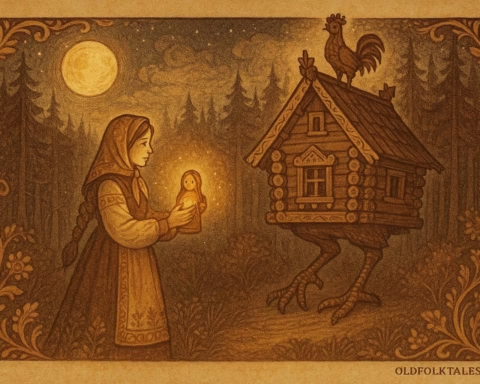
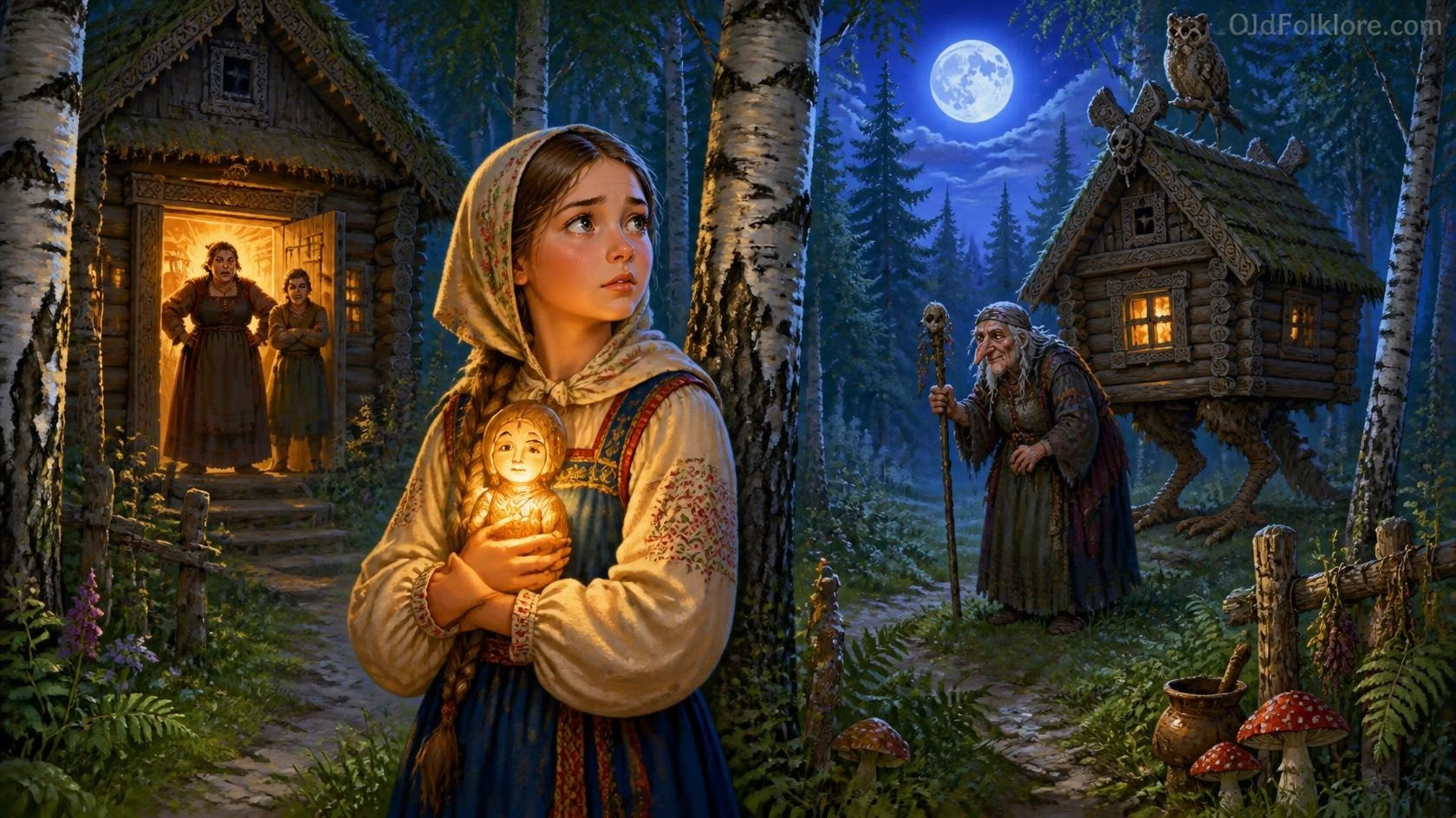
One day, Vasilisa’s father left home on a long business journey. During his absence, the stepmother moved the family into a house near a deep, gloomy forest. Within that forest stood a clearing where Baba Yaga lived in a strange hut. The old witch was feared because she was said to devour human beings.
The stepmother repeatedly sent Vasilisa into the forest, hoping that the girl would wander into danger. But the doll always guided her safely home.
Then came the harvest season, and the family was busy with evening work. One stepsister was making lace, another was knitting a stocking, and Vasilisa was spinning. Their mother had extinguished every fire in the house except the candle beside them.
When the candle finally burned low, one of the sisters deliberately put it out, pretending that it had been an accident.
“What shall we do now?” the sisters cried. “We cannot finish our work without light. Someone must go to Baba Yaga and bring back fire.”
Neither sister was willing to go. One claimed that she could see well enough by the light reflecting from her needles; the other insisted that her knitting needles gave her sufficient light. They pushed the responsibility onto Vasilisa and sent her out into the darkness.
Frightened, Vasilisa hurried to her room and fed the doll.
“They are sending me to Baba Yaga,” she whispered. “What if she eats me? Please, tell me what to do.”
The doll’s eyes shone brightly.
“Do not be afraid, Vasilisushka. Take me with you, and nothing will harm you while I am near.”
Vasilisa slipped the doll into her pocket, crossed herself and entered the forest.
As she walked through the night, a mysterious horseman dressed entirely in white galloped past. His horse, clothes and reins were all white, and his passing brought daylight. Vasilisa continued on her journey. Later, another horseman appeared, dressed in red and riding a red horse. When he passed, the sun rose.
She travelled through the day and into the following night until she reached Baba Yaga’s clearing.
The sight before her was terrifying. A fence surrounded the witch’s hut, but instead of ordinary stakes, it was made from human bones, with skulls fixed upon them. The gate was formed from bones, the bolts resembled hands, and the lock was a mouth filled with sharp teeth.
Vasilisa stood frozen with fear.
Then a third horseman, dressed entirely in black and riding a black horse, swept past the hut and disappeared through its entrance. Night fell, but the skulls along the fence suddenly began to glow, illuminating the clearing as brightly as day.
A terrible crashing sounded from the forest. Trees creaked, dry leaves crackled, and Baba Yaga came rushing towards her hut inside a mortar, propelling herself with a pestle and sweeping away her tracks with a broom.
She stopped, sniffed the air and shouted, “I smell the blood of a Russian girl! Who is there?”
Vasilisa stepped forward, bowed low and explained that her stepmother’s daughters had sent her to ask for fire.
“I know them,” Baba Yaga replied. “Stay here and work for me. If you do everything I command, I shall give you fire. If you fail, I shall eat you.”
The witch ordered the door to open, and Vasilisa followed her inside.
Three Days in the Witch’s House
Baba Yaga was hungry and demanded food. Vasilisa brought out a huge meal, enough for ten men, along with drinks from the cellar. The witch devoured nearly everything, leaving Vasilisa only a little soup, a crust of bread and a small piece of pork.
After eating, Baba Yaga lay down to sleep. Before closing her eyes, she gave Vasilisa a long list of chores.
By morning, the girl was expected to clean the courtyard, sweep the house, prepare dinner, wash clothes, go into the field and sift a quarter of oats. If anything remained unfinished, the witch threatened to eat her.
Once Baba Yaga began snoring, Vasilisa took out her doll and explained the impossible work awaiting her.
“Eat, pray and go to sleep,” the doll told her. “The morning is wiser than the evening. Everything will be done.”
Vasilisa rested, and the doll took care of the tasks.
At dawn, Baba Yaga rose and prepared to leave. Her mortar, pestle and broom appeared when she whistled, and the red horseman passed as the sun rose. The witch climbed into her mortar and disappeared into the forest, sweeping away every trace of her journey.
When Vasilisa woke, she discovered that the work had already been completed. Even the oats had been sifted.
Overwhelmed with gratitude, she thanked her little companion, which reminded her that she needed only to prepare dinner and wait for Baba Yaga’s return.
That evening, the witch inspected the house and courtyard. Finding nothing wrong, she reluctantly acknowledged that the work had been done. She called upon her mysterious servants, and three pairs of hands appeared to carry away the sifted oats.
Before going to bed, she gave Vasilisa another assignment. The following day, the girl must repeat all her previous chores and also clean a quantity of hay in the field, removing every trace of earth and every stray ear of grain.
Once again, the doll promised to help. By the next evening, everything had been completed, and Baba Yaga summoned her unseen servants to collect the poppy seeds.
The witch had begun to wonder about the quiet girl who could accomplish such demanding tasks without making mistakes.
“Why do you sit there without speaking?” she asked Vasilisa during supper. “Are you unable to talk?”
“I did not wish to offend you,” Vasilisa answered. “But if you permit me, I have a few questions.”
“Ask them,” Baba Yaga replied, “but remember that too much knowledge can bring trouble.”
Vasilisa asked about the three horsemen she had encountered on her journey.
“The white horseman was the bright day,” the witch explained. “The red one was the rising sun, and the black one was the dark night. They are my faithful servants.”
Vasilisa remembered the three pairs of hands that had appeared to carry away the oats and poppies, but she dared not ask about them.
Baba Yaga noticed her silence and asked why she had no further questions.
“You warned me that too much knowledge could be dangerous,” Vasilisa replied. “I know enough for now.”
The witch studied her.
“You were wise not to ask about everything,” she said. “I do not tolerate excessive curiosity, and those who pry into matters that do not concern them may be eaten.”
Then Baba Yaga asked Vasilisa how she had managed to complete every task.
“By my mother’s blessing,” Vasilisa answered.
At once, the witch’s manner changed.
“Then you must leave this place immediately! I cannot keep anyone who carries a mother’s blessing.”
She took a skull with burning eyes from the fence, fixed it upon a staff and handed it to Vasilisa.
“You came here seeking fire for your stepmother’s daughters. Take this, and you shall have it.”
Vasilisa hurried away, using the skull’s fiery eyes to light her path. By dawn, she had reached home.
The Fire That Could Not Be Escaped
At first, Vasilisa intended to throw the skull away. But as she approached her stepmother’s house, a voice came from it.
“Do not abandon me. Take me inside.”
She looked towards the house and noticed that every window was dark. Since the night she had left, the family had been unable to keep a fire burning. Any flame they borrowed from their neighbours went out as soon as it entered the house.
Her stepmother and stepsisters welcomed her return and eagerly asked whether the fire she had brought might finally solve their problem.
Vasilisa carried the skull inside.
Its burning eyes turned towards the stepmother and her daughters. No matter where they moved, the terrible light followed them, scorching them until, by morning, all three had been burned to ashes.
Vasilisa alone survived.
She buried the skull in the earth, locked the house and went to live in the town. There she found a poor elderly woman who agreed to shelter her and provide food until her father returned.
Vasilisa did not want to spend her days idle. She asked the old woman to buy her the finest flax so that she could spin.
The work came naturally to her, and soon she had produced an abundance of yarn so fine and smooth that it was like hair. Yet no one was willing to weave it into cloth.
Once again, Vasilisa turned to her doll.
“Find an old comb, a spindle, a shuttle and some horse mane,” the doll instructed her. “I will take care of the rest.”
During the night, the doll made a splendid spinning stool, and by the end of winter, all the flax had been woven into linen of extraordinary fineness. When spring arrived, the linen was bleached, and Vasilisa asked the old woman to sell it and keep the money for herself.
The elderly woman examined the cloth in amazement.
“My child, this is so fine that only the Tsar himself could wear it. I shall take it to the palace.”
She carried the linen to the royal court and waited until the Tsar noticed her.
“What have you brought?” he asked.
“Wonderful cloth, Your Majesty, which I wish to show only to you.”
The Tsar admired the linen so much that he asked its price. The old woman insisted that it was beyond price and offered it as a gift. Pleased by her generosity, the Tsar sent her away with rich rewards.
Soon, he wanted shirts made from the remarkable fabric. But none of his seamstresses could be found willing to undertake the work. Remembering the elderly woman, he summoned her again.
“If you can obtain such wonderful linen,” he said, “surely you can make shirts from it?”
“I cannot make them myself,” the woman replied. “Only the young woman staying with me can do that.”
“Then let her come and make them.”
When Vasilisa heard the request, she smiled.
“I knew this day would come.”
She shut herself in her room and worked until she had sewn twelve shirts. When they were ready, the old woman delivered them to the palace.
Vasilisa washed, combed and dressed herself, then sat beside the window. Before long, a messenger arrived with a royal summons. The Tsar wished to meet the young woman who had made his shirts and reward her personally.
Vasilisa went to the palace. The moment the Tsar saw her, he was captivated by her beauty.
“Fair maiden,” he declared, “I will not let you return to your former life. You must become my wife.”
And so Vasilisa the Fair became the Tsar’s bride.
When her father eventually returned from his travels, he was delighted to find his daughter safe, prosperous and married to the ruler of the land. He remained with her, and Vasilisa also brought the elderly woman to live in her new home.
Through everything she had endured, she never abandoned the little doll her mother had given her. It remained in her pocket, a reminder of the love, blessing and guidance that had carried her through her darkest days.
Explore more stories from our Andrew Lang’s Colour Fairy Books collection.
Moral
Kindness, patience and wisdom can help us endure difficult circumstances, while the guidance and love we receive from others may continue to strengthen us long after they are gone.
Vasilisa survives because she remembers her mother’s instructions, treats her doll with care and knows when to act courageously and when to remain silent. Her story also reminds readers that cruelty and jealousy can ultimately destroy those who practise them.
Knowledge Check
1. What did Vasilisa’s mother give her before she died?A golden necklaceA magical doll and her blessingA bag of gold
2. Why did Vasilisa visit Baba Yaga?She wanted to become a witchShe was searching for her fatherHer stepsisters sent her to obtain fire
3. Who were the three horsemen?Day, the sun and nightThree royal messengersBaba Yaga’s three daughters
4. What made Baba Yaga send Vasilisa away?Vasilisa refused to workVasilisa said she had completed her tasks by her mother’s blessingVasilisa stole the witch’s food
5. How did Vasilisa eventually attract the Tsar’s attention?By defeating Baba Yaga in a contestBy presenting a magical horseBy producing exceptionally fine linen and sewing shirts
Source
Russian Folk-Tales, by A. N. Afanasyev, translated from Russian by Leonard A. Magnus, with introduction and notes by Magnus.
Explore More Folktales
- The Bremen Town Musicians: The Grimm Brothers’ Tale of Four Animals Who Found a New Home
- The Secret of the Little Iron House
- The Bremen Town Musicians: Grimm Fairy Tale
- The Singing Bone: A Grimm Fairy Tale
- Biancabella and the Serpent: A Tale of Betrayal and Justice
- The Bremen Town Musicians: Grimm Fairy Tale
- Little Red Riding Hood: A Grimm Fairy Tale
- The Flea: Basile’s Italian Fairy Tale