A hungry wolf believes that finding food should be simple, especially when he receives instructions from a powerful authority. However, each encounter brings him disappointment, and his final attempt to catch a tailor leads to an embarrassing defeat. The tailor, who has no strength to match the animal, relies instead on quick thinking and an understanding of how to turn a dangerous situation to his advantage.
The Wolf Seeks Something to Eat
This tale belongs to the days when Christ and the Twelve Apostles were still walking upon the earth. One day, as they travelled along a long road, a hungry wolf approached them.
The wolf complained that he was starving. Christ instructed him to go and eat a mare.
Following the instruction, the wolf searched until he found a mare moving about. He approached her and announced that the Lord had commanded him to eat her.
The mare did not immediately run away. Instead, she pleaded with the wolf not to eat her, explaining that she carried a passport that had been driven in very firmly. The wolf became curious and asked to see it.
The mare told him to come closer, directing him towards her hind feet. Trusting her explanation, the wolf approached. The mare suddenly kicked him with her hooves, knocking out his front teeth and throwing him three sazhens away.
Explore more stories from our Afanasyev’s Russian Folk-Tales collection.
While the mare escaped, the injured wolf struggled back to Christ and complained that the animal had nearly killed him.
Christ then instructed him to try eating a ram.
The Ram Escapes the Wolf
The wolf soon found a ram and repeated his announcement. He told the animal that he intended to eat him because the Lord had commanded it.
The ram appeared willing to accept his fate. He suggested that the wolf stand on a hill and open his mouth so that he could jump straight into it.
The wolf agreed. He climbed onto the hill, opened his mouth and waited for the ram to jump in.
Instead of approaching gently, the ram charged down the hill and struck the wolf hard on the forehead with his horns. The blow knocked the wolf off his feet.
When the wolf recovered, the ram had disappeared. Once again, the wolf had failed to obtain a meal.
He returned to Christ and complained that the ram had deceived him and nearly beaten him to death.
This time, Christ told him to go and eat a tailor.
The Tailor Turns the Tables
The wolf set off and soon met a tailor travelling along the road. He informed the man that he intended to eat him by the Lord’s command.
The tailor did not immediately resist. Instead, he asked the wolf to allow him to say goodbye to his relatives.
The wolf refused, insisting that the tailor could not visit his family before being eaten.
The tailor then appeared to accept his situation. He suggested that, before the wolf swallowed him, he should take the animal’s measurements. This would help him determine whether he could slip easily into the wolf’s mouth.
The wolf agreed to the request.
However, the tailor had no intention of making himself an easy meal. He moved behind the wolf, seized his tail and wrapped it tightly around his hand. He then began whipping the animal with it.
The wolf struggled, roared and shrieked as he tried to escape. He pulled with all his strength until his tail tore loose. Once free, he fled as quickly as he could.
The tailor had not only escaped being eaten but had also left the wolf badly injured and without his tail.
Seven Wolves Pursue the Tailor
As the tailless wolf ran along the road, he encountered seven other wolves. They immediately noticed his condition and asked why he had lost his tail.
The wolf explained that a tailor had torn it out. When the others asked where the man was, he pointed towards the road and identified him.
The seven wolves decided to pursue the tailor and punish him. They hurried after him, determined to catch the man responsible for the injury.
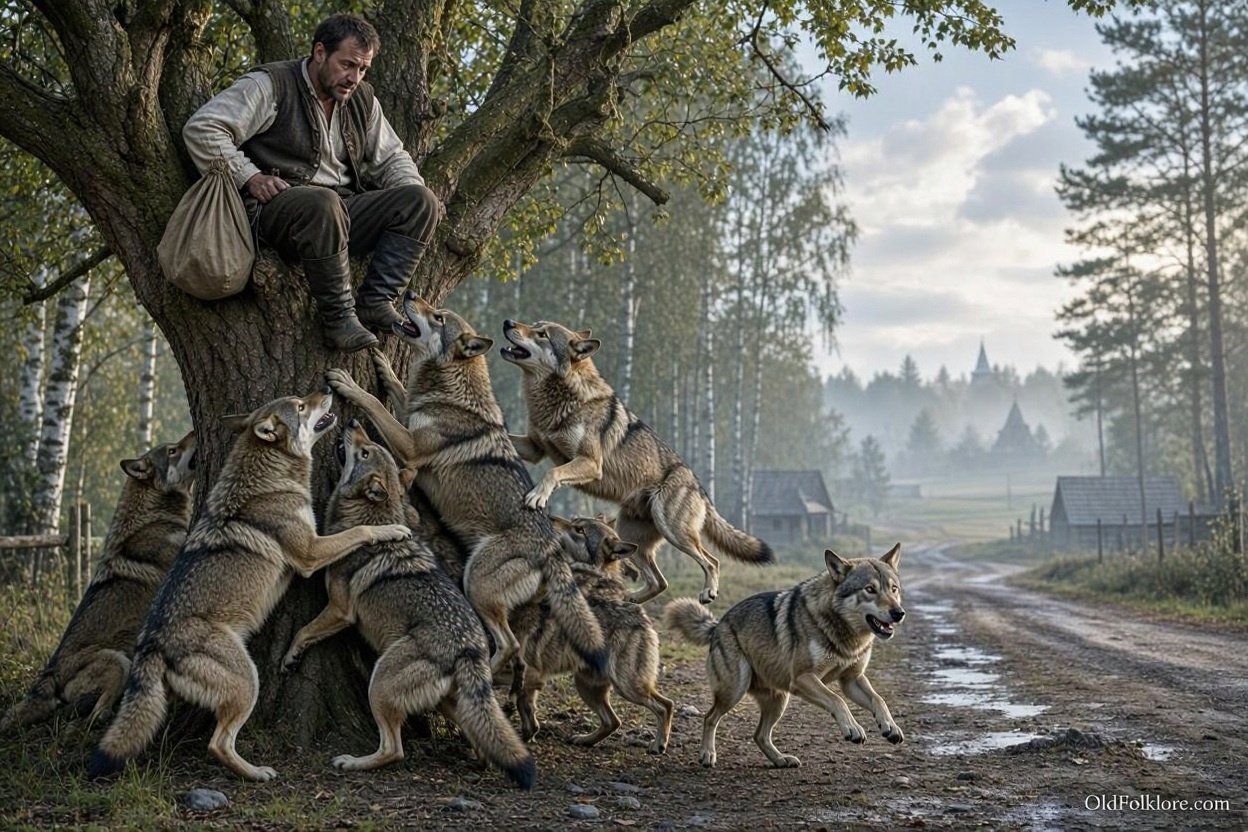
The tailor heard them approaching. When he realised that seven wolves were chasing him, he knew that he was in serious danger. He quickly climbed a tree and settled among its branches.
The wolves arrived beneath the tree and considered how they could reach him. They decided to form a living ladder by climbing onto one another’s shoulders.
They ordered the tailless wolf, whom the tale calls the manx-wolf, to lie at the bottom. The other wolves would then climb upon the animals above them until they reached the tailor.
The arrangement brought the wolves closer to their target. The tailor watched as the growing pile approached his hiding place. He could see that the situation was becoming increasingly dangerous.
The Tailor Escapes
As the wolves climbed towards him, the tailor called out to the wolf at the top.
He declared that the whole trouble was the fault of the manx-wolf at the bottom.
The words frightened the tailless wolf. Believing that he was being blamed for what was happening, he suddenly jumped out from beneath the others and ran away.
Without the support of the wolf at the bottom, the entire arrangement collapsed. All seven wolves tumbled down from one another.
They immediately abandoned their attempt to catch the tailor and turned their attention to the fleeing manx-wolf. They chased him, caught him and tore him to pieces.
The tailor remained safely in the tree until the danger had passed. He then climbed down and returned home.
The story ends with the tailor safely away from the wolves, having escaped through his quick thinking rather than physical strength.
Explore our complete Historic Folklore & Fairy-Tale Collections archive.
Moral Lessons
The tale shows that intelligence can help someone overcome a threat that would be impossible to defeat through strength alone. The tailor is surrounded by dangerous animals, yet he survives because he observes their behaviour and finds opportunities to turn their plans against them.
It also warns against acting too quickly without considering the consequences. The wolf repeatedly trusts the words of others without examining their intentions. His hunger makes him careless, and each encounter leaves him worse off than before.
Finally, the story highlights how fear and blame can disrupt cooperation. The seven wolves have a plan that brings them close to catching the tailor, but their arrangement collapses when the tailless wolf becomes frightened and abandons his position.
Knowledge Check
1. Why did the wolf approach Christ and the Twelve Apostles?
He was hungry and wanted help finding something to eat.
2. What happened when the wolf approached the mare?
The mare directed him towards her hind feet and kicked him, knocking out his front teeth.
3. How did the ram escape?
He charged down the hill and struck the wolf on the forehead with his horns.
4. How did the tailor escape from the wolf?
He seized the wolf’s tail, wrapped it around his hand and used it to whip the animal until the tail tore loose.
5. Why did the seven wolves chase the tailor?
The tailless wolf told them that the tailor had torn out his tail and pointed out the man’s location.
6. How did the tailor escape the seven wolves?
He blamed the manx-wolf for the trouble, frightening the animal into running away. The others fell from their makeshift ladder and chased him instead.
Source
Retold from Alexander Afanasyev’s Russian Folk-Tales, translated by Leonard A. Magnus (first published in 1915; second impression 1916), under the original heading “The Wolf and the Tailor.”
Afanasyev was a collector of Russian folk narratives, while Magnus was responsible for the English translation. The tale’s opening reference to Christ and the Twelve Apostles is part of the traditional narrative framing in the printed version.
Digital source: Project Gutenberg, eBook 62509, Russian Folk-Tales.
Explore More Afanasyev’s Russian Folk-Tales
- Vasilisa the Fair: A Russian Fairy Tale of Magic, Courage and Baba Yaga
- The Sea Tsar and Vasilisa the Wise: Russian Folk Tale
- The Bear, the Dog and the Cat
- The Tale of the Silver Saucer and the Crystal Apple
- The Foundling Prince: A Clever Boy Solves the Tsar’s Riddle