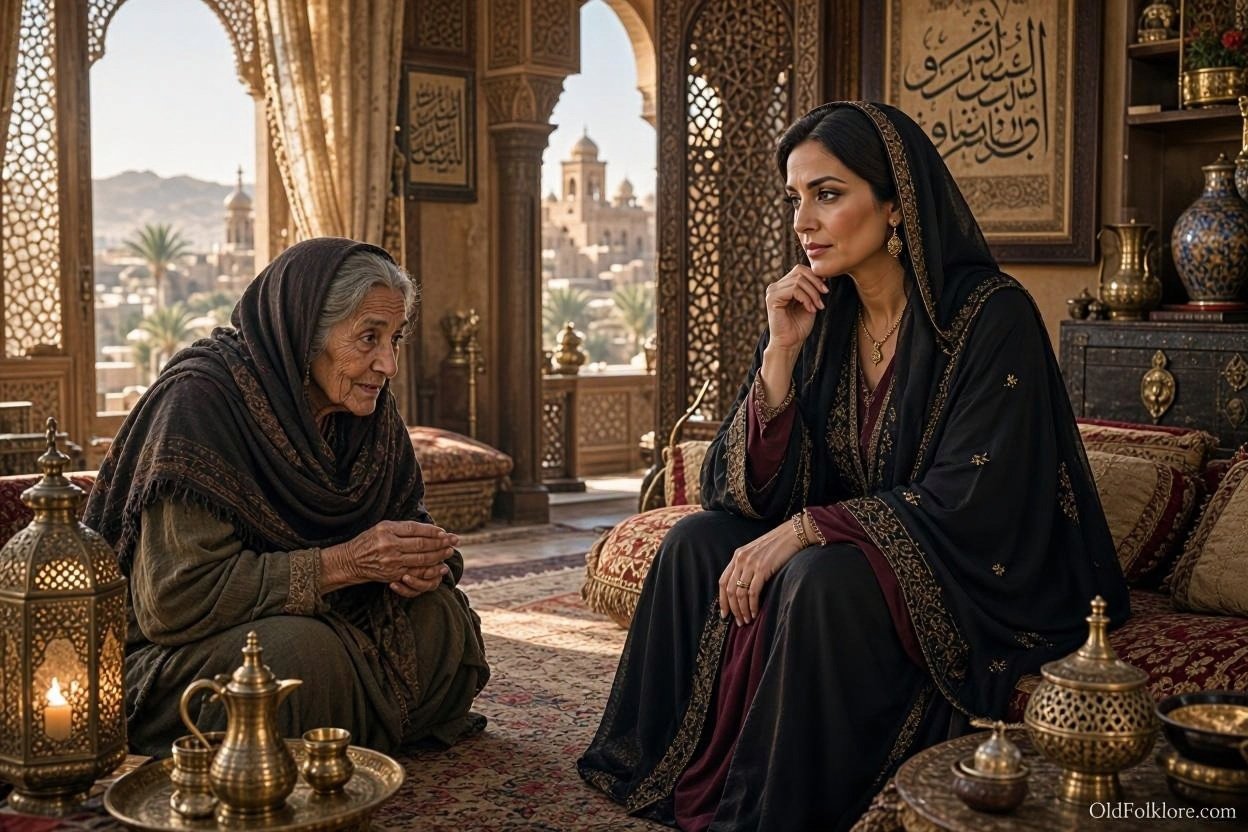
Wealth and independence do not always protect a person from deception. In this Arabian Nights tale, a wealthy widow believes she has found love and happiness when a mysterious old woman introduces her to a handsome young man. Their marriage begins with promises of loyalty and a period of happiness, but a carefully arranged encounter exposes the woman to danger. What follows is a story of manipulation, misplaced trust, jealousy and suffering, told by the woman herself to explain the marks upon her body.
The Portress Inherits a Great Fortune
The woman who later became known as the Portress began her story by explaining that her father had died and left her a considerable inheritance. She remained unmarried for a short time before marrying one of the wealthiest men of his day.
Her marriage lasted only a year. When her husband died, she inherited eighty thousand dinars in gold according to the law of inheritance. She became exceedingly wealthy, and her reputation spread throughout the city. Among her possessions were ten changes of clothing, each worth a thousand dinars.
With her fortune and position, she could live comfortably without depending on anyone. She spent her days at home, enjoying the security her inheritance had provided.
One day, however, an elderly woman came to visit her. The visitor was physically unattractive, with a bent back, a wrinkled face, sparse eyebrows, missing teeth and a generally unpleasant appearance. Despite her appearance, she approached the wealthy widow with elaborate politeness.
The old woman greeted her respectfully and explained that she had an orphaned daughter whose wedding and bridal display were to take place that night. Her family was poor and unfamiliar with the city, and she had few people to turn to for assistance.
She asked the widow to attend the celebration. She explained that if a woman of the widow’s standing appeared at the occasion, other respectable women in the city might follow her example. This would make the orphaned bride feel honoured and comforted.
Explore more stories from our The Arabian Nights collection.
The widow felt sympathy for the old woman’s situation. She agreed to attend and even offered to provide clothing and jewellery for the bride’s display.
The Old Woman Leads Her to a Palace
The old woman left, promising to return when the preparations were complete. Before long, she came back with news that the ladies of the city were waiting for the widow’s arrival.
The widow trusted her and accompanied her through the streets. Instead of taking her to an ordinary wedding celebration, the old woman led her to a magnificent palace.
Inside, the widow was welcomed by a beautiful young woman. The house was richly furnished, and everything about the place suggested wealth and refinement. The young woman greeted her warmly and explained that her handsome brother had fallen deeply in love with her.
According to the young woman’s account, her brother had heard about the widow’s beauty, wealth and good reputation. He wished to marry her honourably, and the young woman had arranged the meeting so that they could become acquainted.
The widow was surprised but pleased by the proposal. She had been a widow for some time, and the idea of marrying a young man who admired her seemed attractive.
The young woman explained that her brother wanted the marriage to be lawful and properly witnessed. A Qazi and four assessors were therefore summoned to prepare the marriage contract.
Before the contract was completed, however, the prospective husband made one important demand. He required the widow to swear upon the Holy Book that she would never look at another man with desire or incline her heart or body towards anyone else.
The widow accepted the condition and took the oath.
The marriage was completed, and the couple began their life together. For a month, they enjoyed happiness and affection. The widow believed that she had entered a fortunate new chapter of her life.
A Visit to the Bazaar
After a month had passed, the widow asked her husband for permission to visit the bazaar. She wanted to purchase some fabrics and other goods.
Her husband granted her request, and she went out accompanied by the old woman and a slave-girl.
At the bazaar, they stopped at the shop of a silk merchant. The old woman began praising the young shopkeeper, describing him as handsome and admirable. She encouraged the widow to speak to him.
The widow immediately reminded her that she had sworn an oath to her husband. She could not address another man, and she did not wish to betray the promise she had made.
The merchant, however, showed interest in her. He presented her with the goods she wanted and declared that she need not pay him money. Instead, he asked for a kiss as his reward.
The widow hesitated. She understood that the request was inappropriate, especially given the oath she had taken. The old woman then began persuading her to accept.
She argued that the widow would not break her promise merely by receiving a kiss. She suggested that if the widow remained silent and did not lean towards the merchant, she would not be guilty of violating the condition of her marriage.
The widow was eventually persuaded to allow the merchant to kiss her beneath her veil.
Instead of giving her a harmless kiss, the merchant suddenly bit her cheek. He tore away a piece of flesh and left her bleeding.
The widow cried out in pain. The merchant’s shop had become the scene of an attack, and she was left with a serious wound.
The old woman quickly intervened. She helped the widow leave the shop and return home, advising her to conceal what had happened.
The Husband Discovers the Wound
When the widow reached home, she tried to hide her injury. The old woman advised her to pretend that she was ill and to avoid revealing the real cause of the wound.
Her husband soon noticed that something was wrong. He questioned her about her condition and wanted to know how she had been injured.
At first, the widow gave an explanation involving firewood carried by a camel. When her husband questioned her further, she changed her account and claimed that she had fallen from an ass.
Her husband became angry at the people responsible for the supposed accident. He wanted to punish those who had supplied the firewood or allowed the animal to cause her injury.
The widow pleaded with him not to take revenge. She insisted that what had happened was simply an act of fate and that no one should be punished.
Her explanations did not satisfy him. He eventually realised that she had broken the oath she had sworn at their marriage.
To him, the incident was not merely an injury or a misunderstanding. He considered it a betrayal of the condition upon which their marriage had been made.
His anger became overwhelming.
He summoned seven black slaves and ordered them to seize the widow. He commanded one of them to cut her body in half and throw the pieces into the Tigris.
The widow was terrified. She wept and pleaded for her life, insisting that her actions did not deserve such a terrible punishment.
Her husband refused to listen. He remained convinced that she had betrayed him and that she must suffer for it.
The Old Woman Pleads for Her Life
As the slaves prepared to carry out the husband’s command, the old woman intervened.
She appealed to him to reconsider his decision. She argued that the widow had not committed an offence that deserved death and reminded him that she was still a young woman.
The old woman continued pleading until the husband finally relented.
He agreed to spare the widow’s life, but he declared that he would leave a permanent mark upon her body so that she would remember his anger.
He ordered the slaves to strip her of her clothes and lay her on the ground. They held her down so that she could not move.
Her husband then brought a rod made from quince wood and began beating her across the back and sides. He continued until the pain became unbearable and she lost consciousness.
The punishment was severe. The widow was left unconscious, her body covered with injuries.
When night came, her husband ordered the slaves to take her away. The old woman accompanied them and showed them the way to the widow’s former home.
They carried her there and abandoned her on the floor before leaving.
The widow did not regain consciousness until dawn. When she finally awoke, she found herself alone and badly injured.
She gathered what strength she had and began treating her wounds with ointments and other medicines. Her body remained painful and weak, and she was confined to her bed for four months before she could recover enough to stand and move about normally.
The marks left by the beating remained visible on her body.
The Widow Returns to Her Former Home
After four months, the widow decided to visit the house where she had lived with her second husband.
She expected to find the place as she had left it, but she was shocked by what she discovered. The building had been demolished, and the entire street had been pulled down. Only heaps of rubbish remained where the house had once stood.
She could find no one who could explain what had happened or why the building had been destroyed.
Having nowhere else to turn, she went to the house of her paternal sister.
When she arrived, she found her sister living with two black bitches. The widow greeted her and explained everything that had happened, from the old woman’s first visit to the marriage, the incident in the bazaar and the terrible punishment inflicted by her husband.
Her sister listened and comforted her. She reminded her that human beings could not always escape the hardships brought by time and misfortune. She thanked Allah that her sister had survived the ordeal.
The widow found comfort in her sister’s compassion. After all she had suffered, she was grateful to have someone who would listen without condemning her.
The Portress and Her Sisters
The widow eventually remained with her paternal sister. Her account also refers to another sister who later joined their household. The women lived together without marrying again.
Their household and the two black bitches became part of the circumstances that surrounded the later gathering of the Porter, the three Kalandars and the three merchants from Mosul.
The widow’s story was eventually heard by the Caliph, who had summoned the people involved in the strange events at the house of the three ladies.
When the Portress finished recounting her experiences, the Caliph was struck by the unusual nature of the account. He ordered that the story be written down and preserved in the royal record chambers so that it would not be lost.
Thus, the Portress’s account came to an end. Her tale explained the marks upon her body and revealed how a wealthy woman, once secure in her independence, had been deceived into a marriage that brought her terrible suffering.
Explore our complete Historic Folklore & Fairy-Tale Collections archive.
Moral Lessons
The tale warns against placing unquestioning trust in strangers, particularly when their intentions are not fully known. The old woman presented herself as a helpless person seeking assistance, but her apparent kindness concealed a plan that brought the widow into danger. Compassion is valuable, but it should be accompanied by sound judgement.
It also demonstrates how manipulation can exploit a person’s desire for companionship and affection. The widow was persuaded to accept a marriage proposal through a carefully arranged meeting. Later, the same old woman encouraged her to approach the silk merchant and downplayed the seriousness of the promise she had made to her husband.
The story further exposes the destructive consequences of jealousy and uncontrolled anger. The husband’s reaction to the incident was cruel and disproportionate. Rather than seeking an explanation or allowing the matter to be resolved, he ordered a punishment that nearly cost the widow her life.
Finally, the Portress’s experience highlights the importance of compassion during hardship. After suffering betrayal and violence, she found comfort in the care of her sister. Her survival and eventual recovery show the value of having someone who offers support when life becomes difficult.
Knowledge Check
1. How did the Portress become wealthy?
Her father left her an inheritance, and after her first husband died, she inherited eighty thousand dinars.
2. Why did the old woman visit the Portress?
She claimed that her orphaned daughter was getting married and asked the Portress to attend the celebration and help the poor family.
3. What condition did the Portress’s second husband impose before their marriage?
He required her to swear upon the Holy Book that she would never look at or incline her heart or body towards another man.
4. How did the silk merchant injure the Portress?
After the old woman persuaded her to accept a kiss, the merchant bit her cheek and tore away a piece of flesh.
5. Why did the Portress’s husband punish her?
He believed she had broken the oath she had made at their marriage and reacted with extreme anger.
6. Where did the Portress go after recovering from her injuries?
She went to the home of her paternal sister, who comforted her and received her into the household.
Source
Retold from The Book of the Thousand Nights and a Night, Volume I, translated and annotated by Richard F. Burton (1885), under the original heading “Tale of the Portress.”
The tale belongs to the larger Arabian Nights narrative tradition. The collection developed through an extended history of storytelling and transmission; Richard F. Burton is credited here as the English translator and annotator, not as the original author of the traditional narrative.
Digital transcription: Project Gutenberg, eBook 3435.
Explore More On The Arabian Nights
- The Tale of the Bull and the Ass
- The Envier and the Envied
- Tale of the Husband and the Parrot
- The First Shaykh’s Story
- The Third Shaykh’s Story: The Man Transformed into a Mule
- The First Kalandar’s Tale: A Prince Tragic Fall