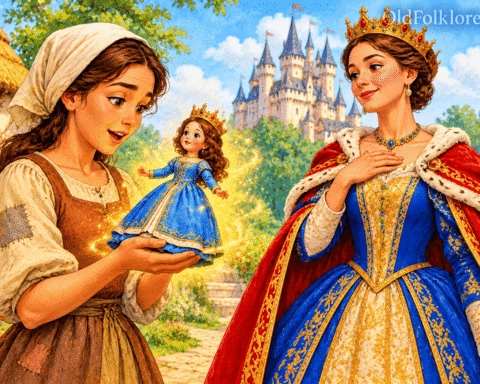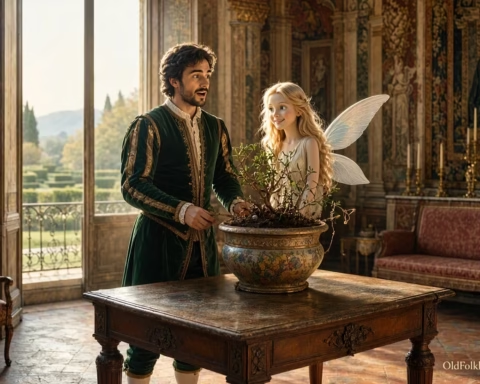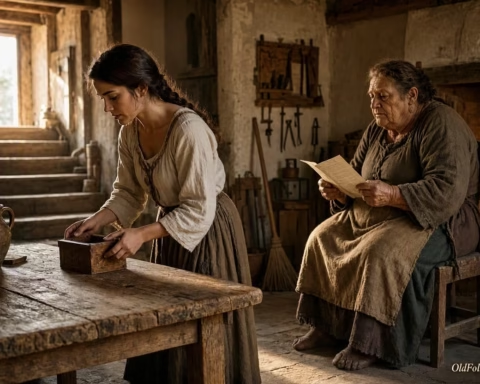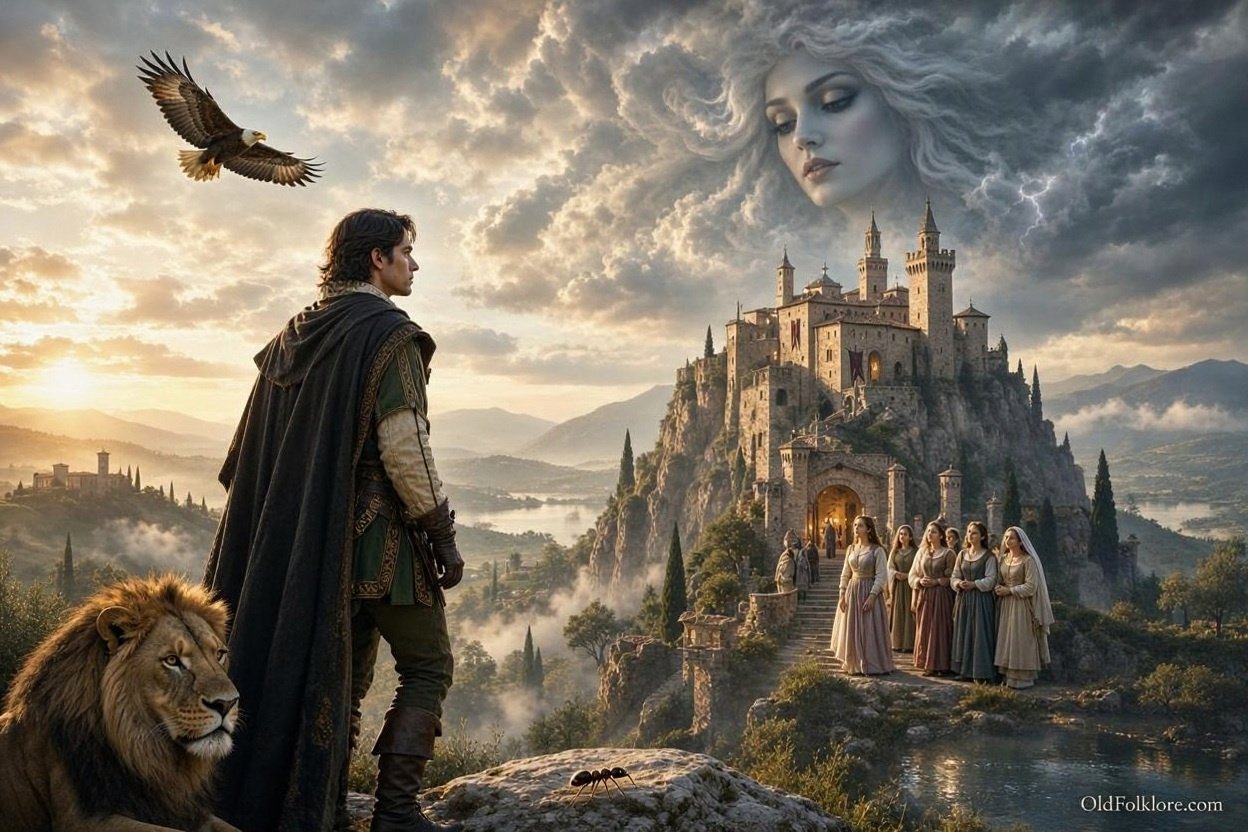
A poor fisherman receives an extraordinary gift from a talking fish, and his family soon discovers that the creature’s promise reaches far beyond their modest home. His three sons grow up with unusual connections to the animals born alongside them, while a mysterious bone hanging in their kitchen provides a warning whenever danger threatens one of the brothers.
When the eldest son leaves home, he encounters strange creatures, receives magical powers and becomes involved in the fate of a kingdom. His journey brings him face to face with an enchantress known as the Cloud, whose victims are young women held under a cruel spell. Although he succeeds in defeating her, his adventure is far from over. The danger that follows will require the courage and cleverness of his younger brothers.
The Fisherman’s Gift from the Talking Fish
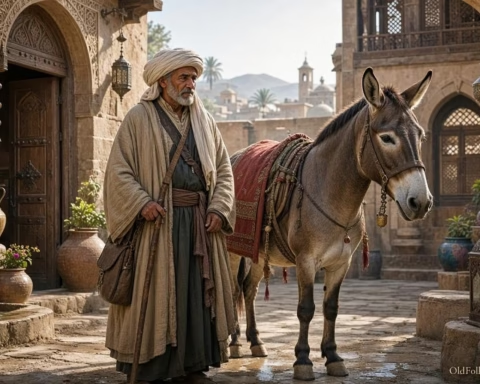
Once upon a time, a fisherman lived with his wife and many children. His family depended on his daily catch, but a period came when he could no longer find enough fish to support them. He continued casting his net, hoping that fortune would change, but his efforts brought little relief.
One day, however, he caught an unusually large fish. To his astonishment, the creature began to speak. It asked him to release it and cast his net again, promising that he would catch as many fish as he desired.
The fisherman followed its instructions. When he cast his net once more, he caught more fish than he had ever remembered bringing home. For a while, his family enjoyed plenty, but the supply eventually disappeared. The fisherman returned to the water and caught the same extraordinary fish again.
This time, the fish told him that its death could no longer be avoided. It instructed him to kill it and divide its body according to its directions. Half was to be given to the king, while separate portions were to be given to the fisherman’s wife, his dog and his horse. The remaining bones were to be tied to the rafters of the kitchen.
The fish also made a remarkable prediction. The fisherman’s wife would give birth to three sons, while the dog and horse would each produce three young. Whenever anything happened to one of the boys, the fish-bone hanging in the kitchen would sweat drops of blood.
The fisherman carried out the instructions. In time, his wife gave birth to three sons, and the dog and horse each had three offspring. The boys grew up, attended school, learned much and prospered. Their family lived with the knowledge that the mysterious bone could reveal when misfortune had struck one of them.
The Eldest Brother Receives Three Magical Powers
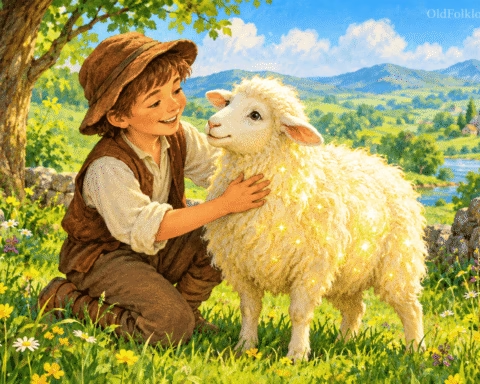
When the brothers had grown older, the eldest became eager to see the wider world. He told his parents that he wished to travel and explore beyond their home. After receiving their blessing, he took one of the dogs, one of the horses and some money, then set out.
During his journey, he entered a forest where he found a lion, an eagle and an ant gathered around the body of a dead ass. The animals wanted to divide the carcass, but they could not agree on how to share it. Their disagreement had become a quarrel, and they called upon the young traveller to settle the matter.
At first, the youth was frightened by the sight of the creatures. Nevertheless, he gathered his courage and examined what remained of the animal. He assigned the lean meat to the eagle, the brains to the ant and the rest to the lion.
Explore more stories from our Italian Popular Tales collection.
Each animal accepted its share and was satisfied with the decision. The young man then continued along his way, believing the matter settled. Before he had gone far, however, the animals called him back. They wished to reward him for resolving their dispute.
The lion explained that the youth could transform himself into a lion whenever he wished. All he needed to say was, “No more a man, a lion, with the strength of a hundred lions!”
The eagle offered him a similar power. By saying, “No more a man, an eagle, with the strength of a hundred eagles!” he could become an eagle.
The ant also granted him the ability to take its form, using the corresponding words of transformation. The young man thanked the three creatures for their gifts and continued his journey, now possessing three extraordinary powers.
As he travelled along the seashore, he noticed a dog-fish stranded outside the water. Rather than leave the creature to die, he returned it to the sea. The grateful fish promised to help him whenever he needed assistance. It instructed him to come to the shore and call, “Dog-fish, help me!”
The youth continued towards a distant city.
The Cloud and the King’s Daughter
When the young traveller reached the city, he noticed that mourning had spread throughout its streets. The people appeared distressed, and the city was filled with signs of sorrow.
He asked what had happened. The inhabitants explained that a terrible cloud came to their city every year. The cloud was, in truth, a fairy who demanded a young girl as her victim. If the people refused to surrender the chosen girl, the creature would hurl so many objects into the city that everyone would be killed.
This year, the lot had fallen upon the king’s daughter.
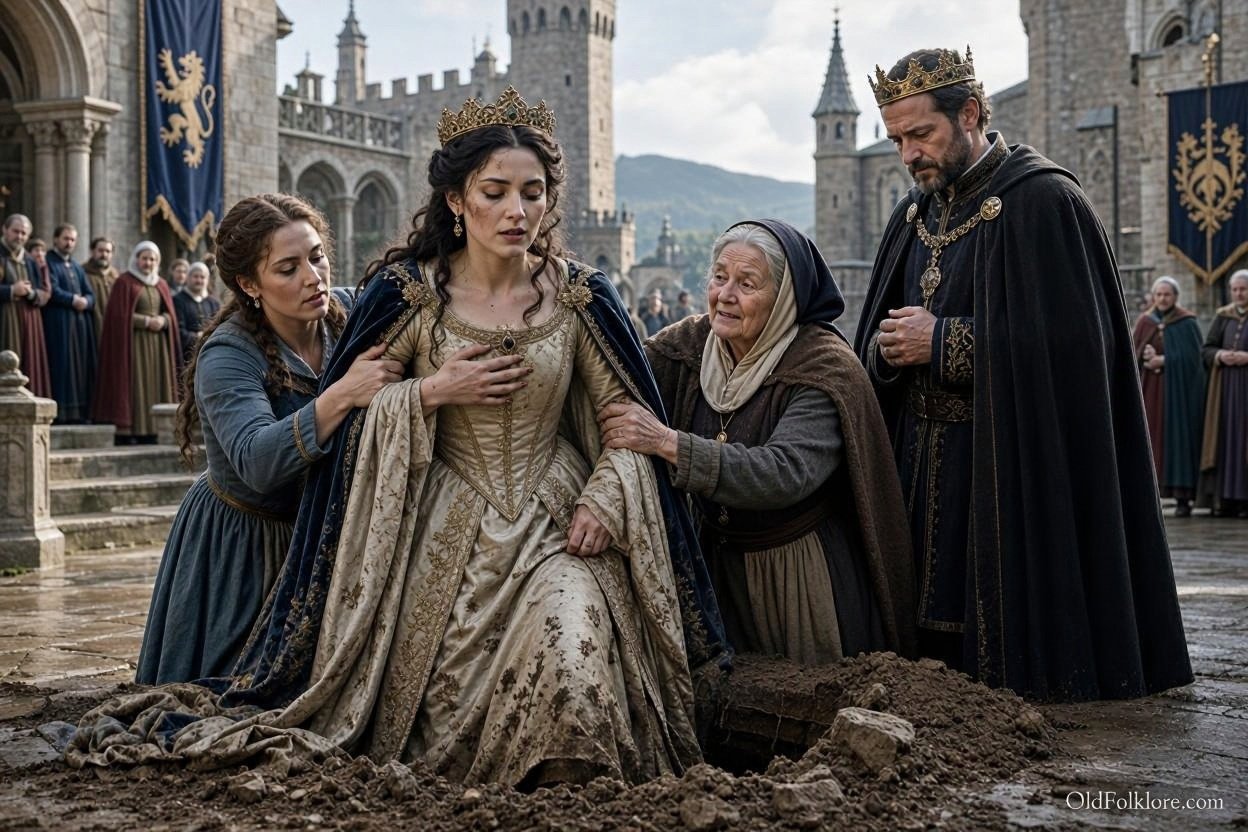
The young man wanted to witness what happened, and the people allowed him to observe the ceremony. With muffled drums and an escort of soldiers, the king and queen accompanied their daughter towards the top of a mountain. They were overcome with grief as the princess was placed in a chair and left alone.
The young traveller had followed the procession and concealed himself behind a bush. He watched as the cloud appeared and approached the helpless princess. The creature took the young woman into her lap, placed her finger in its mouth and began sucking her blood. This was how the fairy sustained herself.
The princess soon became almost lifeless, lying as helplessly as a log. The cloud then carried her away.
The young man decided to follow. He spoke the words given to him by the eagle and immediately transformed into a powerful bird. He flew after the cloud, keeping it in sight until it reached a palace.
The palace doors opened, and the creature carried the princess upstairs. The eagle settled in a tree opposite the building and watched what happened inside. Through the room, he saw many young girls lying in beds. When the cloud entered, they called out to her as their mother.
The girls were not free to leave their beds. Like the king’s daughter, they had been weakened by the fairy, who kept them in a half-dead condition. After placing the new princess among them, the creature announced that she would be away for several days.
The young man understood that he had an opportunity to act while the fairy was absent.
The Princess Sends a Message Home
The youth changed himself from an eagle into an ant by speaking the words of transformation. In this tiny form, he entered the palace without being noticed. Once inside the room occupied by the young women, he resumed his human appearance.
The girls were astonished to see a man suddenly appear among them. One warned him that a dangerous fairy lived there and would kill him if she discovered him.
He reassured them that he had come to help. His first concern was the king’s daughter, whom he approached and asked whether she possessed something that could serve as a token for her mother.
The princess gave him a ring. He carried it back to the queen and explained where her daughter was being held. He also asked the queen to send food for the captive princess.
The queen was able to provide the requested supplies. The young man returned to the palace and informed the girls that help had arrived. He then arranged for the food to be drawn up to them with ropes.
Before hiding himself again, he advised the girls to ask the fairy how she could be killed. He believed that the answer might reveal the secret of defeating her.
When the fairy returned, the girls asked what they should do if she ever died. She dismissed their question, insisting that she would never die.
They continued pressing her for an answer. Eventually, she agreed to explain the secret. The following day, she took them to a terrace and pointed towards a distant mountain.
There, she said, lived a tigress with seven heads. The fairy explained that a lion would have to fight the creature and tear off all seven heads. An egg lay inside the tigress’s body. If someone struck the fairy in the middle of her forehead with that egg, she would die.
There was one condition that made the task especially dangerous. If the egg fell into the fairy’s hands, the tigress would come back to life, regain all seven heads and restore the fairy’s strength.
The girls pretended to be impressed by the explanation, saying that their mother could never die. In their hearts, however, they were discouraged. They could not imagine anyone defeating the seven-headed tigress and securing the egg.
When the fairy left, the young man emerged from his hiding place. The girls told him everything they had learned, but he urged them not to lose hope.
The Battle with the Seven-Headed Tigress
The young man went to the princess’s father and requested several things: a room, a pan of bread, a barrel of good wine and a child who was seven years old.
After receiving them, he shut himself inside the room with the child. He explained that he intended to show the child something remarkable and that he would transform himself into a lion.
The transformation frightened the child at first. The youth reassured him that the lion was still the same man and persuaded him to remain calm. He then instructed the child to feed him whenever he returned hungry.
Once the child understood what was expected, the young man took the necessary provisions and travelled to the mountain where the seven-headed tigress lived.
He prepared the bread and wine in the pan and reminded the child that he would need food when he returned from the fight. Then he spoke the words of transformation and became a lion.
The battle began. The lion fought the tigress with great determination, but defeating her was no simple task. The struggle continued over several days. Each day, he managed to tear off another of her heads.
The first day brought down one head. On the second day, another was removed, and the fight continued until six of the seven heads had been torn away. Throughout this struggle, the fairy grew weaker. Her strength depended upon the tigress, and every lost head brought her closer to defeat.
The lion rested for two days before returning to complete the task. He fought again and, by evening, tore off the final head. The tigress died and disappeared.
However, the youth was not quick enough to catch the egg that emerged from her body. It rolled away and fell into the sea, where the dog-fish swallowed it.
The young man remembered the promise made to him by the creature he had rescued. He went to the shore and called, “Dog-fish, help me!”
The fish appeared and asked what he wanted. The youth asked whether it had found an egg. The dog-fish confirmed that it had and, when asked, gave it to him.
With the egg secured, the young man returned to the fairy’s palace.
The Fairy’s Death and the Princess’s Return
The fairy was astonished when the young man appeared before her holding the egg. She immediately demanded that he hand it over.
He refused to surrender it until she had fulfilled a condition of his own. She had to restore every young woman she had weakened and send them home in handsome carriages.
The fairy had no choice but to comply. She restored the girls to health and arranged for their return.
Only after all the young women had been freed did the youth use the egg. He struck the fairy in the middle of her forehead, exactly as she had described. The creature fell to the ground and died.
The young man made certain that the fairy was truly dead. He then entered a carriage with the king’s daughter and drove towards the royal palace.
When the king and queen saw their daughter alive again, their sorrow turned to overwhelming joy. The princess had been restored to them, and the people were no longer threatened by the creature that had demanded a victim every year.
The king arranged for his daughter to marry the young man who had rescued her. Their wedding was celebrated with great magnificence, and the city rejoiced at the end of the terrible enchantment.
The Fog and the Two Enchantresses
A few days after the wedding, the young husband looked out of a window and noticed a dense fog at the end of the street. Curious about the strange sight, he told his wife that he intended to investigate.
He dressed for the chase and departed with his dog and horse. After passing through the mist, he discovered a mountain where two beautiful ladies were waiting. They approached him and invited him to their palace.
The young man accepted their invitation. They led him into a room, where one of the ladies asked whether he wished to play chess. He agreed, but the game ended in his defeat.
The women then took him into a garden filled with marble statues. There, they transformed him into a statue, along with his dog and horse.
The two ladies were sisters of the fairy he had killed. They had arranged the encounter to avenge her death, and the chess game had been their means of capturing him.
Back at the palace, the princess waited for her husband, but he did not return. His disappearance soon became a matter of concern.
At the home of his parents, the fish-bone hanging in the kitchen began to release drops of blood. The family understood the warning immediately. Something terrible had happened to the eldest son.
The second brother decided to search for him. He took another of the dogs and horses and travelled towards the palace where the princess lived.
When he passed the building, the princess saw him from the window. The brothers looked so much alike that she mistook him for her husband and called him inside.
She spoke to him about the fog and what had happened before his disappearance. The second brother did not understand her account, but he listened carefully. He suspected that his missing brother had become involved in the strange affair.
The following morning, he set out to investigate the fog himself. He passed through it and reached the mountain, where he encountered the two ladies. The same events followed. They invited him into their palace, played chess with him and turned him, his dog and his horse into stone.
The princess continued waiting, while the fish-bone at the family home shed blood more rapidly than before.
The Youngest Brother Breaks the Enchantment
The youngest brother also set out in search of his missing brothers. Like the others, he travelled with one of the dogs and one of the horses.
When he reached the princess’s palace, she saw him and believed that her husband had returned. She called him inside and reproached him for keeping her waiting.
She spoke about the fog and the strange events surrounding it, but the youngest brother did not understand what she meant. He replied that he had not seen clearly what was inside the mist and wished to investigate it again.
He left the palace and passed through the fog. On his way, he met an old man who stopped him and warned him that his brothers had been turned into statues.
The old man explained what would happen when he reached the two ladies. If they invited him to play chess, he must not accept their pieces. Instead, he should insist on playing with his own pawns, which the old man provided.
He also instructed the young man to agree on the conditions of the game. If he won, he could do whatever he wished with the two ladies. If they won, they could do whatever they wished with him.
The old man explained that, should he succeed, the ladies would beg for mercy. He must then demand that they restore every stone statue in their palace to life. Only after they had completed this task would he be free to decide what should happen to them.
The youngest brother thanked the old man and continued his journey.
When he reached the palace, the two ladies received him and invited him to play chess. He followed the old man’s instructions, using the pawns he had been given and insisting upon the agreed conditions.
This time, he won.
The two ladies immediately begged him to spare their lives. He agreed on the condition that they restore all the statues in the palace to life.
They took a wand and touched the statues. One after another, the figures regained their movement and became living beings again.
Among those restored were the two older brothers, their dogs and their horses. The other statues in the palace also returned to life.
But the restored captives did not simply depart. As soon as they were free, they turned upon the two enchantresses and cut them into pieces no larger than their ears.
The Three Brothers Reunite
The three brothers were finally together again. They shared the stories of their separate adventures and then returned to the palace.
The princess was astonished when she saw three men who looked so much alike. She could not immediately tell which one was her husband.
The eldest brother stepped forward and explained that the other two were his brothers. He made himself known to his wife and told her how they had become separated and how the youngest had secured their freedom.
Their reunion brought an end to the dangers that had followed the eldest brother’s first adventure. The family also arranged for their parents to join them at the palace.
The three brothers, their parents and the princess were reunited, and they all lived happily together.
Thus the tale of the three brothers and the Cloud came to its end.
Explore our complete Historic Folklore & Fairy-Tale Collections archive.
Moral Lessons
The story shows the importance of courage when confronting danger. The eldest brother is initially afraid when he encounters the lion, eagle and ant, but he overcomes his fear and settles their disagreement. His willingness to act earns him gifts that later become essential to his adventures.
Kindness can also create unexpected opportunities. When the young man returns the stranded dog-fish to the sea, he does not ask for a reward. The fish nevertheless promises to help him, and that promise becomes crucial when the egg falls into the water.
The brothers’ adventures demonstrate that strength alone is not always enough. The eldest brother defeats the seven-headed tigress through determination, while the youngest succeeds where his older brothers fail because he listens to the old man’s advice and follows a careful plan.
The story also presents family loyalty as a powerful responsibility. When the fish-bone begins to bleed, the brothers understand that one of their own is in danger. Both younger brothers leave home to search for the eldest, and the youngest eventually restores the entire family to one another.
Knowledge Check
1. What did the talking fish promise the fisherman?
It promised that if the fisherman released it and cast his net again, he would catch as many fish as he wished.
2. What happened when the fisherman’s wife, dog and horse received portions of the fish?
His wife gave birth to three sons, while the dog and horse each produced three young. The remaining bone was hung in the kitchen and would sweat blood whenever misfortune struck one of the brothers.
3. Which three animals gave the eldest brother magical powers?
A lion, an eagle and an ant gave him the ability to transform into their respective forms.
4. How did the eldest brother discover the secret of killing the Cloud?
He persuaded the young women held captive by the fairy to ask how she could die. She revealed that a lion had to defeat a seven-headed tigress and obtain the egg hidden inside its body.
5. How did the eldest brother recover the egg after it fell into the sea?
He called upon the dog-fish he had rescued earlier. The fish had swallowed the egg and returned it when he asked for help.
6. How did the youngest brother rescue his two older brothers?
An old man advised him to use his own chess pawns and agree on the conditions of the game. After winning, he demanded that the two enchantresses restore all the statues to life.
Source
Retold from Thomas Frederick Crane, Italian Popular Tales (1885), “The Cloud” (source heading: “VI. THE CLOUD.”). The tale is identified in Crane’s list of stories as Tuscan, from Comparetti, No. 32, “La Nuvolaccia.” Crane served as the English-language compiler and editor of the collection. Digital transcription: Project Gutenberg eBook 23634.
Explore More Italian Popular Tales
- The Language of Animals
- The King of Love: A Sicilian Fairy Tale
- The Crystal Casket: The Enchanted Tale of Ermellina
- The Three Royal Children and the Secrets of the Speaking Bird
- King Bean: A Powerful Tale of Love and Betrayal