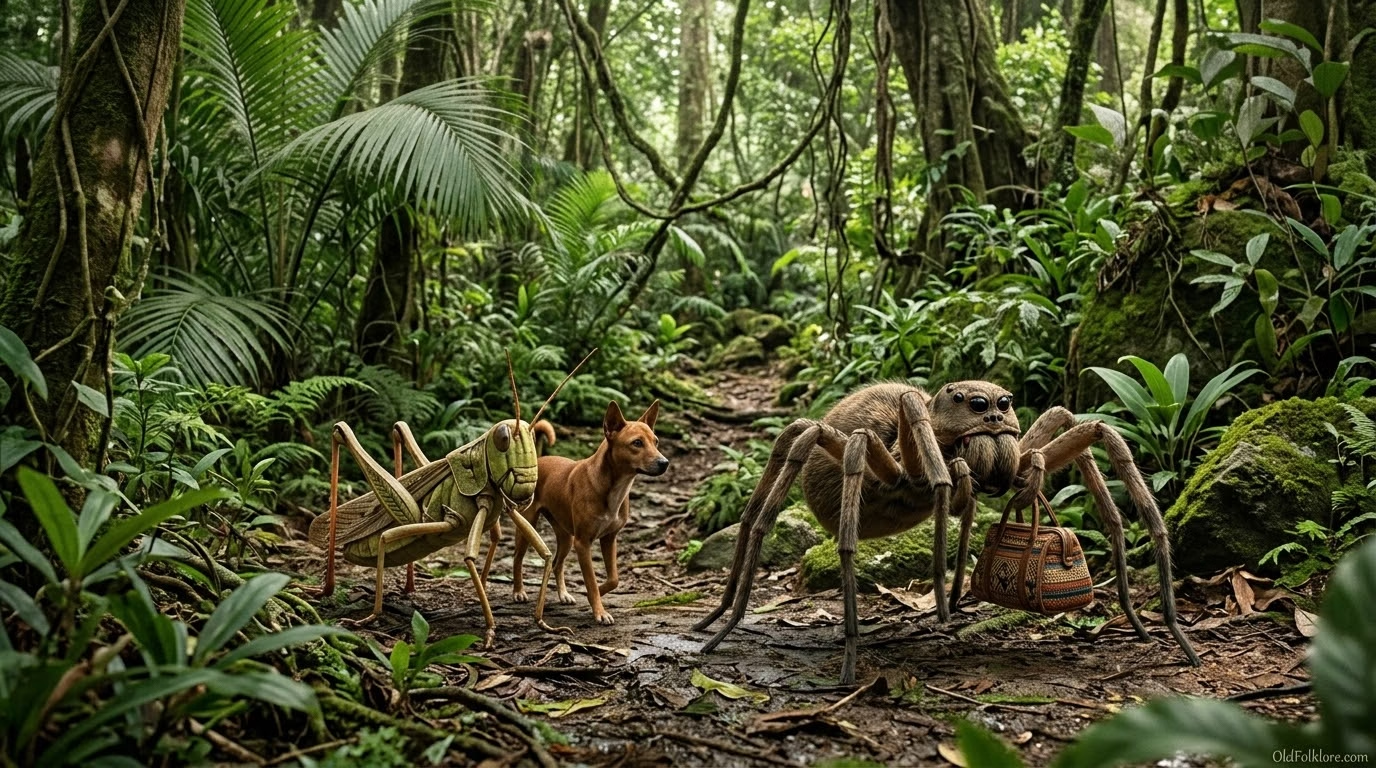
The folktale of the spider and the grasshopper begins with two friends who set out on a journey together. The spider hopes to marry a woman from a distant country, and he asks the grasshopper to accompany him. However, the spider’s greed soon turns their journey into a series of dishonest tricks.
By inventing different names, claiming food meant for both travellers, and later taking credit for his companion’s good fortune, the spider repeatedly puts his own interests first. The grasshopper endures these actions until a final dispute makes their friendship impossible to continue.
Two Friends Begin Their Journey
Long ago, the spider and the grasshopper were good friends. They spent time together and trusted one another, but they differed greatly in character. The grasshopper was patient, while the spider was intensely greedy.
One day, the spider decided to travel to a distant country to marry a woman who lived there. He wanted his friend to accompany him, so he invited the grasshopper to make the journey with him.
The grasshopper agreed. Early one morning, before the sun became too hot, the two friends left their homes and began walking towards the distant country.
After travelling some distance, the spider proposed that they should use different names while away from home.
“While we are travelling together, I want you to call me ‘Stranger’, and I shall call you ‘Dabi’,” he explained. “We must not use our proper names because I do not want people to know who we really are.”
The grasshopper accepted the arrangement without suspecting any harm. He believed his friend had a good reason for the suggestion and continued the journey beside him.
However, the spider had already found a way to benefit from their agreement. He intended to use his new name whenever food was offered specifically to a stranger.
The First Town
After walking for some time, the travellers arrived at a town. The chief welcomed them and ordered food to be brought for their refreshment.
The spider thanked the chief for his kindness but then mentioned that the custom of the country was to offer a special dish of peace to a stranger. This dish consisted of dried meat and kola nuts and was intended to show hospitality and establish friendly relations.
The chief acknowledged the custom and ordered the special food to be brought.
When it arrived, the spider ate almost all the dried meat and kola nuts. He returned one kola nut to the chief and gave another to the grasshopper.
Explore more stories from our Ikom Folk Stories collection.
The spider then told his companion that he would have to wait for the ordinary meal because the special dish had been prepared for the stranger, whose name was now Stranger.
The grasshopper was hungry, but he remained silent.
Later, when the general supply of food was distributed, the spider found another excuse to take his friend’s portion. He argued that the food set aside for the stranger belonged to him because that was the name he was using.
Once again, the grasshopper went without a proper meal while the spider ate his fill.
The spider’s trick had worked exactly as he intended. Their agreement about names had allowed him to claim food that should have been shared. Instead of treating his companion fairly, he used their friendship to satisfy his appetite.
Arrival at the Chief’s House
The next day, the friends continued their journey until they reached the town where the spider intended to marry.
The spider went to the house of his future father-in-law, Chief Tawu, and announced that he had come to marry the chief’s daughter.
Chief Tawu welcomed him warmly. The chief had a wife named Osegi, a kind-hearted woman who would later play an important part in the story.
To honour his future son-in-law and his travelling companion, Chief Tawu ordered a cow to be killed. The people prepared the food and brought it out for the visitors.
When the food arrived, the servants announced that it was the stranger’s portion.
The spider immediately turned to the grasshopper and reminded him that his name had not been mentioned. Since the food had been offered to the stranger, he claimed that he alone was entitled to eat it.
The grasshopper was hungry, but he did not argue. He remained quiet while the spider ate the food.
The spider’s greed was now affecting his friend’s well-being. He had invited the grasshopper to accompany him, yet he repeatedly denied him the food offered during their travels.
A Wedding Feast
The following day, the marriage between the spider and Chief Tawu’s daughter was celebrated.
The people gathered to dance and enjoy themselves. Guns were fired in celebration, and Chief Tawu arranged for four additional cows to be killed to provide food for the visitors who had travelled from distant places.
It should have been a joyful occasion for both friends. However, the grasshopper could not enjoy the celebration because he was hungry and weak.
Once again, the spider claimed both his own share and the grasshopper’s share. Since the grasshopper was known as Dabi, and the servants did not call that name when announcing the stranger’s portion, the spider insisted that the food belonged to him.
The grasshopper sat apart, sad and silent. He watched the others eat and celebrate while he went without the food he needed.
When the spider had finished eating, he joined his new wife and the other guests in dancing. The grasshopper remained behind because he was too hungry and tired to take part.
His silence did not mean that he was content. He had endured his friend’s selfishness for several days, and the situation had become unbearable.
Osegi Learns the Truth
After a while, Chief Tawu’s wife, Osegi, entered the room where the grasshopper sat alone.
She noticed his sadness and wondered why he was not joining the other guests at her daughter’s wedding. Everyone else was feasting and dancing, yet he appeared miserable.
Osegi asked him why he was so quiet.
The grasshopper could no longer keep his troubles to himself. He began to cry and explained what had happened since the two friends left home.
He told Osegi that the spider had instructed him to use the name Dabi and had chosen the name Stranger for himself. Whenever food was offered to the stranger, the spider claimed it all, insisting that the grasshopper had no right to eat because his name had not been mentioned.
For days, the grasshopper had watched his companion eat while he remained hungry.
Osegi listened carefully. She recognised the injustice and felt sorry for the grasshopper.
She promised to help him. She would make sure that the people knew the names the two travellers had been using, so the grasshopper could receive his fair share of food.
Osegi then went out and instructed the servants to call the grasshopper by his proper travelling name whenever food was served.
The Spider Refuses to Eat
That afternoon, the servants brought food and called the grasshopper by the name Dabi.
For the first time during the journey, the spider could not claim the entire portion by insisting that only the stranger was entitled to it. The grasshopper had been recognised, and the trick no longer worked.
The spider was furious. Instead of accepting the change, he refused to eat when the food was brought.
The following day, the servants repeated the arrangement. They called the grasshopper by name again, ensuring that he received his share.
The spider once more refused to eat.
His own scheme had turned against him. By insisting on using false names to claim his companion’s food, he had created a situation in which the grasshopper’s rightful share could be restored simply by calling him by name.
Early on the third day, the spider announced that he was going home. He said he would leave his wife with her family for a time and return for her later.
Chief Tawu agreed to celebrate the departure with another feast. He wanted to see his new son-in-law dance once more before leaving, so the people gathered for another celebration, and another cow was prepared for food.
The spider, however, was still determined to satisfy his appetite.
A Trick with the Grasshopper’s Skin
When the food was ready, the spider invited his friend to join him in dancing.
The grasshopper declined, saying that he would join the celebration later. The spider went to dance alone, leaving the grasshopper near the room where the food had been prepared.
Once he was alone, the grasshopper removed his outer skin and hung it on a peg on the wall. It looked so much like a living grasshopper that someone seeing it from a distance could mistake it for the real creature.
The grasshopper then went out and joined the other dancers.
Meanwhile, the spider became hungry again. He slipped away from the celebration and returned to the room where the food was kept.
As he reached for a piece of meat, he looked up and saw what appeared to be the grasshopper hanging on the wall. Thinking his friend was watching him, he quickly withdrew his hand.
He tried to laugh away the situation, saying that he had only come to inspect the food and had no intention of eating anything.
The spider returned to the dance and was astonished to see the grasshopper there, enjoying himself among the other guests.
He could not understand how his friend had managed to be in two places at once. Nevertheless, his hunger soon overcame his confusion, and he decided to try again.
The Spider Is Fooled
The spider returned to the food room after making sure that nobody was watching.
He lifted the lid and took a large piece of yam. He had barely taken a bite when he noticed the grasshopper’s skin still hanging on the wall.
Once again, the spider became frightened that his friend had caught him trying to steal food.
He put the yam down and hurried outside, calling out that he had only wanted to taste the food to make sure it was good.
When he reached the dance, he saw the grasshopper still celebrating with the other guests.
The spider was astonished. He could not understand how the grasshopper had returned to the dance so quickly after apparently watching him in the food room.
His friend’s trick had exposed the spider’s own dishonesty. The spider had repeatedly taken food meant for others, yet he feared being seen whenever he tried to take more.
The story shows how greed can make a person suspicious and uneasy. The spider had been willing to deceive his friend, but he could not bear the thought of being discovered doing something wrong himself.
Gifts from Chief Tawu
After these events, the travellers prepared to leave the chief’s town and return home.
Chief Tawu gave both the spider and the grasshopper a dog as a present. The two friends then set out together on their journey.
The gifts offered them an opportunity to return home with something useful. The grasshopper valued his dog and intended to take it home. The spider, however, soon showed that his greedy habits had not changed.
After they had walked a short distance outside the town, the spider became hungry. Rather than wait until they reached another settlement, he killed the dog that Chief Tawu had given him and ate the entire animal.
Having finished his meal, he tried to persuade the grasshopper to kill his own dog as well.
The grasshopper refused. He explained that the chief had given him the dog as a present, not as food. He intended to keep it and take it home.
The spider had already destroyed his own gift because he could not control his appetite. Now he wanted his friend to make the same mistake, but the grasshopper would not agree.
The Spider Claims Credit for the Bushbuck
After eating his dog, the spider placed its skull in his bag. He then asked the grasshopper to walk ahead of him.
As they continued through the bush, the grasshopper’s dog caught the scent of an animal and rushed into the undergrowth. It soon returned to the path carrying a small bushbuck.
The grasshopper had gone on ahead and had not waited for his dog. The spider seized the opportunity. He took the bushbuck, cut off its head, and placed it in his bag beside the skull of his own dog. He then sat down and ate the animal’s body.
Later that day, when he caught up with the grasshopper, he showed him the bushbuck’s head.
The spider claimed that his dog’s skull was magical or unusually clever and had somehow killed the bushbuck. He wanted the grasshopper to believe that the skull of the dog he had eaten had brought him good fortune.
The grasshopper understood what had really happened. His dog had caught the animal, but the spider had taken it for himself.
Even so, the grasshopper did not quarrel with him. He continued walking ahead with his dog, as he had done before.
The spider’s lie allowed him to enjoy the meat without acknowledging the grasshopper’s dog. His greed had once again made him take advantage of his friend’s good fortune.
A More Serious Accusation
That night, the two friends slept in the bush. The next day, as they approached the first town they had passed through on their outward journey, the grasshopper’s dog rushed into the forest again.
This time, the dog chased a bush cow and bit it badly on the leg.
When the travellers reached the town, the spider went ahead and told the people that the grasshopper’s dog had chased one of the chief’s cows and injured it.
The accusation made the townspeople angry. They believed that the grasshopper’s dog had attacked an animal belonging to the chief, so they came out carrying sticks, ready to punish him.
The grasshopper saw the people approaching and quickly explained what had happened. He insisted that his dog had not attacked the chief’s cow. It had chased a bush cow in the forest and wounded it.
To prove his account, he offered to show the hunters where the animal had gone.
The hunters agreed to follow him. They took their bows and arrows and examined the tracks left by the wounded animal. Following the blood trail, they eventually found the bush cow and killed it.
The grasshopper’s explanation was proved correct. The animal had been a bush cow, not one of the chief’s domestic cattle.
The spider’s attempt to get his friend into trouble had failed.
The End of Their Friendship
The hunters carried the meat back to the town and placed the horns in front of their ju-ju, as the source describes. Half of the meat was given to the grasshopper, while the remainder was shared among the people.
The spider received nothing.
He was furious. He had expected to benefit from the situation, but the grasshopper had been rewarded for telling the truth and helping the hunters find the animal.
The spider’s jealousy and greed finally overwhelmed whatever friendship remained between them. He told the grasshopper that he no longer wanted him as a friend.
Instead of recognising his own wrongdoing, the spider blamed his companion for the end of their friendship.
The grasshopper had endured repeated tricks, lost meals, and false accusations. He had continued travelling with the spider, but the spider’s selfishness had eventually destroyed their bond.
The spider then began making a net from his web so that he could take revenge on the grasshopper. According to the tale, he has lived on insects ever since.
Thus, the story explains the spider’s habit of catching insects in a web as the result of the quarrel between the two former friends.
Explore our complete Historic Folklore & Fairy-Tale Collections archive.
Moral Lesson
Greed and dishonesty can destroy even a long-standing friendship. Throughout the journey, the spider repeatedly used tricks to obtain food, take credit for his companion’s achievements, and shift blame onto others.
The grasshopper, by contrast, remained patient and truthful. He refused to destroy his dog simply because the spider had done so, and he calmly proved that the animal he had found was a bush cow rather than the chief’s cow.
The tale reminds readers that selfishness may bring temporary rewards, but dishonesty damages trust. A true friend should share fairly, speak honestly, and celebrate another person’s good fortune rather than trying to take advantage of it.
Knowledge Check
1. Why did the spider ask the grasshopper to accompany him?
He wanted to travel to a distant country to marry a woman and asked his friend to go with him.
2. What names did the two friends agree to use during their journey?
The spider called himself Stranger and called the grasshopper Dabi.
3. How did the spider use the names to take advantage of the grasshopper?
He claimed that food offered to the stranger belonged only to him, leaving the grasshopper hungry.
4. How did Osegi help the grasshopper?
She instructed the servants to call the grasshopper by his travelling name so that he could receive his share of the food.
5. Why did the spider accuse the grasshopper’s dog of attacking the chief’s cow?
He wanted to get the grasshopper into trouble, but the grasshopper proved that the animal was a bush cow.
6. What finally ended the friendship between the spider and the grasshopper?
The spider became angry when the grasshopper received half of the bush cow’s meat while he received nothing, and he declared that he no longer wanted the grasshopper as a friend.
Source
“How Two Friends Fell Out: The Spider and the Grasshopper” appears as Chapter VII in Elphinstone Dayrell’s Ikom Folk Stories from Southern Nigeria, published in 1913
Explore More Ikom Folk Stories
- Why a Python Never Swallows a Tortoise
- The Partridge, Monkey, and Elephant
- Igiri and the Mushroom Baby