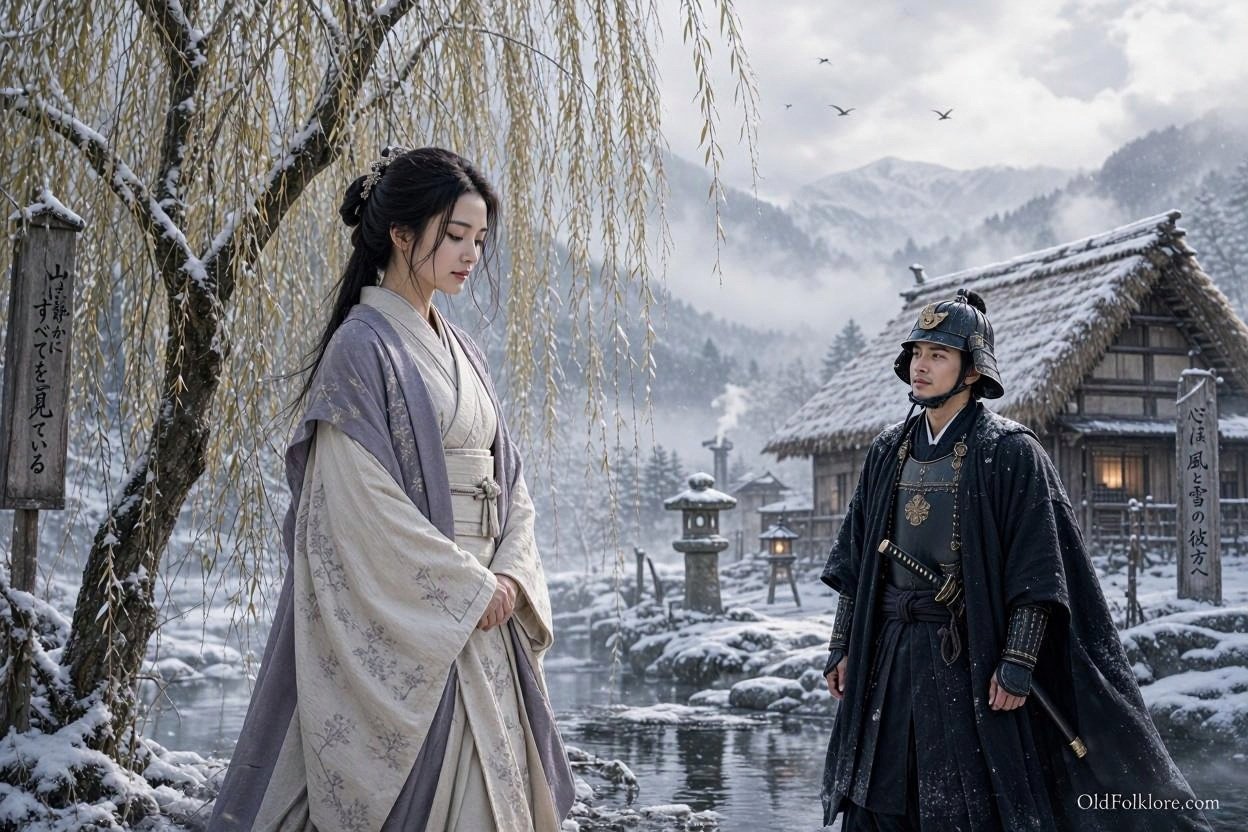
In an age when loyalty, honour and duty shaped the lives of Japanese warriors, a young samurai named Tomotada encountered a woman whose beauty and refinement seemed out of place in a humble mountain cottage.
Her name was Aoyagi, meaning Green Willow. Their affection grew quickly, but their happiness was eventually overshadowed by a mysterious connection between the young woman and the natural world.
Lafcadio Hearn’s The Story of Aoyagi combines historical Japanese settings, romantic devotion and supernatural folklore. It explores the relationship between human life and nature, while presenting love as something that may extend beyond a single lifetime.
Tomotada’s Journey
During the Bummei era, between 1469 and 1486, a young samurai named Tomotada served Hatakéyama Yoshimuné, the Lord of Noto. Originally from Echizen, he had entered the lord’s household as a page while still young.
He received an education in military affairs and developed into an accomplished scholar and soldier. His pleasant character, intelligence and handsome appearance earned him the admiration of his fellow samurai.
When Tomotada was about twenty, his lord entrusted him with a private mission to Hosokawa Masamoto in Kyoto. Since his journey would take him through Echizen, he requested permission to visit his widowed mother along the way.
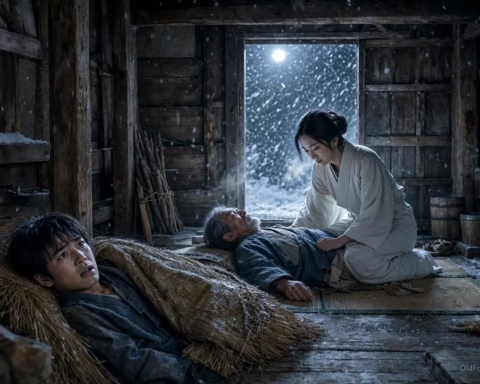
He departed during the coldest part of the year. Snow covered the countryside, and the mountain roads were difficult to travel. His horse gradually became exhausted, while the heavy snowfall made it increasingly dangerous to continue.
On the second day, he realised that he would not reach his intended stopping place before nightfall.
Fortunately, he noticed a small cottage on a nearby hill. Willow trees grew around the dwelling, and its thatched roof offered shelter from the approaching storm.
Explore more stories from our Lafcadio Hearn’s Kwaidan collection.
Tomotada approached and knocked on the closed doors. An elderly woman opened them and welcomed him inside, expressing sympathy for a young traveller caught in such terrible weather.
The Beautiful Girl in the Cottage
Inside the cottage, Tomotada met an elderly couple and a young girl sitting near the fire.
The old people invited him to warm himself while they prepared food and heated rice wine. The girl initially withdrew behind a screen.
Tomotada had already noticed her extraordinary beauty, although her clothing was poor and her long hair appeared untidy. He wondered why someone so attractive lived in such an isolated and humble place.
The elderly man advised him not to continue travelling through the storm. The next village was far away, and the dangerous roads made further movement unwise. He offered the traveller a place to spend the night.
Tomotada gladly accepted.
When the meal was ready, the young woman returned. She had changed into a clean homespun robe, and her hair had been neatly arranged. As she served the wine, the samurai was astonished by her grace and beauty.
Her parents introduced her as their daughter, Aoyagi. They apologised for her lack of experience in serving distinguished guests, explaining that she had grown up almost entirely in the mountains.
Tomotada reassured them that he was fortunate to receive such kindness. He spoke with Aoyagi and discovered that her speech was as graceful as her appearance.
He soon became convinced that she was unlike anyone he had ever met.
A Poem and a Marriage Proposal
Tomotada expressed his admiration through a poem. His verses compared the young woman to a beautiful flower and suggested that he wished to remain because of her.
Aoyagi understood his meaning and answered him with a poem of her own. Her response suggested that she hoped he would remain until morning.
Tomotada was delighted by her intelligence and the elegance of her reply. He realised that his affection was not one-sided.
Without further hesitation, he asked her parents to allow him to marry their daughter. He revealed his identity, family background and position in the service of the Lord of Noto.
The elderly couple were astonished by the proposal. They explained that Aoyagi had been raised in humble surroundings and had received none of the education expected of a noblewoman. They considered themselves unworthy of such an honour.
Nevertheless, they offered her to him as a companion and servant.
When morning arrived, the snowstorm had passed. Tomotada prepared to continue his journey, but he could not bear the thought of leaving Aoyagi behind.
He asked her parents once more to permit the marriage and offered them a purse of gold as a gesture of gratitude.
The old man refused the money. He explained that they had little need for it in their isolated home and that Aoyagi had already been entrusted to Tomotada.
The young woman also wished to accompany him.
Tomotada therefore placed her on his horse, thanked the elderly couple and continued towards Kyoto with his new companion.
The Separation in Kyoto
Hearn explains that the story’s original Japanese narrative becomes incomplete at this point. He acknowledges that he has supplied connecting details to make the remaining events understandable.
According to his reconstruction, Tomotada took Aoyagi to Kyoto before obtaining the formal permission required for a samurai marriage.
A samurai was not free to marry without his lord’s approval. Tomotada therefore kept Aoyagi away from public attention while he carried out his mission.
Unfortunately, a retainer of Lord Hosokawa noticed her and reported their relationship.
Hosokawa ordered that Aoyagi be brought to his residence. Since Tomotada was only a messenger serving a distant lord, he had little power to resist the command.
He was devastated by the separation. He also recognised that his decision to enter into a secret relationship had placed both of them in a difficult position.
After much thought, he composed a short Chinese poem and arranged for it to reach Aoyagi. The verses expressed his longing and the sorrow of being separated from the woman he loved.
Lord Hosokawa’s Unexpected Decision
The following evening, Tomotada received an order to appear before Lord Hosokawa.
He immediately feared that the message containing his poem had been discovered. He expected punishment and even considered fighting the lord if a death sentence was pronounced.
He entered the palace carrying his swords, prepared for the worst.
The atmosphere was formal and intimidating. Lord Hosokawa sat surrounded by high-ranking samurai, while everyone remained silent.
To Tomotada’s surprise, the lord descended from his seat and repeated the opening words of the poem.
When Tomotada looked up, he noticed tears in Hosokawa’s eyes.
The lord explained that he had decided to authorise the marriage on behalf of the Lord of Noto. He had also arranged for the wedding to take place immediately.
The screens of another room were opened, revealing distinguished guests assembled for the ceremony. Aoyagi stood among them, dressed as a bride.
Tomotada was reunited with his beloved, and their wedding was celebrated with great joy. The couple received valuable gifts from Hosokawa and members of his household.
Five Years of Happiness
For five years, Tomotada and Aoyagi lived together happily.
Their marriage brought them peace, and Tomotada had every reason to believe that their life together would continue.
However, one morning, while the couple were discussing an ordinary household matter, Aoyagi suddenly cried out in pain.
Her face became pale, and she appeared terribly weak.
Tomotada was alarmed. He encouraged her to rest, believing that the pain might soon pass.
Aoyagi told him that their separation was approaching. She explained that their union had been connected to a relationship from a previous existence and that their present time together had reached its end.
She then revealed a truth she had concealed throughout their marriage.
She was not human.
Her soul belonged to a tree, her heart was connected to its life, and the sap of a willow sustained her existence. Someone was cutting down the tree to which she was spiritually bound.
That was the cause of her sudden suffering.
Aoyagi begged Tomotada to recite the Nembutsu prayer for her.
He tried to support her, but her body began to disappear. Within moments, there was nothing left of the woman he loved. Only her empty clothing and the ornaments from her hair remained on the floor.
Tomotada’s Final Pilgrimage
The loss of Aoyagi changed Tomotada completely.
He shaved his head, accepted Buddhist vows and became a travelling priest. He journeyed throughout the provinces, visiting sacred places and praying for the soul of his beloved wife.
During his pilgrimage, he eventually returned to Echizen to find the home where Aoyagi had lived with her parents.
But the cottage was gone.
There was no sign of the elderly couple’s dwelling or the household that had welcomed him during the snowstorm. Only three cut willow stumps remained at the site: two old trees and one younger tree.
Tomotada understood that the place was connected to the mystery of Aoyagi’s existence.
Beside the stumps, he constructed a memorial tomb and inscribed it with sacred Buddhist texts. He performed religious services there for the spirits of Aoyagi and her parents.
He continued to honour their memory through prayer, bringing his extraordinary journey to a quiet and solemn conclusion.
Explore our complete Historic Folklore & Fairy-Tale Collections archive.
Moral Lessons
The story explores the enduring nature of love and the possibility that meaningful relationships may extend beyond ordinary human understanding. Tomotada’s devotion to Aoyagi remains strong even after her disappearance, leading him to dedicate his life to prayer and remembrance.
It also encourages readers to recognise beauty and goodness beyond outward circumstances. Aoyagi lives in a poor cottage, yet her intelligence, grace and character distinguish her. Tomotada sees her worth without allowing her humble surroundings to diminish his admiration.
Another lesson concerns the relationship between human beings and nature. Aoyagi’s existence is inseparable from the willow tree, suggesting that the natural world possesses a spiritual significance that people should respect.
Finally, the tale reminds us that happiness can be temporary. Tomotada and Aoyagi enjoy five peaceful years together, but their separation arrives unexpectedly. His response demonstrates the importance of compassion, remembrance and acceptance in the face of loss.
Knowledge Check
1. During which historical period does the story begin?
Answer: It begins during the Bummei era, between 1469 and 1486.
2. Who was Tomotada serving when he began his journey?
Answer: He served Hatakéyama Yoshimuné, the Lord of Noto.
3. How did Tomotada meet Aoyagi?
Answer: A snowstorm forced him to seek shelter in a cottage where Aoyagi lived with her elderly parents.
4. Why was Aoyagi taken to Lord Hosokawa’s residence?
Answer: A retainer discovered her relationship with Tomotada and reported it to the lord, who ordered that she be brought to his palace.
5. What did Aoyagi reveal about her true identity?
Answer: She revealed that she was not human but a spirit whose life was connected to a willow tree.
6. What did Tomotada do after Aoyagi disappeared?
Answer: He became a Buddhist priest, travelled throughout the provinces praying for her spirit and eventually built a memorial beside the three willow stumps.
Source
“The Story of Aoyagi” appears in Lafcadio Hearn’s Kwaidan: Stories and Studies of Strange Things, published in 1904.
Explore More Lafcadio Hearn’s Kwaidan
- Hoichi the Earless
- The Dream of Akinosuké
- Of a Mirror and a Bell: The Strange Legend of Mugen
- Jikininki: The Terrifying Japanese Spirit