Long ago, when the Buddha was staying at Jetavana Monastery in Sāvatthi, a young man from a respectable family came to hear one of his teachings.
The Buddha spoke about the dangers of worldly desires and the importance of seeking a deeper understanding of life. His words touched the young man’s heart. Inspired by what he heard, the young man renounced his former life and joined the Buddhist Order.
After spending five years as a novice, he studied the teachings and learned the principles necessary for meditation. He then approached the Buddha and received a suitable meditation subject.
Determined to devote himself entirely to spiritual development, he travelled to a quiet forest and settled there for the rainy season.
Explore more stories from our Jataka Tales collection.
For three months, he practised meditation with great effort. Yet despite his dedication, he experienced no noticeable progress towards insight.
As the rainy season drew to a close, disappointment began to overwhelm him.
He thought, “Perhaps I am not capable of achieving the spiritual goal. I have tried for so long without success. What is the purpose of remaining in this lonely forest if I cannot make any progress? I would rather return to Jetavana, where I can see the Buddha and listen to his teachings.”
Believing himself incapable of attaining the Path and its Fruits, he abandoned his meditation retreat and returned to the monastery.
His fellow monks were surprised to see him.
“Brother,” they asked, “did you not leave us to practise meditation in solitude? Why have you returned? Have you already attained the highest spiritual goal?”
The young monk admitted that he had achieved nothing.
“I have gained neither the Path nor its Fruit,” he explained. “I believe I am destined to remain spiritually unsuccessful, so I have given up trying.”
His companions were troubled by his attitude.
“You have made a serious mistake,” they told him. “You joined an Order founded upon the teachings of a Teacher renowned for his firmness and determination. You should not abandon your efforts so easily. Come with us. We shall take you before the Buddha.”
They brought the discouraged monk to the Blessed One.
Seeing them approach, the Buddha understood that the young monk had been brought there against his wishes.
“What has happened?” he asked.
The other monks explained that their companion had entered the Order but abandoned his spiritual practice because he had become discouraged by his lack of progress.
The Buddha turned towards the young monk.
“Is it true that you have given up your efforts?”
“Yes, Blessed One,” the monk replied.
The Buddha then questioned him about his determination.
“Why have you become so irresolute? You have entered a teaching that calls for few desires, contentment, seclusion and persistent effort. Yet you have abandoned your purpose. Was your determination always so weak?
“In a former existence, through your own perseverance, you saved five hundred carts, their drivers and their oxen from perishing in a sandy desert. How can you give up so easily now?”
The monk listened carefully. The Buddha’s words awakened something within him, and his determination returned.
The other monks, however, were puzzled.
“Blessed One,” they asked, “we understand that our brother has abandoned his efforts in this life. But how did he once save five hundred carts and their travellers through his determination alone?”
The Buddha agreed to tell them the story of that former existence.
The Merchant and the Great Sandy Desert
Long ago, when Brahmadatta was king of Benares in the kingdom of Kāsi, the Bodhisatta was born into a merchant family.
As he grew older, he became a successful caravan leader, travelling from place to place with five hundred carts filled with merchandise.
One day, his caravan reached an enormous sandy desert stretching twenty leagues across.
The sand was extraordinarily fine. If someone picked up a handful and closed their fist, the grains slipped away between their fingers.
The desert was also dangerously hot. Once the sun rose, the sand became so scorching that travelling across it during the day was impossible.
Caravans crossing this terrible wilderness therefore followed a particular routine.
They carried wood, water, oil and rice in their carts. During the night, when the ground was cool, they travelled under the guidance of a skilled pilot who understood the stars.
At dawn, they stopped, arranged their carts in a protective formation and spread a large canopy to provide shade. They ate their morning meal and rested throughout the day. When evening came and the sand had cooled, they prepared their oxen and continued their journey.
The caravan’s guide was much like a captain steering a ship across the ocean. His knowledge of the stars was essential to keeping everyone on the correct path.
The Bodhisatta had successfully travelled through the desert in this manner many times.
On this particular journey, his caravan had already crossed fifty-nine leagues. Only one more night of travelling seemed necessary to reach the end of the wilderness.
Confident that their journey was almost complete, the merchant decided that they no longer needed the heavy supplies of wood and water.
After the evening meal, he ordered the men to unload them. The oxen were yoked, and the caravan prepared to travel through the night.
The pilot arranged cushions on the foremost cart and settled down to watch the stars, directing the drivers as they moved forward.
Unfortunately, he was exhausted after many nights without proper rest.
Before long, he fell asleep.
Without the pilot’s knowledge, the oxen gradually turned around and began following the very path along which they had travelled the previous night.
They continued moving throughout the darkness.
At dawn, the pilot awoke. Looking up at the stars, he suddenly realised something was wrong.
“Stop the carts! Stop immediately!” he shouted.
The caravan came to a halt just as the morning light appeared.
The travellers began arranging their carts for the day’s rest. But as they looked around, a terrible discovery confronted them.
They were back at the same place where they had camped the previous day.
Their entire night’s journey had brought them nowhere.
Worse still, they had thrown away their wood and water, believing they were about to leave the desert.
Now they were stranded in the middle of the wilderness without the supplies they needed to survive.
Despair spread through the caravan.
The men unyoked their oxen, placed the canopy over them and lay down beneath their carts. Some complained about their misfortune, while others simply waited helplessly.
Everyone believed they were doomed.
The Search Beneath the Sand
The Bodhisatta understood the seriousness of their situation.
He also knew that despair would make matters worse.
“If I lose heart now,” he thought, “every person and every animal in this caravan may perish.”
Instead of surrendering to fear, he began examining the surrounding ground while the morning was still cool.
As he walked, he noticed a small tuft of kusa grass growing in the sand.
He stopped and studied it.
“Grass cannot grow here without some source of moisture,” he reasoned. “There must be water somewhere beneath this ground.”
Hope returned to him.
He immediately ordered the men to bring a digging tool and begin excavating the spot.
The travellers obeyed. They dug deeper and deeper, continuing until the hole reached sixty cubits.
At last, their digging tools struck something hard.
It was a large rock.
The men examined the obstruction and quickly lost hope.
They had already worked so hard, and now it seemed that their search had reached another dead end.
One after another, they abandoned the effort.
But the Bodhisatta refused to accept defeat.
He believed that water must be flowing beneath the rock.
To investigate, he climbed down into the deep pit and placed his ear against the stone.
He listened carefully.
There it was!
A faint, unmistakable sound of water moving beneath the rock.
The Bodhisatta climbed out of the pit and called for his young attendant.
“My boy,” he said, “if you give up now, everyone here will perish. We have come too far to abandon our search. Take this iron hammer, climb down into the pit and strike the rock with all your strength.”
The young attendant accepted the hammer.
Although the other travellers had already surrendered to despair, he followed his master’s instructions with determination.
He climbed down and struck the stone.
The rock split apart and fell away, opening the way for the water beneath it.
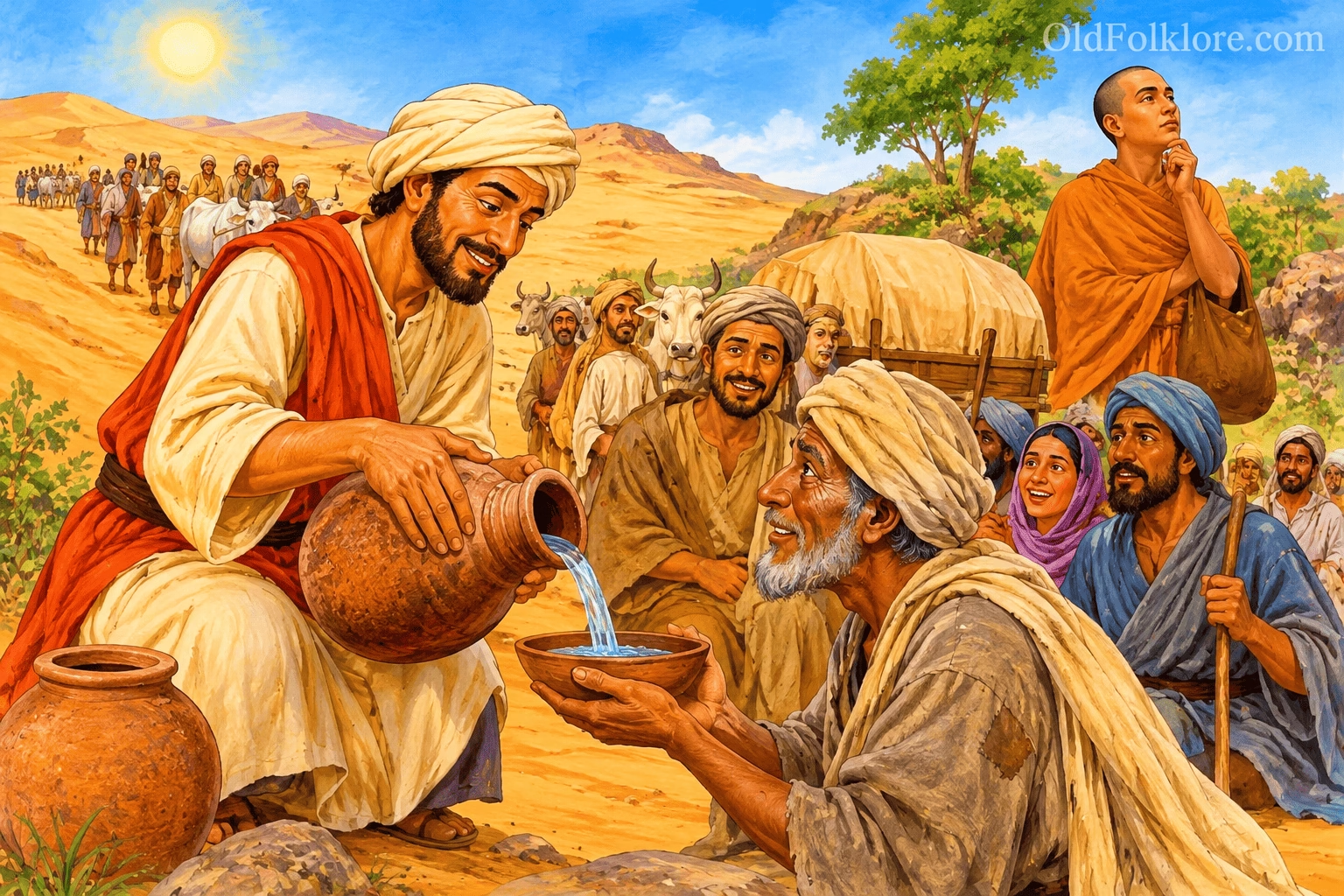
Suddenly, water surged upwards through the hole.
It rose until it reached the height of a palm tree above the well.
The travellers could hardly believe their good fortune.
The water they had feared was beyond their reach was now flowing freely before them.
Everyone drank. They bathed, refreshed themselves and gave their thirsty oxen the water they needed.
Their suffering was finally over.
The Caravan Finds Its Way Home
With their strength restored, the travellers turned their attention to the remaining supplies.
They broke apart some of their spare wooden yokes and cart axles to obtain firewood.
Using the wood, they cooked rice and prepared food for themselves and their oxen.
They rested until the evening, grateful for the water that had saved their lives.
Before leaving, they placed a flag beside the well so that other travellers could recognise the place and benefit from the discovery.
When the desert cooled, the caravan continued towards its destination.
The merchants eventually reached the appointed marketplace, where they sold their goods at two or three times their original value.
Having completed their business successfully, they returned home safely.
They lived long lives, enjoying the rewards of their journey. The Bodhisatta continued performing generous and virtuous deeds throughout his life before passing away according to his actions.
The Buddha Reveals the Meaning of the Story
After completing the tale, the Buddha addressed the monks and explained its lesson.
He recited a verse celebrating those who continue their efforts even when difficulties appear overwhelming:
The determined travellers dug through the sand until they discovered the water they needed. In the same way, wise people who persist in their efforts can find peace if they do not surrender to weariness.
The Buddha then taught the Four Noble Truths.
By the conclusion of the teaching, the monk who had abandoned his meditation practice attained Arahatship, the highest spiritual goal described in the discourse.
Finally, the Buddha explained the connection between the two stories.
The young attendant who had refused to give up and broken the rock in the desert was the very monk who had recently abandoned his efforts in the forest.
The other members of the caravan had been the Buddha’s present-day followers.
And the determined merchant who had led the caravan and discovered the water was none other than the Buddha himself in a former existence.
Thus, the story of the sandy desert became a lesson for the monk who had lost confidence in his spiritual journey.
The Buddha showed him that determination had once enabled him to save hundreds of lives. That same quality could now help him overcome his difficulties and complete his spiritual path.
Explore our complete Historic Folklore & Fairy-Tale Collections archive.
Moral
Never abandon a worthwhile effort simply because success does not come quickly.
Difficulties may appear impossible, but patience, determination, careful thinking and the courage to continue can reveal solutions that despair would otherwise conceal.
Just as the merchant refused to give up searching for water beneath the desert sand, we should learn to face challenges with confidence and persistence.
Knowledge Check
1. Why did the young monk return from the forest?
He became discouraged because three months of meditation had produced no noticeable spiritual progress.
2. What caused the caravan to become lost?
The exhausted pilot fell asleep and failed to notice that the oxen had turned around and travelled back along their previous route.
3. What made the merchant suspect that water was underground?
He noticed a tuft of kusa grass growing in the sandy desert and reasoned that moisture must be present beneath the ground.
4. How was the water finally released?
The merchant heard water moving beneath a large rock. He instructed his young attendant to strike the stone with an iron hammer, splitting it open and allowing the water to rise.
5. Who was the young attendant in the previous-life story?
He was the same monk who had abandoned his meditation practice in the present-life story.
6. What is the central Buddhist teaching of this Jataka?
The story teaches perseverance and sustained effort. It illustrates how determination can help someone overcome difficulties and continue towards a worthwhile spiritual goal.
Source
The story of The Sandy Road, traditionally identified as the Vannupatha Jataka and the second tale in the Jataka collection, is based on Buddhist Birth Stories; or, Jataka Tales: The Oldest Collection of Folk-lore Extant, edited in the original Pali by V. Fausböll and translated into English by T. W. Rhys Davids. The edition was published in London by Trübner & Co. in 1880.
Explore More Jataka Tales