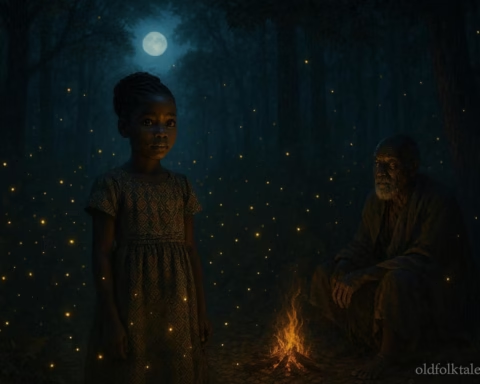
Long ago, among the Kimbundu people of Angola, two hunters met in the forest, and their quarrel gave birth to a tale still remembered today. Their names were Kingungu a Njila and Ngundu a Ndala, both known in their villages as strong men and skilled with the gun. The story of their dispute, and the wisdom it left behind, teaches that truth often reveals itself not through words alone, but through the depth of one’s endurance.
The Hunt in the Forest
One day, Kingungu a Njila prepared his musket and went into the deep forest, seeking elephants. The tall trees of the bush stood thick and silent, and the air was heavy with the smell of dust and leaves. He tracked carefully, listening to the crack of branches and the stirring of the ground. At last, he found a herd. Raising his gun, he took aim at one of the great beasts. The shot rang out sharply. The elephant staggered and fell with a thunderous crash, its body shaking the earth.
Ngundu a Ndala, hunting nearby, heard the gunfire echoing across the forest. Curious, he hurried to the place where the elephant lay. When he arrived, he saw the fallen beast. Without hesitation, Ngundu fired another shot into the elephant and claimed, “This elephant is mine.”
Explore more stories from our Angolan Folktales Collections archive.
Kingungu protested at once, saying, “This is my elephant. You found me here with it. Why do you say it is yours?”
The two men began to quarrel bitterly. Their angry voices rang out beneath the trees. Finally, they agreed: “Let us go to the village. There we shall plead our case before the people.”
The Dispute Before the Judge
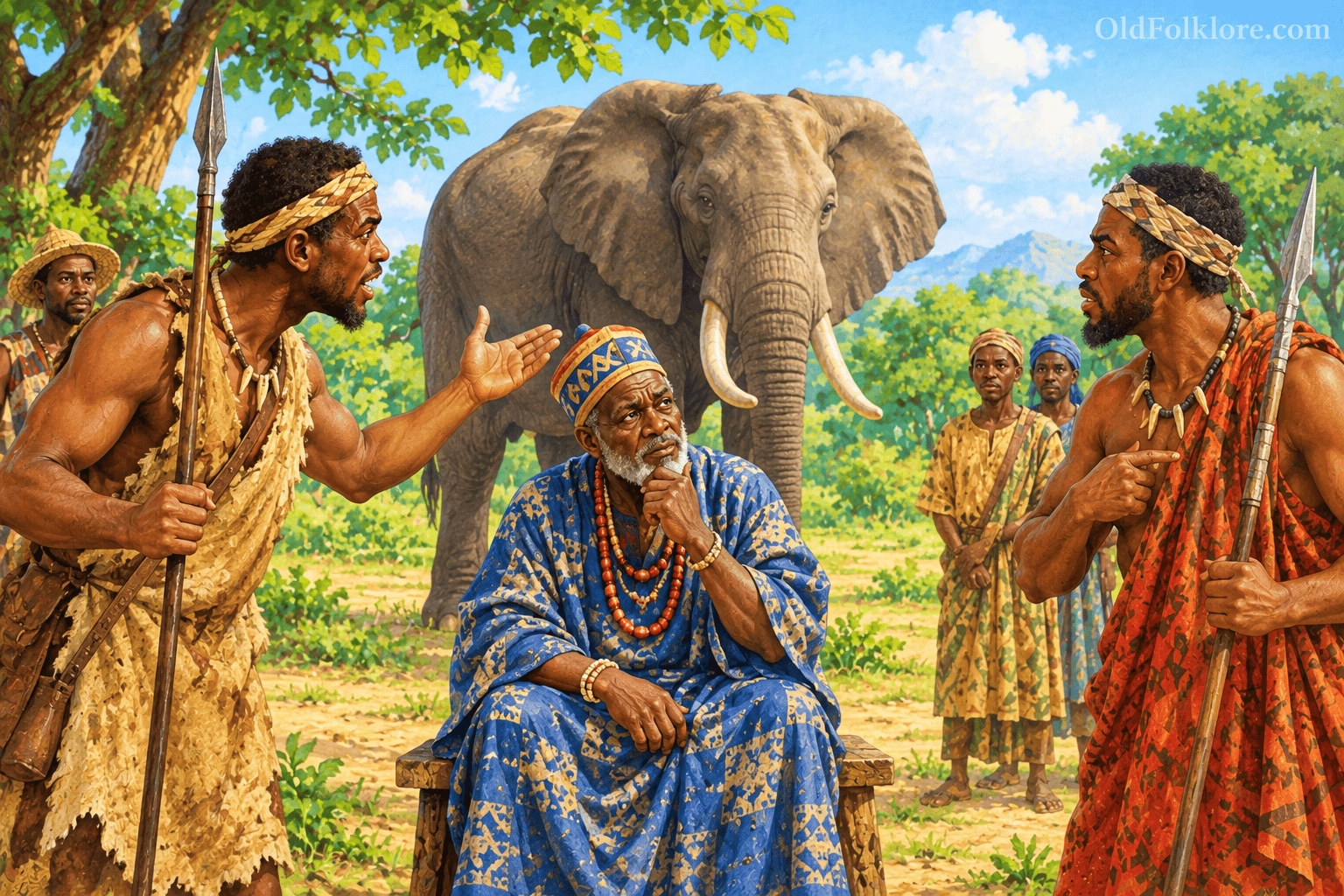
The hunters brought their case before a man of authority, referred to in the tale simply as So-and-So. Kingungu explained how he had killed the elephant with his first shot. Ngundu, however, stood firm in his denial, insisting the beast was his.
The judge listened carefully but found no witness who had seen the first shot. With no evidence, he could not settle the matter. At last, he said, “Go home for now. Tomorrow I shall decide the case, for my wife is not here to advise me.” And so they departed, each still burning with anger and pride.
The Cry of the Claimants
That night, Kingungu returned to the fallen elephant. Standing beside it, he cried out: “This elephant is my elephant! This elephant is mine!” His voice shook with sorrow and frustration. He wept bitterly, repeating his claim again and again, and remained there until dawn.
Ngundu too came to the carcass, weeping loudly for an hour. “This elephant is my elephant! This elephant is mine!” he shouted. But after a while, he ceased, wiped his face, and went home.
Kingungu, however, refused to leave. Through the long, dark night, he wept, his cries unceasing, his sorrow pouring into the earth. Even when the forest grew quiet and the stars faded, his voice still broke the silence. His grief carried into the morning light.
Judgment at Dawn
When the sun rose, the people gathered once again before So-and-So. Both hunters repeated their stories exactly as before. Ngundu stood in his stubborn claim, while Kingungu once more told of his rightful kill.
Then the judge turned to the messengers who had observed them. “Tell me,” he asked, “you who stayed through the night, which of the two men wept until dawn?”
The messengers replied, “Kingungu a Njila cried all night, never ceasing. Ngundu a Ndala wept only for one hour, then left.”
Hearing this, the judge declared, “The man who kept vigil is the true hunter. Kingungu a Njila spoke the truth, for he alone bore the sorrow as a man who had truly lost his own. Ngundu a Ndala is false. He tried to steal what was not his.”
Thus judgment was given, and the people said it was just. The elephant rightfully belonged to Kingungu a Njila.
Explore our complete Africa Folktales collection.
Moral Lesson
This tale from the Kimbundu teaches that truth endures where lies cannot. Words may deceive, but actions and perseverance reveal sincerity. Kingungu proved his honesty not only with his testimony but with his long, unbroken cry of grief, which showed the depth of his rightful claim.
It reminds us that justice does not rest solely on clever speech or quick argument. True justice reveals itself in the quiet endurance of those who hold fast to what is right. In disputes, patience and consistency will often uncover the truth more surely than loud declarations.
Knowledge Check
Who were the two hunters in the story?
Kingungu a Njila and Ngundu a Ndala.
What animal caused their dispute?
An elephant, which both claimed to have killed.
Why was the judge unable to decide on the first day?
There were no witnesses, and he postponed the decision until the next day.
How did Kingungu a Njila show his sincerity?
He cried beside the elephant all night, never ceasing until dawn.
What did Ngundu a Ndala do instead?
He wept for only an hour before leaving.
What lesson does this folktale teach?
That honesty and perseverance reveal truth, while lies fade with time.
Source:
Adapted from Héli Chatelain, Folk-Tales of Angola: Fifty Tales, with Ki-Mbundu Text, Literal English Translation, Introduction, and Notes (Boston and New York: Houghton, Mifflin and Company, 1894), “Kingungu a Njila and Ngundu a Ndala,” p. 233.
Explore More Angolan Folktales
- The Eagle and the Candimba: A Shocking Betrayal
- The Bangão Crocodile: A Fearless Fight for Justice
- Sudika-Mbambi: The Invincible Hero
- The River Spirit’s Three Questions
- The Cave of the Sleeping Ancestors
- The First Soba’s Staff
- Sona: The Sand Drawings of Wisdom
- The Caravan Leaders of Bié
- The Coronation of an Olosoma