When an ageing soba must choose his successor, the elders of an Angolan village select Chisomo, a quiet man known for his honesty and generosity. During his installation, he receives a carved wooden staff that symbolises the responsibilities of leadership. As disputes and difficult choices test his character, Chisomo discovers that carrying the staff means little unless his actions reflect the values it represents.
The Village and Its Elderly Soba
In the highlands of central Angola, a village stood among rolling hills and cultivated fields. Its people depended on farming, livestock keeping and trade with neighbouring settlements. Families worked their land, repaired their homes after heavy rain and gathered to discuss matters that affected their community.
When disagreements arose, the elders listened to those involved and sought a settlement that would preserve peace. They understood that an unresolved dispute could divide neighbours who had depended on one another for years.
The village was governed by a soba, a traditional leader whose responsibilities included guiding the community and helping to resolve disputes. His authority brought obligations as well as respect, for the decisions he made could affect families, livelihoods and relationships.
For many years, an elderly soba named Kandongo had served the village. He was not the wealthiest man in the settlement, nor was he known for displaying his importance. People respected him because he listened patiently, considered different opinions and avoided making decisions in anger.
Whenever two neighbours disagreed over a boundary, Kandongo heard both accounts before giving his judgement. When a family suffered a loss, he encouraged others to offer assistance. If a visitor arrived seeking help, he made sure the person received a fair hearing.
Kandongo believed that a leader’s position did not place him above the people. Instead, it made him responsible for their welfare. He often reminded those who sought his advice that a decision made for personal advantage could weaken the trust on which a community depended.
As the years passed, age began to limit his strength. Walking between the village and its distant fields became tiring, and he could no longer attend every gathering. He recognised that the community needed a successor who could carry its responsibilities into the future.
The elders began discussing the matter. They knew that choosing a new soba was too important to be settled through haste or personal preference. The next leader needed more than wealth, physical strength or a persuasive voice. He needed sound judgement and the willingness to serve others.
The Search for a Worthy Successor
The council considered several people.
One was a successful trader who had built strong relationships with merchants travelling through the region. He understood the value of negotiation and knew how to recognise opportunities that might benefit the village.
Another candidate was a skilled hunter whose courage had earned him considerable admiration. He could remain calm in difficult circumstances and had helped protect others during dangerous journeys.
A respected farmer was also considered. His fields produced reliable harvests, and he understood the patience and effort required to provide for a household.
Explore more stories from our Angolan Folktales Collections archive.
Each candidate possessed useful qualities. Yet the elders wondered whether any of them would place the community’s interests before personal ambition when faced with a difficult choice.
Their attention eventually turned to a quiet man named Chisomo.
Chisomo had never tried to make himself important. He helped neighbours repair damaged roofs after storms and assisted families whose harvests had suffered. When travellers arrived late in the day, he offered them a place to rest whenever he could.
He also had a reputation for honesty. If he made a mistake, he admitted it rather than blaming another person. During disagreements, he listened to both sides and discouraged people from turning a small dispute into a lasting quarrel.
These qualities had not made Chisomo the most celebrated man in the village, but they had earned him the confidence of many families.
When the elders invited him to their meeting, he arrived without knowing why they had summoned him. Kandongo welcomed him and explained that the council had considered his conduct over many years.
They wished him to become the next soba.
Chisomo was surprised. He had never imagined himself occupying such a position. He understood the work Kandongo had undertaken and knew how easily a poor decision could damage relationships throughout the village.
He told the elders that he was uncertain whether he possessed the wisdom they expected.
Kandongo listened before answering. He explained that a person who recognised the seriousness of leadership was already approaching the responsibility with greater care than someone who wanted authority merely for its rewards.
The elders did not expect Chisomo to know everything. They wanted a leader who would continue learning, listen to advice and accept responsibility for his decisions.
After careful consideration, Chisomo agreed to serve.
The Making of the Staff
Preparations began for the installation ceremony. Families cleaned the gathering place, prepared food and welcomed visitors from neighbouring settlements. People helped one another arrange the celebration, understanding that the appointment of a new soba concerned the whole community.
The elders decided that Chisomo should receive a wooden staff as a visible reminder of his office and its responsibilities.
They approached Mavinga, an experienced woodcarver known for his careful work. He examined several pieces of timber before choosing a straight length of hardwood suitable for carving.
Mavinga worked patiently, smoothing the surface and shaping the handle so that it could be carried comfortably. He added restrained decorative lines to the wood, giving the staff a dignified appearance without covering it in elaborate ornament.
As he worked, he considered the meaning of the object. A staff could be admired for its craftsmanship, but its significance as a symbol of authority came from the office and responsibilities it represented.
When the staff was ready, Mavinga presented it to the elders. They examined the carving and agreed that it was suitable for the ceremony.
On the appointed morning, villagers gathered beneath a broad tree near the meeting ground. Guests from neighbouring communities took their places while families shared food and greeted one another.
Chisomo arrived wearing ordinary clothing. He did not carry a weapon or surround himself with attendants. Kandongo had advised him that the ceremony should mark the beginning of service, not an opportunity to display superiority.
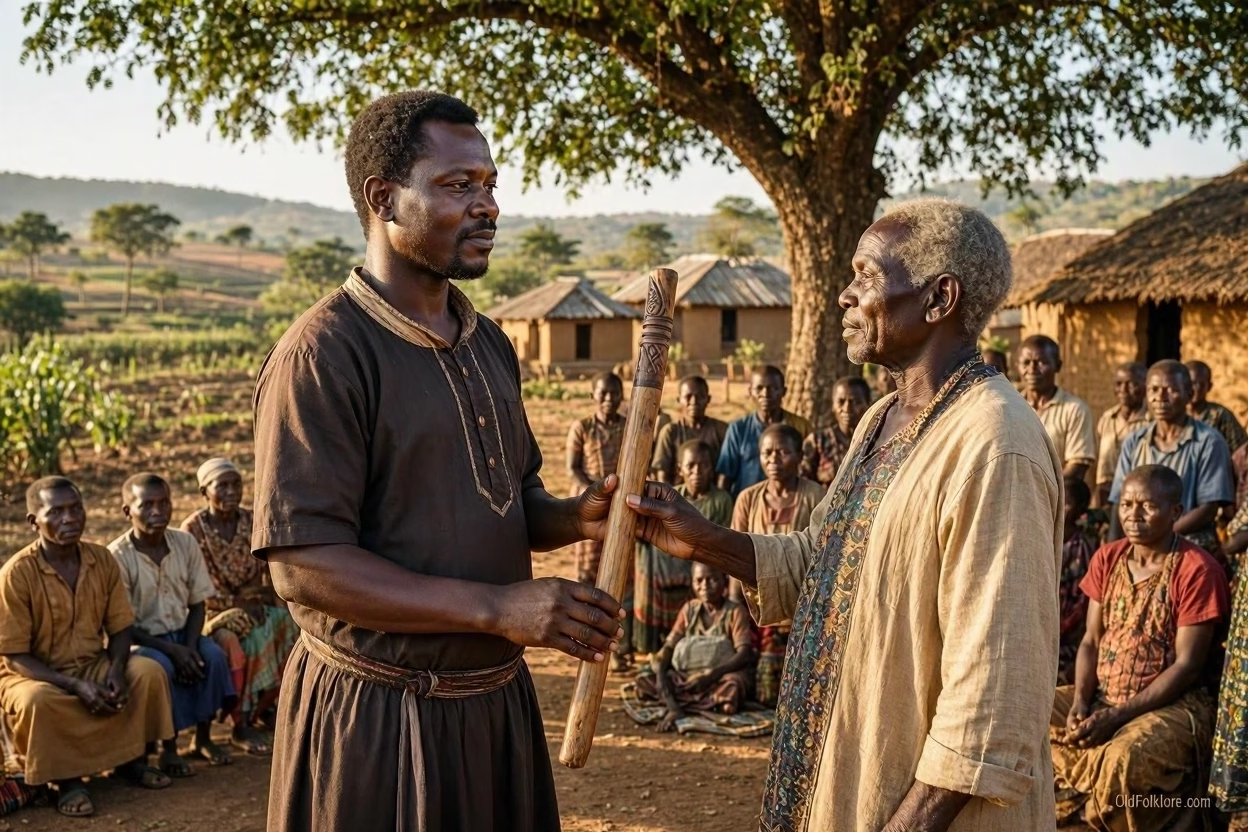
The eldest member of the council stepped forward with the staff in his hands.
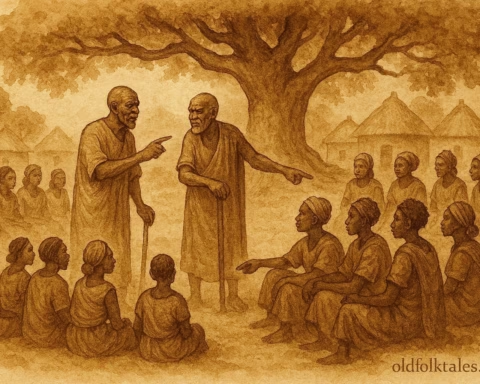
He addressed the gathering, explaining that the object was not a prize awarded to the most powerful person. It represented the trust placed in the soba and the duties that accompanied that trust.
A leader, he said, must listen before judging, protect the interests of the community and resist the temptation to use authority for personal gain.
The elder then placed the staff in Chisomo’s hands.
Chisomo felt its smooth weight against his palms. He knew that the wood itself could not make him wise or guarantee that his decisions would be fair. Its value lay in the reminder it would provide whenever his responsibilities became difficult.
The gathering welcomed the new soba, and the ceremony concluded with a shared meal.
For Chisomo, however, the real work began when the visitors departed and the village returned to its ordinary concerns.
The Dispute Over the Farmland
Chisomo’s first serious challenge came after heavy seasonal rains changed the landscape around two neighbouring farms.
The floodwater had washed away several boundary markers that the families had used for years. When the farmers returned to prepare their fields, each believed that part of the disputed ground belonged to their household.
Both families had worked the land for many seasons. Each had reasons for believing its claim was correct, and neither wished to surrender ground that might affect its next harvest.
The disagreement spread beyond the fields. Relatives began supporting one family or the other, and conversations that had once been friendly became strained.
Several villagers urged Chisomo to settle the matter immediately. They feared that allowing the dispute to continue would create further division.
The new soba could have selected one side and ended the argument quickly. Instead, he remembered the responsibilities represented by his staff.
He visited the disputed ground and examined the places where the old markers had stood. He then invited both families to explain how they understood the boundary and why they believed their claims were justified.
Rather than interrupting, Chisomo allowed each person to speak. He asked the neighbours to describe what they remembered from earlier planting seasons and consulted older residents who had worked in the area for many years.
Their accounts revealed that the boundary had once followed a natural feature that the floodwater had partly altered. The old arrangement could not simply be restored by placing a marker where either family preferred.
Chisomo considered the information and called another meeting. He explained what he had learned and proposed that the families retain the arrangement they had previously followed, with the boundary adjusted to reflect the changed ground. He also recommended that both households agree on clear markers that would be easier to identify in future seasons.
Neither family received everything it had initially demanded. Yet both were given the opportunity to explain their case, and the final arrangement recognised their shared history and practical needs.
After further discussion, the families accepted the settlement.
The dispute did not disappear from their memories overnight, but the decision prevented it from growing into a more serious conflict. Both households returned to their fields, and the village gradually regained its peace.
Chisomo understood that fairness did not always mean giving everyone precisely what they wanted. It meant listening carefully, examining the evidence and seeking a decision that could be justified to those affected by it.
The staff had reminded him of his responsibility, but the judgement itself had required patience and careful thought.
The Merchant’s Tempting Offer
Some months later, a merchant arrived to negotiate a trade arrangement with the village. He hoped to secure favourable terms for the goods he intended to purchase and believed that a personal gift might persuade the soba to support his proposal.
After an initial meeting, the merchant approached Chisomo privately. He offered him valuable goods in return for favourable treatment during the negotiations.
The offer was tempting. The gifts could have improved Chisomo’s household circumstances, and accepting them would have brought immediate personal benefit.
For a moment, he considered how easily the arrangement might remain hidden. The merchant had not asked him to announce the gift publicly, and the agreement could have been presented as an ordinary business decision.
Then Chisomo remembered the installation ceremony. The staff had been placed in his hands as a reminder that his authority existed for the benefit of the community.
If he accepted a private reward, he would have a reason to favour one trader over others. The village might lose the confidence of merchants who expected its agreements to be fair.
Chisomo declined the offer politely. He explained that the negotiations would proceed openly and that the merchant would receive the same consideration as anyone else.
The merchant was disappointed but continued with the discussions. The final arrangement was based on the goods available, the needs of the village and terms that both parties could accept.
Word of the incident eventually reached the elders. They were pleased that Chisomo had resisted the temptation to turn his position into a source of private wealth.
The decision strengthened the village’s reputation for fair dealing. Traders could not expect special treatment through gifts, but they could expect their proposals to receive an honest hearing.
Chisomo had learned that integrity was often tested in private, when a dishonest choice appeared easier than an honest one.
The Staff Becomes a Reminder
As years passed, Chisomo carried the staff during important gatherings and meetings. He did not believe the object possessed special powers, nor did he think that holding it automatically made his decisions correct.
Instead, he treated it as a reminder to examine his conduct.
Whenever anger threatened to influence his judgement, he paused before speaking. When a confident person made a claim, he sought to hear from those who might offer a different account. If a decision affected several families, he considered its wider consequences rather than concentrating only on the loudest complaint.
He also learnt to seek advice. Chisomo understood that the responsibilities of the soba were too extensive for one person to manage without the experience and cooperation of others.
The elders continued to assist him, and he welcomed their guidance even when it challenged his first opinion. He encouraged younger villagers to share their concerns and gave them opportunities to take part in work that benefited the settlement.
His leadership was not free from mistakes. On some occasions, he made a decision before considering every consequence. When people showed him where he had gone wrong, he tried to correct the problem rather than defend himself simply to preserve his pride.
Gradually, the community came to trust him not because he always had an immediate answer, but because he was willing to listen, reconsider and take responsibility.
Young people sometimes asked why he carried the same wooden staff to important meetings. They admired its smooth surface and the simple patterns carved into its length.
Chisomo explained that the staff did not make a person a good leader. Its purpose was to remind the person who carried it of the duties attached to authority.
He told them that respect could not be secured through a title alone. It grew when people saw a leader acting fairly, keeping promises and considering the welfare of the community.
The staff became closely associated with his years of service. Whenever the villagers saw it in his hands, they were reminded of the principles he tried to follow.
Passing Responsibility to the Next Soba
Eventually, Chisomo grew old, and the time came for the elders to select another leader.
He welcomed the council’s decision to begin the process. He understood that the village could not depend indefinitely on one person’s strength or experience. A community needed to prepare for change before age or illness made the transition urgent.
When the elders had chosen a successor, Chisomo invited the new soba to meet with him. He spoke about the disputes he had settled, the temptations he had faced and the mistakes that had taught him to listen more carefully.
He did not claim that his years in office had made him wiser than every other person. Instead, he explained that leadership required continued learning and a willingness to accept advice.
Before the formal handover, Chisomo examined the wooden staff. Its surface showed signs of years of use, but it remained strong enough to serve its purpose.
He placed it in the hands of the new soba and explained that the authority it represented belonged to the office and the community, not to the individual who carried it.
The new leader accepted the staff with respect. He understood that he was inheriting responsibilities as well as an honoured position.
The village gathered to recognise the transition. The elders offered their guidance, and the people welcomed the new soba while remembering the service Chisomo had given them.
In time, the new leader would face decisions of his own. He would need to listen to different accounts, resist personal temptation and find fair solutions to difficult problems. The staff could remind him of those duties, but only his actions could show whether he fulfilled them.
The story of Chisomo and the staff endured as a lesson about the relationship between authority and responsibility. Its message was simple: a symbol could remind a leader of the right path, but it could never walk that path on his behalf.
Explore our complete Africa Folktales
Moral Lesson
True leadership depends on fairness, humility and integrity. Authority is not a personal reward but a responsibility to serve the community, listen to others and make decisions without favouritism.
Knowledge Check
1. Who was Kandongo?
Answer: Kandongo was the ageing soba who had guided the village through fair decisions and concern for its people.
2. Why did the elders choose Chisomo as the next soba?
Answer: They respected his honesty, humility, generosity and willingness to listen to others.
3. What did the wooden staff represent in the story?
Answer: It represented the responsibilities of leadership and the trust the community placed in its soba.
4. How did Chisomo settle the farmland dispute?
Answer: He listened to both families, consulted older residents and proposed a fair arrangement based on the previous boundary and the changed landscape.
5. Why did Chisomo refuse the merchant’s gifts?
Answer: He knew that accepting private gifts could compromise his impartiality and undermine trust in his leadership.
6. What is the main lesson of the story?
Answer: A leader earns respect through fairness, integrity and service rather than through authority or status alone.
Source
A contemporary adaptation inspired by documented Kimbundu leadership traditions and the use of staffs as symbols of authority, described by the Montreal Museum of Fine Arts and discussed in Adrian C. Edwards’s The Kimbundu Under Two Sovereignties (1962).
Explore More Algerian Folktales
- The Hidden Storehouse: An Angolan Folktale of Famine and Greed
- The Eagle and the Candimba: A Shocking Betrayal
- The Bangão Crocodile: A Fearless Fight for Justice
- Sudika-Mbambi: The Invincible Hero
- The River Spirit’s Three Questions
- The Cave of the Sleeping Ancestors