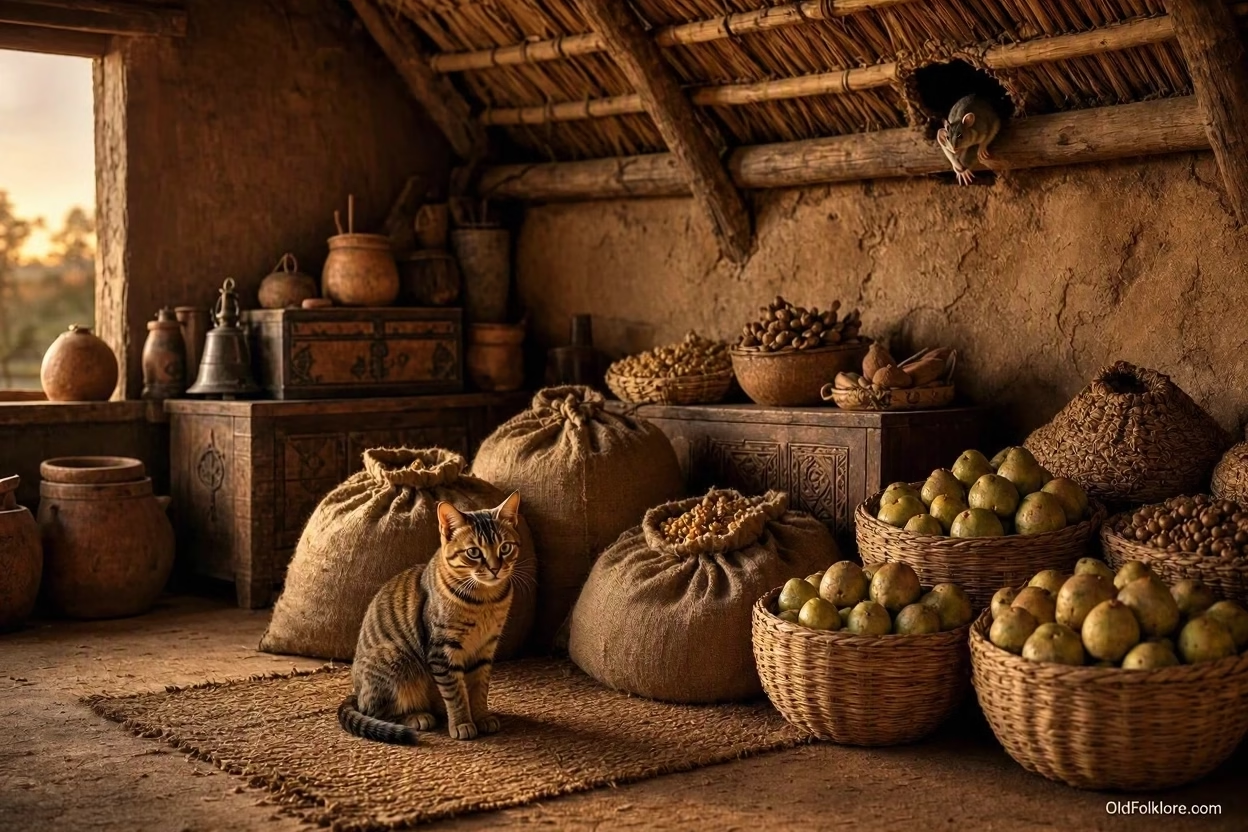
In this Southern Nigerian folktale, the familiar hostility between cats and rats begins with a dispute in the household of a powerful king. His trusted cat manages his store, while a rat serves as a house-boy.
When the rat falls in love with one of the king’s servant girls, he wants to give her presents but has no money. Desperate to impress her, he secretly steals corn and native pears from the king’s store.
His actions soon bring trouble upon the cat, who is responsible for protecting the king’s goods. What follows is a tale of dishonesty, anger, and punishment that explains how the enmity between cats and rats began.
The King and His Trusted Servants
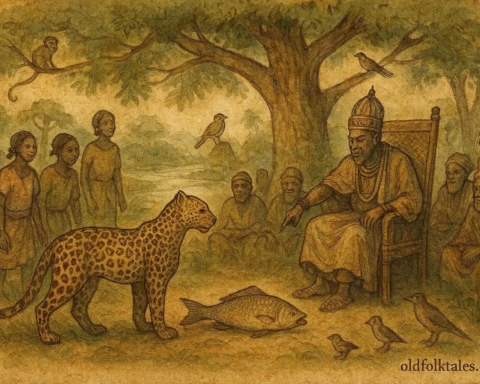
Long ago, Ansa ruled as King of Calabar for fifty years. He was a strong-willed and headstrong ruler, but he had a particular affection for a cat who had served him faithfully for many years.
The cat worked as the king’s housekeeper and was responsible for looking after his store. The king trusted her to keep the goods safe and account for what was kept inside.
A rat also worked in the royal household as a house-boy. Unlike the cat, the rat was poor and had little to offer beyond his labour.
Although they served the same king, the cat and the rat had very different circumstances. The cat enjoyed the king’s confidence, while the rat struggled with poverty.
The Rat Falls in Love
One day, the rat fell in love with one of the king’s servant girls.
He wanted to give her presents to show his affection. However, he had no money and could not afford the gifts he believed would please her.
His poverty frustrated him. He wished to make the girl happy, but he could not see how to do so with the little he possessed.
After thinking about his problem, the rat turned his attention to the king’s store. It contained corn and native pears, and he realised that he could take some of these goods to the girl.
Explore more stories from our Folk Stories from Southern Nigeria collection.
The plan was dishonest, but the rat allowed his desire to give presents to guide his decision.
The Secret Theft
The rat chose to enter the store at night, when the household was quiet. Because he was small, he could get inside through a hole he made in the roof.
Once inside, he stole corn and native pears. He then presented the stolen food to the servant girl he loved.
The rat continued this behaviour, taking goods from the store and using them as gifts. He may have hoped that no one would notice the missing food, but the king’s property was being steadily depleted.
Meanwhile, the cat continued performing her duties, unaware at first that the rat was responsible for the losses.
The rat’s secret seemed to work until the time came for the cat to account for the contents of the store.
The Missing Goods
At the end of the month, the cat had to report to the king about the goods under her care.
During the account, the king discovered that considerable quantities of corn and native pears were missing.
He became very angry. The store was under the cat’s supervision, and he expected her to explain what had happened.
The cat could not account for the missing goods. She had been entrusted with their safekeeping, yet she did not know who had taken them or where they had gone.
The king demanded an explanation, but the cat had no answer to give him.
Her position was now in danger. The king’s trust had been placed in her, and the disappearance of his property made her appear unable to carry out her duties.
The Cat Discovers the Truth
The cat remained troubled by the missing goods until one of her friends brought her important information.
The friend told her that the rat had been entering the store at night and stealing corn and native pears. He had been giving the stolen food to the servant girl he loved.
At last, the cat understood what had happened.
The rat had been taking goods from the king’s store without permission and using them to impress the girl. His actions had caused the very loss for which the cat was being questioned.
Armed with this information, the cat went to the king and explained the rat’s wrongdoing.
The king now knew who was responsible for the missing food. He summoned the servant girl and the rat to face the consequences of their involvement.
The King’s Punishment
The king called the servant girl before him and ordered that she be flogged.
He then handed the rat over to the cat to deal with. Finally, he dismissed both the cat and the rat from his service.
The decision brought the rat’s secret to an end, but it also changed the relationship between the two animals.
The cat had served the king faithfully for years. Yet the rat’s theft had put her in a difficult position and damaged the trust between her and the king.
Now, instead of remaining members of the royal household, both animals had lost their places in his service.
The cat was furious with the rat. She blamed him for the trouble that had followed his theft and for the consequences she had suffered.
Why Cats Kill Rats
The cat’s anger grew until she seized the rat, killed him, and ate him.
From that moment, the story explains, cats and rats became enemies.
Whenever a cat sees a rat, she pursues and kills it. The old quarrel between the royal cat and the thieving rat is offered as the reason for this behaviour.
Thus, the tale provides a traditional explanation for the hostility between the two animals. It connects their familiar relationship in everyday life to a story about theft, anger, and punishment in a king’s household.
Explore our complete Historic Folklore & Fairy-Tale Collections archive
Moral Lesson
Dishonesty can cause harm beyond the person who commits it. The rat stole because he wanted to impress someone he loved, but his actions placed the cat under suspicion and eventually cost both animals their positions in the royal household.
The story also reminds readers that good intentions do not excuse wrongdoing. Love may inspire generosity, but gifts should not come at the expense of another person’s property or trust.
Knowledge Check
1. Who was Ansa?
Ansa was the king of Calabar, who ruled for fifty years according to the tale.
2. What role did the cat perform in the king’s household?
The cat served as the king’s housekeeper and looked after his store.
3. Why did the rat begin stealing from the king’s store?
He was in love with a servant girl and wanted to give her presents, but he had no money.
4. What did the rat steal?
He stole corn and native pears.
5. How did the cat discover who was responsible for the missing goods?
One of her friends told her that the rat had been stealing the food and giving it to the girl.
6. According to the folktale, why do cats kill rats?
The cat became so angry with the rat after the king punished them and dismissed them from service that she killed and ate him. The tale presents this event as the beginning of the enmity between cats and rats.
Source
“Why the Cat Kills Rats” appears as Chapter XVIII in Elphinstone Dayrell’s Folk Stories from Southern Nigeria, West Africa, published in 1910.
Explore More Folk Stories From Southern Nigeria