A hungry wolf finds himself in trouble after a bone becomes stuck in his throat. Unable to remove it himself, he searches for someone with the skill and courage to help him. A crane agrees to assist, using her long beak to reach deep into the wolf’s mouth and remove the bone.
After the wolf is freed from his pain, the crane expects a reward for her help. Instead, she discovers that saving the life of a dangerous animal does not guarantee gratitude. The encounter reveals an important lesson about kindness, trust, and the risks of helping someone who has no intention of returning the favour.
The Wolf’s Painful Problem
One day, a wolf was eating greedily when a bone became lodged in his throat.
The bone caused him considerable pain. He tried to remove it, but his efforts failed. He could neither swallow it comfortably nor get it out of his throat.
The wolf was frightened by his predicament. Without help, he might remain in pain or even lose his life.
He began searching for someone who could help him. However, approaching another animal was not a simple matter. The wolf was a feared predator, and other creatures had good reason to be cautious around him.
At last, he came upon a crane.
The crane’s long beak gave the wolf an idea. Perhaps she could reach into his throat and remove the bone that was troubling him.
The Wolf Makes an Offer
The wolf asked the crane to help him.
He explained that a bone had become stuck in his throat and that he could not remove it himself. He promised to reward her if she succeeded in freeing him from his pain.
Explore more stories from our Aesop’s Fables collection.
The crane considered the request. Helping a wolf was dangerous, especially when the task required placing her head inside the mouth of an animal capable of killing her.
Nevertheless, the wolf’s promise persuaded her to try.
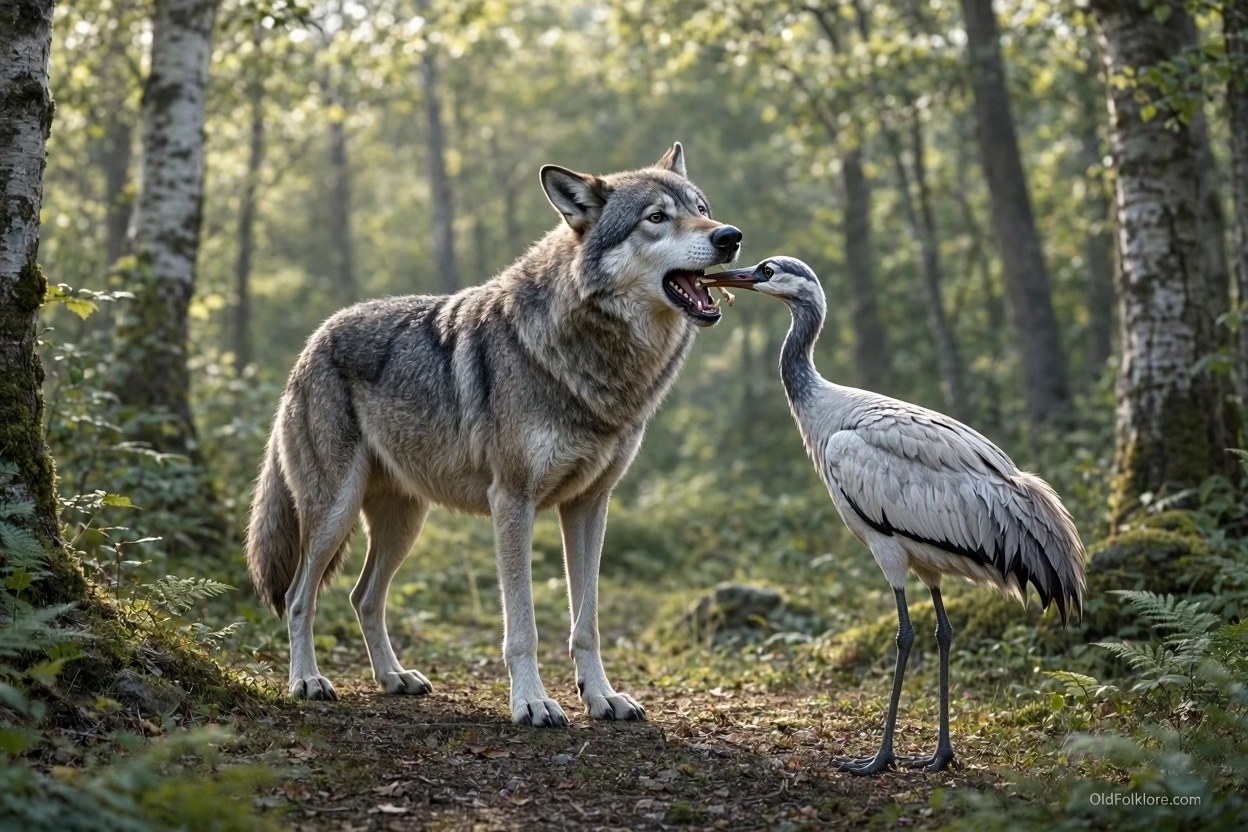
She approached carefully and inserted her long beak into the wolf’s open mouth. Working cautiously, she reached down his throat and grasped the bone.
At last, she managed to pull it out.
The wolf was free from the obstruction. The pain that had troubled him was gone, and he could swallow again.
The crane had accomplished what the wolf could not do for himself. She had taken a considerable risk to help him, trusting that he would keep his promise.
The Crane Asks for Her Reward
Once the bone was removed, the crane withdrew her head from the wolf’s mouth.
She had every reason to expect the reward he had promised. She had helped him when he was in distress and had placed herself in danger to do so.
The crane reminded the wolf of his promise and asked for what he owed her.
Instead of thanking her, however, the wolf responded with arrogance.
He pointed out that she had placed her head inside his mouth and had managed to withdraw it safely. In his view, that alone was enough reward.
The wolf treated the crane’s safe escape as a favour he had granted her rather than recognising the service she had performed for him.
He refused to give her anything.
The crane realised that the wolf had never intended to honour his promise. He had used the prospect of a reward to persuade her to take a risk, then dismissed her request once he no longer needed her help.
A Lesson in Gratitude
The crane had acted out of kindness and had trusted the wolf’s word. She had used her skill to solve his problem, even though doing so could have cost her life.
The wolf, however, cared only about his own needs. While he was suffering, he had been willing to promise anything that might persuade someone to help him. Once the danger had passed, he forgot his promise and refused to show gratitude.
The encounter left the crane with a painful lesson. Not everyone who asks for help will appreciate the person who provides it. Some people accept kindness when they need it but refuse to repay it when their troubles are over.
The wolf’s behaviour also revealed his character. He was not merely ungrateful; he was willing to exploit another creature’s kindness for his own benefit.
The crane had helped him escape his predicament, but she could not force him to become an honest or generous animal.
The fable ends with the wolf keeping his life and the crane receiving no reward. Its lesson remains clear: kindness should be offered with wisdom, especially when dealing with someone whose promises may not be trustworthy.
Explore our complete Historic Folklore & Fairy-Tale Collections archive.
Moral Lesson
The wolf and the crane teaches that kindness is not always repaid with gratitude. The crane risks her safety to help the wolf, but he refuses to honour his promise once he has received what he wants.
The fable also warns readers to be cautious when trusting people who make promises only because they need something. Good judgement matters, and helping others should not mean ignoring serious risks.
Knowledge Check
1. What happened to the wolf while he was eating?
A bone became stuck in his throat.
2. Why did the wolf ask the crane for help?
He believed her long beak could reach into his throat and remove the bone.
3. Why was helping the wolf dangerous for the crane?
She had to place her head inside the mouth of a predator capable of killing her.
4. What did the wolf promise the crane?
He promised to reward her if she removed the bone.
5. How did the wolf respond when the crane asked for her reward?
He refused to reward her and claimed that escaping from his mouth safely was reward enough.
6. What is the main lesson of the fable?
Kindness is not always repaid with gratitude, so people should use good judgement when deciding whom to trust.
Source
“The Wolf and the Crane” is an Aesop fable included in Joseph Jacobs’ The Fables of Aesop, published in 1894
Explore More Aesop’s Fables