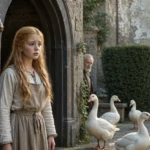
Long ago, there lived a king whose wisdom was admired throughout his kingdom. He seemed to know everything that happened, even secrets hidden from the rest of the world. Yet the king had one peculiar habit. Every day, after dinner, when everyone else had left the table, a trusted servant brought him a covered dish. No one knew what it contained, for the king always waited until he was alone before lifting the lid.
The servant had carried the mysterious dish for a long time, but curiosity eventually overcame him. One day, he took it into his room, locked the door, and lifted the cover.
Inside lay a white snake.
Unable to resist the temptation, he cut off a small piece and tasted it. Almost immediately, he heard tiny voices outside his window. The sparrows were chattering about everything they had witnessed in the fields and woods. To his astonishment, he understood every word.
The white snake had given him the ability to understand the language of animals.
Explore more stories from our Brothers Grimm Tales collection.
He had little time to marvel at his new gift before trouble found him. That very day, the queen discovered that her most beautiful ring was missing. Since the servant was trusted and had access to many parts of the palace, suspicion fell upon him.
The king summoned him and demanded that he identify the thief before the following day. If he failed, he would be treated as the culprit and executed.
The servant protested his innocence, but the king would not listen. Frightened and desperate, the young man went down into the courtyard, wondering how he could possibly save himself.
There, beside a stream, he noticed several ducks resting and cleaning their feathers. Remembering his strange new ability, he listened to their conversation.
One duck complained that her stomach felt unusually heavy. In her haste to eat that morning, she explained, she had swallowed a ring lying beneath the queen’s window.
The servant immediately carried the duck to the kitchen and asked the cook to prepare it. When the cook dressed the bird, the queen’s missing ring was discovered inside.
At last, the servant could prove his innocence. The king realised that he had wrongly suspected a faithful man and offered him a reward. He promised the servant any position at court that he desired.
But the young man had other plans. Rather than seek wealth or influence, he asked only for a horse and some money to travel the world.
The king granted his request, and the servant set off.
As he travelled through the countryside, he came upon a pond where three fish had become trapped among the reeds. They struggled desperately, unable to reach the open water. Although he knew that fish were supposed to be silent, he heard their cries of distress through his new gift.
The servant dismounted, freed the three fish, and returned them to the pond. Delighted to be alive, they promised that they would remember his kindness and repay him one day.
Further along the road, he heard another complaint. An ant-king was furious because the servant’s horse had been trampling the ants beneath its heavy hooves. The young man immediately guided his horse onto another path, sparing the tiny creatures from further harm.
The ant-king thanked him and promised that the ants, too, would remember his kindness.
Later, the servant entered a wood and discovered two old ravens casting their young out of their nest. The parent birds declared that their offspring were old enough to fend for themselves. But the young ravens lay helplessly on the ground, unable to fly and terrified that they would starve.
The servant felt sorry for them. He had no food to offer, so he made a painful decision: he killed his horse and left its body for the hungry young birds. They ate their fill and promised never to forget what he had done for them.
Now the servant had to continue on foot. After walking a long distance, he reached a great city where the streets were crowded with people. A rider was announcing that the king’s daughter was seeking a husband. Any man who wished to marry her would have to complete a dangerous task. Failure meant death.
The servant saw the princess and was captivated by her beauty. Forgetting the danger, he presented himself before the king as a suitor.
The king led him to the sea and threw a golden ring into the water. The young man was ordered to retrieve it from the seabed. If he returned without it, he would be thrown into the sea repeatedly until he drowned.
The onlookers pitied him as they left him alone on the shore. He had no idea how to find a ring at the bottom of the sea, and death seemed certain.
Then three fish swam towards him. They were the very creatures he had rescued from the reeds. The fish in the middle carried a mussel in its mouth and placed it at his feet. When the servant opened the shell, he discovered the golden ring inside.
Overjoyed, he hurried back to the king and presented the ring, expecting the promised reward. But the princess was displeased. She considered him beneath her in social standing and refused to accept him as her husband without further proof of his worth.
She led him into the garden, where she scattered ten sacks of millet seed across the grass. Every grain, she declared, had to be collected before sunrise. If even one grain was missing, he would fail.
The servant sat in the garden, staring at the scattered seeds. He could see no way to gather so many tiny grains before morning. As darkness settled around him, he feared that his life would soon be over.
But when the first rays of sunlight reached the garden, he saw ten sacks standing neatly beside one another, each filled with millet. Not a single grain was missing.
During the night, the ant-king had arrived with thousands upon thousands of ants. Working tirelessly, they had collected every seed and returned them to the sacks.
The princess was astonished when she saw what had been accomplished. Yet her pride remained unbroken. Although the servant had passed both tests, she announced that he must complete one final task before she would marry him: he had to bring her an apple from the Tree of Life.
The young man did not know where the mysterious tree grew. Nevertheless, he set out, travelling through three kingdoms in search of it. He walked for days, with no certainty that he would ever find what he sought.
One evening, exhausted by his journey, he lay down beneath a tree in a wood. As he rested, he heard a rustling among the branches. Suddenly, a golden apple fell into his hand.
At that moment, three ravens descended and settled upon his knee. They were the young birds he had saved by sacrificing his horse. Now grown strong enough to fly across great distances, they had heard of his quest and travelled over the sea to the farthest reaches of the world, where the Tree of Life stood. They had brought him the precious apple.
The servant thanked the ravens and began his journey home.
When he arrived, he presented the golden apple to the princess. She had no further tasks to demand and no excuse left to offer. At last, the two of them cut the Apple of Life in half and ate it together.
As they shared the fruit, the princess’s heart filled with love for the young man. The servant who had once been threatened with death for a crime he had not committed had finally found happiness.
They married and lived together in peace and contentment until they grew old.
Explore our complete Historic Folklore & Fairy-Tale Collections archive.
Moral
Kindness offered without expecting a reward can return to us in unexpected ways. We should not underestimate others because of their size, status, or appearance, and we should never assume that wealth or social position is the best measure of a person’s worth.
Knowledge Check
1. What special ability did the servant gain from eating the white snake?
He gained the ability to understand the language of animals.
2. How did the servant prove that he had not stolen the queen’s ring?
He understood the ducks’ conversation and discovered that one of them had swallowed the missing ring.
3. Which three creatures helped the servant complete the princess’s tasks?
The three fish recovered the golden ring, the ants collected the millet, and the ravens brought the golden apple.
4. Why did the servant sacrifice his horse?
He wanted to save the hungry young ravens from starvation.
5. What is the significance of the animals’ help?
Their assistance shows that compassion and gratitude can create bonds that prove valuable in unexpected circumstances.
Source
Adapted from “The White Snake” (KHM 17), collected by Jacob Grimm and Wilhelm Grimm in Kinder- und Hausmärchen (Children’s and Household Tales), and translated into English by Margaret Hunt.
Explore More Brothers Grimm Tales
- Little Red Riding Hood: A Grimm Fairy Tale
- The Robber Bridegroom’s Terrifying Secret
- The Golden Goose: A Brothers Grimm Fairy Tale
- The Snowman: A Danish Folktale by Andersen
- The Golden Goose: A Brothers Grimm Fairy Tale
- The Bremen Town Musicians: Grimm Fairy Tale
- Clever Hans: A Brothers Grimm Fairy Tale
- The Girl Without Hands: A Grimm Fairy Tale
- The Devil with the Three Golden Hairs: Grimm Tale