Once upon a time, there lived a king who had three brave and intelligent sons. As he grew older, he began to worry that his sons might grow impatient and try to take his throne before he was ready to surrender it. Rather than admit his fears, he devised a plan that would keep them occupied while allowing him to remain king.
One day, he summoned his sons and explained that his advancing age made it difficult to govern as effectively as before. He announced that he would give his crown to whichever prince brought him the most beautiful little dog within a year.
The brothers were surprised by the unusual request, but each accepted the challenge. Before departing, they gathered at a nearby castle, celebrated with their friends, and promised to remain loyal to one another. They agreed to return together when the year was over, each bringing the finest dog he could find.
Explore more stories from our Andrew Lang’s Colour Fairy Books collection.
The youngest prince set out with great enthusiasm. He bought dogs wherever he went, but whenever he found one he considered beautiful, another would catch his eye. Before long, he had spent much of his journey changing one dog for another, never satisfied that he had found the perfect one.
One evening, he wandered into a dark forest. Thunder rolled overhead, rain poured down, and the path grew difficult to follow. Just as he began to fear he would spend the night in the open, he noticed a brilliant light among the trees.
Following it, he came upon a magnificent castle. Its golden entrance glittered with precious stones, and its delicate walls were decorated with colourful scenes from famous stories. At the door hung a deer’s foot attached to a chain of diamonds. Curious, the prince pulled it, and a silver bell rang.
The door opened.
Hundreds of mysterious hands appeared, each holding a torch. They guided him through splendid halls, removed his wet clothes, dressed him in rich garments, and led him through room after room filled with beautiful objects. Although he could see no servants, the hands attended to his every need.
At supper, a group of cats arrived carrying guitars and sheets of music. Their strange performance was so amusing that the prince burst into laughter. Soon afterward, another procession entered, led by two cats dressed in black. Between them walked a small, veiled figure.
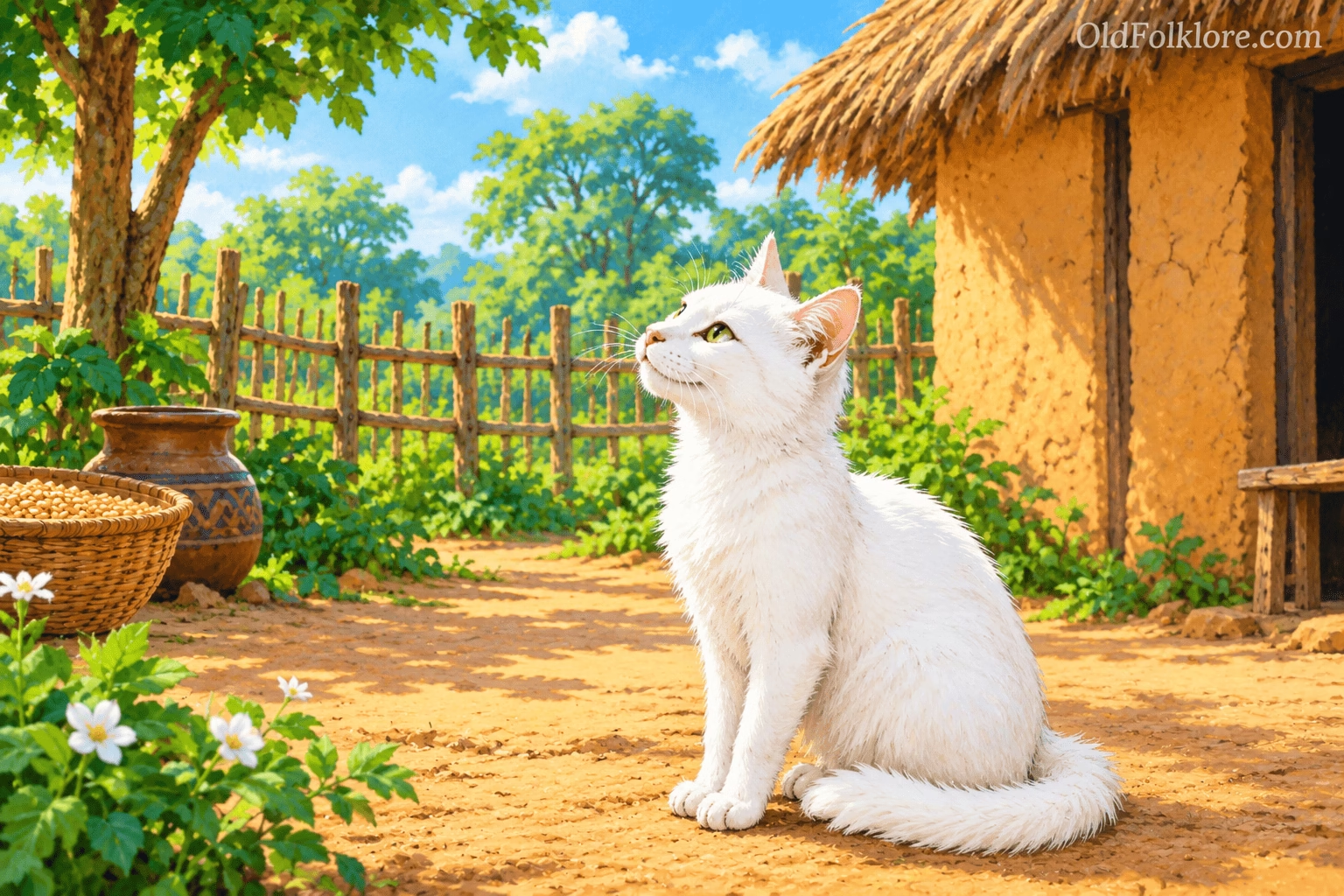
When the figure lifted her veil, the prince saw a beautiful little white cat.
“King’s son, you are welcome,” she said gently. “The Queen of the Cats is pleased to receive you.”
The prince thanked her for her hospitality. He soon discovered that she was no ordinary cat. She spoke with intelligence, understood the world beyond her castle, and seemed interested in everything he had to say.
During supper, he noticed a portrait bracelet on her paw. The picture showed a handsome young man whose features were remarkably like his own. The White Cat grew sad when he asked to examine it, but the prince, not wishing to upset her, changed the subject.
That evening, the castle’s feline performers entertained them with dancing and music. The prince retired to a beautiful bedroom and slept comfortably for the first time in many days.
The next morning, he joined the White Cat on a hunting expedition. Her attendants prepared him for the outing, and he found himself riding a wooden horse that galloped as though it were alive. The White Cat rode upon a monkey, which could climb to the highest eagles’ nests whenever she wished to see the young birds.
The days passed in delightful company. One evening, the White Cat offered the prince a crystal goblet containing a mysterious drink. After he swallowed it, his memories of the outside world disappeared. He forgot his father’s challenge, his brothers, and even the kingdom he had hoped to inherit. All that mattered was the happiness he found beside the White Cat.
But the year was nearly over.
One day, she gently reminded him that only three days remained before he had to return to his father. His brothers, she told him, had already found beautiful dogs.
The prince was horrified. He had forgotten the very task on which his future depended, and he could not imagine finding a suitable dog or travelling home in so little time.
The White Cat reassured him. She gave him a small acorn and told him it contained a dog more beautiful than any he could find elsewhere. When he held it to his ear, he heard a tiny voice bark.
Delighted, the prince wanted to open it immediately, but she advised him to wait until he stood before the king. He thanked her warmly, then departed on the wooden horse, saddened to leave the castle and its mysterious mistress.
He reached the meeting place before his brothers. When they arrived, they exchanged stories about their journeys. The youngest kept his adventure secret, allowing them to believe that an ordinary dog he had acquired was his intended offering.
The next morning, the brothers travelled to the palace together. The two eldest presented their tiny dogs, which were so delicate that everyone struggled to decide which was more beautiful. Then the youngest prince stepped forward and opened the acorn.
Inside lay a dog so small that it could pass through a ring. When placed on the ground, it began to dance, delighting everyone who saw it.
The king was astonished, but he was still unwilling to surrender his crown. He therefore announced a second challenge: his sons must find a piece of muslin so fine that it could pass through the eye of a needle.
Once again, the youngest prince returned to the White Cat. She welcomed him with joy and explained that some of her cats were skilled at spinning. They would make the impossible cloth for him.
As the days passed, the prince enjoyed the castle’s entertainments, including a magnificent display of fireworks. When the year ended, the White Cat presented him with a tiny walnut and instructed him not to open it until he stood before his father.
She also sent him away in a splendid golden carriage drawn by twelve white horses, accompanied by a magnificent procession of guards and officers.
The prince thanked her and confessed that he would gladly abandon the crown if he could remain with her forever. But the White Cat insisted that he must return.
At the palace, his brothers proudly displayed their muslin. The fabric was exceptionally fine, yet the king produced a special needle with an eye so small that their pieces could not pass through it.
Just then, the youngest prince arrived in his magnificent carriage. He opened the walnut, expecting to find the cloth, but discovered a hazelnut inside. Within that was a cherry stone, which contained a kernel. The kernel held a grain of wheat, and the grain concealed a millet seed.
The king and courtiers watched in amusement as the prince continued opening one tiny container after another. For a moment, even the prince began to doubt his mysterious benefactor.
Then he heard the faintest sound and felt a sharp scratch on his hand, as though the White Cat were encouraging him to continue.
He opened the millet seed.
Inside lay a magnificent piece of muslin, four hundred ells long, woven in exquisite colours and patterns. When the king brought out his special needle, the cloth passed through its tiny eye six times with ease.
Once again, the youngest prince had fulfilled the challenge. Once again, his father refused to give up the crown.
The king announced a third and final task. Whoever returned within a year with the loveliest princess would marry her and receive the throne.
The youngest prince returned to the White Cat, who greeted him with flowers, fragrant incense, and a grand celebration. He explained that his father had again invented a new challenge rather than honour his promise.
The White Cat was undisturbed. She would find him a princess, she assured him, and in the meantime they would continue enjoying their time together.
Their happiness deepened. The prince sometimes wondered whether she was a fairy or an enchanted human being, but she never revealed her secret.
As the third year drew to a close, the White Cat told him that he must do one final thing if he wished to take a princess home.
She placed a sword before him.
“Take this sword,” she said, “and cut off my head.”
The prince recoiled in horror. He begged her to ask anything else of him, insisting that he could never harm the creature he loved. But she remained firm and urged him to trust her.
With tears in his eyes and his hand trembling, he finally obeyed.
The moment the White Cat’s head was severed, a beautiful princess appeared before him. The castle doors opened, and a company of knights and ladies entered, each carrying a cat’s skin. They rejoiced at seeing their mistress restored to her human form.
The princess then explained the terrible history behind her enchantment.
Her father had ruled six kingdoms, and her mother, the queen, had loved travelling and exploring. When the princess was only a few weeks old, her mother heard tales of a fairy garden filled with extraordinary fruit. Determined to taste it, she travelled to the fairies’ castle.
The gates remained closed, and every attempt to reach the garden failed. Eventually, an old fairy appeared and offered the queen all the fruit she desired, but only on one condition: she must surrender her infant daughter to the fairies, who would raise the child themselves. The queen would not be allowed to see her daughter again until the girl married.
Desperate to obtain the fruit, the queen agreed.
When she returned home, she regretted her bargain. Her husband was furious, and he refused to hand over their child when the fairies came to claim her. But the fairies sent a terrifying dragon that devastated the kingdom. To protect his people, the king was forced to surrender his daughter.
The fairies took the princess to their enchanted castle, where she grew up surrounded by luxuries but isolated from ordinary human companionship. Her only companions were a talking parrot and a little dog, while the old fairies visited her regularly.
As a young woman, she once saw a handsome prince in the forest below her tower. They began speaking whenever he returned, and eventually they fell in love. The princess made a rope ladder from the flax supplied by the fairies, hoping to escape with him.
But as her lover helped her descend, one of the fairies appeared. Before the prince could defend himself, the dragon swallowed him.
Furious that the princess had tried to escape and refused to marry the king of the dwarfs, the fairies transformed her into a white cat. They also enchanted the people of her father’s court, making some invisible so that only their hands could be seen.
The fairies revealed that the only way for the princess to regain her human form was to win the love of a prince who resembled her lost beloved in every way.
Now she knew that the youngest prince had fulfilled that condition. His appearance, voice, and character reminded her of the man she had lost, and his love had broken the enchantment.
The prince, overjoyed, asked her to marry him. She confessed that she loved him, too, and agreed that they should return to his father together.
They travelled in a magnificent carriage, with the princess hidden behind the curtains of a crystal chair when they approached the castle where the brothers had agreed to meet.
The two elder princes were there with beautiful princesses of their own. When they asked whether their younger brother had found a bride, he teasingly replied that he had found something rarer: a white cat. His brothers laughed, unable to understand why he would speak of a cat when they had found princesses.
At the palace, the king received the two elder couples and was impressed by their beauty. But when the youngest prince arrived, the king asked whether he had returned alone.
The prince directed his father to the crystal chair and explained that it contained a little white cat with soft paws and a charming voice.
The king approached and drew back the curtains. At the princess’s touch, the crystal shattered into a thousand pieces, revealing a radiant woman dressed in white, with flowers crowning her flowing hair.
The court stood amazed.
The princess addressed the king respectfully. She explained that she already possessed six kingdoms and did not seek to take his throne from him. Instead, she offered him and each of his sons a kingdom, asking only for the king’s friendship and permission to marry his youngest son. She and her husband would retain three kingdoms for themselves.
The king gladly accepted, and the marriages of all three princes were celebrated. After months of festivities, each couple departed to rule their own kingdom.
And so the youngest prince, who had won a crown through patience, kindness, and love, married the woman whose true identity had remained hidden behind a little white cat.
Explore our complete Historic Folklore & Fairy-Tale Collections archive.
Moral
True love looks beyond appearances, while patience, kindness, and trust can help people overcome extraordinary difficulties. The story also warns against selfishness and the misuse of power.
Knowledge Check
1. Why did the king send his three sons away?
He wanted to keep them occupied with difficult tasks so that he could postpone giving up his crown.
2. What were the three challenges?
The princes had to find the most beautiful little dog, a piece of muslin fine enough to pass through a needle’s eye, and the loveliest princess.
3. How did the youngest prince obtain the first two treasures?
The White Cat gave him a magical acorn containing a tiny dog and a walnut that concealed extraordinarily fine muslin inside several smaller containers.
4. Why was the White Cat transformed into a cat?
Fairies punished the princess after she tried to escape with the prince she loved and refused to marry the king of the dwarfs.
5. What finally broke the enchantment?
The youngest prince obeyed the White Cat’s request to cut off her head, after which she regained her human form.
6. What makes the youngest prince different from his father?
Although he seeks a crown, he demonstrates affection, loyalty, and trust. His father, by contrast, repeatedly changes the rules to retain his power.
Source
The retelling is based on “The White Cat,” adapted by Minnie Wright from a tale by Madame d’Aulnoy and published in The Blue Fairy Book, edited by Andrew Lang and illustrated by H. J. Ford and G. P. Jacomb Hood. The first edition was published in London and New York by Longmans, Green, and Co. in 1889.
Explore More Andrew Lang’s Colour Fairy Books Folktales
- Prince Hyacinth and the Dear Little Princess
- The Bronze Ring: A Classic Fairy Tale
- Why the Sea Is Salt: The Blue Fairy Book
- The Shepherd and the Clever Chacal
- The Dish That Floated Away
- The Old Man and the River Spirit
- The Enchanted Date Palm of the Oasis