A little goblin lives with a huckster who owns a prosperous shop and serves delicious plum porridge at Christmas. Upstairs, a poor student spends his evenings reading poetry. When the goblin discovers the beauty hidden in the student’s books, he begins to question where his loyalties belong.
The Goblin’s Comfortable Home
There was once a poor student who lived in a garret beneath the roof of a house. He owned very little and had to make do with what he could afford.
On the ground floor lived a huckster, a shopkeeper who traded in everyday goods. The huckster owned the house and had enough money to enjoy a comfortable life. A little goblin had settled in his shop, where he was treated to a special dish of plum porridge every Christmas Eve. A generous lump of butter floated in the middle, making the meal especially tempting.
The goblin enjoyed this annual treat so much that he remained devoted to the huckster. The shop was warm and familiar, and the porridge was a reward he was unwilling to lose.
The student upstairs had neither such comfort nor such riches. His possessions were few, but he had something the goblin had not yet learned to appreciate.
A Book Wrapped Around Cheese
One evening, the student came downstairs to buy some candles and cheese. After paying, he noticed that the cheese had been wrapped in a page torn from an old book.
He stopped to read it. The page contained poetry, and he was troubled to see such writing used as ordinary wrapping paper.
The huckster explained that he had bought several old books from a woman in exchange for a little coffee. He offered to sell the remaining pages to the student for two groschen.
The student agreed to buy them. He could eat his bread and butter without cheese, but he could not bear the thought of a book of poetry being destroyed.
He then joked that the huckster understood practical business but knew no more about poetry than an old cask in the shop.
Explore more stories from our Hans Christian Andersen Tales collection
The huckster laughed at the remark, and the student laughed too. Neither intended it as a serious quarrel. The goblin, however, took offence. He believed the student had insulted the man who provided his comfortable home and favourite food.
The Shop Objects Give Their Opinions
Later that night, after the shop had closed and everyone had gone to bed, the goblin decided to settle the matter.
He entered the bedroom and borrowed the huckster’s wife’s tongue. In Andersen’s magical tale, anything touched by the tongue could speak and express its thoughts. Only one object could use it at a time.
The goblin carried the tongue to an old cask filled with newspapers and asked whether it truly knew nothing about poetry.
The cask confidently declared that poetry was something printed at the bottom of newspaper columns and sometimes cut out. It even claimed to contain more poetry than the student could understand.
The goblin then placed the tongue on the coffee mill, the butter cask and the cash-box. Each object supported the same opinion as the newspaper cask. Since most of the shop’s contents agreed, the goblin felt that the huckster’s side had won the argument.
Satisfied, he went upstairs to tell the student what he had heard.
The Wonder Inside the Student’s Room
The goblin crept towards the student’s door and peered through the keyhole. Inside, the student sat reading the old book he had rescued from the shop.
Suddenly, the room filled with an extraordinary light. A bright beam rose from the book and grew into a mighty tree that spread its branches above the student.
Every leaf looked fresh, and every blossom took the form of a beautiful woman’s head. Some had dark, sparkling eyes, while others had clear blue eyes. The fruits shone like stars, and glorious music filled the room.
The goblin had never witnessed anything so wonderful. He stood on tiptoe and watched until the light disappeared. Even after the student had blown out his candle and gone to bed, the goblin remained outside the door, listening to the gentle music that seemed to continue in the darkness.
For the first time, he understood that the student possessed a treasure that could not be measured by money or food.
The goblin longed to remain with the student and share in the beauty of the room. Yet he remembered that the student had no plum porridge waiting for him. That thought sent him back downstairs to the huckster’s shop.
Torn Between Two Homes
When the goblin returned, he found that the newspaper cask had nearly exhausted the borrowed tongue by speaking everything it contained. He quickly restored the tongue to the huckster’s wife before the cask could continue.
From that night onwards, the shop’s objects treated the cask as their authority. They accepted its opinions without question, and the huckster himself believed that the cask possessed remarkable knowledge. Whenever he read newspaper reviews of theatre and art, he became convinced that the information must have originated from the cask.
The goblin, however, could no longer remain content with the shop’s conversations. Each evening, when light appeared in the student’s garret, he felt drawn upstairs. He would stand outside the door and gaze through the keyhole at the wonderful tree and its beautiful music.
The sight stirred feelings he could scarcely understand. Sometimes he felt overwhelmed and began to cry. He wanted to sit beside the student beneath the magnificent tree, but he had to settle for watching from the cold landing.
Whenever the light went out and the music faded, the goblin shivered in the chilly passage. He would then return to his warm corner in the shop, where he could be comfortable.
At Christmas, the familiar dish of plum porridge arrived, complete with its generous lump of butter. The goblin once again decided that the huckster was the better man.
The Fire and the Goblin’s Choice
One night, a terrible commotion woke the goblin. People were shouting outside, someone was beating against the shutters, and a watchman was blowing his horn. A great fire had broken out, filling the street with smoke and flames.
Everyone in the house hurried to save what mattered most to them. The huckster’s wife took off her gold earrings and placed them in her pocket. The huckster rushed to collect his share-papers, while the maid tried to save her black silk mantilla.
The goblin also wanted to rescue a valuable possession. He leapt upstairs to the student’s room, where the young man stood quietly at the open window, watching the fire in the neighbouring house.
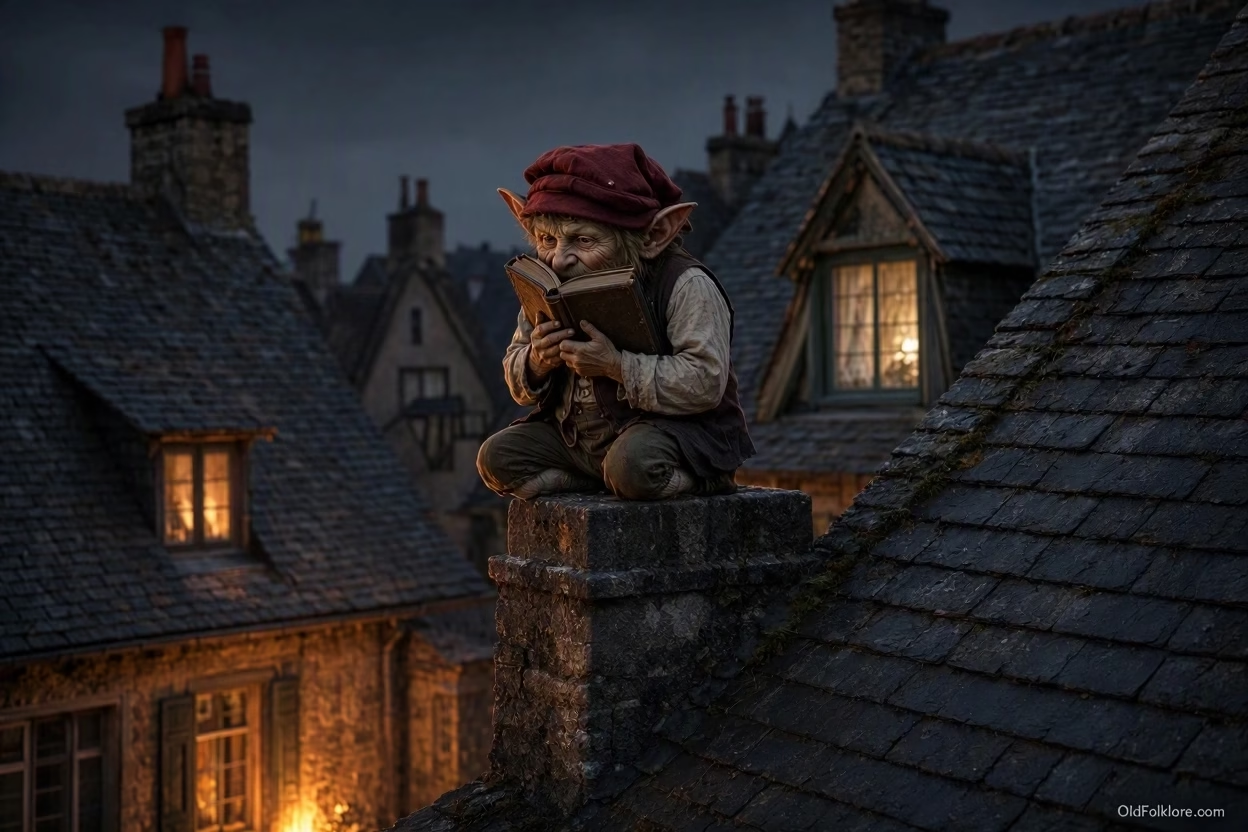
On the table lay the wonderful book. The goblin seized it, placed it inside his red cap and held the cap tightly with both hands.
He then hurried to the roof and climbed onto the chimney. The flames from the burning house illuminated him as he sat there guarding the book.
At that moment, the goblin finally understood where his heart truly belonged. When danger threatened, he had chosen the student’s book over the huckster’s possessions. The poetry had become a treasure he could not bear to lose.
Yet when the fire was extinguished and he had time to think calmly, the old attachment returned.
“I must divide myself between the two,” he decided. “I can’t quite give up the huckster, because of the porridge!”
And so the goblin remained torn between the beauty of poetry and the comfort of his favourite meal. Andersen ends the tale with a playful observation that people, too, continue visiting the huckster for the sake of his porridge.
Explore our complete Historic Folklore & Fairy-Tale Collections archive.
Moral Lesson
Material comfort can be tempting, but it is not the only measure of value. The goblin discovers that poetry and beauty can inspire feelings far beyond the pleasure of a good meal. Yet his attachment to comfort prevents him from choosing one home completely, leaving him divided between what nourishes his body and what enriches his imagination.
Knowledge Check
1. Where did the goblin live?
He lived in the huckster’s shop on the ground floor of a house.
2. Why did the goblin favour the huckster?
The huckster provided him with a comfortable place to stay and served him plum porridge with a generous lump of butter at Christmas.
3. Why did the student object to the cheese wrapping?
He discovered that it was a page from an old book of poetry and did not want the remaining pages to be destroyed.
4. What happened when the goblin used the huckster’s wife’s tongue?
Objects touched by the tongue could speak and express their thoughts, allowing the shop’s contents to give their opinions about poetry.
5. What did the goblin rescue during the fire?
He rescued the student’s wonderful book of poetry by placing it inside his red cap.
6. Why did the goblin decide to divide himself between the student and the huckster?
He loved the beauty he discovered in the student’s room but could not give up the comfort and Christmas porridge he enjoyed in the huckster’s shop.
Source
“The Goblin and the Huckster” is a literary fairy tale by Hans Christian Andersen, published in the English collection What the Moon Saw and Other Tales, translated by H. W. Dulcken in 1866.
Explore More Hans Christian Andersen Tales
- The Snowman: A Danish Folktale by Andersen
- The Farmer Who Traded His Horse for Rotten Apples
- The Beetle Who Wanted Golden Shoes