Long ago, during the reign of the legendary Emperor Yau, there lived a prince named Hou I. He was renowned throughout the land for his extraordinary courage and skill with a bow. His aim was so remarkable that few could match him, and his strength made him one of the greatest heroes of his age.
One day, a terrible disaster threatened the earth. Instead of the single sun that normally illuminated the world, ten suns appeared together in the sky. Their combined heat was unbearable. Rivers and streams suffered beneath the scorching rays, the land grew dangerously hot, and the people could scarcely endure the blazing heavens.
Desperate to save his kingdom, Emperor Yau summoned Hou I and commanded him to put an end to the calamity.
The prince raised his bow and aimed at the blazing sky. One after another, his arrows struck their targets. Nine of the ten suns fell, leaving only one to illuminate the earth. At last, the unbearable heat subsided, and the people could live without fear of being consumed by the scorching light.
Hou I’s bravery became celebrated, but his adventures were not yet over.
Besides possessing a remarkable bow, the prince owned a horse of astonishing speed. It could run so swiftly that even the wind could not overtake it. One day, Hou I mounted the animal and rode out hunting. But the horse suddenly bolted, racing across the land with such force that its rider could neither control nor stop it.
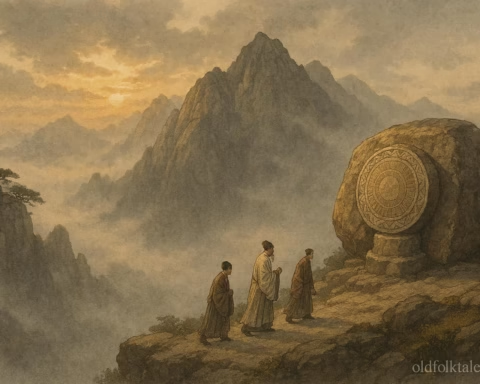
It carried Hou I far from familiar surroundings until he arrived at Kunlun Mountain. There he encountered the mysterious Queen-Mother of the Jasper Sea.
The Queen-Mother welcomed him and gave him a precious gift: an herb that granted immortality. Whoever consumed it would escape death and enjoy everlasting life.
Explore more stories from our The Chinese Fairy Book collection.
Hou I accepted the extraordinary treasure and carried it home. Yet he did not immediately consume it. Instead, he hid the herb in his room, keeping its secret and its promise of eternal life to himself.
His wife, Tschang O, eventually discovered the hidden treasure. One day, while Hou I was away from home, she secretly ate some of the herb.
Its power took effect immediately.
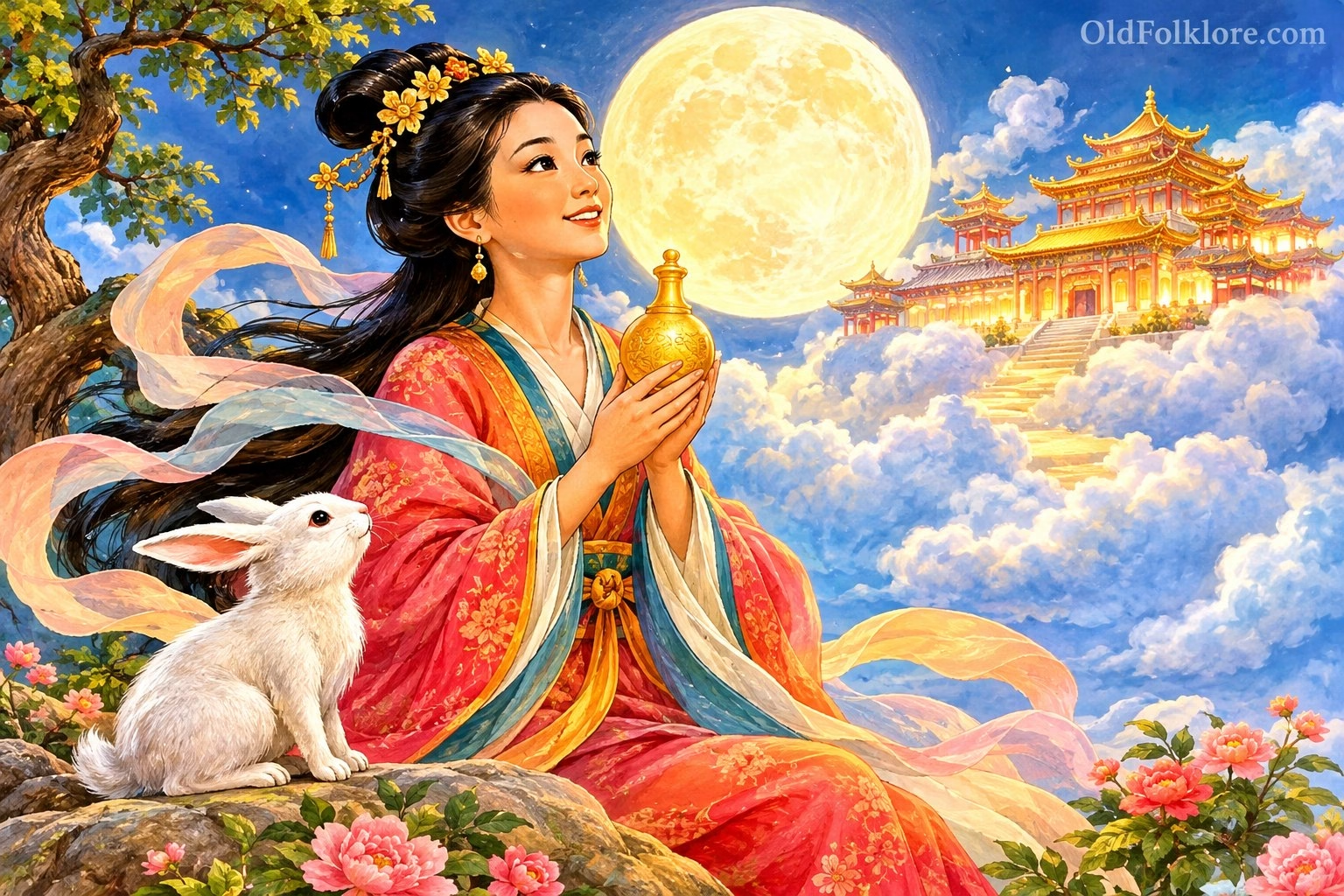
Tschang O began to rise from the earth, floating upwards towards the clouds. Higher and higher she travelled until she reached the moon. There she entered a magnificent castle and made it her home. From that time onward, she became known as the Lady of the Moon.
The Emperor’s Journey to the Moon
Many years later, during the Tang dynasty, another extraordinary encounter with the lunar world took place.
One night in the middle of autumn, an emperor was enjoying wine with two sorcerers. As they sat together, one of the sorcerers took his bamboo staff and threw it into the air.
What happened next was beyond ordinary understanding. The staff transformed into a heavenly bridge, stretching upwards towards the moon.
The sorcerers and the emperor climbed onto this miraculous pathway and travelled through the heavens until they reached the moon.
Before them stood an immense and beautiful castle. Above its entrance was an inscription reading, The Spreading Halls of Crystal Cold.
Nearby grew a magnificent cassia tree. Its blossoms filled the surrounding air with a delightful fragrance, while its branches spread widely beneath the lunar sky.
But the tree was not left to grow without restraint. Sitting among its branches was a man holding an axe. He was busy cutting away the smaller boughs.
One of the sorcerers explained the mystery to the emperor. The tree grew so abundantly that, if left untouched, it would eventually overshadow the radiance of the moon itself. For this reason, the man was required to trim it once every thousand years.
After observing the strange spectacle, the three visitors entered the castle.
Inside, they discovered a world unlike anything on earth. Its magnificent silver storeys rose one above another, while its walls and towering columns appeared to be made of liquid crystal. Cages and ponds were set into the walls, containing birds and fish that seemed almost alive.
Everything around them shimmered with the appearance of glass. The entire palace seemed to belong to a world of extraordinary beauty and enchantment.
While the emperor and his companions were still admiring the wonders around them, a remarkable woman approached.
She was dressed in a flowing white mantle and a gown that shimmered with the colours of the rainbow. Her presence was graceful and majestic. She was none other than the Lady of the Moon.
She looked upon the emperor with a smile and welcomed him, observing that he was a ruler from the dusty world below and that he was fortunate to have found his way into her heavenly dwelling.
Then she summoned her attendants.
The attendants came flying towards the palace on white birds. Beneath the fragrant cassia tree, they began to sing and dance. Their movements were graceful, and their voices produced a music so pure and clear that it seemed to float effortlessly through the moonlit air.
The emperor watched in wonder as the heavenly performance unfolded.
Nearby stood a mortar carved from white marble. Beside it was a rabbit of jasper, busily grinding herbs. The sight was another of the moon’s remarkable mysteries, associated in the account with its darker half.
The visitors remained until the dancing and music had ended. Then the emperor and the two sorcerers returned to the earth by the same miraculous means through which they had travelled to the moon.
Yet the emperor did not wish to lose the extraordinary music he had heard.
Back in his palace, he arranged for the heavenly songs to be written down. He then had them performed in his pear-tree garden, accompanied by flutes made of jasper, so that the beautiful melodies of the moon might be heard again in the earthly world.
And so the emperor carried a little of the moon’s enchantment back to his kingdom.
Explore our complete Historic Folklore & Fairy-Tale Collections archive.
Moral
Extraordinary gifts and powers can lead to unexpected consequences. The story also reminds us that the world contains mysteries beyond ordinary human experience, inspiring curiosity about the heavens and the wonders of nature.
Knowledge Check
1. Who was Hou I?
Hou I was a legendary prince and exceptional archer who saved humanity by shooting down nine of the ten suns that appeared in the sky.
2. Who gave Hou I the herb of immortality?
The Queen-Mother of the Jasper Sea gave him the magical herb when he arrived at Kunlun Mountain.
3. How did Tschang O become the Lady of the Moon?
She secretly consumed the herb of immortality while Hou I was away and immediately floated into the sky until she reached the moon.
4. How did the Tang emperor travel to the moon?
One of the sorcerers transformed his bamboo staff into a heavenly bridge, which the emperor and the two sorcerers climbed to reach the moon.
5. Why was a man cutting branches from the cassia tree?
According to one of the sorcerers, the tree grew so luxuriantly that it would eventually overshadow the moon’s radiance if it were not trimmed once every thousand years.
6. What was the rabbit doing inside the lunar palace?
It was grinding herbs in a white marble mortar, an image associated with the moon’s traditional connection to the elixir of life.
Source
This story is an original literary adaptation of “The Lady of the Moon,” Chapter XIX of Richard Wilhelm’s The Chinese Fairy Book (1921), translated by Frederick H. Martens.
Explore More The Chinese Fairy Book