At Jetavana, where the Buddha was staying, a disagreement arose among the monks over the distribution of food. An elder named Dabba was responsible for assigning food tickets, ensuring that the monks received their proper shares according to the available supplies.
However, one monk, Udāyin, was dissatisfied with the arrangements. He believed that Dabba did not always distribute the tickets fairly. Sometimes he received a ticket for better rice, while on other occasions he was given one for inferior rice.
Rather than recognising the difficulty of managing the distribution, Udāyin became convinced that he could perform the duty better. His complaints eventually attracted the attention of the other monks, who decided to allow him to take charge.
They soon discovered that confidence was not the same as ability. Udāyin’s attempt to manage the food distribution led to confusion, reminding the monks of an earlier incident in which an incompetent person had been trusted with an important responsibility.
When the Buddha heard about the disturbance, he explained that Udāyin’s behaviour was not entirely new. In a former birth, he had also shown poor judgement when given a position that required knowledge and careful reasoning.
He then related the story of a foolish appraiser and a valuable measure of rice.
The Wise Appraiser of Benares
Long ago, in the kingdom of Kāsi, King Brahma-datta ruled from the city of Benares. The king employed a royal appraiser whose responsibility was to determine the value of valuable possessions brought before the court.
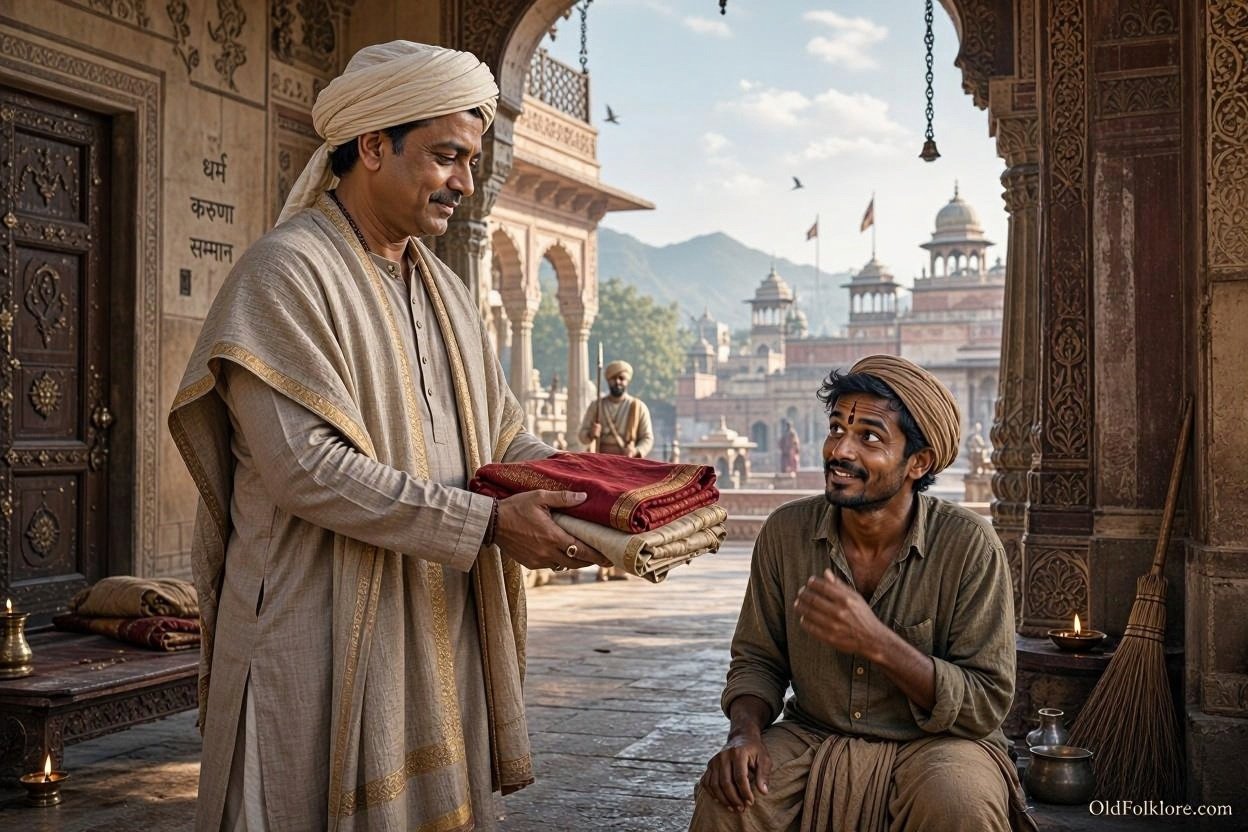
The appraiser was a wise and experienced man. He understood the worth of horses, elephants, jewellery and other expensive goods. He examined each item carefully and made fair assessments, ensuring that sellers received reasonable payment for what they offered.
Explore more stories from our Jataka Tales collection.
His honesty and good judgement made him valuable to the royal household. The king’s affairs were handled properly, and merchants who brought goods to the palace could trust that their possessions would be assessed fairly.
Unfortunately, the king was greedy. He disliked paying fair prices because he wanted to preserve as much of his wealth as possible. Whenever the appraiser assigned a reasonable value to an item, the king felt that he was losing money.
Instead of appreciating the man’s honesty, the ruler became dissatisfied with him.
One day, the king decided to remove the wise appraiser from his position. He went into the palace yard and noticed a foolish peasant nearby. The man appeared suitable to him, and the king decided to appoint him as the new royal appraiser.
The peasant accepted the responsibility without understanding what it required. He had little knowledge of the value of expensive goods, but the king was more interested in having someone who would help him spend less than in employing a capable judge.
The new appraiser soon began making decisions that revealed his ignorance.
The Five Hundred Horses
Some time later, a horse-dealer arrived in Benares with five hundred horses from the northern prairies. He brought the animals to the king, hoping to sell them at a fair price.
The king ordered his new appraiser to examine the horses and determine their value.
The foolish man looked at the animals but made no careful assessment of their quality or worth. He simply declared that all five hundred horses were worth one measure of rice.
The king was delighted by the valuation. It suited his desire to acquire valuable possessions without paying a reasonable price. He immediately accepted the appraiser’s judgement and ordered that the dealer receive the measure of rice in exchange for the entire group of horses.
The horses were then taken to the royal stable.
The dealer was shocked. He had travelled with a large number of valuable animals, only to be told that they were worth a single measure of rice. He understood that the appraiser had treated him unfairly, but he had little power to challenge the king’s decision.
Feeling helpless, he sought the advice of the former royal appraiser.
The Bodhisatta’s Clever Advice
The wise appraiser listened carefully as the horse-dealer explained what had happened. He understood that the new appraiser had made a ridiculous judgement and that the king had accepted it because it benefited him.
Rather than advising the dealer to argue angrily with the king, he suggested a different approach.
He told the dealer to offer the new appraiser a bribe and ask him to determine the value of one measure of rice.
The dealer was puzzled. The appraiser had already declared that five hundred horses were worth one measure of rice. It seemed strange to ask him to value the rice itself.
However, the wise man explained that this was precisely the point. If the appraiser believed that the horses were worth only one measure, he should be required to explain how much that measure was worth.
The dealer followed the advice. He approached the new appraiser, offered him a bribe and requested an official valuation of the measure of rice.
The foolish appraiser accepted the arrangement. He was pleased by the attention and believed that the request would be easy to answer.
The dealer then asked for the valuation to be presented before the king.
The Measure of Rice Is Valued
The dealer appeared before the royal court and requested that the king ask his appraiser to determine the value of one measure of rice.
The king agreed. He summoned the foolish man and asked him to give his judgement.
The appraiser repeated his earlier assessment. He maintained that five hundred horses were worth one measure of rice.
The king then asked him to explain the value of the measure itself.
Without understanding the trap in which he had placed himself, the appraiser declared that one measure of rice was worth the entire city of Benares, including everything within its walls and everything beyond them.
The statement caused immediate astonishment.
The ministers and other people present could hardly believe what they had heard. They began laughing at the absurdity of the judgement.
The contradiction was obvious. If five hundred horses were worth one measure of rice, but that same measure was worth the entire city of Benares, then the appraiser had placed an impossible value on the animals.
The man had exposed his own ignorance before the king and his ministers.
The King Recognises His Mistake
The king was ashamed. He realised that he had appointed an incompetent person simply because he wanted someone who would help him avoid paying fair prices.
His greed had caused him to reject an honest and knowledgeable appraiser in favour of a foolish man who could not distinguish the value of ordinary goods from that of an entire city.
The king understood that the horse-dealer had been treated unjustly. He also recognised that the former appraiser had possessed the knowledge and judgement required for the position.
He therefore dismissed the foolish peasant and restored the wise appraiser to his former office.
The dealer’s case exposed the danger of allowing ignorance and greed to influence important decisions. The king had wanted to save money, but his choice had brought embarrassment upon his court and revealed the weakness of his judgement.
The wise appraiser once again took responsibility for valuing goods brought before the palace. His experience and fairness ensured that future assessments would be made properly.
The Buddha Explains the Former Birth
After completing the story, the Buddha connected the events of the previous life with the disagreement at Jetavana.
He explained that the foolish peasant who had valued five hundred horses at one measure of rice was Udāyin in a former birth. The man who had served as the wise royal appraiser was the Buddha himself.
The comparison helped the monks understand why Udāyin’s confidence had not made him suitable for managing the distribution of food. Just as the foolish appraiser had lacked the knowledge required to value horses, Udāyin lacked the understanding needed to distribute the food tickets properly.
The story therefore offered a warning against accepting responsibilities without possessing the necessary ability. A person may desire an important position, but desire alone cannot replace experience, knowledge and sound judgement.
Explore our complete Historic Folklore & Fairy-Tale Collections archive.
Moral Lessons
Knowledge is essential for making sound decisions. The foolish appraiser accepted an important position without understanding how to value the goods brought before him. His ignorance resulted in an absurd judgement that embarrassed the king and harmed the horse-dealer.
Greed can lead to poor judgement. King Brahma-datta dismissed an honest appraiser because he disliked paying fair prices. His desire to save money caused him to appoint someone incapable of doing the work properly.
Confidence does not replace competence. Udāyin believed he could manage the food distribution better than Dabba, but his actions showed that he did not understand the responsibility. The story reminds readers that important duties require preparation and practical knowledge.
Fairness should guide the treatment of others. The horse-dealer deserved a reasonable payment for his animals, just as the monks deserved their proper shares of food. Those responsible for distributing resources must act with honesty rather than personal interest.
A foolish decision can expose its own weakness. The appraiser’s claim that one measure of rice was worth the entire city revealed the absurdity of his earlier valuation. Careful reasoning can expose mistakes that confidence and authority cannot conceal.
Knowledge Check
1. Why was Udāyin dissatisfied with Dabba’s distribution of food tickets?
He believed that Dabba sometimes gave him tickets for better rice and sometimes for inferior rice.
2. Why did King Brahma-datta dismiss the wise appraiser?
The king was greedy and disliked paying fair prices for valuable goods.
3. How much did the foolish appraiser say five hundred horses were worth?
He valued all five hundred horses at one measure of rice.
4. What advice did the Bodhisatta give the horse-dealer?
He advised the dealer to bribe the new appraiser and ask him to determine the value of one measure of rice.
5. What did the foolish appraiser declare the measure of rice was worth?
He declared that it was worth the entire city of Benares, including everything within and beyond its walls.
6. Who were the two appraisers in their former and present births?
The foolish appraiser was Udāyin in a former birth, while the wise appraiser was the Buddha himself.
Source
This retelling is based on Jātaka No. 5, Taṇḍula-Nāḷi Jātaka, also known as “The Measure of Rice”, in Buddhist Birth Stories; or, Jātaka Tales, Volume I. The collection was edited in Pāli by V. Fausbøll and translated into English by T. W. Rhys Davids in 1880.
Explore More Jataka Tales
- The Monkeys and the Demon
- The Sandy Road
- The Elephant and the Dog
- Holding to the Truth
- The Merchant of Seri and the Golden Bowl