Ants are familiar creatures, often seen carrying pieces of food and other objects that appear almost as large as their bodies. Their remarkable ability to transport such heavy loads has inspired traditional stories across different cultures. In this West African folktale, the explanation begins with two farmers whose crops are threatened by a prolonged absence of rain. When one of them receives magical assistance, his father’s greed leads to a terrible mistake. Anansi’s attempt to escape responsibility eventually brings him before a king, where he receives a punishment that changes the life of an unsuspecting ant. The tale offers a traditional explanation for why ants carry enormous bundles.
The Two Farmers and the Dry Season
Long ago, Kweku Anansi and his son, Kweku Tsin, were both known as clever farmers. Each had a farm, and in ordinary years they usually succeeded in producing good harvests. Their work depended on preparing the land, sowing their seeds and waiting for the crops to grow. When the harvest was successful, they had food for their households.
One year, however, their usual good fortune failed them. They planted their seeds as they had always done, but the rain did not come. More than a month passed after sowing, and the ground remained dry. Without sufficient water, the seeds could not sprout, and there was little hope of obtaining a proper harvest.
Kweku Tsin became worried about the condition of his farm. He walked through the fields, looking at the bare ground and wondering what would happen if the crops failed completely. His concern extended beyond the farm itself. He also thought about the food his family would need if there were no harvest.
As he walked sadly along one day, he noticed a tiny dwarf sitting beside the road. The little figure had a hump on his back and appeared unusual. The dwarf noticed the young farmer’s troubled expression and asked what was causing his sadness.
Kweku Tsin explained that he had planted his seeds, but the absence of rain had prevented them from growing. The ground was dry, and he feared that his farm would produce nothing.
The dwarf listened and offered to help him. He said that he could bring rain to the farm, but Kweku Tsin would have to follow his instructions carefully.
The Dwarf Brings Rain
The dwarf told Kweku Tsin to find two small sticks. He was to use them to tap the dwarf gently on his hump while singing a short song asking the water to rise and rain to fall.
The instruction was unusual, but Kweku Tsin followed it. He obtained two small sticks and used them to tap the dwarf lightly on the hump. As he did so, he sang the requested words.
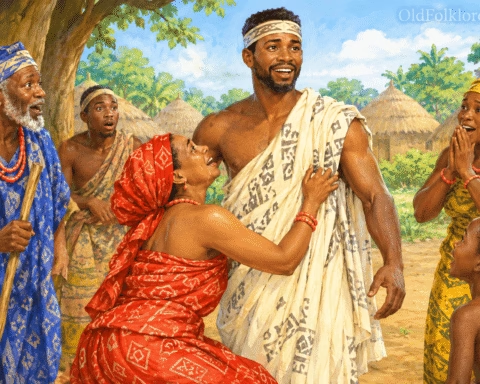
To his great surprise, rain began to fall almost immediately. It continued until the ground was thoroughly soaked. The dry fields received the water they had been waiting for, and the young farmer’s worry began to disappear.
In the days that followed, the seeds germinated. The crops began to grow, and the farm gradually changed from a stretch of bare, dry ground into a promising field.
Explore more stories from our West African Folk-Tales collection.
Kweku Tsin was delighted. The help of the little dwarf had saved his farm from the consequences of the prolonged drought. Instead of losing his harvest, he now had reason to expect a good crop.
Anansi Learns His Son’s Secret
News of the young farmer’s flourishing crops eventually reached Anansi. He noticed that his son’s farm was doing well while his own remained dry and unproductive.
Anansi wanted to know how Kweku Tsin had managed to make his crops grow when both farms had suffered from the same lack of rain. He went directly to his son and demanded an explanation.
Kweku Tsin was an honest young man. He did not hide what had happened or pretend that he had discovered some special farming method. He explained that he had met a small hunchbacked dwarf beside the road. The dwarf had promised to bring rain and had instructed him to use two small sticks to tap his hump gently while singing.
Anansi immediately became interested. If the same method could bring rain to his son’s farm, he believed it could also rescue his own. He decided to find the dwarf and obtain the same assistance.
However, Anansi did not intend to follow the instructions in the same manner as his son. He wanted more than the result Kweku Tsin had received.
Anansi Makes a Fatal Mistake
As Anansi travelled towards his farm, he cut two large, strong sticks. He reasoned that his son had used small sticks, so he would use much bigger ones and make the dwarf work twice as hard.
He did not want the dwarf to notice his plan immediately. Therefore, when he saw the little hunchback approaching, he carefully concealed the large sticks.
The dwarf greeted him and asked what was troubling him. Anansi explained that his farm was dry because there had been no rain. The dwarf, unaware of the old man’s intention, offered to help him just as he had helped Kweku Tsin.
He repeated the same instruction. Anansi was to take two small sticks and beat him lightly on the hump so that rain would come.
This was precisely what Anansi had been waiting to hear. Instead of using the small sticks and treating the dwarf gently, he brought out the large ones and struck him with great force.
The blows were so severe that the dwarf fell down dead.
Anansi had expected to obtain rain by making the dwarf work harder, but his greed and impatience had destroyed the very person who could have helped him. The old man immediately realised that he had created a serious problem.
He knew that the dwarf was the king’s jester and a particular favourite of the king. Killing such an important person could bring severe punishment. Rather than accept responsibility, Anansi began thinking of a way to place the blame on somebody else.
The Body in the Kola Tree
Anansi picked up the dead dwarf and carried the body to a kola tree. He placed it among the upper branches and then sat beneath the tree to wait.
After some time, Kweku Tsin came along. He wanted to see whether his father had succeeded in obtaining rain for his own farm. When he found Anansi sitting beneath the tree, he asked whether the old man had met the dwarf.
Anansi answered that he had indeed seen him. He then claimed that the dwarf had climbed the tree to pick kola and that he was waiting for him.
Kweku Tsin accepted the explanation for the moment and offered to climb up to bring the dwarf down. He began climbing the tree.
As he reached the place where the body had been hidden, his head touched it. The dead dwarf immediately fell from the branches to the ground.
Anansi seized the opportunity to accuse his son. He shouted that Kweku Tsin had killed the king’s jester and demanded to know why he had done such a terrible thing.
But Kweku Tsin understood that his father was trying to deceive him. He quickly turned the accusation around. He claimed that the king was very angry about the jester’s death and had promised a bag of money to anyone who killed him. He therefore announced that he would go to the king and collect the reward.
Anansi could not allow this. He immediately protested that the reward belonged to him because he had killed the dwarf with the two large sticks. He insisted that he would take the body to the king himself.
Kweku Tsin calmly allowed him to go. Having succeeded in making his father admit responsibility, he no longer needed to argue with him.
The King’s Punishment
Anansi set off for the king’s court, pleased with the thought of receiving a reward. He expected the king to welcome him as the person who had supposedly solved a problem by killing the jester.
The reception was very different from what he had imagined. The king was furious because the dead dwarf had been his favourite jester. Instead of rewarding Anansi, he ordered that the body be placed inside a large box.
The king then pronounced Anansi’s punishment. He was condemned to carry the box on his head for the rest of his life.
The punishment was made even more difficult through enchantment. The box could never be placed on the ground. Anansi could not simply remove it when he became tired or decide to abandon it beside the road.
There was only one way he could escape the burden. He had to persuade another person to take the box and place it on their own head.
This was not an easy solution. Nobody was willing to accept such a troublesome object, especially when doing so would mean taking over Anansi’s punishment.
As the days passed, the weight became increasingly difficult for him to bear. He continued travelling with the box balanced on his head, but he was growing exhausted. He desperately needed someone who would agree to hold it, even if only for a short time.
Anansi Meets the Ant
One day, when Anansi was almost worn out from carrying the heavy box, he met an ant.
Seeing an opportunity, he approached the little creature and asked whether it would hold the box while he went to the market to buy some things he urgently needed.
The ant was not easily deceived. It knew about Anansi’s tricks and immediately suspected that the old man wanted to get rid of the burden permanently.
It told him plainly that he understood what Anansi was trying to do. The ant believed that the old man intended to leave the box with him and never return.
Anansi denied the accusation. He insisted that he would come back after visiting the market and promised that he would not abandon the box.
The ant was an honest creature that kept its own promises. It believed that Anansi would behave in the same way. Despite its suspicion, it accepted his assurance and agreed to take the burden.
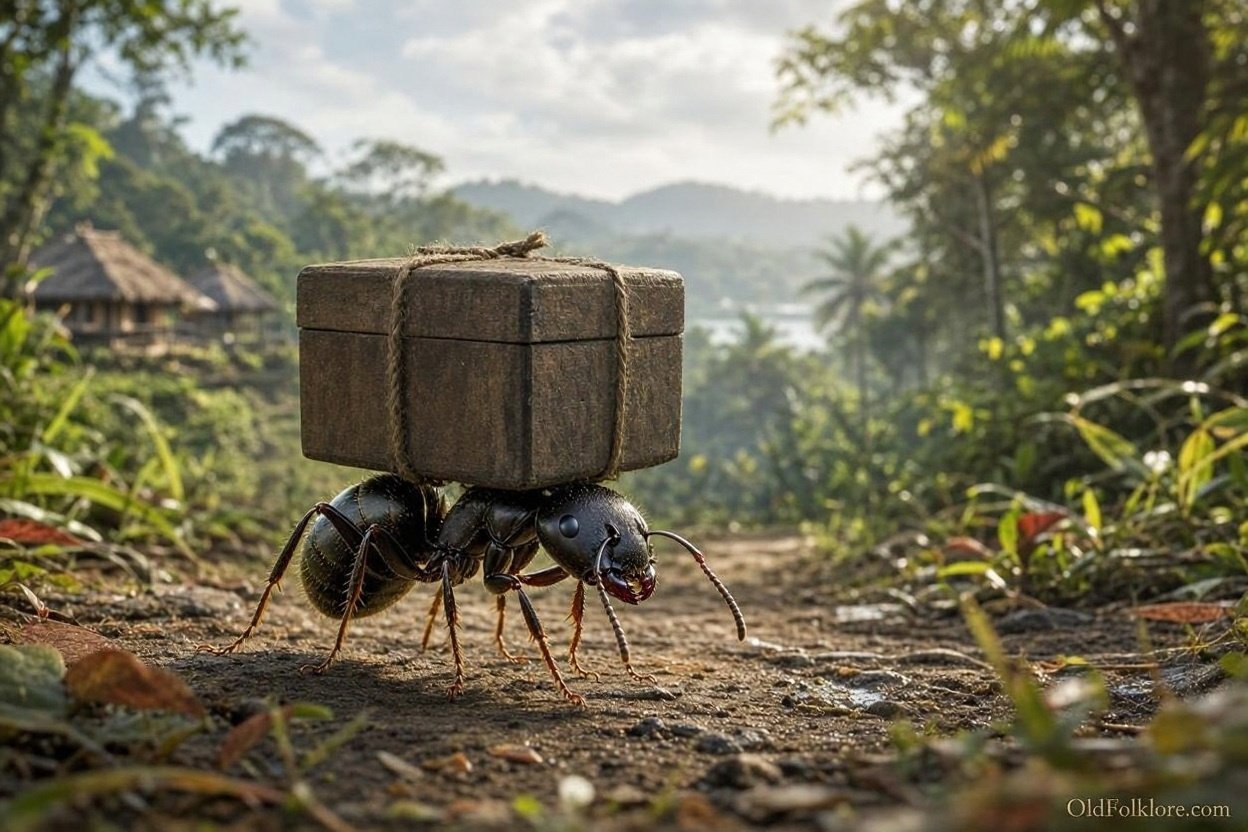
Anansi placed the box on the ant’s head. The little creature accepted the heavy load, trusting that the old man would return as promised.
But Anansi had never intended to keep his word. The moment the ant took the box, he hurried away.
The Ant’s Endless Burden
The ant waited for Anansi to return. It expected the old man to finish his shopping and come back to collect the box, just as he had promised.
However, Anansi never returned.
The ant waited in vain. It had accepted the burden because it believed the promise made to it, but the promise had been a trick. Anansi had finally found somebody willing to take the enchanted box, and he had used the ant’s honesty to escape his punishment.
The little creature was left carrying the box. According to the tale, it had to wander with the burden for the rest of its life.
This is the traditional explanation given in the story for the sight of ants carrying bundles that appear as large as their own bodies. The loads carried by ants are presented as reminders of the box that Anansi abandoned with the honest little creature.
Explore our complete Historic Folklore & Fairy-Tale Collections archive.
Moral Lessons
The story teaches that dishonesty can lead to serious consequences. Anansi caused the dwarf’s death because he wanted greater results without following the instructions he had been given. When he realised the seriousness of his actions, he tried to escape responsibility by blaming his son. His deception eventually brought him before the king and resulted in a punishment he could not easily escape.
The tale also contrasts Anansi’s dishonesty with Kweku Tsin’s honesty and intelligence. The young farmer told his father the truth about the dwarf, but he was also quick enough to recognise his father’s attempt to deceive him. His response prevented Anansi from making him responsible for the death.
The ant’s part in the story highlights the importance of keeping promises. The ant trusted Anansi because it believed that a person’s word should be respected. Anansi abused that trust and left the little creature with a burden that was never meant to be its responsibility.
Finally, the story warns against greed and taking advantage of others. Anansi wanted more than the dwarf had offered, and his desire to force a greater result led to disaster. His actions affected not only himself but also the innocent ant that believed his promise.
Knowledge Check
1. What were the names of the two farmers in the story?
They were Kweku Anansi and his son, Kweku Tsin.
2. Why were their farms in danger?
There had been no rain for more than a month after they planted their seeds.
3. How did the dwarf help Kweku Tsin?
He instructed him to tap his hump lightly with two small sticks while singing a song asking for rain.
4. Why did Anansi use two large sticks instead of small ones?
He believed that using larger sticks would make the dwarf produce twice as much rain.
5. What punishment did the king give Anansi?
The king ordered him to carry an enchanted box containing the dead jester on his head, and it could not be placed on the ground.
6. Why was the ant left carrying the box?
Anansi persuaded the ant to hold it while he went to the market, promising to return, but he abandoned it.
Source
Adapted from “Why We See Ants Carrying Bundles as Big as Themselves”, Chapter IX, pages 63–67, in West African Folk-Tales (1917), collected and arranged by W. H. Barker and Cecilia Sinclair.
Explore More West African Folk-Tales
- Anansi and Nothing: The Trickster Who Lost Everything
- Why the Sun and the Moon Live in the Sky
- How Anansi Won the Right to Have Stories Named After Him
- The Grinding-Stone That Ground Flour by Itself
- King Chameleon and the Animals
- Why the Lizard Moves Its Head Up and Down
- Anansi, Wolf and Leopard: The Tale of the White Ants
- Why Spiders Are Always Found in Corners of Ceilings