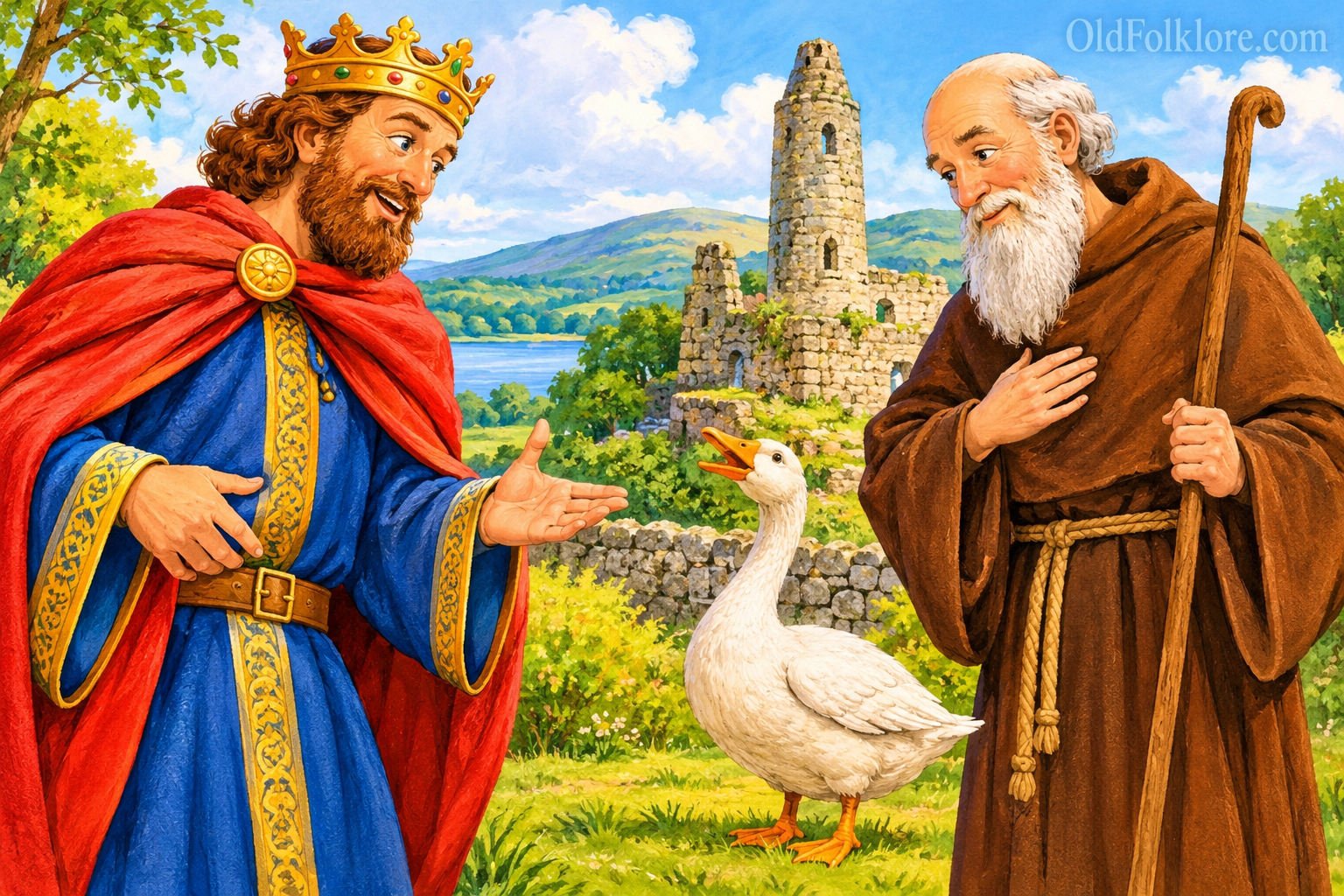
Long ago, there lived a king named O’Toole who loved hunting more than almost anything else. He was a lively man who enjoyed the outdoors, and every morning, as soon as the sun rose, he would set out across the mountains in pursuit of deer. Those were happy days for the king, and he spent much of his time enjoying the pleasures of the countryside.
But the years passed, and age gradually caught up with him. His limbs became stiff, his strength weakened, and eventually he could no longer climb the mountains or ride out on his favourite hunts. Without his usual adventures, the king became terribly bored. He had once found happiness in the excitement of the chase, but now he struggled to find anything that could brighten his days.
At last, he acquired a goose to keep him company.
The bird turned out to be an extraordinary companion. She swam across the lake, dived beneath the water in search of trout, and caught fish for the king’s Friday meals. On other days, she flew around the lake, entertaining her master with her lively movements. The king grew very fond of her, and for a while, she brought back some of the happiness he had lost.
Unfortunately, the goose was growing old too. Before long, her wings weakened, and she could no longer fly or perform the tricks that had once delighted the king. She had become as old and stiff as her master.
King O’Toole was miserable. One morning, he wandered beside the lake, mourning his unhappy condition. He had lost his favourite pastime, and now even his beloved goose could no longer entertain him. His despair became so great that he began thinking of throwing himself into the water.
Explore more stories from our Joseph Jacobs’ Celtic Fairy Tales collection.
Just then, a young man appeared around a bend in the path. He looked respectable and pleasant, and there was nothing about his appearance to suggest that he was anything extraordinary.
“God save you,” said the king.
“God save you kindly, King O’Toole,” replied the stranger.
The king was surprised.
“You know who I am, then?” he asked. “I am King O’Toole, prince and ruler of these parts. But how did you recognise me?”
“Oh, never mind that,” the young man replied. “I know more about you than you might imagine. Tell me, how is your goose?”
The king stared at him in astonishment.
“How in the world did you hear about my goose?” he demanded.
“I have my ways of finding things out,” said the stranger.
After a little more conversation, the king became curious about his visitor.
“And what sort of man are you?” he asked.
“I am an honest man,” the stranger answered.
“Well, honest man, how do you earn your living so easily?”
“By making old things as good as new,” said the young man.
“Are you a tinker?” asked the king, thinking he had met someone who repaired household objects.
“No, King O’Toole. I have a better trade than that. Tell me, what would you say if I could make your old goose as good as new?”
The king could hardly believe his ears. His eyes widened, and for a moment he could scarcely speak. If this stranger could restore his goose, he would have given almost anything.
He whistled, and the old bird came waddling towards him, just as a faithful dog might answer its master’s call. She was a poor, worn-out creature, but the king loved her dearly.
The young man examined her and confidently promised to restore her.
“By heaven!” cried the king. “If you can do that, I shall declare you the cleverest fellow in all seven parishes.”
“That praise alone will not pay for the work,” replied the stranger. “I am not going to repair your goose for nothing. What will you give me in return?”
“I shall give you whatever you ask,” said the king. “Is that not a fair offer?”
“Nothing could be fairer,” said the stranger. “Then this is my bargain: will you give me all the land your goose flies over the first time I set her flying again?”
The king did not hesitate.
“I will,” he promised.
“But you will not go back on your word?” the stranger asked.
“Honour bright!” declared King O’Toole, holding out his fist.
“Honour bright!” replied the young man, sealing the bargain.
With that, he approached the unfortunate goose, lifted her by the wings, and made the blessed sign of the cross over her. Then he raised her into the air and gave a sharp breath to help her on her way.
What happened next astonished the king.
The old goose suddenly spread her wings and soared into the sky. She flew with extraordinary strength, as lightly as an eagle, twisting and turning through the air like a swallow dancing before a rainstorm. She was no longer the weak, helpless bird that had been waddling beside the king.
King O’Toole stood watching with his mouth open. He could hardly believe what he was seeing. The goose circled above him, flew about with remarkable energy, and finally descended at his feet.
The king rushed towards her and lovingly patted her head.
“My darling!” he exclaimed. “You are the sweetest creature in the world!”
The young man, however, was waiting for something more than gratitude.
“And what do you say to me for restoring her?” he asked.
The king thought for a moment.
“I say that nothing surpasses the skill of man, except the work of the bees,” he replied.
“And is that all you have to say?” asked the stranger.
The king added that he was deeply indebted to him.
“Then what about our bargain?” the young man reminded him. “Will you give me all the land your goose flew over?”
“Of course,” said the king. “You shall have it, and you are welcome to it, even if it is the last acre I own.”
The stranger looked at him carefully.
“You will keep your promise?”
“As surely as the sun shines,” answered King O’Toole.
“You are fortunate that you have given me your word,” said the young man. “Had you refused to honour it, your goose would never have flown again!”
The king had no intention of breaking his promise. True to his word, he surrendered the land the goose had flown over.
Only then did the stranger reveal who he really was.
“King O’Toole,” he said, “you are an honourable man. I came here to test you, and you have kept your word. You did not recognise me because I was disguised.”
The king looked at him in confusion.
“Then who are you?” he asked.
“I am Saint Kavin,” replied the stranger, making the sign of the cross.
The king was overwhelmed. He immediately made the sign of the cross himself and fell to his knees.
“Merciful heavens!” he cried. “Have I been speaking all this time to the great Saint Kavin without recognising him? I thought I was merely talking to an ordinary young man!”
“I am indeed Saint Kavin,” said the saint.
The king could hardly contain his astonishment. He had never imagined that such an extraordinary visitor would appear before him, let alone offer to restore his beloved goose.
From that day, King O’Toole had his goose back in her youthful condition, and she entertained him for the remainder of his life. Saint Kavin also took care of the king after receiving the land promised to him.
But the king’s happiness did not last forever.
One Friday, the goose went into the lake, expecting to catch a trout for her master’s meal. Unfortunately, she made a terrible mistake. Instead of a trout, she encountered a fierce horse-eel. The creature attacked and killed her.
Yet the eel did not eat the goose. It dared not consume a bird upon which Saint Kavin had laid his blessed hands.
And so, although the king had regained his wonderful companion, he eventually lost her again. The goose’s extraordinary restoration had given him happiness for a time, but even a miraculous gift could not protect her from every danger.
Explore our complete Historic Folklore & Fairy-Tale Collections archive.
Moral
A promise should never be made carelessly, because keeping one’s word is a mark of honour. The story also reminds us that kindness, companionship and gratitude can bring happiness, even when circumstances change.
Knowledge Check
1. Why did King O’Toole become unhappy in his old age?
He could no longer go hunting because his limbs had become stiff and his strength had weakened.
2. How did the goose entertain the king?
She swam across the lake, dived for trout, caught fish for his Friday meals and flew around the lake.
3. Who was the mysterious young man?
He was Saint Kavin, also known as Saint Kevin, who had disguised himself as an ordinary young man.
4. What did Saint Kavin demand in exchange for restoring the goose?
He demanded all the land the goose flew over on her first flight after being restored.
5. Why did the king surrender the land?
He had promised it to the stranger and chose to honour his word.
6. What eventually happened to the goose?
She was killed by a horse-eel while attempting to catch a trout for the king’s Friday meal.
7. What is one of the main lessons of the story?
People should honour their promises, even when fulfilling them becomes difficult.
Source
The retelling is based on “King O’Toole and His Goose,” included in Celtic Fairy Tales, selected and edited by Joseph Jacobs, illustrated by John D. Batten, published in London by David Nutt in 1892. The tale appears on printed pages 93–98.
Explore More Joseph Jacobs’ Celtic Fairy Tales