Once upon a time, there lived a man who travelled far and wide in search of a wife. He met women of different ages and backgrounds. Some were young, others old; some were wealthy, others poor. He encountered women of great beauty and those whose appearance was more ordinary, but none seemed suitable for him.
Then, one day, he met a young, beautiful and wealthy woman unlike any he had encountered before. She possessed something extraordinary: her right arm was made entirely of solid gold.
The man was immediately taken with her. He wasted no time in making her his wife, believing himself to be the luckiest man alive. They settled down together and appeared to enjoy a happy marriage. To everyone around them, he seemed devoted to his wife and grateful for the life they shared.
But beneath his outward affection was a selfish secret. Although he pretended that he loved her for all her qualities, he valued her golden arm more than anything else about her. It was the treasure he admired most, and his desire for it grew quietly while his wife remained unaware of the true depth of his greed.
Explore more stories from our Joseph Jacobs’ English Fairy Tales collection.
Their marriage continued until the woman eventually died.
At her funeral, the husband dressed himself in the darkest mourning clothes and wore an expression of deep sorrow. He behaved like a grieving man, giving everyone the impression that he had lost someone he dearly loved.
But his sadness was nothing more than an act.
That night, when the world was asleep and no one could see what he was doing, he crept out and made his way to his wife’s grave. He dug up her body and, without hesitation, cut off her golden arm.
Having taken what he wanted, he hurried home with his stolen treasure. He was convinced that nobody would discover what he had done. As far as he was concerned, the golden arm was finally his, and he could keep it without anyone standing in his way.
The following night, he placed the golden arm beneath his pillow and settled into bed. He was just beginning to drift off when something strange happened.
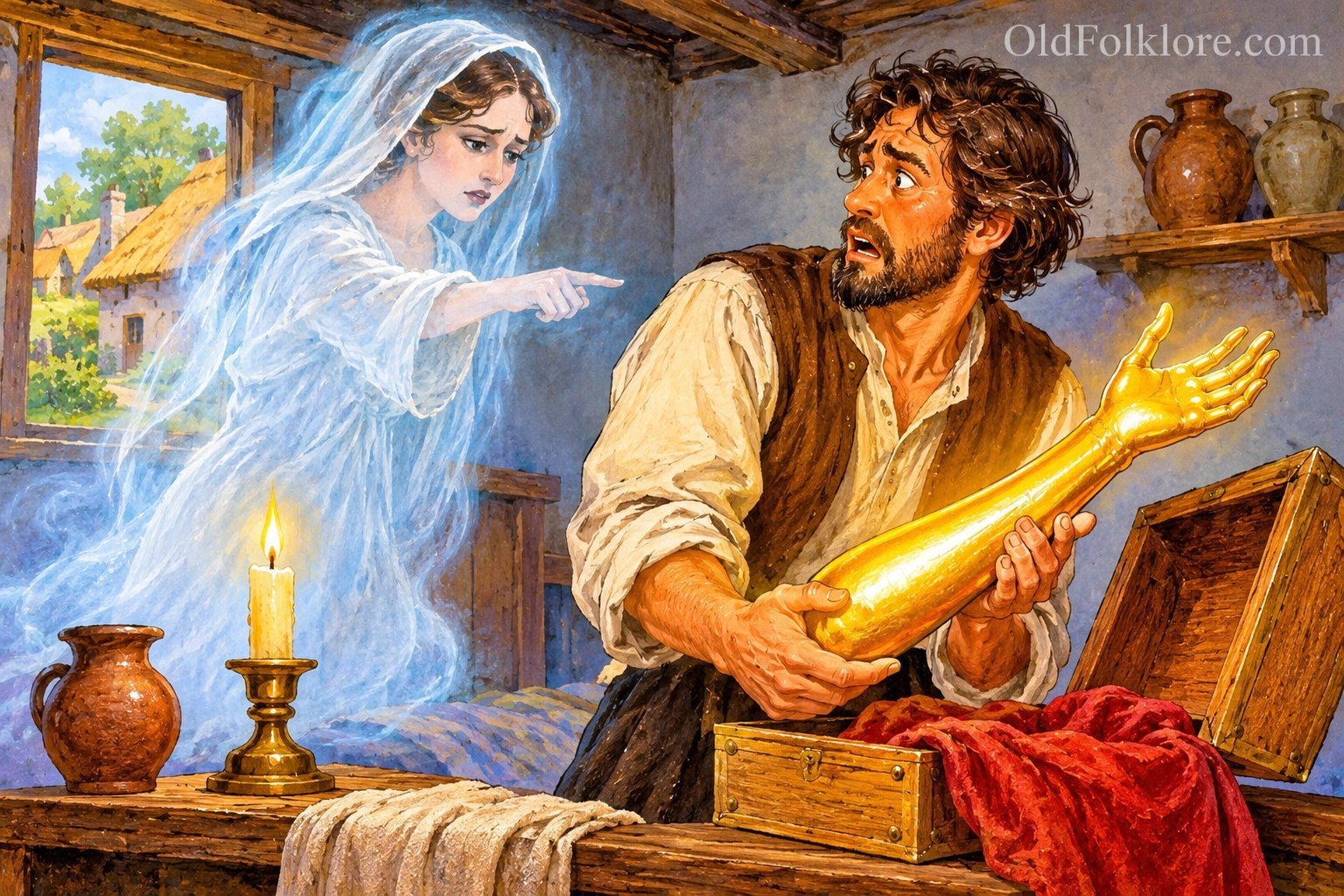
The ghost of his dead wife appeared in the room.
She glided silently towards his bedside, drew back the curtain and stared at him with a reproachful expression. Her appearance was frightening, but the husband tried to hide his fear. He pretended to be calm and spoke to her as though nothing unusual had happened.
“What hast thou done with thy cheeks so red?” he asked.
“All withered and wasted away,” the ghost replied in a hollow voice.
The man continued.
“What hast thou done with thy red rosy lips?”
“All withered and wasted away.”
He asked again:
“What hast thou done with thy golden hair?”
“All withered and wasted away.”
Then came the question he had been dreading, though he tried to conceal his uneasiness.
“What hast thou done with thy Golden Arm?”
The ghost suddenly gave her answer in a terrible voice:
Explore our complete Historic Folklore & Fairy-Tale Collections archive.
Moral
Greed can turn even the closest human relationship into an opportunity for selfish gain. The husband’s obsession with the golden arm makes him forget the dignity of his dead wife, and his attempt to possess it brings him face to face with the consequences of his actions.
Knowledge Check
1. Why did the man marry the woman?
He was attracted to her beauty and wealth, particularly her right arm, which was made of solid gold.
2. What did the husband do after his wife died?
He secretly dug up her grave and cut off her golden arm so that he could keep it.
3. Why did the wife’s ghost visit him?
She returned after discovering that her husband had taken her golden arm from her grave.
4. What did the ghost mean when she said, “Thou hast it!”?
She revealed that the golden arm was in the husband’s possession, exposing his crime.
5. What is the central theme of the story?
The destructive nature of greed and the consequences of placing material wealth above human relationships.
Source
“The Golden Arm,” in Notes on the Folk-lore of the Northern Counties of England and the Borders, by William Henderson, with an appendix on household stories by the Reverend Sabine Baring-Gould, published by Longmans, Green, and Co., London, 1866, p. 338.
Explore More Joseph Jacobs’ English Fairy Tales
- The Lambikin: A Classic Indian Folktale About Cunning, and Survival
- Soria Moria Castle: Halvor’s Quest to Win Back His Princess
- The Yellow Dwarf: The Princess, the Cursed Ring, and a Love That Ended in Tragedy
- The Three Sillies: An English Fairy Tale
- The Frog-King and Iron Henry: The Princess Who Broke Her Promise
- The Death of Koschei the Deathless: The Red Fairy Book