In a narrow, crooked street stood a tall, weather-beaten wooden house. Poverty could be seen everywhere, but it was especially noticeable in the little attic room beneath the roof. Beside its only window hung an old birdcage. The cage had no proper drinking glass, so someone had improvised by using the neck of a broken bottle, turned upside down and fitted with a cork.
A little chaffinch lived in the cage. It hopped happily from perch to perch, singing as though the world held nothing but pleasant things.
The bottle-neck, however, was not impressed.
“How easily you sing,” it thought. “You have all your limbs, while I have lost almost my entire body. You have no idea what it means to be reduced to a neck and a mouth, and then be expected to serve others. If you had experienced what I have, perhaps you would not be so cheerful.”
Still, the bottle-neck admitted that it was good to have someone in the room who could sing. It could no longer make music itself, although it remembered the days when it had been a complete bottle. Back then, people used to rub its sides with a cork, making it produce a sound so delightful that they called it a magnificent lark.
It had lived through many remarkable experiences. It had known fire and water, travelled across the sea, and even risen high into the air. Now it hung outside a birdcage, exposed to the sunshine.
Explore more stories from our Hans Christian Andersen Tales collection.
If only it could tell its story!
And so, while the little bird continued singing and the busy street carried on below, the bottle-neck began remembering.
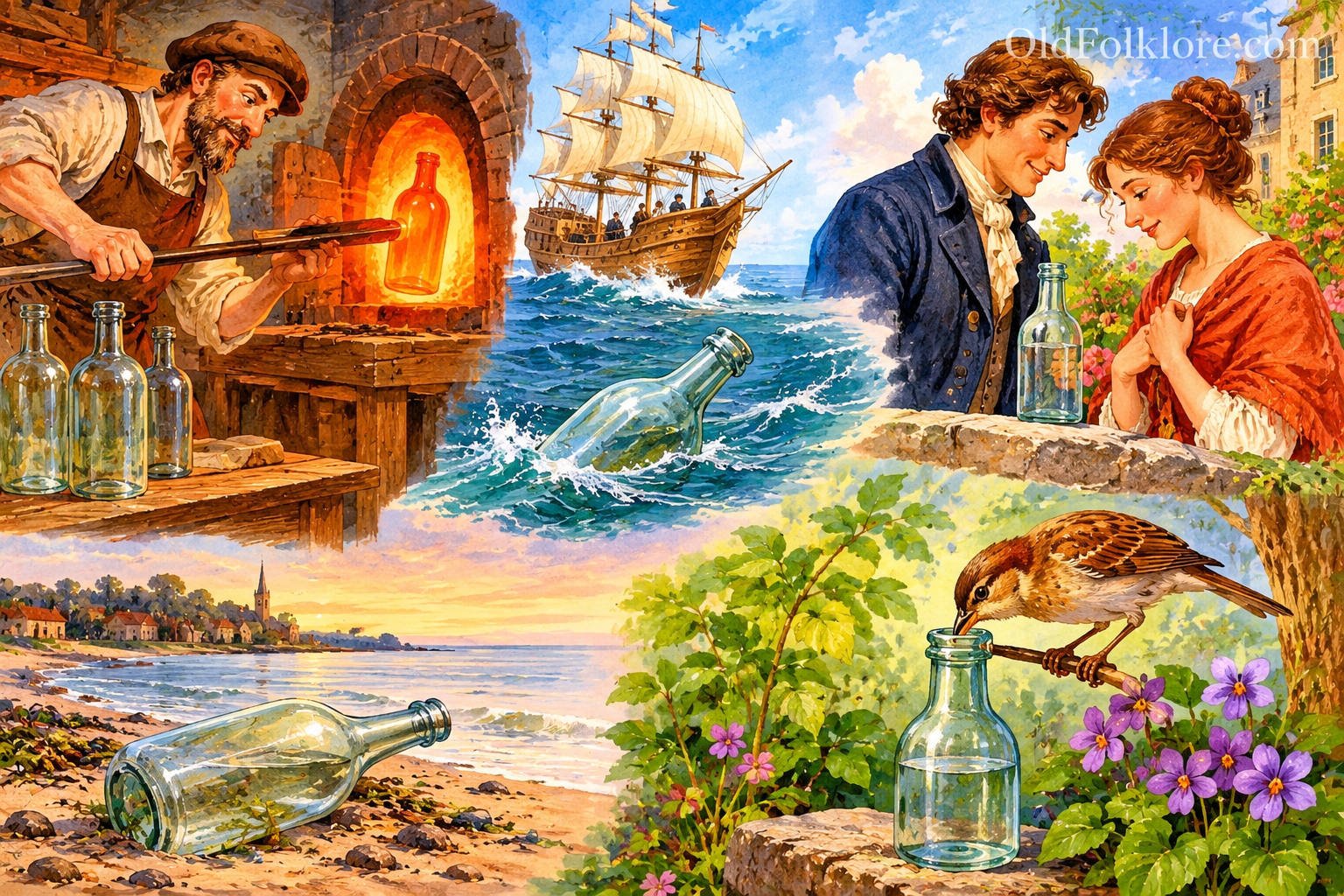
It remembered the blazing furnace where it had first taken shape. It had been blown into existence from molten glass, surrounded by countless other bottles made in the same fire. Some became champagne bottles, others beer bottles, and each seemed destined for a different life.
After cooling, they were packed together and transported to a wine merchant’s cellar. There, the bottle was unpacked, washed and filled with expensive wine. A cork was fitted into its mouth, and a label declaring it first quality was attached to its body.
The bottle felt extraordinarily important. It seemed that its contents carried the music of distant vineyards, sunny mountains and the cheerful people who tended the grapes. It was young, full of promise, and convinced that life was beautiful.
One morning, it was purchased by a tanner’s apprentice who had been sent to buy the finest wine available.
The bottle was placed inside a large provision basket alongside ham, cheese, sausages, butter and fresh bread. The tanner’s daughter had packed everything herself. She was a beautiful young woman with laughing brown eyes, delicate hands and a gentle smile.
As the family prepared for an outing in the forest, the bottle caught sight of the young woman and the sailor sitting beside her. He was the son of a portrait painter and a close friend of the family. He had recently passed his examination as a ship’s mate and was preparing to leave on a long voyage.
The young woman and the sailor had known each other for years. Their affection was clear, although the approaching separation weighed heavily on them.
The bottle could not hear their conversation from inside the basket, but it noticed that the young woman gradually became happier. By the time the family stopped in the forest, laughter had returned, and her cheeks glowed with excitement.
Then came the moment the bottle would never forget.
The girl’s father took it out and removed the cork. The sudden release made the bottle feel as though its entire body had been shaken. Its precious wine was poured into the waiting glasses.
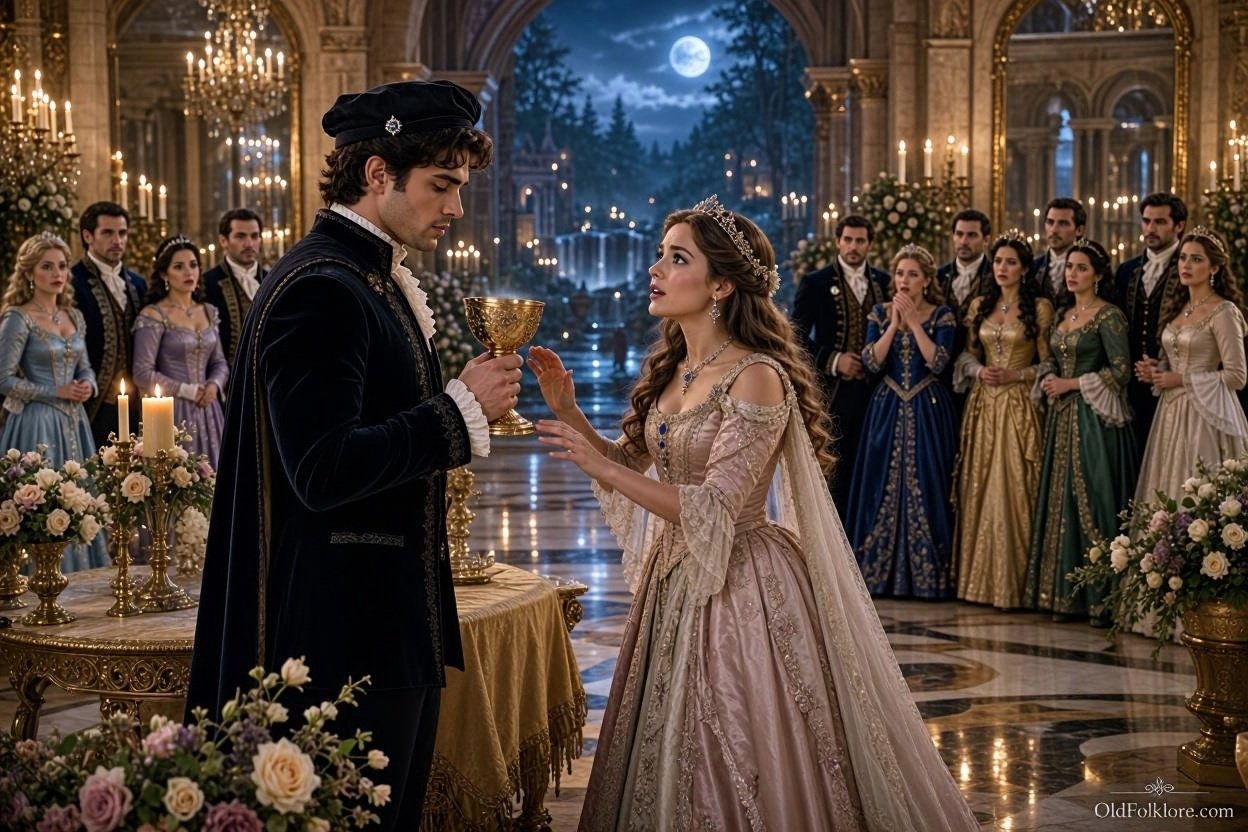
“Good health to the betrothed couple!” the father announced.
Everyone raised their glasses. The young sailor kissed his beautiful bride, and the older couple wished them happiness and blessings.
The sailor then filled the glasses again.
“May you return safely, and may we celebrate your wedding on this very day next year!” he declared.
When everyone had drunk, he took the bottle, lifted it high and made a promise.
“You have been present at the happiest day of my life. You shall never serve another!”
With that, he threw it into the air.
The bottle sailed above the gathering before falling into the thick reeds beside a little woodland lake. It lay there for some time, remembering the joyful voices of the family as they gradually disappeared into the distance.
“I gave them wine, and they have given me marsh water,” it thought. “But perhaps everything happened for the best.”
Two peasant boys eventually discovered it among the reeds and carried it home.
Their eldest brother was a sailor preparing to leave on a long voyage. His mother was packing supplies for him, including a small bottle of medicinal brandy. When the boys arrived with their discovery, the family decided that the larger bottle would be more useful.
The medicinal drink was poured into it. Although it was bitter and nothing like the fine wine it had once contained, the bottle was ready for another journey.
It was taken aboard the very ship on which the young mate, the bridegroom from the forest, was travelling.
The sailor did not recognise it. He could never have guessed that it was the same bottle from which he had drunk on the happiest day of his life.
Nevertheless, the bottle soon became popular among the crew. Whenever Peter Jensen brought it out, his companions called it The Apothecary, because it contained medicine that strengthened the weak and helped those who were unwell.
It was generous with its contents, giving out the medicinal drink until nothing remained. When rubbed with its cork, it produced its familiar musical sound, and the sailors affectionately called it Peter Jensen’s Lark.
Months passed. The bottle eventually stood empty in a corner of the ship.
Then disaster struck.
A terrible storm swept across the sea. Huge waves rose against the vessel, throwing it violently from side to side. The mainmast broke, and one of the ship’s planks was forced out of place. Water rushed in, and the pumps could no longer save the vessel.
It was a dark and frightening night.
Realising that the ship was sinking, the young mate wrote a final message on a piece of paper. He wrote that God’s will should be done and that they were going down. He included his own name, the name of his beloved and the name of the ship.
He placed the message inside an empty bottle, sealed it with a cork and threw it into the raging sea.
He did not know that the bottle was the very one that had once carried the wine at his betrothal celebration.
The ship disappeared beneath the waves, taking the young sailor and the rest of the crew with it. The bottle, however, survived. It floated across the water, carrying the final words of a man who would never return to the woman he loved.
For a long time, the currents carried it wherever they pleased. It experienced calm waters and violent storms, drifting north and south without knowing where it was going.
Eventually, it reached a distant land.
The people who found it examined the bottle and discovered the message inside. They took out the paper and studied it, turning it over repeatedly. Unfortunately, they could not understand the language in which it was written.
They realised that the bottle had been thrown into the sea and that the paper contained some kind of message, but its meaning remained a mystery.
Eventually, they returned the paper to the bottle and placed it inside a cupboard in a large house.
Whenever visitors arrived, someone would bring out the mysterious message and show it to them. But because the writing had been made in pencil, the repeated handling gradually rubbed it away.
Before long, the words could no longer be read.
After another year, the bottle was moved into a loft, where dust and cobwebs gathered around it.
There it remained for twenty years.
It often remembered its former adventures: the joyful day in the forest, the voyage across the sea and the final message it had carried through the waves. It wondered what had become of the people whose lives it had touched.
At last, the house was scheduled for renovation. The roof was removed, and the workers discovered the forgotten bottle.
They washed and cleaned it, making it look almost new again. But during the washing, the paper that had travelled so faithfully inside it was destroyed.
The bottle was then filled with seeds, corked and carefully wrapped for another journey. It travelled in darkness, unable to see the road ahead, until it finally arrived at its destination.
When it was unpacked, the people were surprised that it had survived the journey without breaking.
The bottle soon recognised the language being spoken around it. It was the familiar language it had heard in the furnace, at the wine merchant’s and in the forest. It had returned to its homeland.
Overcome with happiness, it hardly noticed when its cork was removed and its contents emptied. It was carried into a cellar and placed among other bottles.
For years, it remained there, comfortable in the familiar surroundings.
Then one evening, the bottles were brought out for a grand celebration in a beautiful garden. Colourful paper lanterns hung among the trees, glowing like flowers, while lamps illuminated the pathways. Music filled the air, and guests gathered to enjoy the festivities.
The bottle was placed among others in a quiet garden walk, where it held a light. It was once again surrounded by laughter, music and celebration, much like the day it had witnessed the young couple’s betrothal.
As it stood there, a couple passed nearby. Their presence reminded it of the sailor and the tanner’s daughter who had once walked together in the forest.
Among the visitors was an elderly unmarried woman. She, too, was thinking about a couple from long ago. Their betrothal had been one of the happiest moments of her life, and she had never forgotten it.
Neither the woman nor the bottle recognised the other. Yet they were standing in the same town, brought together again by memories of the past.
The bottle was eventually returned to the wine merchant, filled with wine and sold to an aeronaut preparing for a balloon ascent.
On the appointed Sunday, a great crowd assembled to watch the spectacle. Military music played, and the enormous balloon was prepared for its journey into the sky.
The bottle lay in a basket beside a live rabbit that was also to be taken aloft before being lowered by parachute.
As the balloon filled with air, it grew larger and larger until the ropes holding it down were released. It rose into the sky, carrying the aeronaut, the rabbit and the bottle.
The crowd cheered.
The bottle was amazed by the experience. It had travelled by land and sea, but now it was sailing through the air.
Far below, the elderly woman stood at the window of her attic room, watching the balloon. Beside her hung the birdcage, where the little chaffinch lived. A potted myrtle stood on the windowsill.
She watched as the aeronaut released the rabbit by parachute. Then he raised the bottle and drank to the health of the spectators before throwing it high into the air.
The old woman never suspected that the bottle was the same one she had seen thrown into the air on the day of her betrothal many years earlier.
The bottle, meanwhile, had reached the highest point of its extraordinary journey. Roofs and church steeples appeared tiny beneath it, and the people looked like little specks.
Then it began falling.
It spun and tumbled through the air, feeling almost as young and free as it had been when it first left the furnace. The sunlight shone upon it as the crowd watched its descent.
But its flight came to an end when it struck a roof.
The glass shattered, and the broken pieces bounced and scattered into the courtyard below. Almost everything was destroyed, except for the neck, which remained whole, its edges cut cleanly and smoothly.
Some workers examining the fragments thought the surviving piece would make an excellent drinking vessel for a bird. However, they had neither a bird nor a cage that needed one.
They remembered the old woman living in the attic. Perhaps she could use it.
So the bottle-neck was taken upstairs, fitted with a cork and placed upside down in the little birdcage. Fresh water was poured into it, giving the chaffinch a proper drinking vessel at last.
The bird immediately began singing and hopping happily.
“Yes, it is all very well for you to sing,” thought the bottle-neck.
It had become a bird’s drinking glass, and that was all anyone knew about its remarkable past. The only adventure people remembered was its journey in the balloon.
Inside the room, the old woman was entertaining a friend. They were discussing the myrtle tree standing by the window.
The visitor had a daughter who was soon to be married and was considering spending money on a bridal wreath.
“No,” the old woman insisted. “You must not spend a dollar on a wreath for your daughter. I will give you a beautiful little bouquet of flowers myself. Just look at how wonderfully this tree has grown.”
She explained that the myrtle had a history of its own.
It had grown from a cutting taken from a branch of the myrtle her friend had given her the day after her betrothal. She had intended to use it to make her own wedding wreath when the year was over.
But that wedding never happened.
“The eyes that were meant to be my happiness and joy throughout my life have closed,” she said sadly. “My beloved sleeps beneath the sea.”
Her intended husband had died in the shipwreck, and she had spent the rest of her life remembering him.
The original myrtle had eventually withered. But before it died, she had taken its final green shoot and planted it. That small cutting had grown into the beautiful tree now standing beside her window.
After all those years, it would finally serve at a wedding. Its flowers would become a wreath for her friend’s daughter.
Tears filled the old woman’s eyes as she remembered the young man she had loved and the happy day they had become engaged in the forest.
She never realised that the little bottle-neck hanging outside her window had been present at that very celebration. It had once held the wine with which their engagement was toasted, and it had heard the young sailor promise to return.
But the bottle-neck was not listening to her story.
It was too busy thinking about her.
Explore our complete Historic Folklore & Fairy-Tale Collections archive.
Moral
Life does not always follow the course we expect. Circumstances change, people experience loss, and familiar things take on new purposes. The story reminds us that something’s value is not necessarily determined by its appearance or original function. It also shows how deeply memories of love and loss can remain with someone throughout a lifetime.
Knowledge Check
1. Why was the bottle-neck hanging outside the birdcage?
It had been cut from a glass bottle and repurposed as a drinking vessel for the little chaffinch.
2. What important event did the bottle witness in the forest?
It witnessed the engagement of the tanner’s daughter and a young sailor.
3. Why did the bottle become known as Peter Jensen’s Lark?
The sailors enjoyed the musical sound it produced when rubbed with its cork, and they also valued the medicinal brandy it carried.
4. What happened to the young sailor?
His ship sank during a terrible storm. Before dying, he placed a final message inside the bottle and threw it into the sea.
5. Why was the message never delivered to the sailor’s fiancée?
The people who discovered it could not understand the language in which it was written. Eventually, the pencil writing became illegible, and the paper was destroyed when the bottle was washed.
6. What happened to the bottle at the end of its journey?
It broke after being thrown from a balloon, but its neck survived and was turned into a drinking vessel for the chaffinch.
7. What did the old woman reveal about the myrtle tree?
It had grown from a cutting taken from the myrtle given to her after her engagement. She had originally intended to use it for her own bridal wreath, but her fiancé died before they could marry.
Source
The original story, Flaskehalsen (The Bottle-Neck), was written by Danish author Hans Christian Andersen and first published in 1857 in Folkekalender for Danmark.
Explore More Hans Christian Andersen Tales
- The Snowman: A Danish Folktale by Andersen
- The Farmer Who Traded His Horse for Rotten Apples
- The Beetle Who Wanted Golden Shoes
- The Goblin and the Huckster: Hans Christian Andersen