A young prince’s curiosity leads him into an adventure that takes him far beyond his parents’ kingdom. When he hears of Princess Labam, whose beauty is said to illuminate the night, he becomes determined to find her, even though nobody can tell him where her country lies. His journey brings him into contact with creatures in need, a group of quarrelling fakirs and a mysterious old woman. Through kindness, cleverness and unexpected friendships, he gains the help he needs to overcome the difficult challenges that stand between him and the princess.
The Prince Hears of Princess Labam
In a certain country, a Raja lived with his wife, the Rani, and their only son. The young prince enjoyed hunting and went out regularly to explore the land around his father’s kingdom.
One day, his mother gave him an unusual instruction. She told him that he could hunt on three sides of their country but must never venture towards the fourth.
The Rani had a particular reason for this warning. She knew that if her son went in that direction, he might hear about the beautiful Princess Labam. Once he learnt of the princess, she feared he would leave his parents and travel in search of her.
For some time, the prince obeyed his mother’s wishes. However, curiosity eventually overcame him. While hunting in the permitted areas one day, he remembered the forbidden direction and wondered why his mother had warned him against it.
He decided to investigate.
When he reached the fourth side, he entered a jungle filled with parrots. The prince raised his gun and shot at some of the birds. Most flew away, but one remained behind. This parrot was their king, known as Hiraman.
Hiraman called after the other parrots, warning them not to abandon him. If they left him alone while the prince continued shooting, he threatened to tell Princess Labam.
The parrots immediately returned, chattering around their king.
The prince was astonished. He had never seen birds speak before, so he asked them who Princess Labam was and where she lived.
The parrots refused to reveal her location. They only told him that he could never reach her country.
Their answer troubled the prince deeply. He threw away his gun, returned home and became so unhappy that he refused to speak or eat. For four or five days, he remained in bed, appearing seriously ill.
At last, he explained his longing to his parents. He wanted to find Princess Labam and see her for himself.
His father and mother admitted that they did not know where her country was. They begged him to remain at home because he was their only child. They feared that he would never find the princess and might die during the journey.
But the prince would not change his mind. He believed that he had to try, even if the journey cost him his life.
His parents eventually agreed to let him go. His father provided fine clothes, a horse, weapons and plenty of rupees. His mother prepared sweetmeats, wrapping them in her handkerchief so that he would have food along the way.
After saying goodbye, the prince mounted his horse and began his journey.
The Prince Helps the Ants and the Tiger
The prince travelled until he reached a jungle with a tank and shady trees. He bathed himself and his horse, then sat beneath a tree to eat the sweetmeats his mother had packed.
When he opened the handkerchief, he discovered ants inside the sweets. He took out one sweetmeat after another, but every piece contained ants.
Rather than eat them or destroy them, the prince placed all the sweetmeats on the ground and allowed the ants to feed.
The Ant-Raja appeared before him and thanked him for his kindness. He promised that whenever the prince found himself in trouble, he should think of the ants, and they would come to his assistance.
The prince thanked the Ant-Raja and continued his journey.
He soon reached another jungle, where he heard a tiger roaring in pain. The animal had a thorn lodged in its foot and explained that it had suffered from the injury for twelve years.
The prince offered to remove the thorn. However, he feared that the tiger might eat him once it was free from pain.
The tiger promised not to harm him.
The prince took a small knife and carefully cut the thorn from the animal’s foot. The tiger roared loudly as he removed it, attracting the attention of his wife, who lived in a neighbouring jungle.
When she came running, the tiger hid the prince so that she would not see him. She demanded to know who had hurt her husband.
The tiger explained that a Raja’s son had removed the thorn. His wife insisted on meeting the young man, but the tiger first made her promise not to kill him.
She agreed, and the prince came out of hiding.
The two tigers welcomed him with respectful greetings and offered him a good dinner. He stayed with them for three days, during which he continued checking the injured foot. By the third day, the wound had healed completely.
When the prince prepared to leave, the tiger thanked him and promised that he and his wife would help whenever he needed them.
Explore more stories from our Joseph Jacobs’ Indian Fairy Tales collection.
The prince continued towards his destination, grateful for the friendships he had made along the way.
The Four Fakirs and Their Magical Treasures
After travelling through another jungle, the prince came upon four fakirs who were quarrelling over the possessions of their deceased teacher.
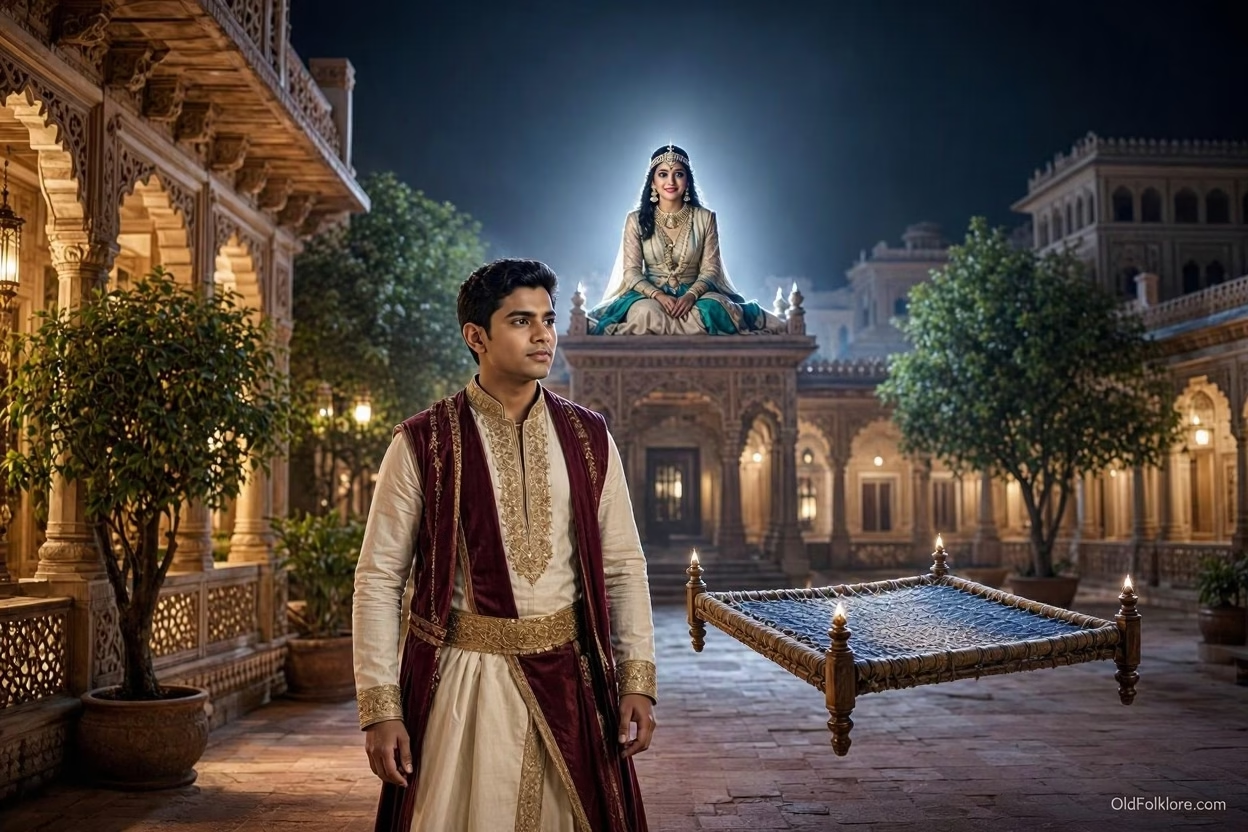
The teacher had left them four extraordinary objects. The first was a small bed that could carry anyone sitting on it wherever they wished to go. The second was a bag that produced anything its owner requested, including food, clothing and jewels.
The third object was a stone bowl that supplied as much water as its owner needed, even when there was no tank nearby. The final possession consisted of a stick and a rope. When their owner commanded the stick to beat an approaching army, it would attack the soldiers while the rope tied them up.
Each fakir wanted the treasures, and none would surrender his claim.
The prince listened to their argument and proposed a solution. He offered to shoot four arrows in different directions. The fakir who retrieved the first arrow would receive the magical bed. The person who found the second would get the bag, the third would earn the water bowl, and the last would receive the stick and rope.
The fakirs accepted the arrangement.
The prince shot the first arrow, and all four men hurried after it. When they returned, he shot the second, then the third, and finally the fourth. Each time, the fakirs ran off to retrieve the arrow.
While they were searching for the last one, the prince acted quickly. He released his horse into the jungle, climbed onto the magical bed and gathered the other three treasures.
He commanded the bed to take him to Princess Labam’s country.
Immediately, it rose into the air and flew away. It carried him across the distance until it landed in the country he had been seeking.
The prince asked some men nearby whose kingdom it was. They confirmed that he had reached the country of Princess Labam.
At last, his long journey had brought him to the place he had hoped to find.
The Old Woman’s House and the Princess’s Radiance
The prince continued until he came to a house where an old woman lived. She asked who he was and where he had come from.
He explained that he was a traveller from a distant country and requested permission to stay for the night.
The woman initially refused. Her king had forbidden people from other countries to lodge in his kingdom, and she feared imprisonment if he discovered that she had sheltered a stranger.
The prince pleaded with her, explaining that night was approaching and wild animals might attack him if he slept outside.
The old woman eventually agreed to let him remain for one night, but warned him that he would have to leave the following morning.
When she began preparing dinner, the prince stopped her. He brought out his magical bag and asked it to provide a meal. At once, it produced a delicious dinner served on two gold plates.
The old woman was amazed. After they ate, she offered to fetch water, but the prince used his magical stone bowl instead. He commanded it to fill with water, and it supplied as much as they needed.
As darkness approached, the prince asked why she did not light a lamp.
The old woman explained that the king had forbidden lamps throughout the country. His daughter, Princess Labam, came out each night and sat on the roof of her palace. Her extraordinary radiance illuminated the entire kingdom, allowing the people to continue their work as though it were daylight.
When night fell, the prince watched as the princess dressed in rich clothes and jewels. She arranged her hair and placed a band of diamonds and pearls across her head. Her beauty shone like the moon, brightening the darkness around her.
She sat on the roof of the palace, and the prince watched her with admiration.
During the day, the princess remained inside her house. Only at night did she appear, and her light allowed the people of her father’s kingdom to carry on with their activities.
At midnight, when everyone had retired, the princess returned to her room and fell asleep.
The prince then climbed onto his magical bed and asked it to carry him to her bedroom. Using his bag, he produced a large quantity of betel-leaf and placed it near her bed before returning to the old woman’s house.
The following morning, the princess’s servants discovered the betel-leaf and began eating it. When she asked where it had come from, they explained that they had found it near her bed. Nobody knew how it had appeared there.
The Shawl, the Ring and the Prince’s Identity
The old woman continued to worry about the prince’s presence in her house. She reminded him that the king might punish her if he discovered that she had sheltered a foreign visitor.
The prince asked her to allow him to stay another day, claiming that he was unwell.
She agreed.
That night, the princess again appeared on the roof, shining brightly over the kingdom. At midnight, she returned to her bedroom and fell asleep.
The prince used his magical bed to visit her room once more. This time, he asked his bag to produce a beautiful shawl. He spread it over the sleeping princess and returned to the old woman’s house.
In the morning, the princess was delighted to find the splendid shawl. She showed it to her mother and believed that Khuda must have sent her such a beautiful gift.
Her mother agreed that it was a wonderful present.
The old woman again told the prince that he must leave. However, he persuaded her to let him remain hidden for a few more days.
On the third night, he visited the princess again. He asked his bag for a beautiful ring and gently took the princess’s hand to place it on her finger.
This time, she woke up.
Frightened, she demanded to know who he was and why he had entered her bedroom.
The prince reassured her that he was not a thief. He explained that he was the son of a great Raja and that Hiraman, the talking parrot, had told him about her. After hearing her name, he had left his parents and travelled a great distance to find her.
The princess listened to his explanation. She agreed that, because he was the son of a great Raja, she would not have him killed. She also told him that she wished to marry him and would inform her parents.
The prince returned to the old woman’s house.
The next morning, Princess Labam told her mother about the young man and expressed her wish to marry him. Her mother carried the news to the king.
The king agreed to consider the marriage, but he imposed a condition. The prince would have to complete a series of seemingly impossible tasks. If he failed, the king would have him killed.
The King Sets the First Three Tasks
The king’s first challenge involved eighty pounds of mustard seed. The prince had to extract all the oil from the seeds within a single day and bring it to the king the following morning.
When the prince heard the condition, he became frightened. He had no idea how he could crush so much mustard seed in such a short time.
He returned to the old woman’s house with the seeds and wondered what to do.
Then he remembered the Ant-Raja.
As soon as he thought of the ants, the Ant-Raja and his followers appeared. They asked why he looked so unhappy.
The prince explained the king’s demand. The Ant-Raja assured him that he should not worry. The ants would crush all the mustard seed while he rested.
The prince lay down, and the ants carried out their promise. By the following morning, they had extracted all the oil.
He took it to the king, who was surprised that he had completed the task.
However, the king had no intention of allowing the marriage so easily. He announced a second challenge: the prince had to fight and kill two demons.
The king had captured the demons long before and kept them locked in a cage. He feared releasing them because they might devour the people of his kingdom. He had therefore decided that any prince seeking his daughter’s hand would have to fight them.
The young Raja was distressed. He could not imagine defeating two dangerous demons.
Then he remembered the tiger and his wife.
The two animals appeared when he thought of them and asked what troubled him. The prince explained the king’s demand, and the tiger promised that they would fight the demons for him.
The prince used his magical bag to produce two splendid coats decorated with gold, silver, pearls and diamonds. He dressed the tigers in the beautiful garments and presented them to the king.
He asked whether the tigers could fight the demons on his behalf.
The king agreed because he cared only that the demons should be killed. When the cage was opened, the tigers fought the creatures and eventually defeated them.
The prince had completed the second task.
But the king imposed another condition. Somewhere high in the sky stood his kettle-drum, and the prince had to climb up and beat it.
The young man returned to the old woman’s house and used his magical bed. He commanded it to carry him to the drum.
The bed rose into the sky, and the prince reached the instrument. He beat it loudly enough for the king to hear.
When he returned, the king acknowledged that he had completed the third challenge. Yet he still refused to give him Princess Labam’s hand.
Princess Labam’s Hair and the Final Challenge
The king brought out a very thick tree trunk and gave the prince a hatchet made of wax.
He ordered him to cut the trunk in two by the following morning. If he failed, he would die.
The prince returned to the old woman’s house in despair. He had managed the mustard seed with the ants, defeated the demons with the tigers and reached the kettle-drum with his magical bed. But he could not see how a wax hatchet could cut through a thick tree trunk.
That night, he used his bed to visit Princess Labam and told her about the king’s latest demand.
The princess listened and reassured him. She told him not to be afraid because she knew how he could complete the task.
She pulled a hair from her head and gave it to him. She instructed him to wait until nobody was nearby, then speak to the tree trunk and tell it that Princess Labam commanded it to allow itself to be cut by the hair.
He was then to stretch the hair along the edge of the wax hatchet’s blade.
The next day, the prince followed her instructions exactly. He placed the hair along the blade and touched it to the tree trunk.
Immediately, the trunk split into two pieces.
The king could no longer refuse him. He announced that the prince could marry his daughter.
The Wedding and the Return Home
The wedding celebrations were grand. Rajas and kings from neighbouring countries were invited, and the marriage was celebrated with great rejoicing.
After a few days, the prince spoke to Princess Labam about returning to his father’s kingdom.
Her father gave the newly married couple camels, horses, rupees and servants for their journey. They travelled in great state to the prince’s country.
When they arrived, the prince’s parents welcomed them, delighted to see their only son again and to meet the princess he had travelled so far to find.
The prince and Princess Labam settled into their new life and lived happily together.
He continued to keep his magical bag, water bowl, flying bed, stick and rope. The stick and rope remained unused because nobody ever came to make war against him.
Thus, the prince’s journey ended with the marriage he had pursued, the return to his family and the lasting friendship of those who had helped him along the way.
Explore our complete Historic Folklore & Fairy-Tale Collections archive.
Moral Lesson
The story highlights the value of kindness, gratitude, courage and perseverance. The prince helps the ants and the injured tiger without demanding anything in return. Their gratitude later becomes essential when he faces challenges he cannot overcome alone.
His journey also shows that determination must be supported by good judgement and the willingness to accept help. The prince does not succeed through strength alone. He relies on the kindness of others, the magical gifts he receives and Princess Labam’s intelligence.
Princess Labam also plays an important role in securing their future. Her advice helps the prince overcome the final challenge, showing that wisdom and cooperation can achieve what physical strength cannot.
Knowledge Check
1. Why did the Rani forbid her son from hunting on the fourth side of their country?
She feared that he would hear about Princess Labam, leave his parents and travel in search of her.
2. How did the prince earn the Ant-Raja’s gratitude?
He allowed the ants to eat the sweetmeats instead of harming them after discovering them inside his mother’s food.
3. What did the prince do for the tiger?
He removed a thorn that had been lodged in the tiger’s foot for twelve years.
4. What four magical possessions did the prince obtain from the quarrelling fakirs?
He obtained a flying bed, a wish-granting bag, a water-supplying stone bowl, and a stick and rope that could defeat and bind an attacking army.
5. How did the prince complete the king’s first three challenges?
The ants extracted the mustard oil, the tigers killed the two demons, and the flying bed carried him to the king’s kettle-drum in the sky.
6. How did Princess Labam help the prince complete the final challenge?
She gave him one of her hairs and instructed him to stretch it along the edge of the wax hatchet. When he touched the tree trunk with it, the trunk split in two.
Source
This story is adapted from “How the Raja’s Son Won the Princess Labam,” included in Joseph Jacobs’s Indian Fairy Tales (1892), Chapter II, page 3.
Explore More Joseph Jacobs’ Indian Fairy Tales