In the mountains of Wales, a tragic legend tells of a faithful greyhound whose loyalty was repaid with a terrible injustice. Gellert was a beloved companion of Prince Llewelyn, a courageous hunting dog who was also gentle and affectionate within the castle. He was trusted around the prince’s young son and was known for his devotion to his master.
One day, while Llewelyn was away hunting, a dangerous wolf entered the castle and threatened the child. Gellert fought the intruder and saved the little boy, but the prince returned to find blood on the dog and disorder in the nursery. Without discovering the truth, he made a decision that would haunt him for the rest of his life.
The Prince and His Beloved Greyhound
Prince Llewelyn had a favourite greyhound named Gellert, a remarkable animal given to him by his father-in-law, King John. The prince treasured the dog because of his unusual combination of gentleness and courage.
At home, Gellert behaved like a mild and affectionate companion. He was comfortable around the prince and those who lived within the castle. During a hunt, however, he became a different creature. He was swift, fearless and determined, making him one of the finest hounds in Llewelyn’s company.
The dog was not valued merely for his usefulness in the chase. He was also a trusted companion who watched over his master. He stayed close to Llewelyn, served him faithfully and guarded his resting place. The prince had every reason to believe that Gellert would remain loyal in every circumstance.
There was also a special bond between the greyhound and Llewelyn’s young son, who was about a year old. The child often played with the dog, and Gellert was accustomed to being near him. The prince had no reason to suspect that the animal would ever harm his little boy.
The Hunt Begins Without Gellert
One morning, Llewelyn prepared to go hunting. The day was beginning, and the hunting party was ready to leave the castle.
Standing outside, the prince raised his hunting horn and sounded the familiar call that summoned his hounds. The dogs responded, gathering as they recognised the signal. Their excitement filled the morning air as the hunters prepared to ride out.
Explore more stories from our Joseph Jacobs’ Celtic Fairy Tales collection
But one dog was missing.
Gellert did not appear.
Llewelyn was surprised because his favourite hound had always been eager to join him. He sounded the horn again, this time with greater force, and called the greyhound by name.
Still, there was no response.
The prince wondered where his faithful companion could have gone. Gellert was not usually absent when the hunting horn sounded, and his failure to appear was unlike his usual behaviour.
After waiting for some time, Llewelyn decided that he could delay no longer. He gathered the other hounds and continued with the hunting party, leaving Gellert behind.
As the hunters travelled through the rugged countryside, their calls and the sounds of the chase echoed across the rocks and valleys of Snowdon. The dogs pursued the game, and the party moved through the mountainous landscape.
Yet the prince could not enjoy the outing as he normally would. Gellert was the swiftest and boldest of his hounds, and his absence was deeply felt. The hunt produced little satisfaction, and the day’s sport was disappointing.
Llewelyn eventually turned towards home, irritated by the poor results and still wondering why his favourite dog had failed to answer his call.
Gellert Returns Covered in Blood
As Llewelyn approached his castle, he noticed a familiar figure coming towards him.
It was Gellert.
The greyhound bounded out to welcome his master, appearing pleased to see him. Normally, such a greeting would have delighted the prince. But as the dog drew nearer, Llewelyn noticed something deeply disturbing.
Gellert was covered in blood.
His mouth and teeth were stained, and blood ran from his lips and fangs. The prince stopped in alarm. He had never seen the gentle animal return in such a condition.
Gellert, unaware of the terrible conclusion forming in his master’s mind, approached him with the same affection as before. But when he sensed Llewelyn’s reaction, he lowered himself at the prince’s feet.
The dog appeared confused by the sudden change in his master’s manner. He had expected a welcome, not fear and suspicion.
Llewelyn looked at the blood on the greyhound and immediately thought of his young son.
The child had been left within the castle, and Gellert was one of the animals allowed near him. A dreadful possibility entered the prince’s mind. Had the dog attacked the boy?
Unable to dismiss the thought, Llewelyn hurried towards the nursery.
The Terrible Discovery in the Nursery
As the prince rushed through the castle, he began noticing signs of disorder. There were bloodstains in places where he did not expect to find them, and the rooms appeared to have been disturbed.
His fear increased with every step.
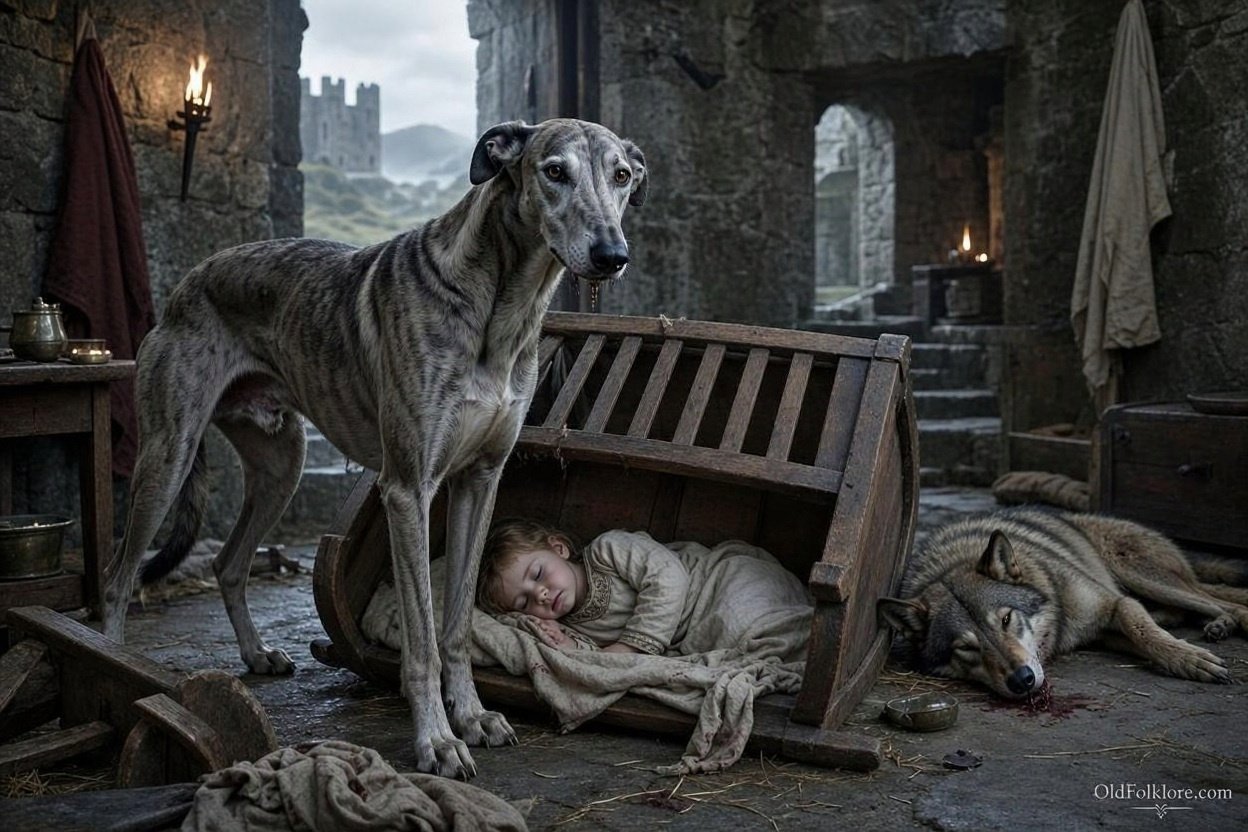
When he reached the nursery, the sight before him was horrifying. The child’s cradle had been overturned, and the covering was stained with blood. The room showed evidence of a violent struggle.
Llewelyn called for his son, but no answer came.
He searched the nursery, looking for the child. He examined the disturbed surroundings and found more blood, but the little boy was nowhere to be seen.
The prince’s fear turned into panic. He could not understand what had happened in his absence, and the blood on Gellert seemed to offer an explanation.
He imagined that the greyhound had attacked the child and that the evidence of the struggle was spread throughout the room.
Rather than stopping to investigate further, Llewelyn allowed his fear to become certainty. He believed that his beloved hound had destroyed the very child he had once been trusted to protect.
The thought filled him with rage.
The Prince Kills the Faithful Dog
Llewelyn turned towards Gellert, who had followed him into the nursery area.
The greyhound still did not understand why his master was treating him with such hostility. He had returned from a struggle in which he had defended the prince’s son, but the blood on his body made him appear guilty.
Overcome by grief and anger, Llewelyn accused the dog of devouring his child.
He drew his sword and struck Gellert, driving the blade into the greyhound’s side.
The faithful animal fell.
Even as he lay dying, Gellert continued to gaze towards his master. His final look carried no explanation that Llewelyn could understand. The prince had acted before learning the truth, and the dog could no longer defend himself.
Then a sound interrupted the terrible silence.
As Gellert gave his dying cry, another cry answered from beneath the overturned cradle.
It was the voice of a child.
Llewelyn turned towards the sound. Beneath the disturbed bedding and the fallen cradle, he found his little son alive and unharmed. The child had been concealed from his search and had only just awakened.
But the prince’s discovery did not end there.
Beside the child lay the body of a great, gaunt wolf. The animal had been torn apart in a desperate struggle, and its body was covered in blood.
At once, Llewelyn understood what had happened.
The Truth About Gellert’s Courage
The wolf had entered the nursery while the prince was away. It had threatened the helpless child, who was too young to protect himself.
Gellert had remained behind when the hunting party departed. When the wolf entered the castle and approached the child, the greyhound had fought it.
The struggle had been violent. The wolf was a dangerous opponent, but Gellert had attacked with all his strength and killed the intruder before it could destroy the prince’s son.
The blood on the dog’s mouth had come from that battle. The overturned cradle and the disorder in the nursery were evidence of the fight between the two animals.
The child had survived because Gellert had stood between him and the wolf.
The prince had therefore killed the very creature that had saved his son.
His favourite hound had not betrayed him. Gellert had remained faithful even when his master was absent, protecting the child entrusted to his care. Yet Llewelyn had mistaken the signs of that protection for evidence of an attack.
The truth came too late to change what had happened.
The prince’s grief was overwhelming. He looked upon the dead greyhound and understood that no apology or expression of sorrow could restore the life he had taken.
The Grave of Gellert
Llewelyn could not bring his faithful dog back to life. His regret remained, and the memory of his terrible mistake became a burden he could never escape.
He decided that Gellert deserved a resting place where his courage would not be forgotten. The prince arranged for the dog to be buried outside the castle walls, within sight of the great mountain of Snowdon.
Over the grave, he raised a large cairn of stones. In Spencer’s fuller poem, the memorial is described as an honoured resting place, decorated to preserve the memory of the faithful animal. Llewelyn also associated the place with the objects of the hunt, remembering the days when Gellert had accompanied him through the mountains.
The grave became a reminder of the dog’s loyalty and of the prince’s rashness. Those who passed the place were expected to remember the tragedy and the price of acting without knowing the truth.
The name associated with the grave was Beth Gellert, also written as Bedd Gellert, understood in the legend as the Grave of Gellert.
The story also became connected with a saying expressing deep regret for an irreversible mistake: the sorrow of the man who killed his greyhound.
Thus, Gellert’s memory endured not only as that of a brave and faithful dog but also as a warning about the consequences of suspicion and uncontrolled anger.
The Historical Background of the Legend
Although the story is associated with the Welsh village of Beddgelert and Prince Llewelyn, its historical origin requires care.
In the notes to Celtic Fairy Tales, Joseph Jacobs explains that his retelling was based on the poem Beth Gêlert, or the Grave of the Greyhound, written by the Hon. William Robert Spencer. The poem was first printed as a broadsheet in 1800 and later appeared in Spencer’s Poems in 1811.
Jacobs also questions the claim that the story had been preserved as an ancient local tradition from the time of Prince Llewelyn. He observes that earlier accounts of the place do not establish the familiar dog legend. His notes discuss the work of Edward Jones and the later popularisation of the story through Spencer’s poem.
Jacobs further connects the underlying tale of a person killing a faithful animal through a tragic misunderstanding with much older story traditions that travelled across cultures. He therefore distinguishes the long history of the wider tale from the comparatively recent association of the Gellert story with Beddgelert.
The legend should consequently be read as a literary retelling associated with Welsh tradition, rather than as a verified account of a documented incident in Prince Llewelyn’s life.
Explore our complete Historic Folklore & Fairy-Tale Collections archive.
Moral Lessons
The legend of Beth Gellert teaches the importance of patience and careful judgement. Prince Llewelyn saw blood on his dog and disorder in the nursery, but he did not investigate the circumstances before deciding that Gellert was responsible for his child’s disappearance. His assumption led to an irreversible act.
The story also celebrates loyalty and selfless courage. Gellert protected the prince’s young son even in his master’s absence. The dog did not abandon the child when danger arrived, and his actions saved a life.
Another lesson concerns the destructive power of uncontrolled anger. Llewelyn allowed fear to overwhelm his judgement. By acting immediately, he destroyed the faithful companion who had served him so well.
Finally, the tale reminds readers that discovering the truth after an irreversible decision can bring a lifetime of regret. The prince eventually understood Gellert’s bravery, but that knowledge could not undo his mistake.
Knowledge Check
1. Who gave Gellert to Prince Llewelyn?
Gellert was given to the prince by his father-in-law, King John.
2. Why did Llewelyn leave Gellert behind when he went hunting?
The greyhound failed to answer the hunting horn, even after the prince called him by name.
3. What made Llewelyn suspect that Gellert had harmed his son?
He saw blood on the dog’s mouth and found the child’s cradle overturned and stained with blood.
4. What had actually happened in the nursery?
A wolf had entered the nursery and threatened the child. Gellert fought and killed the wolf, protecting the boy.
5. Why did Llewelyn regret killing Gellert?
He discovered that the dog had saved his son rather than attacked him.
6. What does Beth Gellert mean in the legend?
It is understood as the Grave of Gellert, the place associated with the greyhound’s burial.
Source
Retold from Joseph Jacobs, Celtic Fairy Tales (1892), “Beth Gellert”.
Original literary source: The Hon. William Robert Spencer, “Beth Gêlert, or the Grave of the Greyhound”, first printed as a broadsheet in 1800 and later published in Poems (1811).
Source attribution: Joseph Jacobs selected and edited Celtic Fairy Tales and retold Spencer’s poem in prose. William Robert Spencer was the poet whose ballad Jacobs paraphrased. The story is associated with Welsh legend, but its connection to Prince Llewelyn and Beddgelert should not be presented as established historical fact.
Digital source: Project Gutenberg, Celtic Fairy Tales, eBook 7885. The collection identifies Joseph Jacobs as compiler and reproduces his story and notes.
Explore More Joseph Jacobs’ Celtic Fairy Tales
- The Field of Boliauns: An Irish Folktale
- Connla and the Fairy Maiden: A Celtic Fairy Tale
- Guleesh: The Irishman Who Rescued a French Princess
- The Sprightly Tailor
- Fair, Brown, and Trembling at the Royal Church