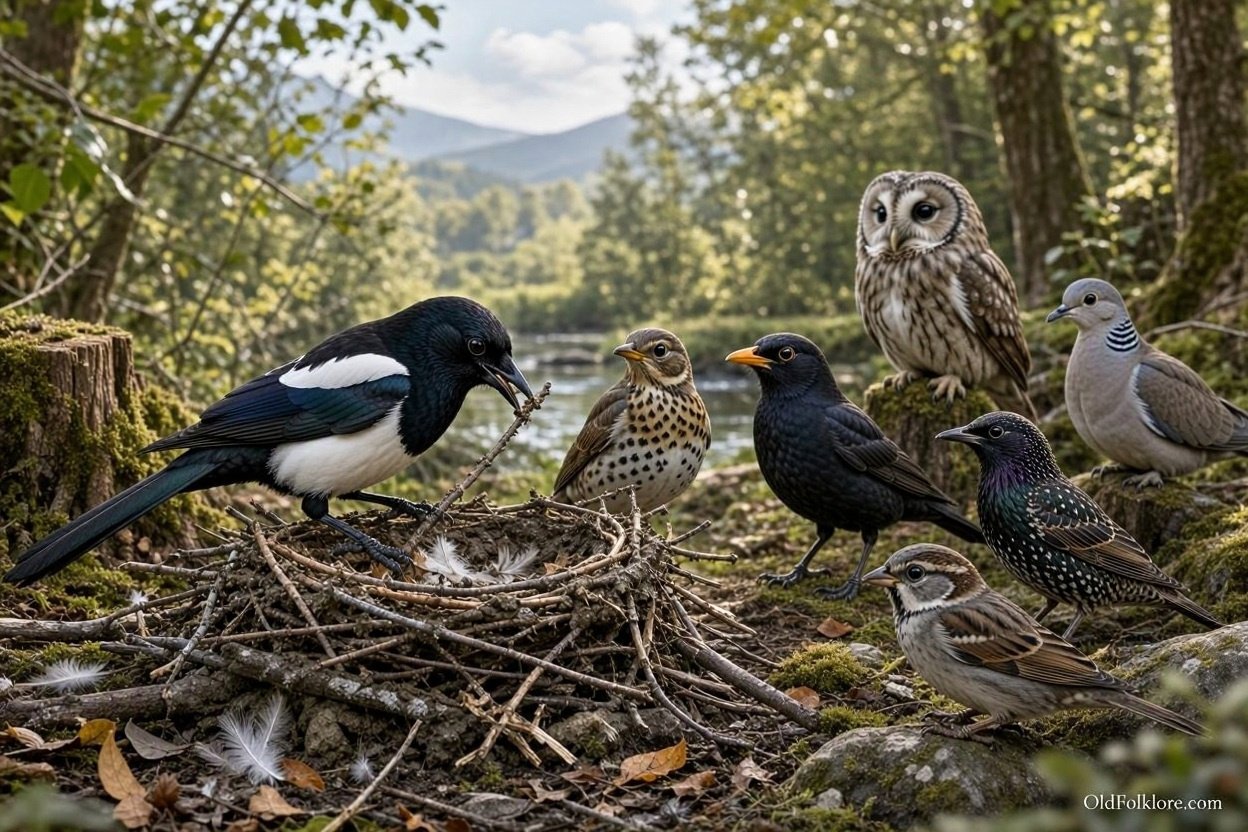
Long ago, the birds of the air decided they needed help learning how to build their nests. They turned to the magpie, a bird renowned in this tale for her skill at nest-building. Confident in her knowledge, she gathered them together and began demonstrating each stage of the work.
However, the birds were not patient learners. One after another, they hurried away as soon as they thought they had understood enough. By the time the lesson ended, the magpie had discovered that teaching a group of eager but impatient pupils was not an easy task.
The Birds Gather Around the Magpie
Once upon a time, when pigs spoke rhyme, monkeys chewed tobacco, hens took snuff to make themselves tough and ducks went quack, quack, quack, all the birds of the air gathered around the magpie.
They had come to ask her to teach them how to build nests. The magpie was considered the cleverest bird at this task, so the others believed she could show them how to make comfortable homes for themselves.
The magpie agreed to help. She brought the birds together and began her demonstration.
First, she collected some mud and shaped it into a round cake. Before she could explain the next step, the thrush watched her work and decided that it had already learnt enough.
Explore more stories from our Joseph Jacobs’ English Fairy Tales collection.
“Oh, that’s how it’s done,” said the thrush.
It immediately flew away, carrying only that first part of the lesson with it. According to the tale, this was how the thrush came to build its nest.
The magpie continued without stopping. She gathered some small twigs and arranged them around the mud.
The blackbird watched carefully. It believed the method was now clear.
“Now I know all about it,” said the blackbird.
It flew away before the magpie could demonstrate anything further. The tale explains that blackbirds have continued making their nests in that manner ever since.
Each Bird Learns Only Part of the Lesson
The magpie was still determined to finish her demonstration. She placed another layer of mud over the twigs.
The owl observed this new step and decided that it had understood the entire process.
“Oh, that’s quite obvious,” it declared.
Then it flew away. The tale humorously suggests that owls have never improved their nest-building since leaving the lesson so early.
Next, the magpie collected more twigs and carefully twined them around the outside of the nest.
The sparrow watched and immediately recognised what it considered the important part.
“The very thing!” it exclaimed.
Without waiting for the remaining instructions, the sparrow flew away. The magpie was left to continue her work alone, while the sparrow carried away only the knowledge it had chosen to understand. The story links this hurried lesson to the rather untidy nests sparrows make.
The magpie then turned her attention to making the nest comfortable. She gathered feathers and other soft materials and used them to line the inside.
The starling was pleased with this final touch.
“That suits me,” it cried.
It too flew away, satisfied with the small portion of the demonstration it had witnessed. The tale explains that starlings consequently make very comfortable nests.
One by one, the birds had taken away something from the magpie’s lesson. None had remained long enough to watch the entire process.
The Turtle-Dove Interrupts the Lesson
While the other birds departed, the magpie continued working. She added one part after another, concentrating on the nest and giving little attention to what was happening around her.
Eventually, only the turtle-dove remained.
Unlike the other birds, the turtle-dove had not been watching the demonstration. It had spent the lesson repeating its familiar cry:
“Take two, Taffy, take two-o-o-o.”
The magpie carried on until she reached the point where she needed to place a twig across the nest. Hearing the turtle-dove’s repeated call, she answered:
“One’s enough.”
But the turtle-dove continued:
“Take two, Taffy, take two-o-o-o.”
The magpie became irritated.
“One’s enough, I tell you,” she insisted.
Still, the turtle-dove would not stop repeating its cry. It continued urging her to take two.
At last, the magpie looked up. She had been so occupied with her work that she had not realised all the other birds had disappeared. Only the turtle-dove remained, still repeating the same words without paying attention to her instructions.
The magpie became thoroughly angry. She abandoned the lesson, flew away and refused to teach the birds how to build their nests again.
And that, according to the tale, is why different birds build their nests differently. Each had left the demonstration before learning the complete method, taking away only the part it had seen.
Explore our complete Historic Folklore & Fairy-Tale Collections archive.
Moral Lessons
The Magpie’s Nest offers a humorous reminder that learning requires patience and attention. The birds were eager to acquire a useful skill, but most of them left as soon as they believed they had understood enough. Because they did not wait for the complete demonstration, each learned only a portion of the process.
The story also highlights the importance of listening carefully before reaching a conclusion. The birds assumed that the first steps they witnessed were all they needed to know. Their haste prevented them from understanding the full lesson.
Finally, the tale reminds readers that a teacher can offer guidance, but learners must also be willing to pay attention. Knowledge is more useful when people take the time to understand it properly rather than rushing away with incomplete information.
Knowledge Check
1. Which bird taught the others how to build nests?
The magpie taught the other birds how to build their nests.
2. Why did the birds approach the magpie?
They believed she was particularly clever at building nests and wanted her to teach them.
3. Why did the thrush leave the lesson early?
It believed it had learnt enough after watching the magpie shape mud into a round cake.
4. Which bird left after the magpie arranged twigs around the mud?
The blackbird left after watching that stage of the demonstration.
5. What did the turtle-dove keep repeating?
It repeatedly cried, “Take two, Taffy, take two-o-o-o.”
6. Why did the magpie abandon the lesson?
She became angry because the turtle-dove continued repeating its call instead of paying attention to her instructions. She flew away and refused to teach the birds again.
Source
Retold from Joseph Jacobs, English Fairy Tales (1890), “The Magpie’s Nest” (original printed heading: “THE MAGPIE’S NEST”).
Explore More Joseph Jacobs’ English Fairy Tales
- The Horned Women: An Irish Folktale of Twelve Witches
- The Three Sillies: An English Fairy Tale
- Cap o’ Rushes: An English Fairy Tale
- Kate Crackernuts: An English Fairy Tale
- The Old Woman and Her Pig
- How Jack Went to Seek His Fortune
- The Story of the Three Bears
- Henny-Penny and the Farmyard Animals