A wicked magician named Punchkin holds the power to transform people into stones and trees, keeping his victims beyond the reach of their families. When a young prince discovers that his missing relatives have fallen into the magician’s hands, he sets out to rescue them. His journey leads him to a dangerous secret: Punchkin’s life depends on a small green parrot hidden far away, protected by supernatural guardians.
The Seven Princesses
Once upon a time, a Raja had seven beautiful daughters. The youngest, Balna, was cleverer than her six elder sisters. Their mother had died when they were very young, so the girls took turns preparing their father’s dinner while he attended to the affairs of his kingdom.
Around this time, the kingdom’s Prudhan, or chief minister, died, leaving a widow and a daughter. Every day, the widow came to the palace to ask for a little firewood. Balna suspected that the woman meant them harm, but her sisters dismissed her concerns and allowed the visitor to approach the kitchen.
Whenever the sisters looked away, the widow secretly threw mud into the dishes prepared for the Raja. The food became spoiled, and the Raja eventually decided to discover how this happened.
Hiding in a neighbouring room, he watched his daughters prepare the meal. He saw the widow enter and contaminate the food while pretending to collect firewood.
The Raja ordered the woman to be brought before him. Instead of punishing her, however, he was won over by her clever explanations and persuasive words. He married her and made her his Ranee. The widow and her daughter then moved into the palace.
The new Ranee soon revealed her true character. She wanted her own daughter to inherit the privileges enjoyed by the seven princesses, so she treated her stepdaughters cruelly. She gave them little food and water, leaving them hungry and miserable.
The princesses often visited their dead mother’s grave to weep over their suffering. One day, a beautiful pomelo tree sprang from the grave, bearing ripe fruit. The girls ate the fruit and found relief from their hunger.
When the Ranee discovered how they were surviving, she ordered the tree to be uprooted. Yet another wonder appeared beside the grave: a small tank filled with a creamy substance that hardened into a nourishing cake.
The princesses ate this instead, but their stepmother discovered the new source of food and ordered the tomb destroyed and the tank filled with rubble.
The Princesses Find New Homes
The Ranee’s hatred grew until she pretended to be gravely ill. She told the Raja that only one remedy could save her: he must kill his seven daughters by his first wife and smear their blood on her forehead and hands.
The Raja was horrified. Although he could not bring himself to kill his daughters, he feared his wife’s anger and the consequences of breaking his promise. He took the girls into the jungle, prepared food for them and waited until they fell asleep. Then he quietly abandoned them, hoping this would spare their lives.
Explore more stories from our Joseph Jacobs’ Indian Fairy Tales collection.
When the princesses awoke, they found themselves alone in the forest. They cried out for their father, but he was already too far away to hear them.
Fortunately, seven young princes were hunting in the same jungle. The youngest heard the sisters calling and persuaded his brothers to investigate. When they discovered the abandoned princesses and learned their story, they agreed to marry them.
Each prince took one sister home. The youngest and handsomest married Balna.
The seven couples lived happily in the princes’ country. In time, Balna gave birth to a son. Since none of the other six couples had children, the boy became the acknowledged heir of the whole family.
Punchkin Appears
The family’s happiness did not last. One day, Balna’s husband went hunting and failed to return. His six brothers set out to discover what had happened, but they also disappeared.
The seven princesses feared that their husbands had been killed. Balna remained with her young son, determined to raise him despite their loss.
Some time later, a man dressed in black arrived at the palace claiming to be a holy mendicant. The servants allowed him to enter, unaware that he was actually Punchkin, a wicked magician.
Punchkin wandered through the palace until he found Balna beside her baby’s cradle. Captivated by her beauty, he asked her to marry him. Balna refused, explaining that she would remain with her son and raise him to seek news of his father when he grew older.
Angered by her rejection, Punchkin transformed her into a little black dog and carried her away. He told the servants that one of the princesses had given him the animal as a present, and they allowed him to leave.
When Balna’s sisters discovered that she had vanished, they searched for her without success. They were left to care for her son, who grew up knowing little about the fate of his parents.
The Prince Begins His Search
When Balna’s son reached fourteen, his aunts finally told him the history of their family. He immediately resolved to search for his father, mother and uncles.
His aunts feared losing him as well, but the prince promised to return if he could. He travelled for many months without finding any useful information.
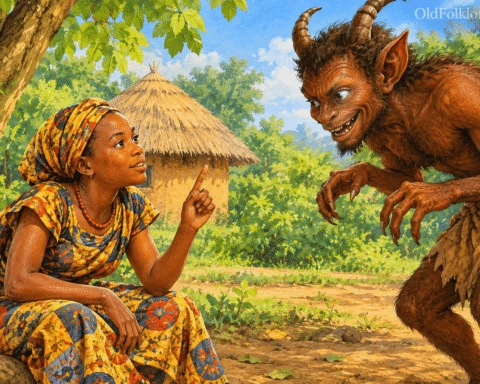
Eventually, he reached a strange country filled with rocks, trees and a great palace crowned by a tall tower. Nearby lived the wife of a gardener, who warned him that the land belonged to a powerful enchanter.
She explained that the magician turned anyone who displeased him into stone or wood. Many of the rocks and trees had once been living people. She also told the prince about a beautiful princess imprisoned in the tower because she refused to marry the enchanter.
The prince suspected that the missing members of his family were among the magician’s victims. The gardener’s wife agreed to help him and disguised him as a girl so that Punchkin would not recognise him.
One day, Punchkin saw the disguised prince and instructed him to take flowers to the imprisoned princess.
The prince realised that the prisoner might be his mother. Before leaving, he tied a small gold ring to a bouquet. The ring had originally belonged to Balna’s husband and had been placed on the prince’s finger when he was a baby.
When Balna discovered the ring, she recognised it immediately. She knew that her son had found her and that he had travelled a great distance to rescue her.
The Secret of Punchkin’s Power
Balna was delighted but frightened for her son’s safety. She explained that Punchkin had kept her imprisoned for twelve years because she refused to marry him.
The prince urged his mother to stop openly opposing the magician. Instead, she should pretend to accept his proposal and persuade him to reveal the secret of his power.
Balna followed this advice. She told Punchkin that she was willing to marry him but wanted to know more about him first. She asked whether he was immortal and whether anything could cause him pain.
Pleased by the prospect of marriage, Punchkin boasted that his life was unlike that of ordinary men.
Far away, he explained, stood a circle of palm trees in a desolate jungle. In the centre were six water-filled chattees, or pots, stacked one above another. Beneath the lowest pot was a small cage containing a green parrot.
Punchkin’s life depended on that parrot. If the bird died, he would die too.
He believed the secret made him invulnerable because thousands of genii guarded the place. Anyone who approached the palm trees would be killed.
Balna passed this information to her son. Although she begged him not to attempt such a dangerous journey, the prince knew that the parrot was the key to freeing his family.
The Green Parrot
The prince travelled many hundreds of miles until he reached a thick jungle. Exhausted, he fell asleep beneath a tree.
A rustling sound awakened him. A large serpent was climbing towards an eagle’s nest, where two young eaglets lay helpless. The prince drew his sword and killed the serpent before it could harm them.
When the parent eagles returned, they discovered what he had done. Grateful for his courage, they promised to help him whenever he needed them. They also allowed him to use their young as servants.
The two eaglets spread their wings, and the prince climbed onto their backs. They carried him high above the jungle until he reached the circle of palm trees.
Thousands of genii guarded the place, but the heat of the midday sun had lulled them to sleep. The eaglets swooped down, allowing the prince to jump from their backs.
He overturned the six pots of water and seized the little green parrot from its cage. Wrapping the bird in his cloak, he mounted the eaglets again and escaped as the genii awoke and howled over the loss of their treasure.
After thanking the eagles, the prince continued his journey on foot. At last, he returned to Punchkin’s palace, carrying the parrot.
The Magician Is Defeated
Punchkin saw the prince sitting outside the palace and immediately recognised the green parrot. Frightened, he begged the boy to give it to him.
The prince refused. Punchkin offered to pay any price, but the prince demanded that the magician restore his father and six uncles, whom he had transformed into rocks and trees.
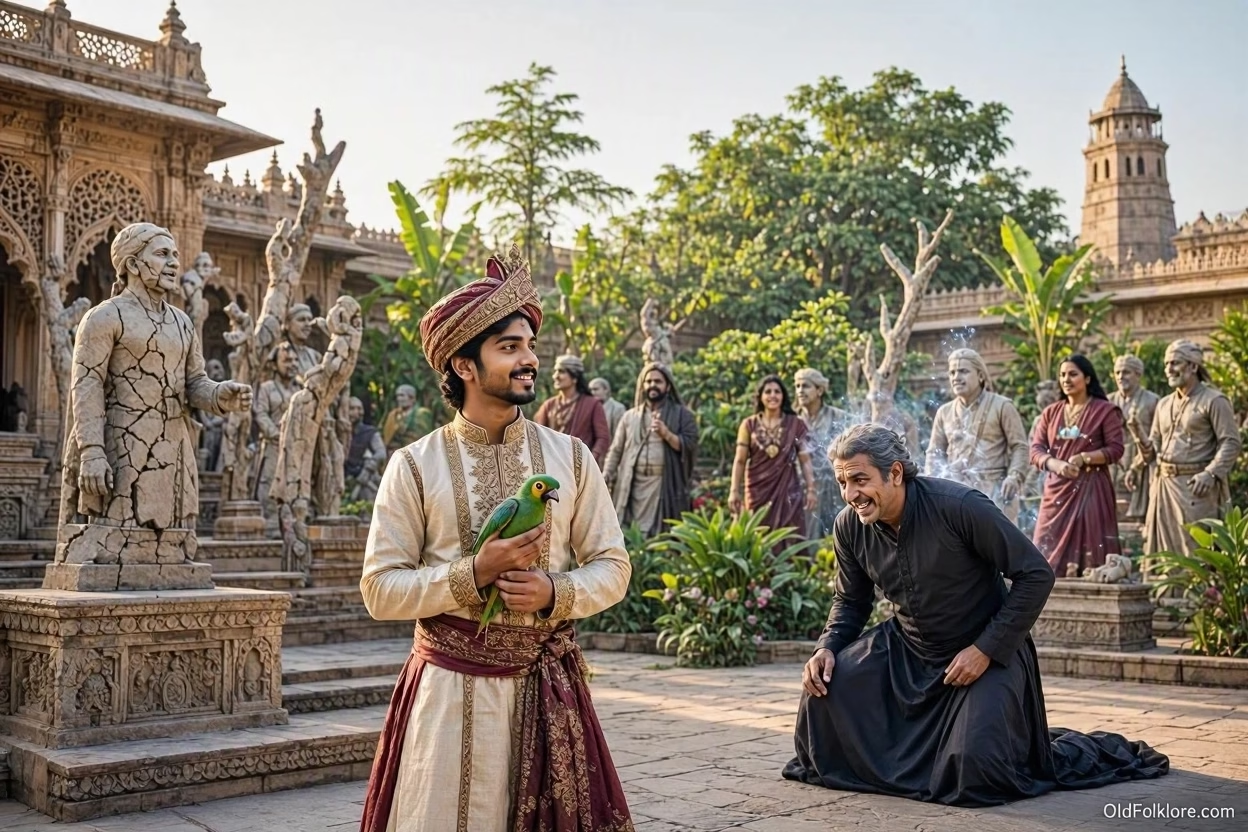
Punchkin agreed and waved his wand. Balna’s husband and his six brothers regained their human forms.
The prince then insisted that the magician restore every other person he had imprisoned in this way. Punchkin complied, and the palace grounds filled with living people where stones and trees had stood.
Still, the magician continued to plead for the parrot.
The prince began to remove the bird’s limbs one by one. As he pulled off its right wing, Punchkin’s right arm fell away. When he removed the left wing, the magician lost his left arm. The same thing happened when the prince removed each leg of the parrot.
At last, Punchkin was left with only his body and head. He continued begging for the bird until the prince finally wrung its neck and threw it towards him.
Punchkin’s head twisted round, and he died with a fearful groan.
Balna was released from the tower. She, her son, her husband and the six princes returned to their own country, where they were reunited with their families and lived happily ever after.
The Meaning of Punchkin
Punchkin is a tale of family loyalty, courage and the discovery of hidden weaknesses. The magician appears almost invincible because he can imprison people in the forms of stones and trees, transform Balna into a dog and keep her locked away for years.
Yet his power depends on a secret object that can be destroyed. The prince succeeds not through strength alone but by listening to his mother, learning the truth and planning his journey carefully.
Balna also plays an important part in the victory. By persuading Punchkin to explain his secret, she gives her son the knowledge he needs to defeat him.
The story’s central idea is that even a seemingly all-powerful enemy may have a vulnerability. Courage becomes effective when joined with intelligence, patience and loyalty to those in danger.
Explore our complete Historic Folklore & Fairy-Tale Collections archive.
Moral Lesson
The story teaches that courage and clever thinking can overcome great obstacles. It also celebrates devotion to family, showing how Balna and her son refuse to abandon one another despite imprisonment, separation and danger.
Knowledge Check
1. Who was Balna?
Balna was the youngest and cleverest of the Raja’s seven daughters.
2. Why did the Ranee mistreat the seven princesses?
She wanted her own daughter to enjoy their privileges and wealth.
3. How did Punchkin capture Balna?
When she refused to marry him, he transformed her into a little black dog and carried her away.
4. How did the prince discover his mother’s identity?
He sent her a gold ring that she recognised as belonging to her family.
5. What protected Punchkin’s life?
His life depended on a small green parrot kept in a cage beneath six pots of water in a distant jungle.
6. How did the prince defeat Punchkin?
He captured the parrot and destroyed it, causing the magician to die and allowing his family and other prisoners to be freed.
Source
Source: “Punchkin,” in Joseph Jacobs’s Indian Fairy Tales (1892), Chapter IV.
Explore More Joseph Jacobs’ Indian Fairy Tales