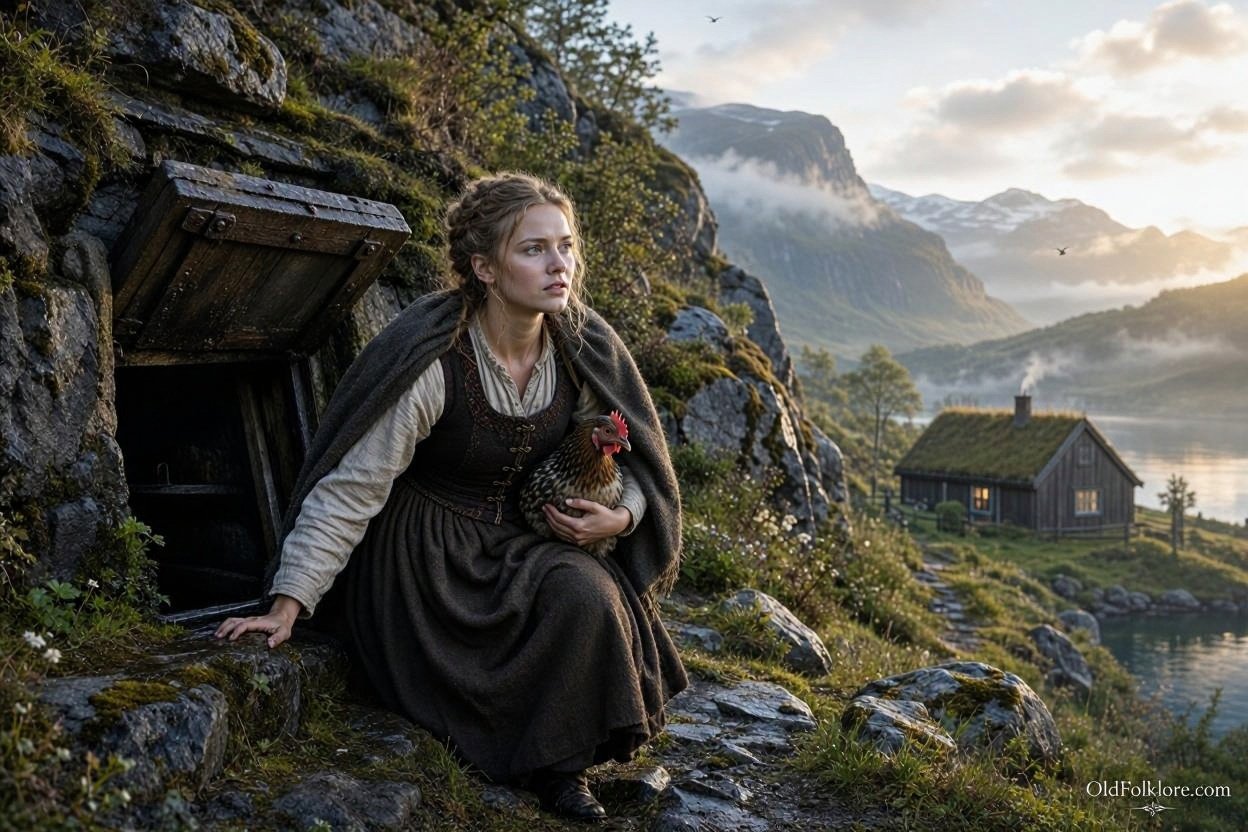
A poor widow lived with her three daughters in a lonely cottage beneath a hillside. Their possessions were few, and the only creature they owned was a hen that the old woman cherished more than anything else. It followed her everywhere, providing companionship in a life marked by hardship.
One day, the hen disappeared without warning. The widow searched around the cottage but found no trace of it. Determined to recover her treasured bird, she sent her daughters out one after another to look for it. Their search led them to a mysterious opening in the hillside and into the underground dwelling of a dangerous creature.
What began as a simple search for a missing hen soon became a struggle for survival. The eldest and middle daughters fell into terrible danger, but the youngest discovered that patience, observation and cleverness could be more powerful than brute strength.
The Widow Loses Her Only Hen
Once upon a time, an old widow lived far away from other people, in a cottage beneath a hillside. She had three daughters, but poverty had left the family with almost nothing. Their only possession of any value was a single hen.
The old woman loved the bird dearly. It was always close to her, following her about and making its familiar noises around the cottage. She took great care of it and watched over it constantly because it was the only creature she had to keep her company.
One day, however, the hen vanished.
The widow searched around the cottage and looked in every direction, calling for the bird as she walked. She went around the house repeatedly, hoping to find it somewhere nearby, but her efforts were useless. The hen had disappeared, and she could not discover where it had gone.
Unwilling to accept the loss, she called her eldest daughter.
“You must go out and see whether you can find our hen,” she told her. “We must have it back, even if we have to fetch it out of the hill.”
The eldest daughter agreed and went out to search.
The First Two Sisters Enter the Hill
The eldest daughter walked about the hillside, looking carefully and calling for the missing hen. She searched for some time without success. Just as she was beginning to give up, she heard a voice coming from a cleft in the rock.
“Your hen trips inside the hill! Your hen trips inside the hill!”
Surprised by the strange announcement, she approached the opening to discover who was speaking. But as soon as she stepped inside the cleft, the ground gave way beneath her. She fell through a trapdoor and dropped deep underground.
Explore more stories from our Asbjørnsen & Moe’s Norwegian Folk Tales collection.
At the bottom, she found herself in a series of rooms. Each room appeared finer than the one before it, and she continued until she reached the innermost chamber.
There she encountered a great and ugly man belonging to the hill-folk. He looked at her and asked whether she would become his sweetheart.
The girl refused. She had not come looking for a husband or a new home. She wanted only to return to the surface and find the hen that had disappeared.
Her refusal enraged the Man o’ the Hill. Without giving her another chance, he seized her, wrung her head from her body and threw her remains into the cellar.
Meanwhile, her mother waited anxiously at home. At first, she expected the eldest daughter to return with the hen. But as the hours passed and neither the girl nor the bird appeared, the widow became worried.
She eventually sent her second daughter to look for her missing sister. She also reminded her to call for the hen while searching.
The second daughter followed the same path. She walked about the hillside, looking for her sister and calling the bird. Before long, she heard the same mysterious voice coming from the cleft in the rock.
“Your hen trips inside the hill! Your hen trips inside the hill!”
Curious, she entered the opening and suffered the same fate. The trapdoor gave way beneath her, and she fell into the underground rooms.
She made her way through the chambers until she reached the innermost one. There, the Man o’ the Hill approached her and asked whether she would be his sweetheart.
Like her elder sister, she refused. She wanted to return home and continue searching for the missing hen.
The Man o’ the Hill became furious once more. He wrung her head from her body and threw her into the cellar with her sister.
The Youngest Daughter Discovers the Truth
The old widow waited a long time for her second daughter, but she did not return either. She could neither see nor hear anything from her two older children.
Eventually, she turned to her youngest daughter and asked her to go and find her sisters. She admitted that losing the hen had been foolish, but losing both daughters would be far worse. Even then, she did not forget to remind the girl to call for the hen.
The youngest daughter set out.
She walked around the hillside, searching for her sisters and calling for the bird. For some time, she found nothing. Eventually, she reached the same cleft in the rock and heard the familiar voice.
“Your hen trips inside the hill! Your hen trips inside the hill!”
She entered the opening and fell through the trapdoor into the underground dwelling.
Unlike her sisters, however, the youngest daughter did not allow fear to hurry her. She moved through the rooms carefully, taking time to observe everything around her. The chambers were grand, and she examined them as she made her way towards the innermost room.
During her exploration, she noticed a trapdoor leading into a cellar. She looked through it and was horrified by what she saw.
Her two sisters were lying dead below.
The discovery revealed the danger she had entered. Before she could investigate further, the Man o’ the Hill approached and asked her the same question he had asked the other girls.
“Will you be my sweetheart?”
The youngest daughter understood that refusing him might bring about the same fate that had befallen her sisters. She therefore answered that she would gladly accept.
The Man o’ the Hill was delighted. He had been so pleased to find someone willing to become his sweetheart that he promised her fine clothes and anything else she desired. From that moment, he treated her generously and gave her whatever she requested.
The girl, however, had not forgotten her sisters or the danger she faced. She knew she needed a plan if she was ever to escape.
The First Sack of Food and Treasure
After living underground for some time, the youngest daughter became unusually sad and withdrawn. The Man o’ the Hill noticed her unhappiness and asked what was troubling her.
She explained that she was worried about her mother. The old widow was poor, she said, and must be struggling to find enough food and drink. She also had no one with her at home.
The Man o’ the Hill told her that he could not allow her to visit her mother. However, he offered to carry some provisions to the widow himself.
The girl thanked him and agreed to prepare a sack of food and drink. But she had a different plan in mind.
At the bottom of the sack, she placed a large quantity of gold and silver. She then covered the treasure with a little food so that the contents would appear to be nothing more than provisions for her mother.
When the sack was ready, she warned the Man o’ the Hill not to look inside it. He promised that he would obey.
As he travelled towards the widow’s cottage, however, the sack began to feel heavy. Eventually, he became suspicious and decided to open it.
Just as he was about to untie the mouth of the sack, the girl called out from the underground dwelling:
“I see what you’re at! I see what you’re at!”
The Man o’ the Hill was startled. He believed that she could somehow see him, even from such a distance. He abandoned the idea of inspecting the sack and continued on his way.
When he reached the widow’s cottage, he threw the sack through the door and announced that her daughter had sent food and drink. He also assured the old woman that the girl wanted for nothing.
The widow received the provisions, unaware that the sack contained treasure as well as food.
The youngest daughter had succeeded in sending help to her mother without revealing her plan.
The Magic Ointment Brings the Sisters Back to Life
Some time later, a billy-goat fell through the trapdoor into the underground dwelling.
The Man o’ the Hill was furious at the unexpected arrival. He seized the animal, wrung its head from its body and threw it into the cellar.
The youngest daughter protested. She told him that she might have enjoyed having the goat for company.
The Man o’ the Hill dismissed her concern. He explained that he could easily restore the animal to life.
He then took a flask hanging against the wall. After placing the goat’s head back on its body, he smeared the animal with ointment from the flask. Almost immediately, the goat recovered and became as lively as before.
The girl watched carefully.
She understood that the flask contained something powerful. If the ointment could bring the goat back to life, perhaps it could also restore her sisters.
She waited for an opportunity to act.
One day, when the Man o’ the Hill was away, she went to the cellar and brought out her eldest sister. She carefully placed the sister’s head back on her shoulders and applied the ointment, following the same method she had watched the Man o’ the Hill use on the goat.
In an instant, the eldest sister came back to life.
The youngest daughter then placed her sister inside a sack and covered her with a little food. When the Man o’ the Hill returned, she asked him to carry another sack of provisions to her mother.
Once again, she warned him not to look inside.
The Man o’ the Hill agreed. But as he travelled, the sack became heavy, and he soon began to suspect that something was hidden inside it.
He decided to untie the sack and investigate.
Before he could do so, the girl inside called out:
“I see what you’re at! I see what you’re at!”
The Man o’ the Hill immediately believed that the youngest daughter was watching him. He dared not look inside and hurried to the widow’s cottage, where he threw the sack through the door and announced that her daughter had sent more food.
The eldest sister was therefore returned safely to her mother.
The youngest daughter repeated the plan with her other sister. She restored the middle daughter to life using the ointment, then placed her inside another sack.
This time, she also filled the sack with as much gold and silver as it could hold, covering the treasure with a small amount of food.
She asked the Man o’ the Hill to carry the provisions to her mother and once again warned him not to inspect the sack.
The sack grew heavy as he travelled. He stopped and considered opening it, but the girl inside repeated the familiar warning:
“I see what you’re at! I see what you’re at!”
Believing that the youngest daughter could see him, the Man o’ the Hill abandoned his plan. He carried the sack straight to the widow’s cottage and threw it through the door.
The second sister was now safely home, and the widow had received another supply of treasure.
The Youngest Daughter Makes Her Escape
Although the youngest daughter had managed to rescue both sisters, she remained trapped beneath the hill. She knew that the Man o’ the Hill would eventually discover what she had done.
She therefore waited for a suitable opportunity to escape.
One day, the Man o’ the Hill announced that he intended to go out for the day. The girl pretended to be ill and unhappy. She complained and acted as though she would not be able to prepare supper until late at night.
She told him that he should not return before midnight because she would need the extra time to get everything ready.
The Man o’ the Hill accepted her explanation and left.
As soon as he was gone, the girl began preparing her escape. She stuffed some of her clothes with straw and arranged them in a corner near the chimney. She placed a broom in the figure’s hand so that it looked like a person standing in the room.
Having made the figure resemble herself, she slipped away and returned home to her mother and sisters.
She did not leave the family unprotected. She also arranged for a sharp-shooter to remain at the cottage.
When midnight approached, the Man o’ the Hill returned to his underground home. He expected the girl to have supper waiting for him.
“Give me something to eat,” he demanded.
The straw figure remained silent.
He repeated his demand, but there was still no answer. Growing angrier, he called for food a third time and threatened to wake her if she continued to ignore him.
The figure did not move.
In a rage, the Man o’ the Hill struck it across the face. The blow scattered the straw and exposed the deception.
He immediately understood that the girl had escaped.
He rushed to the cellar and discovered that both sisters had disappeared as well. Realising that he had been tricked, he hurried towards the widow’s cottage, determined to punish the youngest daughter.
The Man o’ the Hill Meets His End
The Man o’ the Hill reached the widow’s cottage, but he did not dare enter.
The sharp-shooter was waiting inside. When the man approached, the sharp-shooter fired his weapon.
The sound frightened the Man o’ the Hill. He believed it was thunder and immediately turned away, fleeing towards his underground dwelling as quickly as he could.
He ran until he reached the trapdoor.
But just as he arrived, the sun rose. The moment its light appeared, the Man o’ the Hill burst.
The youngest daughter had escaped, her sisters had been restored to life, and the family was together again.
The tale ends with the suggestion that anyone who knew where the trapdoor was hidden might still find a great quantity of gold and silver beneath the hill.
Explore our complete Historic Folklore & Fairy-Tale Collections archive.
Moral Lessons
The story shows how courage and careful observation can help someone overcome a dangerous situation. The youngest daughter recognised the threat posed by the Man o’ the Hill and avoided making the same mistake as her sisters. Rather than acting hastily, she watched his behaviour and learned how his underground home worked.
It also highlights the importance of using knowledge wisely. By observing how the Man o’ the Hill restored the billy-goat to life, the youngest daughter discovered a way to save her sisters. She used the opportunity not for personal gain alone, but to rescue her family and secure their freedom.
The tale further suggests that appearances can be misleading. The Man o’ the Hill believed that the youngest daughter could see him from a distance, and this mistaken belief allowed her to deceive him repeatedly. His confidence in his own power made him careless, while the girl’s patience enabled her to outwit him.
Above all, the story celebrates loyalty and family devotion. Even after escaping the immediate danger, the youngest daughter did not abandon her sisters. She returned for them, restored them to life and ensured that they reached their mother safely.
Knowledge Check
1. What was the only animal owned by the old widow and her daughters?
They owned one hen, which the widow treasured dearly.
2. What happened to the eldest and middle daughters after they entered the hill?
Both refused the Man o’ the Hill’s proposal and were killed. He threw their bodies into the cellar.
3. Why did the youngest daughter agree to become the Man o’ the Hill’s sweetheart?
She had discovered her sisters’ bodies and realised that refusing him could lead to the same fate. She agreed to protect herself while looking for a way to escape.
4. How did the youngest daughter send treasure to her mother?
She hid gold and silver beneath food in sacks and persuaded the Man o’ the Hill to carry them to the widow’s cottage.
5. What enabled the youngest daughter to bring her sisters back to life?
She watched the Man o’ the Hill restore a billy-goat using ointment from a flask. She later used the same ointment to revive her sisters.
6. How did the youngest daughter finally escape, and what happened to the Man o’ the Hill?
She made a straw figure to deceive him and escaped while he was away. A sharp-shooter frightened him from entering her mother’s cottage, and the Man o’ the Hill burst when he reached the trapdoor at sunrise.
Source
Retold from Asbjørnsen and Moe, Popular Tales from the Norse, translated into English by George Webbe Dasent, “The Old Dame and Her Hen” (source heading: “THE OLD DAME AND HER HEN”). Peter Christen Asbjørnsen and Jørgen Moe were the collectors of the Norwegian tales, while George Webbe Dasent translated the collection into English. Digital transcription: Project Gutenberg eBook 8933.
Explore More Asbjørnsen & Moe’s Norwegian Folk Tales
- East of the Sun and West of the Moon
- The Giant Who Had No Heart in His Body
- True and Untrue: A Norwegian Folk Tale
- The Cat on the Dovrefell: A Strange Christmas Eve Encounter
- The Princess on the Glass Hill: A Remarkable Tale of Courage