A person may enjoy great wealth, authority and comfort yet still face the unavoidable passage of time. Even a powerful ruler cannot prevent ageing, and the signs of advancing years may remind someone that worldly achievements do not last forever. In this Buddhist birth story, a king who has enjoyed an extraordinarily long life discovers a single grey hair among his dark locks. Rather than dismissing it as an ordinary sign of ageing, he considers what it means for his spiritual life.
His response surprises those around him. Although he still has many years left to live, he decides that the appearance of the grey hair is a reminder to abandon worldly ambitions and pursue religious discipline. His decision becomes an example of renunciation, showing that the search for spiritual understanding need not wait until the final moments of life.
The Buddha Recalls a Former Renunciation
The story begins at Jetavana, where the Buddha was staying with his disciples. On one occasion, the monks gathered and began discussing his Great Renunciation. They spoke with admiration about his decision to abandon worldly life in pursuit of spiritual understanding.
While they were discussing the subject, the Buddha entered their assembly and took his usual seat. He asked the monks what they had been discussing.
They answered that their conversation concerned his renunciation.
The Buddha then explained that his decision to leave worldly life had not occurred for the first time in his present existence. In a former birth, he had also abandoned royal life and devoted himself to religious practice.
Explore more stories from our Jataka Tales collection.
The monks wished to understand how this had happened. In response, the Buddha revealed an account from a former existence, explaining an event that had been hidden by the changes of birth.
King Makhā Deva and His Long Reign
Long ago, in Mithilā, in the land of Videha, there lived a righteous king named Makhā Deva. He governed his kingdom with justice and was known for ruling according to righteousness.
His life had been extraordinarily long. He had spent eighty-four thousand years as a prince, another eighty-four thousand years sharing in the government, and a further eighty-four thousand years ruling as king.
Despite the immense length of his life and the authority he possessed, Makhā Deva remained conscious that his time in the world would not continue indefinitely.
He gave his barber an important instruction. Whenever the barber noticed grey hairs appearing on his head, he was to inform the king immediately.
The king wanted to be alerted to the first visible sign of ageing. He did not ask the barber to wait until his hair had become grey throughout or until his appearance had changed considerably. Even a single grey hair was enough to attract his attention.
The barber remembered the instruction and continued attending to the king’s hair over the years.
The First Grey Hair
After a very long time had passed, the barber finally discovered a grey hair among the king’s jet-black locks.
He immediately informed Makhā Deva that a grey hair had appeared on his head.
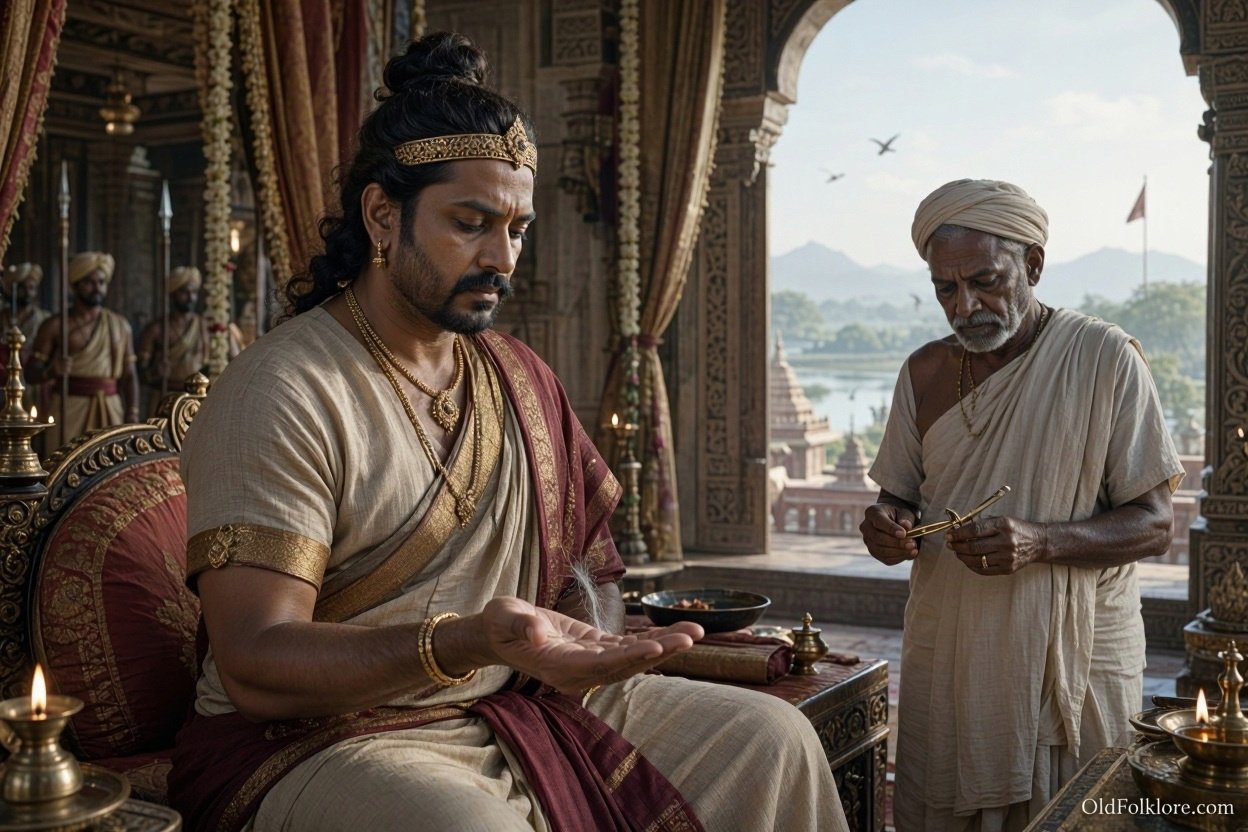
The king asked him to pull it out and place it in his hand. The barber used golden pincers to remove the hair and carefully presented it to the ruler.
Makhā Deva examined the single grey strand.
At that time, he still had eighty-four thousand years remaining in his allotted lifetime. By ordinary expectations, there was no immediate reason for him to fear that death was approaching. He remained king, possessed great authority and had many years ahead of him.
Nevertheless, the sight of the grey hair deeply disturbed him.
The king felt as though the King of Death had come close to him or as though he had suddenly found himself inside a burning house. The small strand of hair represented something far greater than a change in appearance.
He began to reflect upon his life and the condition of his mind. Although he had lived for an extraordinary length of time, he recognised that he had not yet freed himself from the human frailties and passions that continued to trouble the heart.
He considered himself foolish for allowing so much time to pass without overcoming these weaknesses.
As he continued thinking about the grey hair, his distress grew. His heart seemed to burn within him, perspiration rolled down his body, and even his royal garments became uncomfortable.
The discovery had changed the way he regarded his position. His throne, possessions and remaining years no longer seemed as important as the spiritual work he had neglected.
Makhā Deva made a firm decision.
He would leave the world that very day and devote himself to religious life.
The King Surrenders His Kingdom
Having decided to renounce his royal position, Makhā Deva first rewarded the barber who had brought the grey hair to his attention.
He granted him a village whose revenue amounted to one hundred thousand. The gift was a substantial reward for the barber’s service and for carrying out the instruction faithfully.
The king then summoned his eldest son.
He explained that grey hairs had appeared on his head and that he had become an old man. He had finished pursuing ordinary human hopes and now wished to seek heavenly things.
He told his son that the time had come for him to abandon worldly life and instructed him to assume the sovereignty.
Makhā Deva would no longer remain on the throne. Instead, he intended to live in the garden known as Makhā Deva’s Mango-grove, where he would train himself in the qualities of someone whose heart had been brought under discipline.
The king’s ministers were surprised by his decision. They could not understand why a ruler who still had so many years remaining would voluntarily surrender his authority.
They approached him and asked what had caused him to give up the world.
Makhā Deva did not answer by speaking about political difficulties, financial problems or dissatisfaction with his kingdom. His decision had come from the realisation that ageing was a reminder of the need for spiritual preparation.
Holding the grey hair in his hand, he recited a verse:
These grey hairs that have come upon my head
Are angel messengers appearing to me,
Laying stern hands upon the evening of my life!
’Tis time I should devote myself to holy thought!
Through these words, he explained the meaning he had attached to the grey hair. He regarded it as a messenger warning him that the time for spiritual reflection had arrived.
Having spoken to his ministers, he gave up his sovereignty that very day.
A Life of Religious Discipline
After surrendering the throne, Makhā Deva became a hermit and went to live in the Mango-grove that bore his name.
He devoted himself to religious discipline rather than the responsibilities and privileges of kingship. His practice centred on perfect goodwill towards all beings and constant meditation.
The account states that he continued this way of life for eighty-four thousand years.
His former position as king had given him authority over a kingdom, but his new life was directed towards the discipline of his own mind. Instead of pursuing further worldly achievements, he concentrated on goodwill and meditation.
When he eventually died, he was reborn in the Brahma heaven.
His existence there continued until the allotted time in that heavenly state was exhausted. Afterward, he was born again in Mithilā as a king named Nimi.
In this later existence, he reunited his scattered family. The account then explains that he once again became a hermit in the same Mango-grove.
There, he practised perfect goodwill towards all beings, just as he had done during his former renunciation. After completing that period of religious practice, he returned to the Brahma heaven.
The story thus presents Makhā Deva’s renunciation as part of a continuing pattern of spiritual discipline across successive births. His decision to abandon kingship was not merely a temporary rejection of royal responsibilities. It formed part of a longer pursuit of religious development.
The Buddha Reveals the Former Identities
After completing the account of King Makhā Deva, the Buddha returned to the monks who had been listening to him.
He explained that his former renunciation showed that he had abandoned worldly life not only in his present existence but also in an earlier birth.
The Buddha then proclaimed the Four Truths. At the conclusion of his teaching, some of the monks entered the First Stage of the Path to Nirvāna, while others attained the Second and Third Stages.
Finally, he established the connection between the people in the former story and those in his present life.
He explained that the barber who discovered the grey hair had been Ānanda. The prince who received the kingdom had been Rāhula. King Makhā Deva himself had been the Buddha in that former existence.
With this identification, the Buddha completed the account and brought the monks’ discussion of his renunciation to its conclusion.
Explore our complete Historic Folklore & Fairy-Tale Collections archive.
Moral Lessons
Makhā Deva’s experience teaches that ageing can serve as a reminder to reflect on the direction of one’s life. The grey hair was a small physical change, but the king understood it as a warning that worldly life was temporary. Rather than ignoring the sign, he used it as an opportunity to examine his priorities.
The story also emphasises that wealth, authority and long life do not remove the need for spiritual development. Makhā Deva had enjoyed an extraordinary period as prince, co-ruler and sovereign, yet he recognised that these achievements had not freed him from human weaknesses. His decision to renounce the throne shows that outward success does not necessarily mean inward fulfilment.
Another lesson concerns the importance of acting when one recognises the need for change. Makhā Deva did not postpone his decision until his remaining years had nearly ended. Once he understood the significance of the grey hair, he surrendered his sovereignty and began his religious life that same day.
The king’s conduct also illustrates the value of goodwill towards all beings. After becoming a hermit, he devoted himself to meditation and the practice of perfect goodwill. His spiritual progress was therefore expressed not only through abandoning worldly possessions but also through cultivating a disciplined and compassionate mind.
Knowledge Check
1. Where did King Makhā Deva rule?
He ruled in Mithilā, in the land of Videha.
2. What instruction did Makhā Deva give his barber?
He instructed the barber to inform him whenever he discovered grey hairs on his head.
3. How did the king react when the barber found a grey hair?
He became deeply agitated and interpreted the hair as a reminder of ageing and the need for spiritual development.
4. What did Makhā Deva give the barber?
He granted the barber a village whose revenue amounted to one hundred thousand.
5. Where did the king go after surrendering his throne?
He became a hermit and lived in Makhā Deva’s Mango-grove, practising goodwill towards all beings and meditation.
6. Who were the characters from the former story in the Buddha’s present life?
The barber was Ānanda, the prince was Rāhula, and King Makhā Deva was the Buddha himself.
Source
Retold from Buddhist Birth Stories, or Jātaka Tales, Volume I (1880), edited by V. Fausbøll and translated by T. W. Rhys Davids. The story appears as Jātaka No. 9, under the heading “Makhā-Deva”.
The Jātaka belongs to the Buddhist birth-story tradition. V. Fausbøll edited the Pāli text, while T. W. Rhys Davids translated the English volume.
Digital transcription: Project Gutenberg, eBook 51880.
Explore More Jataka Tales
- The Monkeys and the Demon
- The Sandy Road
- The Elephant and the Dog
- Holding to the Truth
- The Merchant of Seri and the Golden Bowl
- The Measure of Rice: How One Ridiculous Judgement Restored Justice