When a soothsayer lay dying, he left his younger son with an unusual inheritance: a horoscope predicting a life of poverty, ten years of imprisonment, death on a seashore and, finally, a period of happiness. The young man, Gangazara, could not understand how such a terrible series of events could lead to a happy ending. Nevertheless, he knew that his father’s predictions had often proved accurate.
Rather than remain at home and wait for his future to unfold, Gangazara set out for Benares. His journey brought him into contact with four creatures and a goldsmith trapped in a deep well. His decision to rescue them would eventually shape his destiny. Yet the horoscope’s prediction of imprisonment and death still awaited him, and the kindness he showed would not be returned by everyone.
The Horoscope That Predicted a Difficult Life
A soothsayer, knowing that his death was near, prepared a horoscope for his second son, whose name was Gangazara. He left this horoscope as the young man’s only inheritance, while the greater part of his property went to his eldest son.
After his father’s death and funeral ceremonies, Gangazara examined the document carefully. It predicted that poverty would follow him from birth. It also foretold that he would spend ten years in prison and eventually die on a seashore, far away from his home and relatives.
The final prediction confused him most. After all these misfortunes, the horoscope promised that he would experience some happiness.
Gangazara wondered what kind of happiness could follow such suffering. He had seen his father’s predictions come true during his lifetime and therefore did not dismiss the horoscope. Nevertheless, he could not see how his future could possibly unfold as written.
Explore more stories from our Joseph Jacobs’ Indian Fairy Tales collection.
He decided to leave home and travel to Benares. After taking leave of his elder brother, he set out, hoping to discover what life had in store for him.
The Five Prisoners in the Well
Gangazara travelled through the Deccan and the Vindhya mountains. During his journey, he became lost in a desert where there was neither food nor water.
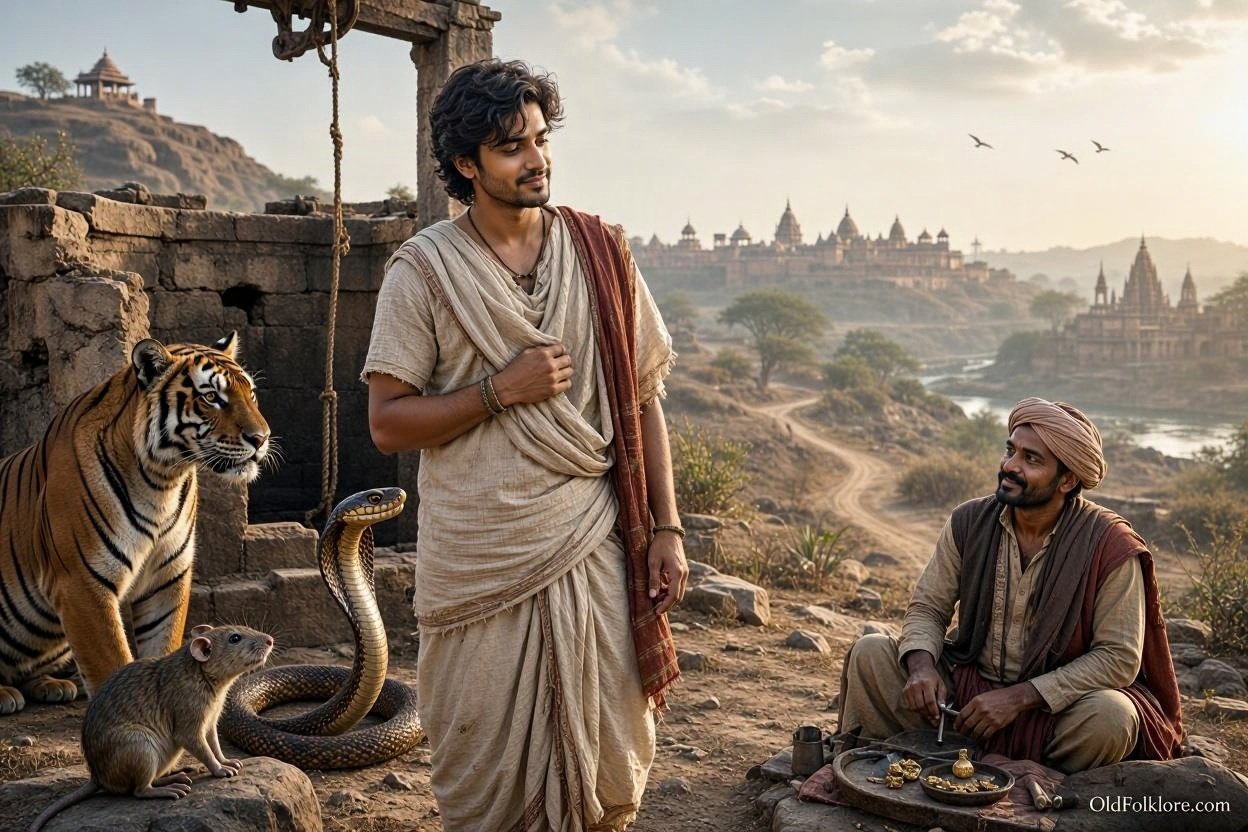
After wandering for a long time, he came upon an old, ruined well. Looking inside, he discovered that several creatures and a man had fallen into it and could not climb out.
The prisoners were a tiger, a serpent, a rat, and a goldsmith. Each appealed to Gangazara for help.
The tiger explained that he was the king of the tigers. The serpent was the king of the serpents, while the rat was the king of the rats. They pleaded with Gangazara to rescue them.
Before he helped, however, the animals warned him about the goldsmith. They told him that he should not rescue the human prisoner because a goldsmith could not be trusted. They feared that the man would repay kindness with betrayal.
Gangazara considered their warning. Nevertheless, he could not bring himself to leave anyone trapped in the well. He rescued the tiger, serpent and rat, and then helped the goldsmith climb out as well.
The goldsmith thanked him and introduced himself as Manikkasari. He lived in East Main Street, Ujjaini, and invited Gangazara to visit him if he ever travelled to that city.
The four rescued creatures also expressed their gratitude. They promised that Gangazara would not be forgotten if he ever needed their help.
After the rescue, Gangazara continued his journey.
Ten Years Away from Home
Gangazara eventually reached Benares, where he remained for more than ten years. During this period, the poverty predicted in his father’s horoscope continued to shape his life.
When he finally decided to return, he remembered the place where he had rescued the prisoners. He passed by the old well and found the animals there.
They had not forgotten him.
The tiger king welcomed Gangazara and presented him with a royal crown. The serpent king and the rat king also offered gifts in gratitude for the kindness he had shown them.
Gangazara accepted their presents and continued towards Ujjaini.
He remembered Manikkasari’s invitation and decided to visit the goldsmith. He showed him the crown, explaining that it was a gift from the tiger king.
Manikkasari immediately recognised its value. He offered to melt it down and separate the gold from the diamonds, claiming that he could help Gangazara obtain money from it.
Gangazara trusted the man because he had once rescued him from the well. He did not suspect that the goldsmith had other intentions.
The Goldsmith’s Betrayal
The king of Ujjaini had been killed by a tiger. Manikkasari knew about the death and saw an opportunity to gain a reward.
Instead of helping Gangazara, he accused him of murdering the king. He presented the crown as evidence and claimed that the young man had obtained it through the crime.
Gangazara was arrested and taken before the authorities. He tried to explain that the crown had been given to him by the tiger king, whom he had rescued from a well. His explanation did not save him.
The accusation was accepted, and he was thrown into a deep underground dungeon.
The prediction in his father’s horoscope had begun to unfold. Gangazara had fallen into the hands of a man whose life he had saved, and he was now imprisoned because of that kindness.
The Animals Remember Their Benefactor
Although Gangazara was locked away, the animals he had rescued did not forget him.
The rat king learned of his imprisonment and decided to help. He sent his army of rats into the dungeon. They dug through the earth until they could reach Gangazara’s cell.
The rats brought him food, including bread and sweets, so that he would not starve. They also helped provide him with water through wet cloth.
The serpent king arranged another form of assistance. He sent serpents and tigers to attack people in the kingdom. Their attacks caused widespread fear and suffering, making it difficult for the authorities to ignore the strange events.
Gangazara remained imprisoned, but the animals continued to support him.
Time passed, and ten complete years went by. The young man remained in the underground cell throughout the period. His hair grew so long that it covered his face, while his body acquired an unusual lustre from his long confinement.
The prophecy had predicted ten years of imprisonment, and Gangazara had now endured every one of them.
The Princess Dies from a Serpent’s Bite
On the final evening of the tenth year, a serpent entered the bedchamber of the king’s daughter and bit her. The princess was the king’s only child, and she died from the attack.
The king was devastated. He summoned those who knew how to treat snakebites and promised a great reward to anyone who could restore his daughter to life.
He offered half his kingdom and the princess’s hand in marriage to the person who succeeded.
A servant who had repeatedly heard Gangazara crying out from his dungeon remembered him. The servant informed the king that a prisoner had been confined underground for many years.
The king ordered the cell to be examined.
When Gangazara was brought out, the people were astonished by his appearance. His hair had grown so long that it had to be cut before his face could be seen properly. His ten years underground had also given his body an extraordinary lustre.
The king was struck by his presence and wondered whether he was a divine being.
He asked Gangazara to save the princess.
Gangazara Restores the Dead to Life
Gangazara agreed to help, but he made an unusual demand.
He asked the king to gather all the people and animals in the kingdom who had died and remained unburied. They were to be brought together so that he could attempt to restore them.
The king accepted the request and arranged for the dead to be collected.
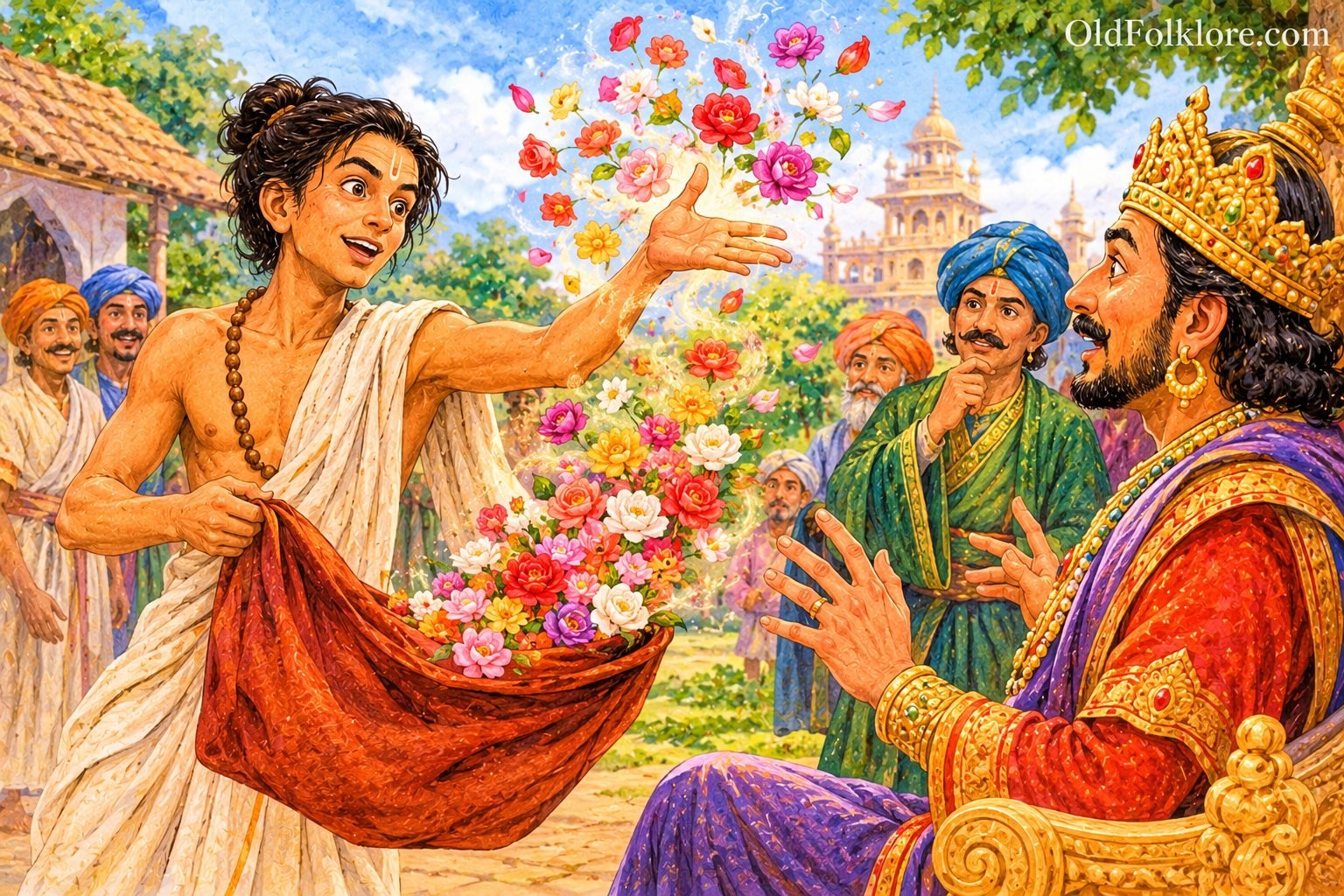
Gangazara then sprinkled water over them while thinking of the tiger king and the serpent king who had once been among those he rescued from the well.
Through the power associated with his animal companions, the dead were restored to life. The princess also returned to life.
The people were astonished. The king’s daughter had been brought back, and those who had died were alive again.
Gangazara had fulfilled a task that ordinary healers could not accomplish.
The Tiger and Serpent Kings Confront the Kingdom
After restoring the dead, Gangazara asked that all the people of the kingdom be gathered together.
The tiger king and serpent king arrived with their respective armies. Their presence revealed the reason behind the attacks that had troubled the kingdom during Gangazara’s imprisonment.
The animals explained that they had been trying to secure his release. They had not forgotten that he had saved them from the well, and they could not allow him to suffer indefinitely for an offence he had not committed.
The tiger king also explained the injustice surrounding the king’s death and the false accusation made against Gangazara.
The king recognised that he had treated an innocent man unjustly. He apologised to Gangazara and promised to govern with greater fairness.
The tiger and serpent kings then agreed to stop their attacks on the people.
The kingdom was finally free from the terror that had followed the animals’ efforts to help their benefactor.
Manikkasari Faces the Consequences
The goldsmith’s deception was also exposed.
Manikkasari had accused Gangazara of murdering the king, even though he knew that the crown had been given to the young man by the tiger king.
The king and his subjects now understood that the goldsmith had betrayed the person who had rescued him from the well.
Gangazara could have demanded severe punishment. Instead, he chose to pardon Manikkasari.
The man who had repaid kindness with betrayal was spared through the mercy of the very person he had wronged.
The king was grateful to Gangazara for saving his daughter and restoring the dead. He offered him the princess in marriage and promised him the whole kingdom.
Gangazara did not immediately accept. He explained that he wished to visit his elder brother first. He would return afterwards to receive the king’s offer.
The Death on the Seashore
Gangazara set out to find his elder brother. During the journey, he accidentally took the wrong road and found himself near the seashore.
There, he unexpectedly met his brother.
The two men were overjoyed to see each other after their long separation. They embraced, overwhelmed by the happiness of their reunion.
At that moment, Gangazara died.
His death took place on the seashore, exactly as his father’s horoscope had predicted. The prophecy that had troubled him from the beginning had now been fulfilled in its terrible detail.
His brother was devastated. He had only just found Gangazara again, and now the young man lay dead before him.
Ganesa Restores Gangazara to Life
Unable to accept what had happened, Gangazara’s brother turned to Ganesa. He worshipped the deity and asked him to protect the body.
Ganesa’s Ganas, however, came and devoured Gangazara’s corpse.
When his brother discovered what had happened, he reproached Ganesa. The deity was ashamed that the body entrusted to his protection had been destroyed.
Ganesa therefore used his divine power to restore Gangazara to life.
The young man who had died on the seashore returned to the living.
His brother was reunited with him, and the two continued their journey to Ujjaini.
The Horoscope Is Fulfilled
When Gangazara returned to Ujjaini, he married the princess and became king.
He also rewarded his elder brother, ensuring that the man who had shared his family life and mourned his death was not forgotten.
Gangazara had experienced poverty from birth. He had endured ten years of imprisonment, been betrayed by someone he had rescued, and died on a seashore far from home.
Yet his story did not end with death. His kindness to the animals had brought him powerful allies, and his brother’s devotion had led to his restoration.
The happiness promised in the horoscope finally came. Gangazara became a king, married the princess and rewarded his brother.
In the end, every part of his father’s prediction had been fulfilled.
Explore our complete Historic Folklore & Fairy-Tale Collections archive.
Moral Lessons
Gangazara’s journey illustrates the importance of kindness, even when there is no immediate reward. He rescued the creatures and the goldsmith because he could not bear to leave them trapped. Although the goldsmith betrayed him, the animals remembered his kindness and later helped him survive imprisonment.
The story also contrasts gratitude with ingratitude. The tiger, serpent and rat repaid Gangazara’s compassion, while Manikkasari used the opportunity to accuse him falsely. Their different responses show how people may react very differently to the same act of generosity.
Gangazara’s experience also raises questions about fate and perseverance. His father’s horoscope predicted suffering, but the young man continued to travel, help others and make decisions rather than simply surrendering to fear. Even after the predicted death occurred, his story continued through divine intervention.
Knowledge Check
1. What did Gangazara inherit from his father?
He inherited a horoscope predicting poverty, ten years of imprisonment, death on a seashore and happiness afterwards.
2. Whom did Gangazara rescue from the ruined well?
He rescued a tiger king, a serpent king, a rat king and a goldsmith named Manikkasari.
3. How did Manikkasari betray Gangazara?
He falsely accused Gangazara of murdering the king of Ujjaini after seeing the crown given to him by the tiger king.
4. How did the animals help Gangazara during his imprisonment?
The rat king sent rats to provide him with food and water, while the serpent king arranged attacks that pressured the kingdom to address his imprisonment.
5. How did Gangazara restore the princess and the other dead?
He asked for the dead and unburied people and animals to be gathered, then sprinkled water over them while thinking of the tiger and serpent kings.
6. How was Gangazara’s predicted death reversed?
After he died on the seashore, his brother appealed to Ganesa. When Ganesa’s Ganas devoured the body, Ganesa restored Gangazara to life through divine power.
Source
Retold from Joseph Jacobs, Indian Fairy Tales (1892), “The Soothsayer’s Son” (Story X, p. 70).
Joseph Jacobs was the English-language editor and adapter of this version. In his source note, he identifies Mrs Kingscote’s Tales of the Sun as the immediate source, tracing it to Pandit Natesa Sastri’s Folk-Lore of Southern India, Part II, which had originally appeared in The Indian Antiquary. Jacobs stated that he had considerably condensed and modified the earlier English version.
The tale is therefore presented here as a retelling of Jacobs’s published adaptation, not as a story originally written by Jacobs or as a direct translation from an independently consulted oral account.
Explore More Joseph Jacobs’ Indian Fairy Tales
- The Lambikin: A Classic Indian Folktale
- The Rose-Tree: A Grim Fairy Tale
- Tom Tit Tot
- How the Raja’s Son Won the Princess Labam
- The Talkative Tortoise and the Two Wild Ducks
- The Broken Pot: A Foolish Dream of Wealth and Fortune