The eagle was among the most powerful creatures in the sky. Its sharp eyes could detect movement from great heights, and its strong wings carried it above the landscape in search of prey. From its lofty position, it watched the world below, confident in its ability to recognise danger and seize opportunities.
One day, while observing a hare, the eagle became the target of a concealed hunter. The encounter ended with a painful discovery: the weapon that struck it had been made more effective by something that had once belonged to the eagle itself.
The Eagle Watches Its Prey
An eagle sat upon a lofty rock, looking down over the land beneath it. From that high position, it watched the movements of a hare that had attracted its attention. The bird was accustomed to observing creatures from above, and the hare appeared to be suitable prey.
The eagle remained focused on the animal below. Its attention was directed towards the hunt, and it did not notice the danger approaching from another direction.
Some distance away, an archer had also seen the eagle. Unlike the bird, which watched the hare openly from its elevated position, the archer remained concealed. He observed the eagle carefully and prepared his weapon.
Explore more stories from our Aesop’s Fables collection.
The hunter took aim, directing his arrow towards the bird. His position gave him an opportunity to strike without first attracting the eagle’s attention.
The Archer’s Fatal Shot
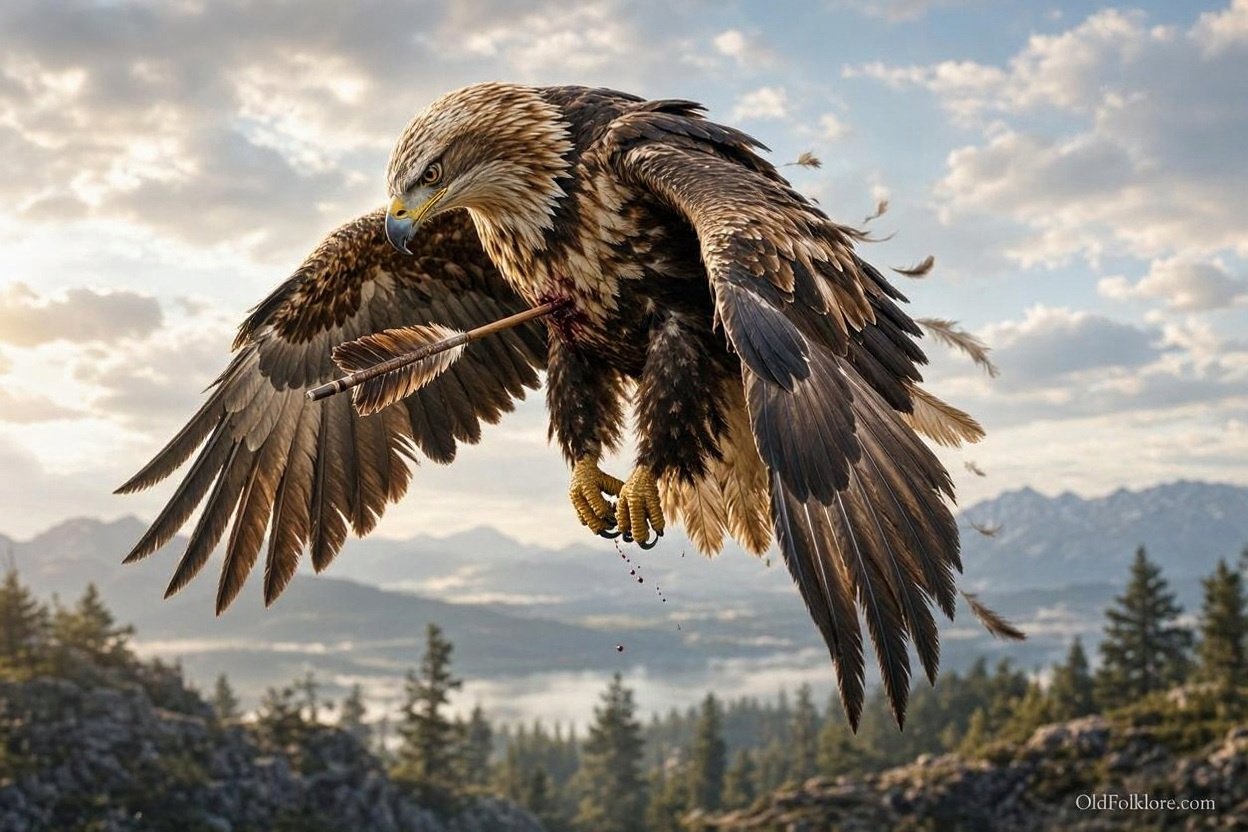
The archer released the arrow. It travelled through the air and struck the eagle with deadly force.
The eagle was mortally wounded. The bird that had once watched the ground from a position of strength could no longer remain safely upon its lofty rock. The arrow had entered its body, and the injury was beyond recovery.
As death approached, the eagle turned its attention towards the weapon that had struck it. It looked closely at the arrow and noticed something deeply troubling.
The feathers attached to its shaft were not ordinary feathers. They had come from the eagle’s own wings.
The bird recognised its own plumage on the weapon responsible for its approaching death. Something that had once belonged to it had become part of the instrument used against it.
The Eagle’s Final Realisation
The discovery made the eagle’s suffering more bitter. It was already dying from the hunter’s shot, but the sight of its own feathers on the arrow gave the tragedy another meaning.
The eagle understood that the weapon had been furnished with something taken from its own body. Its own feathers had helped make the arrow capable of flying towards its target.
In its final moments, the eagle recognised the cruel irony of the situation. It had not merely been struck by an enemy’s weapon; it had been wounded by a weapon that carried a part of itself.
With its strength failing, the eagle expressed its final thought:
“We often give our enemies the means for our own destruction.”
The bird died from its wound, leaving behind a warning about the consequences of supplying others with the very means they may eventually use against us.
Explore our complete Historic Folklore & Fairy-Tale Collections archive.
Moral Lessons
The fable warns that our own actions can sometimes contribute to our misfortune. The eagle’s feathers had become part of the arrow that killed it, illustrating how something we provide may later be turned against us.
It also teaches the importance of recognising potential consequences before offering assistance, resources or advantages to others. Generosity and cooperation are valuable, but they should be accompanied by sound judgement.
The story further reminds readers that danger does not always come from an entirely separate source. Sometimes, the things that make our difficulties possible are connected to choices we have made ourselves.
Knowledge Check
1. Where was the eagle when it first noticed the hare?
The eagle was sitting on a lofty rock, watching the movements of the hare below.
2. What was the eagle watching?
It was watching a hare that it hoped to catch as prey.
3. Who attacked the eagle?
An archer who had seen the eagle and remained concealed before taking aim.
4. What happened when the archer released his arrow?
The arrow struck the eagle and wounded it mortally.
5. What did the eagle discover when it examined the arrow?
It discovered that the arrow’s feathers had come from its own wings.
6. What lesson did the eagle express before dying?
It warned that people sometimes give their enemies the means to bring about their own destruction.
Source
The fable is traditionally attributed to Aesop. This expanded retelling draws on the version translated by George Fyler Townsend in Three Hundred Æsop’s Fables (1867). The fuller account describes the eagle watching a hare from a lofty rock before an archer, hidden from view, shoots it with an arrow feathered from the eagle’s own wings.
The assigned Joseph Jacobs collection, The Fables of Aesop: Selected, Told Anew and Their History Traced (1894), contains a shorter version of the same fable. Jacobs’s text is therefore distinct from the fuller Townsend wording used for this retelling.
Explore More Aesop’s Fables
- The Fox and the Crow
- The Wolf and the Crane: An Aesop Fable
- The Wind and the Sun: An Aesop’s Fable
- The Fox and the Grapes
- The Goose with the Golden Eggs
- The Wolf and the Lamb
- The Fox and the Mask: Why Inner Worth Matters
- The Milkmaid and Her Pail: A Fable About Unfulfilled Plans