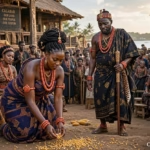
Long ago, when Burundi was ruled by kings, the safety of the kingdom depended on the courage and loyalty of those entrusted with its defence. The king, known as the Mwami, governed his people and relied on groups of warriors to protect the royal court and preserve order throughout the land.
Among these warriors were the Intore.
They were known for their military responsibilities and their association with the defence of the king against internal rebellions and attacks from outside the kingdom. Their duties required courage, discipline and readiness to serve whenever the monarchy faced danger.
The Intore were not the only warriors in the kingdom. Other groups, including the Ibirima, Amasuka and Abadasigana, also formed part of the royal military tradition. Yet the Intore became especially remembered for the ceremonial display associated with their return from battle.
Their story would eventually live beyond the royal court, becoming part of Burundi’s traditional dance and cultural memory.
The King’s Call
Whenever danger threatened the kingdom, the responsibility of protecting the royal authority became especially important. The Mwami needed warriors who could respond to challenges and defend the monarchy against those who sought to weaken it.
The Intore belonged to this royal military tradition.
Their service was not simply a matter of carrying weapons. They represented the strength of the king’s authority and the organisation through which the kingdom defended itself. Their position demanded courage and loyalty, while their military duties required discipline and coordination.
The kingdom also had other groups of warriors, each remembered within the wider organisation of royal defence. Together, they formed part of the system that supported the monarchy.
Explore more stories from our Burundian Folktales Collections archive.
The Intore’s reputation became closely associated with their public appearance as royal defenders. Their weapons, clothing and movements distinguished them, while their return from military campaigns provided an occasion for the people to recognise their service.
The Warriors Return
After a military campaign, the return of the warriors was an important occasion. The people gathered to welcome those who had gone out in the service of the king.
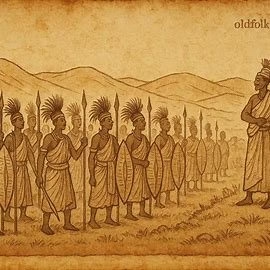
The warriors approached with their weapons, carrying the appearance of men who had fulfilled their responsibilities. Their arrival was not treated as an ordinary gathering. It became a public display of military pride and royal authority.
Before the king and the assembled people, the warriors presented themselves through a ceremonial parade.
They carried spears and shields, displaying the movements associated with their military identity. Their appearance recalled their responsibilities as defenders of the monarchy, while their coordinated actions showed the discipline expected of royal warriors.
The occasion allowed the people to recognise the men who had served the kingdom. It also strengthened the connection between the royal court, the warriors and the wider community.
The parade was remembered beyond the moment of the warriors’ return. Its movements and ceremonial character gradually became part of a cultural tradition through which later generations could remember the Intore.
The Dance of the Intore
As generations passed, the military parade associated with the Intore developed into a traditional dance.
The dance preserved the appearance and movements of the royal warriors, transforming their military display into a performance that could be witnessed at important gatherings.
The performers did not appear in ordinary clothing. They wore traditional garments that recalled the former warriors. Leopard skins were worn around their bodies, while long headdresses made from sisal fibres completed their distinctive appearance.
They also wore necklaces and bells around their ankles. Each performer carried a spear in the right hand and a shield in the left, recalling the weapons associated with the royal military tradition.
When the performance began, the dancers moved together in a coordinated formation. Their steps were energetic and controlled, reflecting the physical strength and discipline associated with the warriors.
The sound of the ankle bells accompanied their movements, adding rhythm to each step. The dancers did not perform in silence. Traditional instruments and poetry helped guide the performance.
The antelope horn, whistles and drums contributed to the atmosphere. Their sounds created a powerful accompaniment as the dancers moved and displayed their skill.
A leader delivered poetry during the performance, and the dancers adjusted their movements in response to its words. The poetry gave direction to the display, while the coordinated movements brought the words to life.
What had once been a military parade had become a way of remembering the royal warriors.
A Tradition Passed to New Generations
The passing of the monarchy in Burundi in 1966 brought an end to the old royal political institution. The warriors no longer served the king in the same way, and the ceremonies of the royal court changed.
However, the Intore tradition continued.
Rather than disappearing with the monarchy, the dance survived as an expression of Burundian cultural heritage. The movements, costumes and instruments continued to represent the warriors whose military responsibilities had given the tradition its original meaning.
Children and younger performers could learn the steps and understand the significance of the clothing and instruments. Through practice and performance, knowledge of the tradition passed from one generation to another.
The dance also found a place at official national ceremonies and cultural gatherings. People could watch the performers and recognise the connection between the modern display and Burundi’s royal past.
In Kirundo Province, in northern Burundi, the Intore dance is recognised as an important cultural attraction. Its continued performance demonstrates how a tradition connected with the former monarchy has remained part of the country’s cultural identity.
The Intore Take Their Place on the National Stage
Today, when the Intore appear at a public celebration, their performance recalls a period when warriors served the Burundian king.
The dancers gather in their traditional clothing, carrying spears and shields. Their ankle bells are ready to accompany their movements, while the drums, whistles and antelope horn provide the sounds that guide the display.
As the performance begins, the dancers move with energy and coordination. The leader’s poetry directs their actions, and the rhythm of the instruments fills the gathering.
The audience witnesses more than a dance. It sees a representation of the courage, discipline and ceremonial pride associated with the royal warriors.
The performance does not recreate one particular battle or celebrate the victory of a named warrior. Instead, it preserves the wider memory of the Intore and their place in the history of the Burundian monarchy.
The tradition has also received international recognition. In 2014, UNESCO inscribed Burundi’s ritual dance of the royal drum on its Representative List of the Intangible Cultural Heritage of Humanity. Although this is a distinct tradition from the Intore dance, the recognition reflects the wider importance of traditional performance in preserving Burundi’s cultural identity.
The Intore dance continues to remind people that the history of a nation is preserved not only in written records and monuments but also in the traditions its people maintain.
The royal warriors who once defended the Mwami are no longer assembled for military service. Yet their memory remains visible whenever performers put on their traditional clothing, lift their spears and shields, and begin the movements passed down through generations.
Their legacy lives on in the dance.
Explore our complete Africa Folktales collection.
Moral Lesson
The story of the Intore teaches that courage, discipline and service can leave a lasting legacy. The warriors were remembered for their responsibility to protect the kingdom, but their influence continued long after their military duties had ended.
Their tradition also shows the importance of preserving cultural heritage. Even when political institutions disappear, the songs, dances, clothing and customs associated with them can survive. By passing the Intore dance from one generation to another, Burundians continue to honour an important part of their history.
Knowledge Check
1. Who were the Intore warriors?
A: They were royal warriors associated with defending the Burundian king against internal rebellions and external attacks.
2. What happened when the warriors returned from battle?
A: They took part in a ceremonial parade before the king and the people.
3. What clothing did the traditional Intore dancers wear?
A: They wore leopard skins, sisal-fibre headdresses, necklaces and ankle bells.
4. Which objects did the dancers carry?
A: They carried spears and shields.
5. What accompanies the Intore dance?
A: Traditional instruments such as drums, whistles and antelope horns, together with poetry.
6. How is the Intore tradition preserved today?
A: It continues through cultural performances at official national ceremonies and other gatherings, including events associated with Kirundo Province.
Source
Based on the Burundi National Tourism Office’s account of the Intore warriors and their dance tradition, with supporting cultural documentation from the Kirundo Provincial Profile published by the Institut National de la Statistique du Burundi.
Explore More Burundian Folktales
- The King’s Lost Shadow
- The River That Refused to Sleep
- The Woman Who Carried the Mountain
- The Clever Hare and the Greedy Hyena
- The Girl Who Married the Rain