In a village nestled among rolling hills, where the sound of grinding stones echoed through compound walls and children’s laughter mingled with the bleating of goats, there lived a man named Agha. He had two wives but understood neither of them as well as he believed.
His household, like many others in that time, was divided by the complicated dynamics of polygamous marriage, where affection, rivalry, and jealousy sometimes existed side by side.
Masafi, his first wife, was known throughout the village as a woman whose tongue moved faster than a weaver’s shuttle. Every evening, when Agha returned from his daily labor, she greeted him not with water to wash his dusty feet but with a stream of complaints about her co-wife.
“Ajientoh is a bad wife,” she would begin, her eyes flashing with indignation. “She isn’t a good cook. Her soup tastes like water mixed with disappointment. Ajientoh’s children always bully my children when we are not watching. She’s selfish, keeping the best pieces of meat for her own family. And lazy! You should see how she spends her time at the river instead of working.”
Explore more stories from our Cameroonian Folktales Collections archive.
These poisonous words fell upon willing ears, for Agha had long ago chosen a favorite between his two wives.
His affection for Masafi was so intense that he would boast to anyone willing to listen about the lengths he would go to prove his devotion.
“I could kill a lion for her,” he would declare, pounding his chest with pride. “I would even do something as unlawful as laying the head of that lion at her feet.”
Such was his infatuation that he remained blind to Masafi’s manipulative behavior and ignored the wisdom that might have helped him understand her true character.
Ajientoh, meanwhile, moved through her daily existence like a quiet river flowing around stones.
Where Masafi’s presence filled every corner with noise and complaints, Ajientoh brought a calm steadiness that often went unnoticed and unappreciated.
She rose before dawn to kindle the cooking fires, cared for her children with patience, performed her household duties without complaint, and endured her co-wife’s insults with dignity.
She never burdened her husband with endless complaints about Masafi or constantly sought his sympathy for the difficulties she experienced.
One morning, as the dry season painted the landscape in shades of gold and brown, Agha awoke with a troubled mind.
He claimed that disturbing dreams had visited him during the night, revealing that his wives’ affection was false and that neither truly loved him.
The seed of suspicion, once planted, quickly grew in the fertile soil of his thoughts.
“I must test them,” he muttered to himself as his wives departed early for their farms, carrying their farming tools and empty baskets that they hoped to return with full of harvest.
“Only through a trial can I discover which of my wives truly loves me.”
As the sun climbed higher and the compound settled into the quiet rhythm of midday, Agha began carrying out his cruel plan.
He spent the morning repairing a hole in the goat pen, his hands working mechanically while his mind remained occupied with his deceptive scheme.
When evening shadows began stretching across the nsaa, he selected one of his finest goats and slaughtered it.
His preparations were disturbing and deliberate.
After draining the animal’s blood, Agha carefully removed its intestines, handling them as though they were props in a gruesome performance.
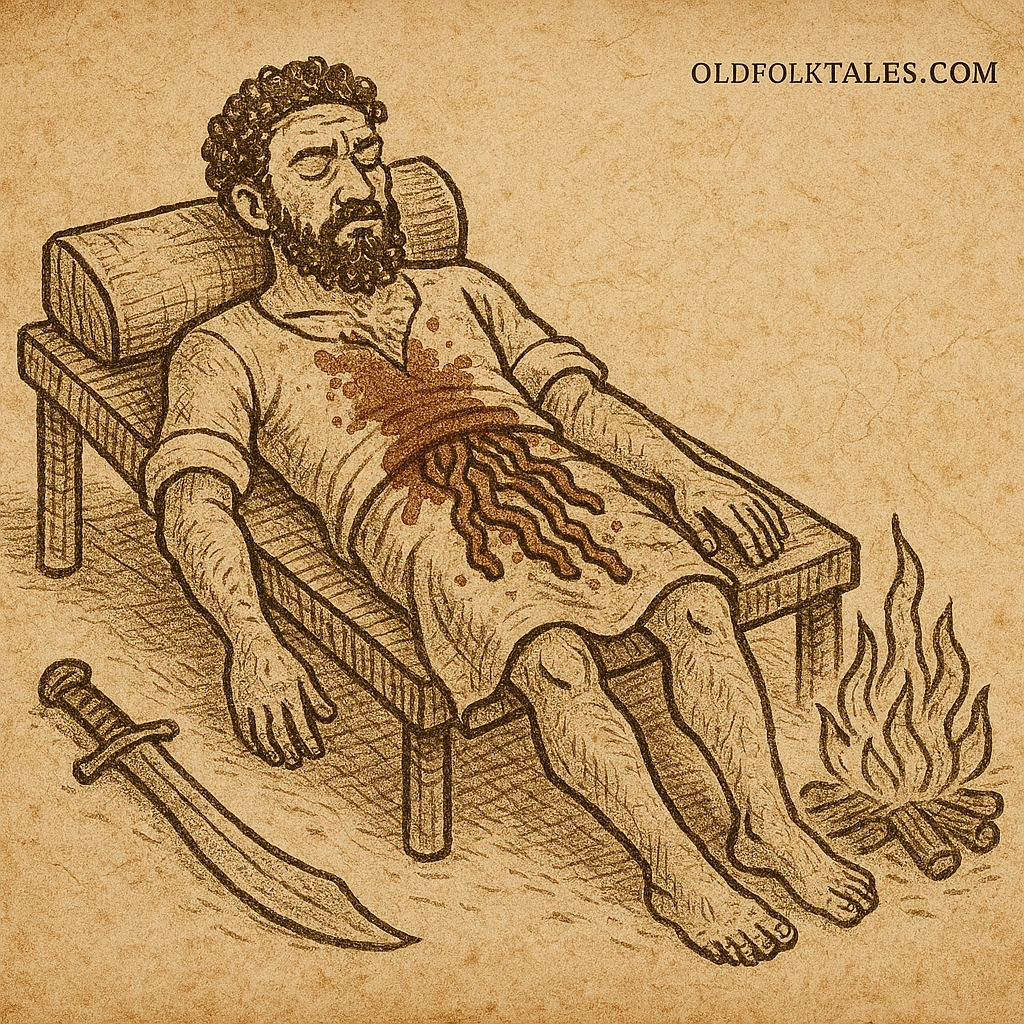
He positioned himself on his bamboo bed beside the fireside and arranged the bloody entrails across his bare stomach.
He then smeared goat’s blood across his chest and throat until he resembled someone who had suffered a brutal attack.
Finally, he placed the bloodstained cutlass on the floor beside his bed and lay motionless, pretending to be dead.
As twilight painted the sky in shades of purple and gold, the sound of returning footsteps and children’s voices announced the arrival of his wives.
They returned from the fields covered in dust and exhausted from their day’s work. Their backs were bent beneath heavy loads of groundnuts, corn, and cocoyams gathered for their families.
Masafi, always eager to receive her husband’s attention first, hurried directly to Agha’s house to deliver her customary evening greeting.
But her cheerful words died in her throat when she entered and saw the horrifying scene before her.
Her husband lay motionless on his bed, his body covered in blood, with what appeared to be his intestines spilling from his stomach.
Without crying out in grief or taking a moment to confirm whether he was truly dead, Masafi immediately turned her attention to practical matters.
She quickly climbed a ladder into the smoky darkness of the ceiling storage space, where valuable family possessions were kept.
Her hands searched through the hidden belongings until she found precious horns, one containing afuondo medicine and another holding her husband’s money, together with his valuable ndip and other possessions.
Like a thief working under the cover of darkness, she gathered the treasures and secretly carried them to her own house.
Afterward, she disappeared toward the stream.
Meanwhile, Ajientoh followed her usual evening routine.
She first went to the stream to bathe and wash away the day’s labor before preparing the family’s evening meal.
Only after completing these duties did she approach her husband’s house to announce that supper was ready.
She carried herself with the same quiet dignity that had always characterized her behavior.
But the house greeted her with the silence of a tomb.
As darkness gathered, she kindled a fire to provide light.
When the flames illuminated the horrifying scene, a piercing scream escaped her throat.
It was a cry of genuine anguish from someone who believed she had lost her husband.
The children, hearing her cries, came running from every direction.
Soon, the entire compound was filled with neighbors drawn by the commotion. Their faces were marked with concern and horror as they approached Agha’s bedside.
Ajientoh’s cries guided them toward the apparent tragedy, and they stood in shocked silence.
“What happened to him?” some whispered.
“Oh, what an abomination! Who could have done such a thing?” others wondered.
Murder was regarded as a terrible violation of the peaceful life the villagers valued. The sight of so much blood and the apparent brutality of the attack left even the most experienced elders speechless.
Agha’s uncle, being the next senior male in the family hierarchy, began assuming the responsibilities that tradition demanded.
He started giving instructions for the necessary cleansing rituals and burial preparations that would follow such a tragedy.
But before his instructions could be completed, Agha suddenly leaped from his deathbed.
The bloody goat intestines tumbled to the ground, splattering several onlookers.
Women screamed in terror.
Some people fled the compound, while others spread the news that they had witnessed a ghost rising from Agha’s house.
The confusion was complete.
“My brothers! My sisters!” Agha called out, raising his hands in an attempt to calm the frightened crowd.
“My people, what you are seeing are merely the entrails of a goat. When you do not understand the language of the drum, you call it noise. Had I not pretended to die, I would never have discovered which of my wives truly cared for me.”
His revelation struck the compound like lightning.
When Masafi heard his words, she realized that her actions had been exposed.
She quickly gathered her belongings and disappeared to her father’s compound, never returning to face the consequences of her conduct.
Agha’s neighbors, meanwhile, turned away from him with expressions of disgust and disappointment.
They considered him a man who had violated the trust and dignity expected of a husband and responsible member of the community.
His cruel deception had caused unnecessary fear and distress, disturbing the peace of the entire village.
To remain in the community and rebuild his damaged reputation, Agha was required to make amends.
He purchased five precious jugs of palm wine, prepared two full bunches of plantains, and invited his neighbors to a feast of reconciliation.
They gathered to eat and drink together. Libations were poured in front of his house as part of the customary effort to appease the ancestors and restore harmony.
Only after these acts of reconciliation did the community begin considering his wrongdoing partially addressed.
Ajientoh, whose genuine grief had revealed the depth of her concern, agreed to remain with him as his wife.
However, the trust between them had been damaged, and their relationship would never be entirely free from the wounds caused by his deception.
Explore our complete Historic Folklore & Fairy-Tale Collections archive.
Moral Lesson
This Beba folktale warns against the dangers of jealousy, favoritism, manipulation, and cruel tests in relationships.
It teaches that genuine love and loyalty are demonstrated through consistent actions, kindness, and responsibility rather than dramatic promises or artificial trials.
Agha’s deception also reveals that testing another person’s character through cruelty can damage the very relationship one hopes to protect.
Trust is difficult to build but easy to destroy. Once broken, it may take considerable time and effort to restore.
Knowledge Check
1. What motivated Agha to test his wives in this Cameroon folktale?
Agha claimed that troubling dreams had made him suspect that his wives did not genuinely love him. He therefore devised a cruel plan to pretend to be dead and observe their reactions.
2. How did Masafi’s and Ajientoh’s reactions differ when they found Agha apparently dead?
Masafi immediately searched for and removed valuable household possessions, while Ajientoh reacted with genuine distress and called for help from the community.
3. What cultural significance does the community’s reaction to Agha’s deception have?
The neighbors’ disappointment and demand for reconciliation demonstrate the importance of family trust, community harmony, and making amends after wrongdoing.
4. What role does polygamy play in this traditional African story?
The story explores the complications that can arise in polygamous households, particularly favoritism, jealousy, rivalry, and unequal treatment between co-wives.
5. What is the symbolism of the goat’s intestines and blood in this folktale?
They represent deception and the manipulation of appearances. Agha uses them to create the illusion of death, but his scheme ultimately exposes his own poor judgment.
6. How does this tale reflect African values about community and family relationships?
The story emphasizes that family relationships are connected to wider community responsibilities. Deception can disturb communal peace, while reconciliation and accountability help restore harmony.
Source
Adapted from The Sacred Door and Other Stories: Cameroon Folktales of the Beba, published by Ohio University Press.
Explore More Cameroonian Folktales
- The Sacred Forests of the Bakossi
- The Water Ceremony
- The Keeper of the Royal Drum of Bafut
- The Great Canoes of the Wouri
- The Festival of the Elephant Masks
- The Iron Masters of the Mandara Hills
- The Great Market of Maroua
- The Counsel of the Bamum Queen Mother
- The Night Market Where Humans Trade with Spirits