In a time when poverty could mark a man more deeply than any physical scar, there lived a young man whose misfortune seemed woven into the very fabric of his existence. Death had claimed both his father and mother, leaving him with nothing but empty hands and an emptier stomach. His fields lay barren, yielding not even the humblest of crops, while his granary remained as hollow as his hopes for the future.
No woman in the village would look favorably upon him, for what maiden would dream of marrying a man who could not provide even the most basic necessities? The cruel tongues of his neighbors had nicknamed him “the village scarecrow,” a walking reminder of failure who seemed to frighten away prosperity rather than attract it.
The sting of their mockery drove him daily into the embrace of the forest, where the judgmental eyes of his community could not follow and where the trees offered silent companionship to his wounded spirit.
One morning, as hunger gnawed at his belly with the persistence of a termite boring through wood, he shouldered his rusty cutlass and worn axe, determined to carve a better future from the wilderness. The familiar forest paths no longer satisfied his desperate search for fertile land, so he ventured deeper into unknown territory, where ancient trees stood like pillars supporting the roof of the world.
Explore more stories from our Cameroonian Folktales Collections archive.
Exhaustion finally forced him to rest beneath a towering mahogany tree whose trunk could have sheltered an entire family. Its shade provided relief from the scorching sun, but his empty stomach cramped with pain, leaving him dizzy and weak.
He searched the surrounding trees with desperate eyes, hoping to spot wild fruits hanging from the branches, but the forest seemed as barren as his own fields.
Then, as if she had emerged from the very essence of the forest, an old woman appeared before him. Her presence carried the weight of countless seasons, and her eyes held depths that spoke of ancient wisdom and mystery.
“Mother, are you lost?” he asked, his voice hoarse with hunger and surprise.
“Where are you from?” she replied, studying him with an intensity that seemed to pierce through his skin and examine his very soul.
“My father and mother have both died,” he answered honestly, his words heavy with the grief that never quite left him. “I am looking for a place to plant some seeds.”
The old woman’s command came swiftly and unexpectedly.
“Give me that cutlass and axe.”
Without hesitation, perhaps driven by desperation or some supernatural influence, he handed over his tools, the only possessions that made him feel more than a beggar.
“Turn around. Take off your clothes,” she commanded with the authority of someone accustomed to being obeyed.
The man turned his back to the mysterious woman, his fingers trembling as he removed his brown, tattered singlet and the simple loincloth that provided his only covering.
As he finished undressing and lifted his eyes to survey his surroundings, the world transformed completely.
The familiar forest, with its towering mahogany trees and dappled sunlight, had disappeared.
Instead, he found himself standing in a magnificent kingdom where golden light seemed to emanate from the very air itself. The people of this miraculous realm welcomed him with joy shining from their faces. Without ceremony or explanation, they escorted him to a palace more magnificent than anything he had ever imagined.
Before he could fully comprehend the transformation, a jeweled crown was placed upon his head, and voices throughout the palace proclaimed him their king.
The poor man who had once been mocked as a scarecrow now ruled a kingdom of unimaginable wealth and beauty.
A nkwob, the most senior of the palace nobles, became his guide through this extraordinary new world.
Their tour lasted an entire day as they explored luxurious living quarters, ceremonial grounds where gold and silver glittered like captured stars, and gardens where flowers bloomed in magnificent harmony.
The king’s new domain stretched as far as his eyes could see, offering him everything a man could desire.
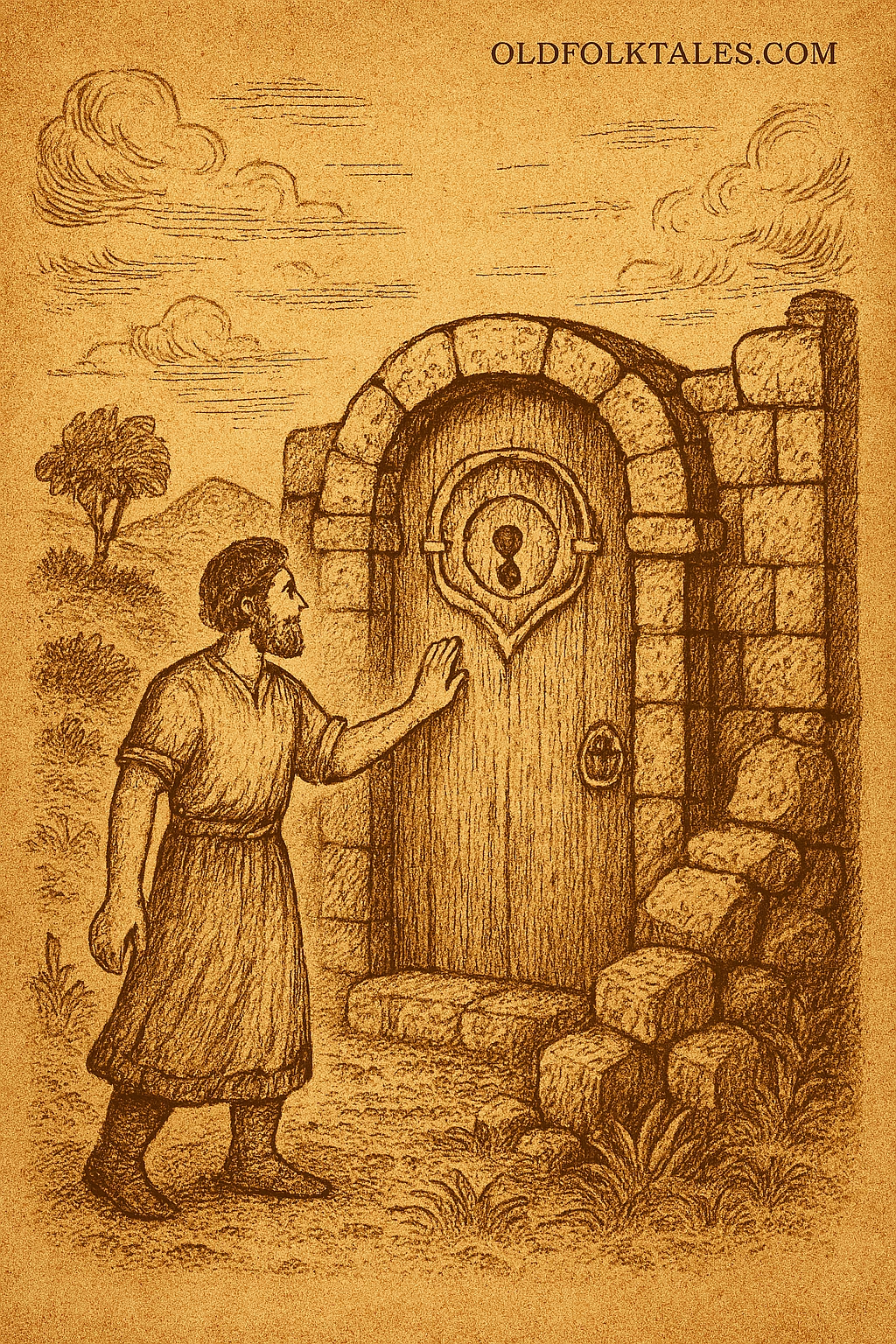
Finally, as evening shadows painted the palace walls in shades of purple and gold, they came to a single door that stood apart from all the others.
The nkwob bowed deeply, his voice carrying an air of absolute seriousness.
“Mbeh, everything in this palace is yours, but you must never open this door. It is the sacred door.”
Years flowed by like a gentle river, and the king settled into his new position with surprising skill.
He governed with wisdom and compassion, earning the deep love of his subjects, who prospered under his benevolent rule.
The gods seemed to smile upon his reign, blessing him with many children whose laughter filled the palace halls.
By every measure, he should have been the happiest of men.
Yet, as the Beba people say, his throat remained bitter.
Deep inside, he was desperately dissatisfied.
The forbidden door haunted his waking moments and invaded his dreams with its terrible mystery.
“Why shouldn’t I touch that door?” he would mutter to himself during the dark hours before dawn. “Am I not the king? Have I not been good to my people? Why am I being treated like a stranger in my own palace? What secrets are hidden behind that door?”
His teeth would gnash with frustration as the sacred door tormented his mind like a persistent itch that could never be scratched.
The man who ruled an entire kingdom found himself enslaved by a curiosity more binding than iron chains.
He vowed that somehow, someday, he would discover what lay beyond that forbidden threshold.
After all, was he not the king?
His opportunity finally arrived during the most sacred celebration of the year: the nwa ngeh, the Feast of the Cutting-of-the-Grass.
This annual festival brought together the entire kingdom in gratitude and reverence. The king provided abundant food and drink, and his subjects celebrated with hearts full of joy.
They performed the traditional nwa ngeh ceremonies, invoking their gods through ancient songs of thanksgiving.
Together, they expressed gratitude for the life-giving rains, the blessing of new births, good health, and the bountiful harvests that filled their granaries.
Libations flowed freely as precious palm wine was poured upon the earth. A ceremonial goat was sacrificed, and its blood was offered as part of the prayers to the ancestors. The people also recited traditional incantations seeking protection against enemies, evil omens, and those who might bring harm to their peaceful kingdom.
The celebration continued deep into the night, with eating, drinking, dancing, and singing that echoed across the kingdom like thunder rolling through distant valleys.
But when the festivities finally ended and his satisfied subjects retired to their beds, the king found sleep impossible.
As the palace settled into the profound silence that follows a great celebration, one lonely figure began roaming its halls.
The king’s troubled mind whispered into the darkness.
“Today is the day I must open that door. If I cannot open it on a sacred day like this, when can I? A day of spiritual significance such as this surely provides the perfect opportunity to open the sacred door.”
His bare feet moved silently across the cold stone floors as he navigated the sleeping palace.
Each step brought him closer to the forbidden threshold that had dominated his thoughts for years.
His heart hammered against his ribs like a caged bird desperate for freedom as he approached the sacred door.
With trembling hands, he gently turned the handle and stepped across the threshold that had been denied to him for so long.
The door closed behind him with a soft click that seemed to echo through eternity.
Suddenly, shivers raced down his spine like lightning striking the earth.
The magnificent palace, his royal robes, and his crown had all vanished like morning mist touched by sunlight.
He stood completely naked in the middle of the forest clearing, his skin exposed to the cool air.
The old woman sat exactly where he had first encountered her, beneath the same mahogany tree, as if no time had passed at all.
Her ancient eyes held no surprise, only the patient wisdom of someone who had witnessed this scene countless times before.
“Here are your things,” she said simply.
She extended her weathered hands, offering him his ragged clothes, rusty cutlass, and worn axe, the same poor possessions he had carried into the forest so many years earlier.
The kingdom, the palace, the crown, and everything he had enjoyed had disappeared.
He had returned to the life he once knew, having lost the extraordinary opportunity that had been given to him.
Explore our complete Historic Folklore & Fairy-Tale Collections archive.
Moral Lesson
This Beba folktale warns against the destructive power of uncontrolled curiosity and the inability to respect established boundaries.
It teaches us that not every mystery must be uncovered and that some conditions must be respected, even when we do not fully understand their purpose.
True wisdom lies in appreciating our blessings, exercising self-control, and honoring the responsibilities that come with the opportunities we receive.
Sometimes, the desire to discover what is forbidden can make us lose everything we already possess.
Knowledge Check
1. What role does the old woman play in this Cameroon folktale?
The old woman serves as a mysterious supernatural figure who transforms the poor man’s life by granting him a kingdom, while establishing a condition that he must never violate.
2. What is the significance of the nwa ngeh festival in the story?
The nwa ngeh, described as the Feast of the Cutting-of-the-Grass, represents an important annual celebration during which the people express gratitude to their gods and ancestors. It also provides the occasion during which the king decides to open the forbidden door.
3. Why does the king ultimately open the forbidden door?
His growing curiosity and dissatisfaction make him increasingly obsessed with discovering what lies behind the door, despite being warned never to open it.
4. What does the sacred door symbolize in this African folktale?
The sacred door symbolizes forbidden knowledge, personal boundaries, and the importance of respecting conditions attached to extraordinary blessings.
5. How does this folktale reflect traditional African beliefs about supernatural gifts?
The story illustrates the idea that extraordinary supernatural blessings may come with conditions and responsibilities that must be respected.
6. What cultural lesson does this tale teach about leadership and humility?
It teaches that even kings must recognize their limitations and respect sacred boundaries. True leadership requires wisdom, humility, and self-control.
Source
Adapted from The Sacred Door and Other Stories: Cameroon Folktales of the Beba, published by Ohio University Press.
The narrative reflects Beba storytelling traditions, with the original cultural expressions and central supernatural elements retained.
Explore More Cameroonian Folktales
- The Sacred Forests of the Bakossi
- The Water Ceremony
- The Keeper of the Royal Drum of Bafut
- The Great Canoes of the Wouri
- The Festival of the Elephant Masks
- The Iron Masters of the Mandara Hills
- The Great Market of Maroua
- The Counsel of the Bamum Queen Mother
- The Night Market Where Humans Trade with Spirits