Long ago, when the Mossi kingdoms were growing in strength, the people understood that a kingdom needed more than powerful rulers and brave warriors. It needed a way to remember its beginnings, honour its ancestors and preserve the wisdom of those who had governed before.
Yet the passage of time threatened to weaken these memories. Younger generations knew the names of their leaders but did not always understand the struggles, sacrifices and responsibilities behind their positions.
One day, an elderly drummer helped the people discover how the sound of a single instrument could preserve the history of an entire kingdom. Through his wisdom, a remarkable tradition began to take shape, reminding generations that a ruler’s authority was connected to the history and identity of the people.
A Kingdom in Need of Remembrance
In the early days of the Mossi kingdoms, settlements spread across the open plains of the region now known as Burkina Faso. Farmers cultivated their fields, herders cared for their animals, craftsmen produced useful tools, and families gathered around their elders to hear stories about earlier generations.
The kingdom was governed by rulers whose authority depended not only on their strength but also on their connection to established royal lineages. Their names carried memories of earlier reigns, victories, disputes and important decisions.
Whenever a new ruler took his position, the people celebrated. Messengers travelled between settlements, elders gathered to offer advice, and the royal court prepared for ceremonies marking the beginning of another reign.
Explore more stories from our Burkinabe Folktales Collections archive.
But as generations passed, an important difficulty emerged.
Some young people could remember the names of the kings but knew very little about their predecessors. Others confused the achievements of one ruler with those of another. Stories that had once been carefully preserved through oral recitation began to change as different people remembered them in different ways.
The elders recognised the danger.
They understood that a community could lose part of its identity if it forgot the people and events that had shaped its history.
Among the people who worried about this problem was an elderly drummer named Barka.
Barka had spent many years serving the royal court. He knew how to handle traditional instruments and had learnt the importance of rhythm, memory and careful listening from older musicians.
He believed that history should not exist only in the minds of a few elderly people. It needed to be carried forward in a form that younger generations could learn and remember.
The Wisdom of the Old Drummer
One afternoon, Barka was summoned to a gathering of elders.
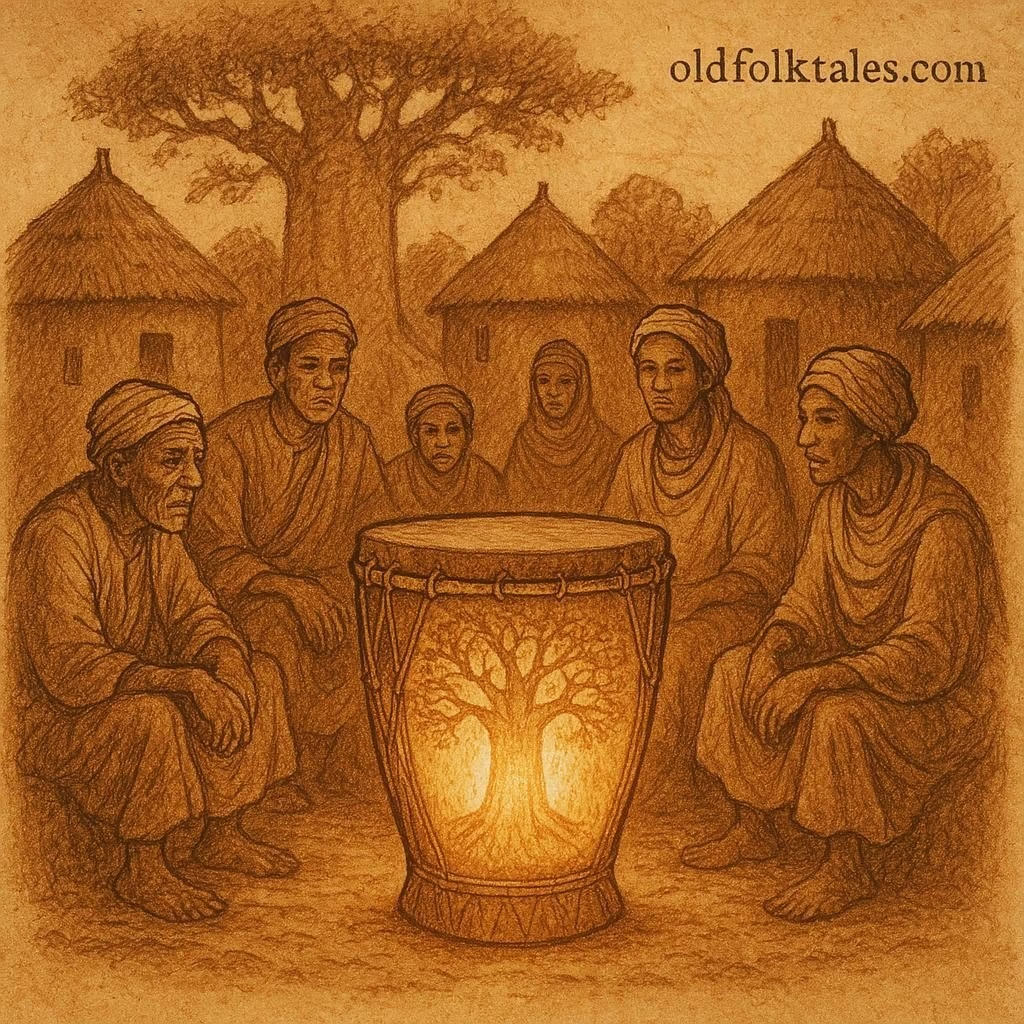
The senior men had assembled beneath a large tree to discuss the growing difficulty of preserving the kingdom’s history.
“We cannot allow the names of our ancestors to disappear,” one elder said. “Their decisions shaped the kingdom we now inhabit. Our children must understand where their people came from.”
Another elder agreed.
“But how shall we preserve everything? Stories are forgotten, and memories become uncertain as the years pass.”
Barka listened carefully before speaking.
“Words can be remembered,” he said, “but they can also be lost. We need something that can carry the memory of the kingdom from one generation to another.”
The elders asked what he had in mind.
Barka explained that music and rhythm could help people remember long passages of information. A familiar pattern could be repeated, learnt and passed from one musician to another.
He believed that a drum could become more than an instrument used for entertainment. With proper training, it could carry important messages and preserve the names of those who had ruled.
Some elders were doubtful.
“How can a drum preserve the history of a kingdom?” one asked.
Barka answered patiently.
“A drum speaks differently from a human voice, but its sounds can be arranged and understood by those who know the tradition. If we teach our musicians carefully, they can preserve the memories of our rulers through rhythm.”
The elders considered his proposal.
They eventually agreed that Barka should demonstrate what he meant.
The Making of the Royal Drum
Barka began searching for the materials needed to make an instrument suitable for the task.
He did not want an ordinary drum used only for dancing. He wanted an instrument whose sound could carry across a gathering and whose rhythm could be recognised by trained listeners.
He selected a large, mature gourd and carefully prepared it. The inside was hollowed, and its surface was shaped to produce a deep, resonant sound.
A suitable goatskin was then stretched across its opening and secured firmly.
When the instrument was ready, Barka examined it closely. He adjusted its surface and tested different positions with his fingers.
The first sounds were uneven. Some were too sharp, while others lacked the depth he wanted.
He continued practising until he discovered a sequence of tones that could be repeated consistently.
The elders gathered to hear his demonstration.
Barka struck the drum gently.
A deep sound emerged, followed by a lighter rhythm. He repeated the sequence, changing the pressure and position of his fingers.
The people listened.
Although they could not yet understand everything he intended to communicate, they recognised that the instrument had a distinctive voice.
Barka explained that the drum would require careful training. Its sounds could not be understood by simply listening once. Musicians would need to learn the established patterns and the history they were expected to preserve.
The elders approved.
They agreed that the instrument should be respected and used for important occasions at the royal court.
The First Recitation
Barka’s next task was to prepare the history that the drum would carry.
He visited elderly men who remembered earlier rulers. He listened to their accounts, compared their recollections and arranged the names and achievements into an order that could be taught to younger musicians.
The work required patience.
Some elders remembered particular events differently, so Barka returned to them for clarification. He refused to rush the process because he understood that an incorrect account could confuse future generations.
Eventually, he prepared a sequence of royal names and historical recollections.
When the day of the first demonstration arrived, the royal court gathered.
The ruler took his place, accompanied by members of his household and important dignitaries. Villagers and visitors assembled to witness the occasion.
Barka sat before the gourd drum.
He looked towards the elders, received their approval and began.
The first beats were slow and deliberate. He then introduced a series of changing rhythms, carefully following the sequence he had learnt.
The drum seemed to speak.
Its sounds carried the names and memories of earlier rulers, recalling the royal lineages that had shaped the kingdom.
The people listened with attention.
Those who already knew the history recognised familiar names. Younger listeners discovered that the rhythm could help them follow a long account without losing its order.
When Barka finished, the gathering remained quiet for a moment.
Then the elders praised his work.
They understood that the drum could serve an important purpose beyond ceremony and entertainment. It could help preserve the kingdom’s historical memory.
The Drum Becomes a Symbol of Royal Memory
After the successful demonstration, the royal court encouraged the training of other musicians.
Barka taught younger drummers the techniques required to produce clear sounds. He also explained that technical skill alone was insufficient.
A drummer needed to understand the history being communicated. He had to learn the names of the rulers, the order of their reigns and the importance of preserving the accounts entrusted to him.
The instrument gradually became associated with the royal court.
It accompanied important gatherings and helped communicate the history of the ruling lineage. Its rhythms reminded the people that the present ruler belonged to a longer succession of leaders.
The drum also became an important part of public ceremonies.
Whenever the ruler appeared before the people, musicians could perform established rhythms associated with royal authority. During important occasions, their performances helped create an atmosphere of respect and remembrance.
The people began to appreciate the musicians differently.
They no longer regarded them simply as entertainers. They recognised that trained drummers carried responsibilities connected to the kingdom’s history and identity.
Barka was pleased with this development.
He understood that the instrument’s importance depended on the knowledge preserved through its performance. Without trained musicians and careful transmission, its sounds would eventually lose their meaning.
A Lesson for the Younger Generation
Years passed, and Barka grew old.
His hands became less steady, and he could no longer perform for long periods without resting. Yet he continued teaching younger musicians because he wanted the tradition to survive beyond his lifetime.
One afternoon, a young drummer named Koudougou approached him.
“Master,” the young man said, “why must we spend so much time learning the names of rulers who lived before our grandfathers were born? Would it not be easier to play beautiful rhythms without remembering their histories?”
Barka smiled.
“Beautiful music can bring happiness,” he replied, “but a musician who serves the royal court has another responsibility. You must understand what your drum is communicating.”
The young man listened.
Barka continued.
“When you repeat the history of a ruler, you remind the people that leadership did not begin today. Every generation inherits something from those who came before it. A ruler must understand that authority carries responsibilities, and the people must remember the experiences that shaped their kingdom.”
Koudougou considered these words.
He realised that learning the drum required more than practising rhythms. It involved patience, knowledge and respect for the past.
From that day forward, he took his training seriously.
He learnt the established patterns, listened to the elders and studied the history associated with the royal lineage.
When Barka finally passed away, the younger musicians continued the work he had taught them.
They trained others, and the knowledge travelled from one generation to another.
The Legacy of the Royal Drum
As the Mossi kingdoms continued to develop, the drum remained connected to royal memory and ceremony.
Its sounds reminded the people of the rulers who had governed before them. Through the work of trained musicians, dynastic histories could be recited and preserved for those who had not witnessed earlier reigns.
The instrument became a powerful reminder that a kingdom’s identity was not created by one ruler alone.
It was shaped by generations of people whose decisions, struggles and achievements contributed to the society that followed.
The elders continued to teach young people the importance of respecting their history. Musicians were encouraged to understand the meaning of their performances rather than treat them as empty displays.
The royal drum therefore represented more than music. It became associated with memory, authority, continuity and the responsibility to preserve inherited knowledge.
And whenever its deep rhythms sounded before the royal court, the people were reminded that the past remained connected to the present.
The story of Barka and his drum continued as a literary reminder of the importance of preserving ancestral knowledge. The instrument’s greatest value was not simply the sound it produced, but the history and identity it helped carry forward.
Explore our complete Africa Folktales collection.
Moral of the Story
The Origin of the Mossi Kingdom’s Drum teaches that preserving history is an important responsibility shared across generations. Wisdom, knowledge and cultural traditions should not disappear with the passing of elders. Through patience, respect and proper teaching, communities can preserve their identity and help younger generations understand the responsibilities that come with leadership.
Knowledge Check
1. Why were the elders concerned about preserving the kingdom’s history?
They feared that younger generations would forget the names, achievements and experiences of earlier rulers.
2. Who was Barka?
Barka was an elderly royal drummer who believed that rhythm could help preserve the history of the kingdom.
3. What instrument did Barka prepare?
He prepared a traditional gourd drum covered with goatskin.
4. What important purpose did the drum serve?
It helped communicate and preserve the dynastic history of the royal lineage.
5. What did Barka teach the younger musicians?
He taught them that drumming required technical skill, historical knowledge, patience and respect for tradition.
6. What is the main lesson of the story?
Cultural traditions and ancestral knowledge should be preserved and passed from one generation to another.
Source
Creatively inspired by documented Mossi royal drumming traditions described by Junzo Kawada in “Notes on the Drum Language of the Ancient Mossi Kingdoms (Burkina Faso),” Japanese Review of Cultural Anthropology, Volume 15 (2014), pages 199–215.
Explore More Burkinabe Folktales
- The Origin of Mossi Blacksmiths: A Story of Three Brothers
- The Child Marked by the Spirit World
- Yennenga the Warrior Princess
- Ouédraogo and the Origin of the Mossi Kingdom
- The Tale of the Singing Camel