The Sun has always been both a blessing and a burden to humanity. We complain when his rays grow unbearably hot against our skin, yet we miss his warmth when he withdraws behind the clouds. Whatever we say about him, we cannot live without his light. Perhaps, as our people sometimes explain, this is why the Sun married one of our daughters, hoping to make amends for all the complaints and demands we have made of him.
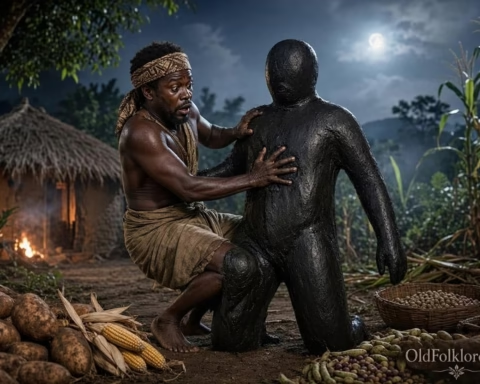
This happened long ago, during the planting season, when women went to their farms to prepare the land and sow pumpkin seeds. Among them was a woman named Majieno. While the other women worked hard, clearing their plots and planting their seeds, Majieno preferred to avoid the labour. Instead of sowing her pumpkin seeds, she roasted them over a fire and ate them. She was satisfied with her little feast and gave no thought to the harvest she would miss.
What Majieno did not realise was that Mashii, a bird watching from a nearby tree, had witnessed everything. After she had eaten the seeds, Mashii gathered the discarded shells and planted them in the soil. He tended the seeds and allowed them to grow.
The seasons passed, and the pumpkin vines spread across Majieno’s farm. When the time came for the women to taste their first pumpkins, they prepared to visit their farms and enjoy the fruits of their labour.
As the women made their way towards the farms, they chatted and laughed together. Majieno, however, remained unusually quiet.
“Why are you so silent today?” her companions asked. “You are usually among the first to laugh and talk. What is wrong?”
“I am not feeling well,” Majieno replied.
When they reached the top of the hill and looked down towards their farms, Majieno suddenly became excited. Her plot was covered with beautiful, mature pumpkins. She could hardly contain her happiness.
Her companions wondered why she had suddenly become cheerful.
“The Sun has touched my face, and I am feeling much better,” she explained.
But Majieno’s happiness did not last. When the women descended to their farms and began gathering their pumpkins, she discovered that she could not harvest hers.
Each time she picked a pumpkin and placed it in her basket, Mashii appeared and sang:
Tinke bo’, Tinke bo’, Tinke tinke bo’.
Back to the stem, pumpkin.
Back to the stem, pumpkin.
Back to the back to the stem, pumpkin.
As soon as Mashii finished singing, the pumpkin returned to its vine. No matter how many times Majieno tried, she could not take a single pumpkin home.
Explore more stories from our Cameroonian Folktales Collections archive.
Her companions eventually noticed her difficulty. Majieno explained that whenever she picked a pumpkin, Mashii sang his song and caused it to return to its stem.
The other women felt sorry for her and shared their harvest with her so that she would not return home empty-handed.
When Majieno arrived home, she told her mother what had happened. Her mother listened carefully and suggested that she accompany her to the farm the following day.
The next morning, Majieno and her mother went to the farm. Instead of attempting to harvest pumpkins, they spent their time weeding. When it was time to eat, they sat down to enjoy their meal of cocoyam and soup.
Mashii soon came down to join them. He ate with the two women until only one piece of food remained. They invited him to take the last piece, and the bird flew into their basket to collect it.
At that moment, Majieno’s mother quickly turned the basket over, trapping Mashii inside.
“Please do not kill me,” Mashii pleaded. “If you spare my life, I will provide you with cooking oil and salt whenever you need them.”
The women agreed not to harm him and carried him home.
From then on, Mashii became a valuable source of provisions for their household. Whenever they needed cooking oil or salt, they could ask him, and he would provide what they required.
One day, Majieno went to the farm and left her young daughter at home. Before leaving, she instructed the girl to ask Mashii for the provisions needed to prepare their meal.
The girl approached the bird with a bowl, but she struggled to hold both him and the container comfortably. As she adjusted her hands, she loosened her grip, allowing Mashii to escape.
She chased after him, hoping to catch him before her mother returned, but the bird was nowhere to be found. Eventually, she caught an ordinary bird and brought it home, hoping it could take Mashii’s place.
When Majieno returned, she asked for cooking oil and salt. The replacement bird could produce neither. Instead, it gave them sand.
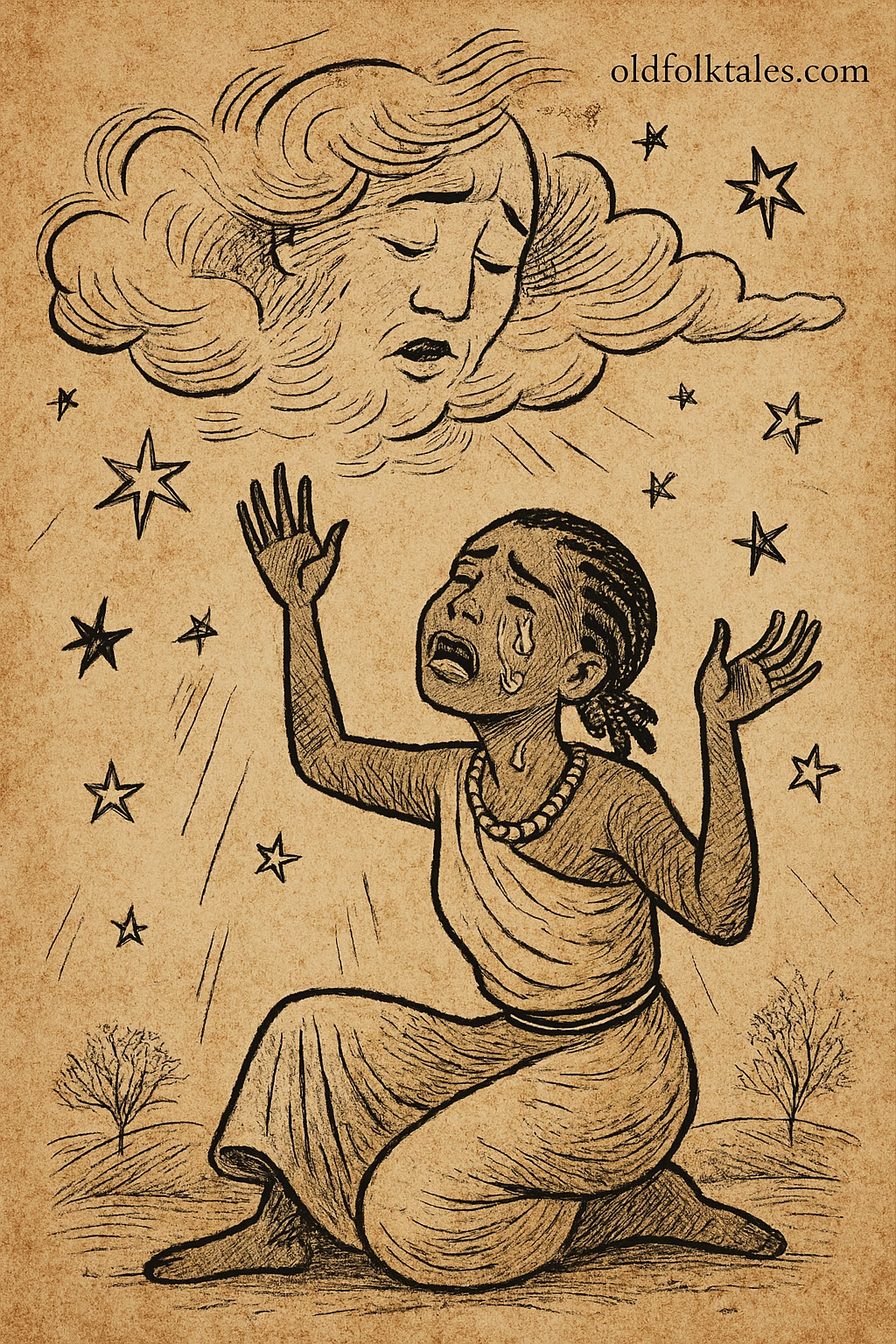
Majieno became furious. Believing that her daughter had been careless with something so valuable, she beat her severely. Heartbroken and frightened, the girl went outside and wept beneath the open sky.
As she cried, she sang a desperate song, calling upon the sky and the earth to take her away:
O sky, come down and take me.
O earth, come up and take me.
O sky, fall down and take me.
O earth, rise up and take me.
The Sky heard her plea and descended to carry her away. The Earth also responded, but the Sky moved faster and took the girl upwards into its vast expanse.
There, the girl eventually met the Sun and became his wife.
After some time, she accompanied her mother-in-law, the Sun’s mother, on a journey to catch crabs. During the expedition, her mother-in-law showed her a special stone known as the ndeb netswegh, which could be used to travel between the celestial world and the Earth.
As they searched for crabs, the girl lifted a large stone to expose those hiding beneath it. She called her mother-in-law to come closer. When the older woman approached, the girl released the stone, allowing it to fall upon her.
Having carried out her plan, the girl returned home. She sat beside the fire, grinding corn, and sang a song about what had happened:
Bekee bekee be kro ato ndeh neneb.
Bekee bekee be kro ato ndeh neneb.
Crabs, crabs are eating Sun’s mother’s head.
Crabs, crabs are eating Sun’s mother’s head.
Meanwhile, back on Earth, Majieno was overwhelmed by the loss of her daughter. She regretted the way she had treated the girl and wept bitterly, wishing she could see her again.
Ntifekwu, the Spider, noticed her grief and offered to help her reach the heavens. In exchange for a portion of goat meat, he agreed to spin a web that would connect the Earth to the celestial world.
Majieno accepted the offer. After receiving his share of the meat, Ntifekwu spun a great web reaching upwards into the sky. With the spider’s help, Majieno climbed the web until she finally reached her daughter.
The reunion brought great happiness to both mother and daughter. After spending time together, however, Majieno had to return to Earth.
The Sun offered to accompany his mother-in-law on her journey home. But his kindness concealed another intention. Along the way, he dug a pit and filled it with neyibobo ants. He then placed Majieno inside the pit, burying her up to her neck and leaving her exposed to the painful stings of the insects.
After leaving her there, the Sun returned home, pleased with what he had done.
His wife soon became suspicious. She followed the path he had taken and discovered her mother suffering in the pit. She immediately began removing the ants from Majieno’s hair and body until she had freed her.
“Go back to Earth,” she told her mother. “I will come and join you soon.”
Majieno returned home, while her daughter went back to the celestial household.
Later, the girl sat beside the fire once more, grinding corn. When she had finished, she placed the flour near the hearth and prepared to leave the Sun’s household.
Taking the ndeb netswegh stone, she used it to descend from the sky to Earth. She had decided to abandon her husband and return to the world from which she had come.
And so the Sun lost his human wife, while the daughter who had once cried beneath the stars found her way back to Earth.
Explore our complete Historic Folklore & Fairy-Tale Collections archive.
Moral Lesson
The Sun’s Abandoned Wife explores the consequences of laziness, dishonesty, harsh punishment, and betrayal. Majieno’s refusal to plant her seeds brings unexpected consequences, while her treatment of her daughter leads to a separation neither of them initially anticipated. The daughter’s experiences in the celestial world reveal another side of the story, where cruelty and deception exist even beyond the human world. Ultimately, the tale explores the complicated relationships between parents and children, the consequences of mistreatment, and the desire to return home after experiencing hardship.
Knowledge Check
- Why was Majieno unable to harvest the pumpkins on her farm?
She had eaten the pumpkin seeds instead of planting them. Mashii the Bird had planted the discarded shells, but prevented her from harvesting the pumpkins by singing a song that returned each pumpkin to its stem. - How did Majieno and her mother capture Mashii?
They invited the bird to share their meal. When he entered their basket to collect the final piece of food, Majieno’s mother trapped him by turning the basket over. - What did Mashii promise in exchange for his freedom?
He promised to provide the household with cooking oil and salt whenever they needed them. - How did Majieno’s daughter end up in the sky?
After Mashii escaped and her mother beat her for losing the magical bird, the girl wept and sang a song asking the Sky and Earth to take her away. The Sky descended and carried her upwards. - What was the ndeb netswegh?
It was a special stone associated with travel between the Earth and the celestial world. The girl used it to return from the Sun’s household to Earth. - How did Ntifekwu help Majieno reunite with her daughter?
The Spider agreed to help her in exchange for goat meat. He spun a web reaching into the heavens, allowing Majieno to climb up and visit her daughter. - Why did the daughter eventually abandon the Sun?
After the Sun mistreated her mother during their journey back to Earth, the daughter rescued Majieno and later used the magical stone to leave her husband’s household permanently.
Source
This is a Beba folktale from Cameroon, recorded in Juliana Makuchi Abbenyi-Nfah’s The Sacred Door and Other Stories: Cameroon Folktales of the Beba (2007), Part Three, “Pumpkin, Pumpkin, Back to the Stem,” pages 158–163.
Explore More Cameroonian Folktales
- The Sacred Forests of the Bakossi
- The Water Ceremony
- The Keeper of the Royal Drum of Bafut
- The Great Canoes of the Wouri
- The Festival of the Elephant Masks
- The Iron Masters of the Mandara Hills
- The Great Market of Maroua
- The Counsel of the Bamum Queen Mother
- The Night Market Where Humans Trade with Spirits