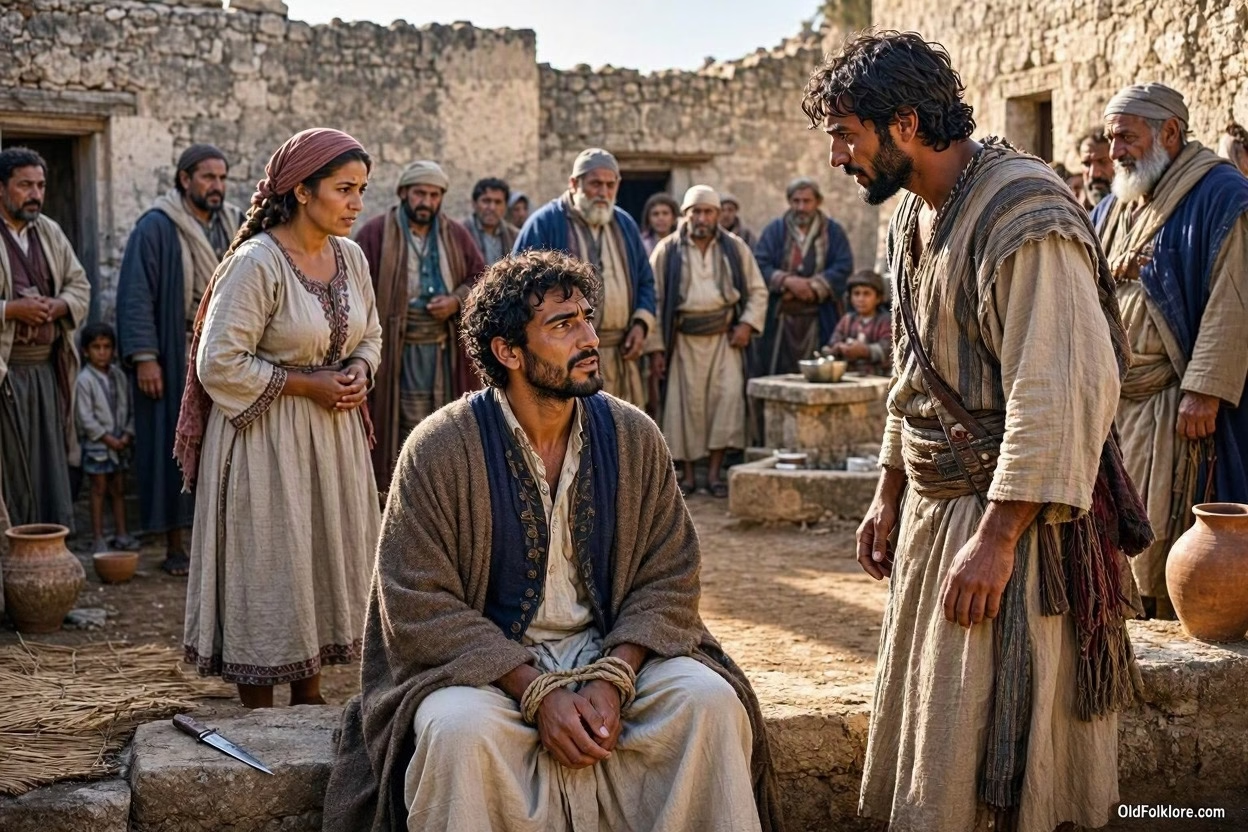
Two companions travel together until evening forces them to seek shelter in different homes. Before separating, they pray that God will protect them from wrongdoing they have never committed. One traveller soon finds himself accused of a terrible crime, even though he has done nothing wrong. With an angry crowd demanding punishment, his fate depends on an unexpected voice that exposes the real culprit.
Two Travellers Seek Shelter
Long ago, two companions named Sidi el Marouf and Sidi Abd el Qader travelled together. As evening approached, they realised they needed somewhere to spend the night.
Before going their separate ways to find shelter, Sidi Abd el Qader suggested that they pray for protection from evil and from wrongdoing they had never committed.
His companion agreed. They offered their prayer and then went towards different houses, hoping to find people willing to welcome them for the night.
Sidi el Marouf approached a house and asked whether anyone could provide lodging for a traveller.
A woman answered the door and welcomed him inside. She assured him that he could stay with her household.
Grateful for the hospitality, he entered and prepared to spend the night there.
A Terrible Crime
When evening turned to night, the woman served the traveller his supper. After the meal, she spread a mat on the floor for him to sleep on. She and her husband also settled down for the night.
The household became quiet, and everyone appeared to be asleep.
But the woman had a terrible plan.
She rose silently, took a knife and killed her husband. Then she waited until morning before raising an alarm.
As daylight appeared, she began shouting that the traveller had murdered her husband.
Explore more stories from our West African Folk-Tales collection.
Her cries quickly attracted the villagers. People rushed to the house, where they found the dead man and the woman accusing her guest.
The traveller protested his innocence, but the accusation had already turned the crowd against him. The villagers seized him, bound him and began gathering wood to burn him as punishment for the supposed crime.
Sidi el Marouf was now in grave danger. He had entered the house as a guest and had done nothing to deserve such a fate, yet the crowd believed the woman’s accusation.
An Old Friend Arrives
Before the villagers could carry out their punishment, Sidi Abd el Qader arrived.
He found his friend in tears and asked what had happened. Sidi el Marouf explained that he had been accused of killing the woman’s husband, although he had committed no such act.
Sidi Abd el Qader reminded him of the prayer they had said before separating.
They had asked for protection from wrongdoing they had never committed. Now, his friend faced death for a crime he had not done.
The situation seemed hopeless. The woman continued to insist that the traveller was the murderer, and the crowd had little reason to question her story.
But Sidi el Marouf did not give up. He asked his companion to bring the woman forward so that he could question her.
Sidi Abd el Qader turned to her and asked whether the accused traveller had truly killed her husband.
She repeated her claim and declared that he was responsible.
Her answer appeared to settle the matter in the eyes of the crowd. Yet Sidi Abd el Qader was not convinced.
The Unborn Witness
The woman was pregnant.
Sidi Abd el Qader turned his attention to the child she carried and called upon the unborn baby to reveal who had killed the child’s father.
Then something extraordinary happened.
The unborn child spoke.
The child declared that the mother herself had committed the murder. The child also explained that the knife she had used could be found hidden in her hair.
The villagers searched the woman’s hair and discovered the knife. Blood on the weapon provided evidence of the crime, exposing the lie she had told about the traveller.
The truth finally came to light.
Sidi el Marouf had been innocent all along. The woman had murdered her husband and attempted to escape responsibility by placing the blame on an unsuspecting guest.
The extraordinary testimony revealed her deception, and the innocent traveller was spared the punishment intended for him.
Justice Prevails
The story ends with the exposure of the woman’s crime and the vindication of the innocent man.
The two companions had separated for the night after praying for protection from wrongdoing. One of them encountered danger through no fault of his own, but the truth emerged before the crowd could carry out its unjust punishment.
The tale presents justice as something that may be delayed or obscured by lies, but which can still emerge when the evidence is revealed.
Explore our complete Algerian Folktales archive.
Moral Lesson
The story teaches that accusations should not be accepted without careful examination. A person may appear guilty because others insist on a particular version of events, but appearances and accusations do not always reveal the truth. It also warns against dishonesty and reminds us that innocent people deserve a fair hearing before anyone decides their fate.
Knowledge Check
1. Who were the two friends in the story?
They were Sidi el Marouf and Sidi Abd el Qader, two companions travelling together.
2. Why did the friends separate as evening approached?
They needed to find separate places where they could spend the night.
3. What happened after Sidi el Marouf was welcomed into the woman’s house?
The woman killed her husband during the night and accused Sidi el Marouf of committing the murder.
4. What punishment did the villagers prepare for the traveller?
They bound him and gathered wood to burn him as punishment for the alleged crime.
5. How was the real murderer exposed?
The unborn child identified the mother as the killer and revealed where she had hidden the knife.
6. What is the main lesson of the folktale?
The tale teaches that people should not condemn others based on accusations alone and that truth and evidence are essential to justice.
Source
Adapted in original English from “Les deux amis,” recorded by Joseph Rivière in Recueil de contes populaires de la Kabylie du Djurdjura (Paris: E. Leroux, 1882), beginning on page 109.
Explore More Algerian Folktales
- The Lion and the Son of Woman
- The Raven and the Child: A Mysterious Kabyle Folktale
- The Two Hunters: An Algerian Folktale of Justice
- Mohamed ben Soltan: A Thrilling Kabyle Folktale
- Thizourith Imellah: A Powerful Tale of Jealousy