“Little Thumb” is a French literary fairy tale by Charles Perrault, included in his collection of tales known as Mother Goose. It follows the youngest of seven brothers, a small and quiet boy whose intelligence proves far greater than others expect. When poverty drives his parents to abandon their children in a forest, Little Thumb takes responsibility for guiding his brothers to safety.
Their troubles do not end there. A second abandonment leads the boys to the home of a terrifying ogre who intends to eat them. Little Thumb must rely on careful observation and quick thinking to protect his brothers. His clever escape, involving the ogre’s daughters and a pair of magical seven-league boots, eventually changes the fortunes of the entire family.
The Story of Little Thumb
Once upon a time, there lived a poor woodcutter and his wife who had seven children. All seven were boys. The eldest was only ten years old, while the youngest was seven. Their parents struggled to provide for them because none of the children was old enough to earn a living.
The youngest boy was especially small and delicate. He rarely spoke, and many people mistook his silence for a lack of intelligence. In truth, he was the most thoughtful of the brothers. He listened carefully, observed what happened around him and considered his words before speaking.
When he was born, he had been no bigger than a man’s thumb. For this reason, everyone called him Little Thumb.
The family lived through a period of severe hardship. Food became scarce, and the parents grew increasingly anxious about how they would feed their children. One evening, while the woodcutter sat beside the fire with his wife, he admitted that he could no longer bear to watch the boys suffer from hunger.
He suggested taking the children deep into the forest and leaving them there. His wife was horrified by the idea. She reminded him that they were their children and that she could not willingly abandon them. However, as their poverty continued to worsen, she eventually agreed, believing that leaving them in the forest might be less painful than watching them starve.
Little Thumb happened to overhear their conversation. He had quietly slipped beneath his father’s seat and listened without being noticed. He understood the danger facing his brothers and began thinking of a way to bring them home.
Early the following morning, he went to a nearby stream and collected small white pebbles. He filled his pockets with them and returned home without telling anyone what he had done.
Later that day, their parents led the seven boys into a thick forest. The woodcutter began cutting trees, while the children gathered sticks to make bundles of firewood. When the boys were occupied with their work, their parents slipped away along a winding path.
After some time, the children realised that they had been left alone. They began crying and calling for their parents, but nobody answered. The forest seemed enormous, and the trees stood so close together that they could barely see beyond a short distance.
Explore more stories from our Charles Perrault Tales collection
Little Thumb, however, was not surprised. As they had walked into the forest, he had quietly dropped the white pebbles from his pockets at regular intervals. He now gathered his brothers and told them not to be afraid. By following the pebbles, he explained, they could find their way home.
The boys followed him along the trail. Before long, they reached their house and stood outside, listening to their parents.
At that very moment, the lord of the manor sent the woodcutter ten crowns that he had owed him for a long time. The unexpected payment brought great relief to the parents. Their father sent their mother to buy meat, and for the first time in a long while, the family had enough food for a satisfying meal.
As the parents ate, the mother began thinking about her children. She wondered where they were and feared that wolves might have found them. Her sorrow became so great that she cried aloud.
The boys, who were still standing outside, heard her voice and answered together. Their mother hurried to the door and embraced them. She cleaned the mud from their clothes, welcomed them inside and gave them food. The family was happy to be together again.
Unfortunately, the improvement did not last. When the ten crowns had been spent, the parents returned to their former poverty. Once again, they began worrying about how to feed seven growing boys. They eventually decided to abandon the children a second time, but this time they planned to take them much farther into the forest.
Little Thumb overheard this conversation too. He intended to collect more white pebbles, but his parents had locked the door. He could not leave the house to gather them.
The next morning, their father gave each boy a piece of bread before leading them into the forest. Little Thumb thought quickly. Since he had no pebbles, he decided to drop small crumbs of bread along the path. He believed he could follow them back home just as he had followed the stones.
Their parents took the children much deeper into the forest than before. When the boys were distracted, they slipped away and left them behind.
Little Thumb was initially confident that he could guide his brothers home. However, when he searched for the bread crumbs, he discovered that not a single one remained. Birds had eaten every crumb.
The brothers were now truly lost. They wandered through the forest, hoping to find a familiar path, but the farther they travelled, the more confused they became. Evening arrived, and a strong wind began blowing through the trees. The boys imagined that wolves were approaching from every direction. Soon, heavy rain fell, soaking their clothes and making the ground slippery. They stumbled through the mud, frightened and exhausted.
Little Thumb refused to give up. He climbed to the top of a tree and looked across the forest. After searching in every direction, he noticed a faint light in the distance. It looked like a candle shining from a house beyond the trees.
He climbed down and told his brothers what he had seen. They walked towards the light, although it disappeared whenever they entered low parts of the forest. After a difficult journey, they finally reached the house.
A woman opened the door. Little Thumb explained that they were lost children who needed shelter for the night. When she saw them, she felt sorry for their condition. However, she soon warned them that the house belonged to a cruel ogre who ate children.
The boys were frightened by this news, but they believed that remaining outside in the forest would be even more dangerous. Little Thumb begged the woman to let them stay. He reasoned that the wolves might devour them if she refused, whereas the ogre might perhaps show mercy if she pleaded on their behalf.
The woman felt compassion for them and allowed them inside. She took them near the fire so they could warm themselves. A large sheep was roasting for the ogre’s supper, and the boys were grateful to escape the cold rain.
Their relief did not last long. Soon, they heard loud knocks at the door. The ogre had returned.
His wife quickly hid the children beneath the bed before opening the door. The ogre entered and sat down to eat. He began sniffing the air, insisting that he could smell fresh meat. His wife tried to persuade him that the smell came from the animal prepared for supper, but he was not satisfied.
He got up and searched the room. When he reached the bed, he discovered the seven boys hiding beneath it.
The ogre dragged them out and announced that they would make a fine meal. The children fell to their knees and begged him to spare their lives, but he refused to listen. He took a large knife and began sharpening it, preparing to kill them.
His wife intervened. She pointed out that there was already plenty of meat for supper and suggested that he could wait until the following day. The ogre considered her argument and agreed to postpone eating the children. He ordered her to feed them properly and put them to bed.
The boys were too frightened to enjoy their meal, but they ate because they needed their strength. The ogre, meanwhile, drank more wine than usual and eventually went to sleep.
The ogre had seven daughters, all young children. They had unusual features, including small grey eyes, hooked noses, large mouths and sharp teeth. Although they were still young, they already showed signs of the cruelty associated with their father. Each daughter wore a golden crown on her head.
The seven brothers were placed in a bed in the same room as the ogre’s daughters. Little Thumb noticed the crowns and became worried. He suspected that the ogre might change his mind during the night and decide to kill the boys before morning.
He therefore devised a plan. When everyone was asleep, he quietly got up and removed the golden crowns from the ogre’s daughters. He placed the crowns on his own head and those of his brothers. Then he took the boys’ caps and placed them on the heads of the seven ogresses.
He hoped that if the ogre came into the room in the darkness, he would mistake his daughters for the boys and the boys for his daughters.
Little Thumb’s fears proved justified. In the middle of the night, the ogre woke and regretted postponing the meal. He took his large knife and went upstairs to find the children.
Feeling his way in the darkness, he first approached the bed where the seven brothers were sleeping. He touched their heads and felt the golden crowns. He concluded that he must have drunk too much and gone to the wrong bed.
He then moved to the other bed. There, he felt the small caps on the heads of the seven girls. Believing that he had found the boys, he killed all seven of his daughters.
Satisfied that he had dealt with the children, the ogre returned to bed.
Little Thumb had remained awake. As soon as he heard the ogre snoring, he woke his brothers and told them to dress quickly. The boys followed him quietly out of the room, crossed the garden and escaped over the wall.
They ran through the night, terrified that the ogre might discover their escape. They did not know exactly where they were going, but they continued moving away from the house.
When the ogre woke the following morning, he told his wife to go upstairs and dress the boys. She was surprised by his unusual kindness, but she obeyed. When she entered the room, she discovered that her seven daughters were dead.
She fainted from shock. The ogre soon came upstairs and saw what had happened. Furious at being deceived, he demanded his seven-league boots so that he could pursue the children.
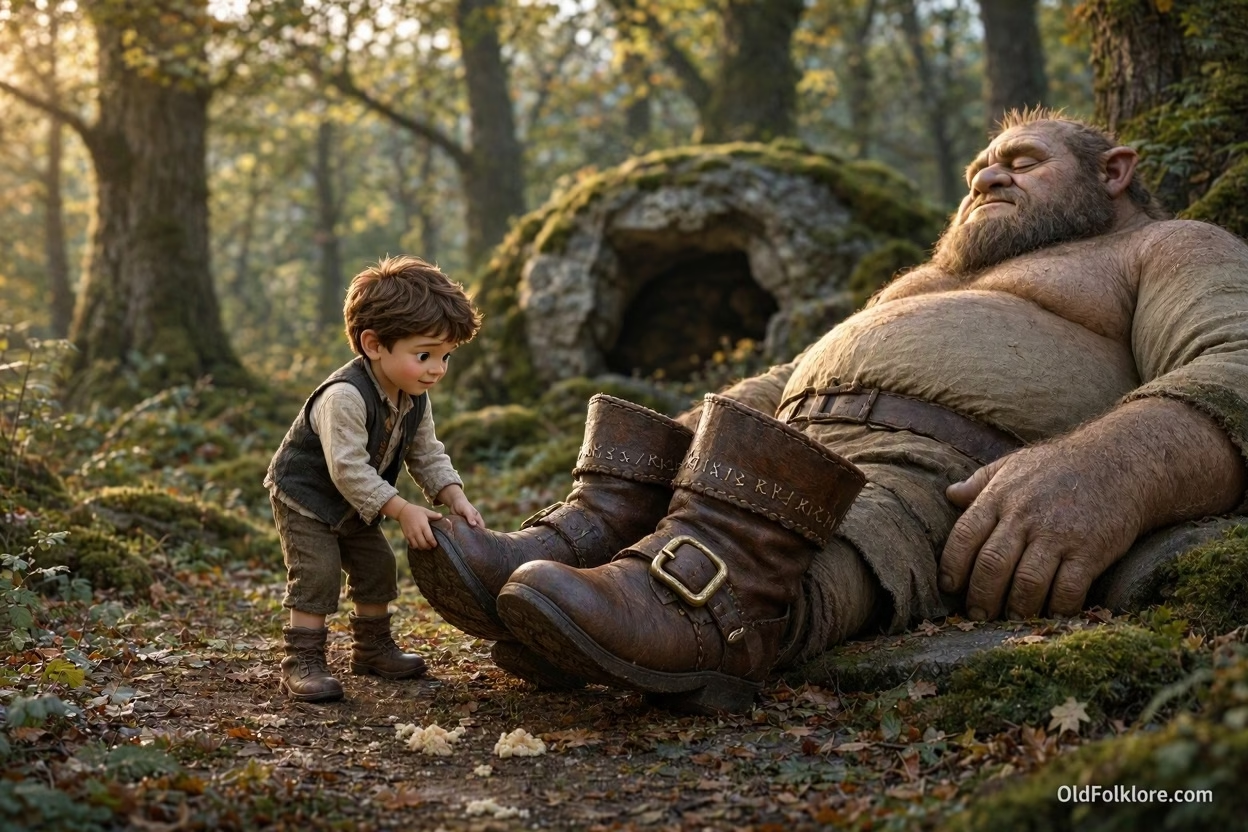
These were magical boots that allowed their wearer to cover seven leagues in a single stride. The ogre put them on and rushed out in search of the boys.
Little Thumb and his brothers were still travelling when they saw the ogre approaching. His enormous strides carried him across hills and over rivers, making it difficult for the children to escape.
Little Thumb quickly noticed a hollow rock nearby. He pushed his brothers into the narrow space and squeezed in after them. They remained hidden as the ogre approached.
The ogre had travelled a great distance and was exhausted. By chance, he sat down on the very rock where the children were hiding. Before long, he fell asleep. His snores were so frightening that the boys feared he might wake at any moment.
Little Thumb remained calm. He told his brothers to leave quietly and continue towards home while the ogre slept. They followed his instructions and hurried away.
When they were safely gone, Little Thumb approached the sleeping ogre. He carefully removed the seven-league boots and put them on his own legs. Although they were far too large at first, the boots were magical and could change their size to fit whoever wore them.
Little Thumb now possessed the means to travel quickly. He went to the ogre’s house and found the ogre’s wife mourning the loss of her daughters.
He told her that her husband had been captured by thieves who threatened to kill him unless she surrendered all his gold and silver. Little Thumb claimed that the ogre had sent him to collect the valuables and had lent him the magical boots so that he could travel quickly.
The woman believed his story. Frightened for her husband’s life, she handed over the ogre’s valuable possessions. Little Thumb then returned to his family with the money and riches. His parents and brothers welcomed him with great joy, and the family was no longer burdened by the poverty that had once threatened to separate them.
There was, however, another account of what happened after Little Thumb took the ogre’s boots. Some people disagreed with the story that he had deceived the ogre’s wife and taken the ogre’s wealth. They maintained that he had simply taken the boots because the ogre used them to chase and kill children.
According to this version, Little Thumb went to the royal court after escaping. The king was anxious because an army was far away, and he wanted news of the outcome of a battle. Little Thumb offered to travel to the army and return with information before nightfall.
The king promised to reward him generously if he succeeded. Wearing the seven-league boots, Little Thumb travelled swiftly and returned that same evening with the news.
His success made him known at court. The king began paying him well to carry messages and orders to the army. Ladies also employed him to carry news to their lovers, and this work became another profitable source of income.
After earning considerable wealth, Little Thumb returned to his father’s house. His family welcomed him with immense happiness. He used his earnings to improve their circumstances, securing comfortable positions for his father and brothers. He also continued his own work and became highly favoured by the king.
Thus, the quiet youngest son who had once been dismissed as foolish became the person who rescued his brothers and transformed his family’s future.
Explore our complete Historic Folklore & Fairy-Tale Collections archive.
Moral Lesson
Little Thumb teaches that intelligence is not measured by physical size, age or how much a person speaks. Careful observation, courage and quick thinking can help someone overcome difficult circumstances. The story also highlights the importance of looking after others, as Little Thumb repeatedly places his brothers’ safety before his own.
Knowledge Check
1. Why did Little Thumb’s parents decide to abandon their children?
They were extremely poor and believed they could no longer provide enough food for their seven sons.
2. How did Little Thumb guide his brothers home after the first abandonment?
He followed the small white pebbles he had dropped along the path.
3. Why did Little Thumb’s second plan to mark the forest path fail?
He used bread crumbs, but birds ate them before the boys could follow the trail home.
4. How did Little Thumb save his brothers from the ogre’s knife?
He exchanged the boys’ caps with the golden crowns worn by the ogre’s daughters, causing the ogre to mistake the girls for the boys.
5. What were the seven-league boots?
They were magical boots that allowed their wearer to cover seven leagues in a single stride.
6. What were the two accounts of Little Thumb’s success after taking the boots?
One account says he deceived the ogre’s wife and took the ogre’s wealth. The other says he became a royal messenger and earned his fortune through paid work.
Source
Charles Perrault, “Little Thumb,” in The Tales of Mother Goose: As First Collected by Charles Perrault in 1696, translated by Charles Welsh (Boston, New York and Chicago: D. C. Heath & Co., 1901), pp. 29–44.
Explore More Charles Perrault Tales
- Puss in Boots Perrault: A Classic French Folktale
- Riquet with the Tuft
- Bluebeard: The Forbidden Room That Revealed a Terrible Secret
- The Fairy: A Charles Perrault Fairy Tale