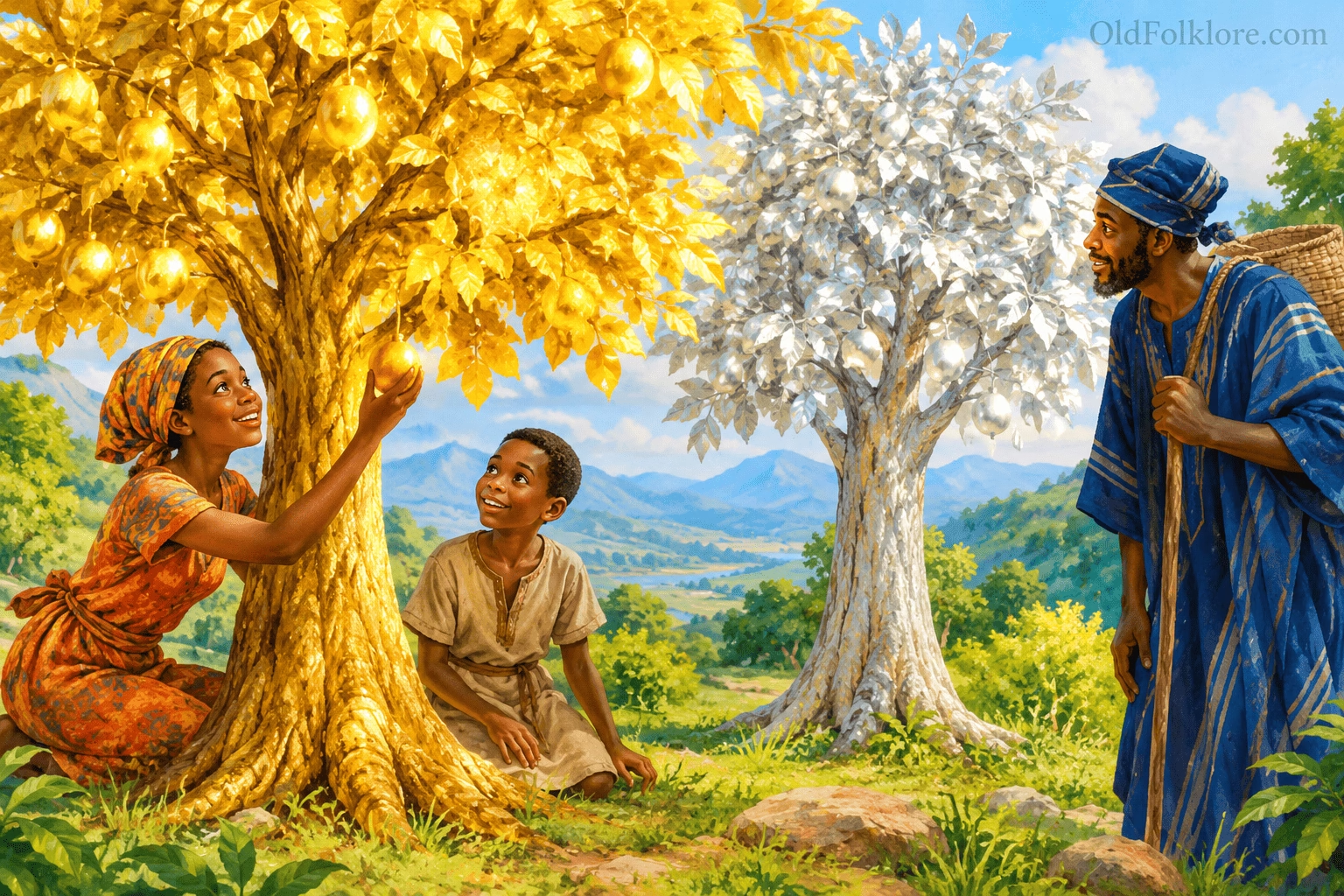
Long ago, a king lived with his wife, Silver-Tree, and their daughter, Gold-Tree. One day, the queen and princess visited a secluded glen where a trout lived in a well.
Silver-Tree leaned over the water and asked the little fish whether she was the most beautiful queen in the world.
“No,” replied the trout. “Gold-Tree, your daughter, is more beautiful than you.”
The answer filled the queen with jealousy. She returned to the palace, took to her bed and declared that nothing could restore her health except eating her daughter’s heart and liver.
Explore more stories from our Joseph Jacobs’ Indian Fairy Tales collection.
When the king heard this, he promised to do whatever he could to help his wife. Fortunately, a prince from a distant kingdom had recently asked for Gold-Tree’s hand in marriage. The king accepted the proposal, and the young princess departed to marry her suitor abroad.
To satisfy Silver-Tree without harming his daughter, the king obtained the heart and liver of a he-goat and gave them to his wife. Believing she had received what she wanted, the queen recovered and returned to her usual life.
A year passed before Silver-Tree visited the glen again. She bent over the well and repeated her question to the trout.
Once more, the little fish declared that Gold-Tree was more beautiful.
The queen was astonished. She insisted that her daughter had been dead for a year, for she had eaten the girl’s heart and liver. The trout revealed the truth: Gold-Tree was alive and happily married to a great prince in a distant land.
Silver-Tree immediately persuaded the king to prepare their longship so that she could visit her beloved daughter. She took the helm herself, and before long, the royal party reached the prince’s kingdom.
The prince was away hunting when Gold-Tree recognised her father’s ship approaching. Fear seized her. She knew her mother had come to kill her.
The servants quickly hid the princess in a locked room, where Silver-Tree could not reach her. When the queen arrived, she called for her daughter, pretending to have come out of love and longing.
Gold-Tree explained that she could not leave the room because it was locked. Silver-Tree then asked her to put one little finger through the keyhole so that her mother could kiss it.
Trusting her mother’s affectionate words, Gold-Tree obeyed. But Silver-Tree had brought a poisoned pin. She thrust it into her daughter’s finger, and Gold-Tree fell dead.
When the prince returned from hunting and discovered what had happened, grief overwhelmed him. Unable to bear the thought of burying his beautiful wife, he placed her body in a private room and kept it away from everyone.
Time passed, and the prince eventually married another woman. His new wife managed the household, except for the locked room that he always kept under his own key.
One day, he accidentally left the key behind. Curious about the forbidden room, his wife entered and discovered the body of an extraordinarily beautiful young woman. As she examined Gold-Tree, she noticed the poisoned pin lodged in her finger.
She carefully removed it.
At once, Gold-Tree came back to life.
That evening, the prince returned from hunting, weighed down by sorrow. His wife asked what she could give him to bring back his happiness. He answered that nothing could make him laugh again unless Gold-Tree returned to life.
His wife smiled and told him to visit the room.
When the prince found Gold-Tree alive, his joy was beyond measure. He embraced her again and again. Seeing how deeply he loved his first wife, the second wife offered to leave, believing that Gold-Tree deserved to take her place.
But the prince refused to send her away. He declared that both women would remain with him.
Another year passed. Silver-Tree returned to the well and asked the trout the same question she had asked twice before.
Again, the answer was Gold-Tree.
The queen could scarcely believe it. She insisted that her daughter could not possibly be alive because she herself had poisoned the girl’s finger. But the trout revealed that Gold-Tree still lived.
Consumed by the need to see the truth for herself, Silver-Tree once again persuaded the king to prepare their longship. She sailed to her daughter’s kingdom, confident that her visit would succeed.
Gold-Tree recognised the approaching ship and feared another attack. This time, however, the second wife stood beside her and promised that they would face the queen together.
When Silver-Tree came ashore, she called warmly to Gold-Tree, inviting her to come down and receive a precious drink she had brought as a gift.
The second wife intervened. She declared that, in their country, anyone offering a drink must taste it first.
Silver-Tree raised the vessel to her lips. The second wife struck it, forcing some of the poisoned drink down the queen’s throat. Silver-Tree fell dead, and her body was carried away for burial.
At last, Gold-Tree was free from her mother’s murderous jealousy. She, the prince and his second wife lived together in peace for many years.
And that is where the story leaves them.
Explore our complete Historic Folklore & Fairy-Tale Collections archive.
Moral
Jealousy and the desire to be admired can destroy the very relationships that should be cherished. Gold-Tree and Silver-Tree teaches that kindness, courage and loyalty can overcome cruelty, while those who seek to harm others may ultimately bring about their own downfall.
Knowledge Check
1. Why did Silver-Tree want to eat Gold-Tree’s heart and liver?
She became jealous after the trout told her that her daughter was more beautiful than she was.
2. How did Gold-Tree survive Silver-Tree’s first attempt to kill her?
Her father arranged her marriage abroad and gave Silver-Tree the heart and liver of a he-goat instead.
3. Who rescued Gold-Tree after the poisoned pin killed her?
The prince’s second wife discovered the pin in Gold-Tree’s finger and removed it, bringing her back to life.
4. How was Silver-Tree finally defeated?
The prince’s second wife forced Silver-Tree to swallow some of her own poisoned drink.
5. What makes this version different from many familiar Snow White stories?
Gold-Tree is threatened by her own mother rather than a stepmother, and the prince’s second wife becomes her rescuer and ally.
Source
The source is Celtic Fairy Tales, edited and collected by Joseph Jacobs and published in London by David Nutt in 1892. The story appears as Chapter XI, “Gold Tree and Silver Tree,” and was taken from The Celtic Magazine, volume XIII, pages 213–218, in Gaelic and English, as supplied by Kenneth MacLeod.
Explore More Joseph Jacobs’ English Fairy Tales
- The Lambikin: A Classic Indian Folktale About Cunning, and Survival
- Soria Moria Castle: Halvor’s Quest to Win Back His Princess
- The Yellow Dwarf: The Princess, the Cursed Ring, and a Love That Ended in Tragedy
- The Three Sillies: An English Fairy Tale
- The Frog-King and Iron Henry: The Princess Who Broke Her Promise
- The Death of Koschei the Deathless: The Red Fairy Book