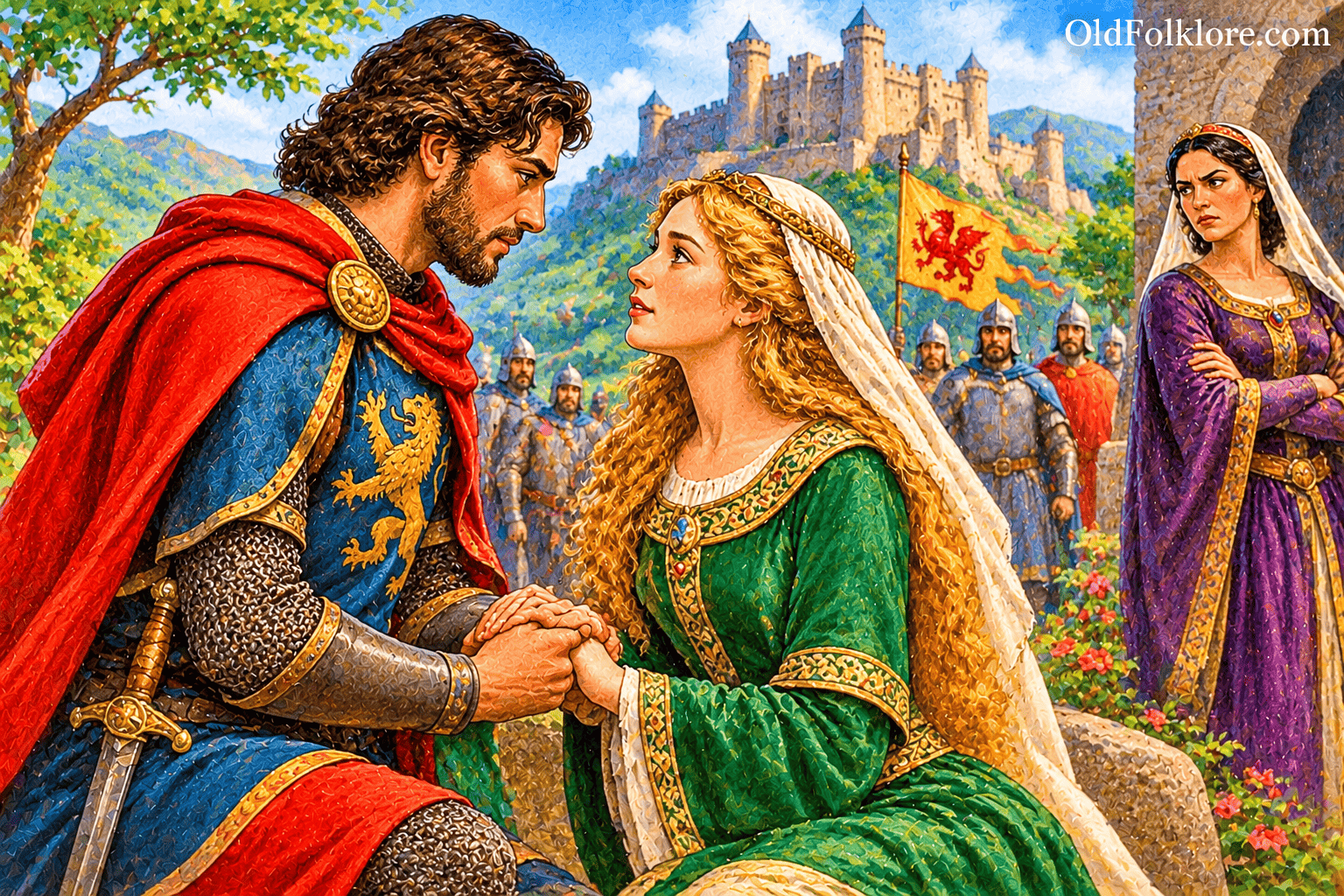
Some legendary figures become famous through their strength, others through their victories in battle. Taliesin earns his place through knowledge, poetry and the extraordinary power of his words. His life begins with a magical transformation, continues through a dangerous encounter with a powerful enchantress and leads him into the court of a king whose pride is challenged by the wisdom of a young bard.
Taliesin’s story combines enchantment, prophecy, cleverness and the importance of recognising true ability. Although he enters the world under unusual circumstances, his gifts eventually bring honour to the man who rescues him and expose the arrogance of those who believe themselves superior.
Caridwen’s Cauldron of Inspiration
Long ago, Tegid Voel lived with his wife, Caridwen, beside Lake Tegid in Penllyn. They had three children. Their son Morvran was strong and handsome, while their daughter Creirwy was considered exceptionally beautiful. Their other son, Avagddu, was very different. He was so unattractive that his mother worried about the difficulties he might face because of his appearance.
Caridwen believed that Avagddu needed another kind of advantage. If he could not gain admiration through beauty, she hoped that knowledge and wisdom might earn him respect. She therefore decided to prepare a magical cauldron that would grant the gifts of inspiration and learning.
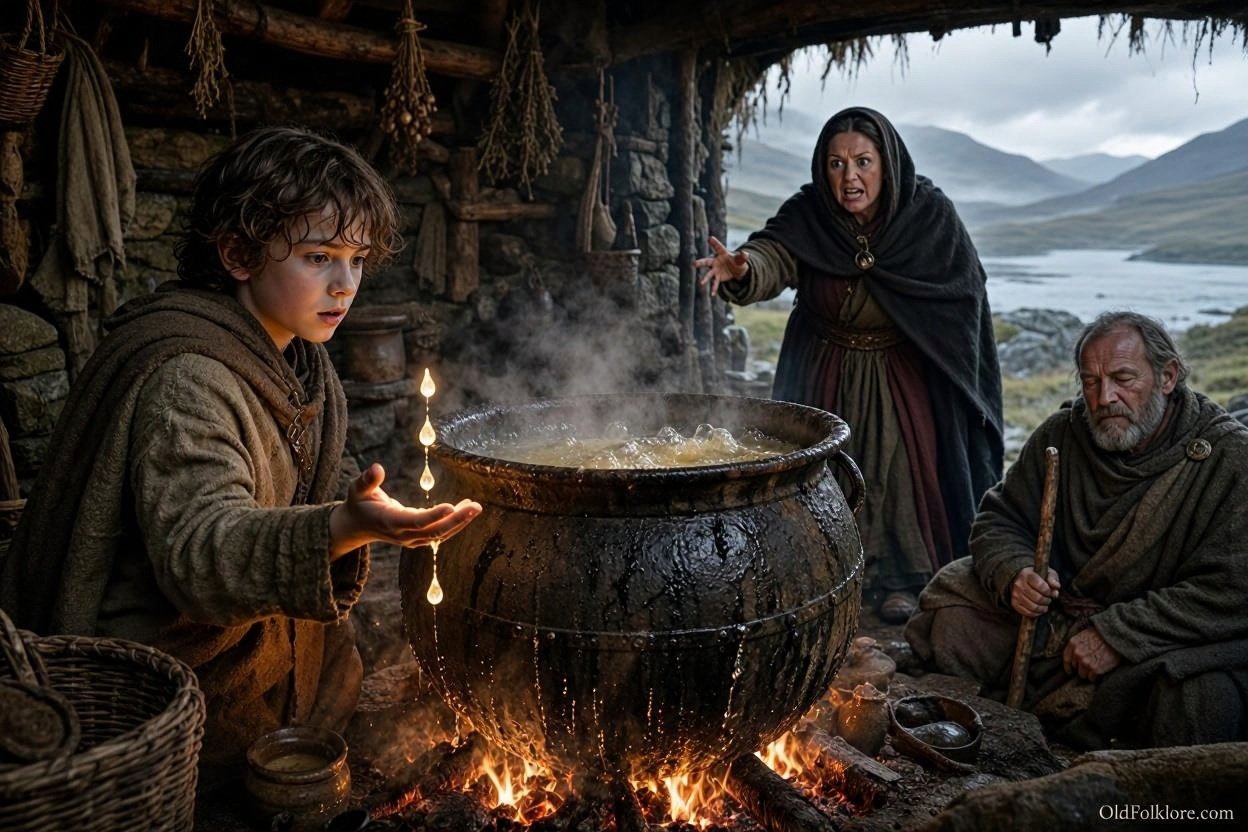
The mixture had to boil for a year and a day. Caridwen gathered the necessary herbs and placed them in the vessel, carefully maintaining the preparation. She appointed a blind man named Morda to tend the fire and instructed a young servant, Gwion Bach, to stir the cauldron.
The work continued for months. As the appointed period approached its end, the mixture became ready to release its extraordinary power. Three drops suddenly flew from the boiling liquid and landed on Gwion’s finger.
The drops were extremely hot. Without thinking, Gwion placed his finger in his mouth to ease the pain. In that instant, the magical knowledge intended for Avagddu entered Gwion instead. He immediately understood the nature of the danger before him and realised that Caridwen would be furious when she discovered what had happened.
The remaining liquid in the cauldron became poisonous. The vessel burst, and the dangerous mixture flowed into a nearby stream. According to the tale, it poisoned the horses belonging to Gwyddno, giving rise to the name Poison of the Horses of Gwyddno.
Explore more stories from our The Mabinogion collection.
When Caridwen discovered the failure of her preparation, she turned her anger towards Morda and struck him. Gwion, however, had already fled.
The Great Shape-Shifting Chase
Caridwen pursued Gwion, determined to punish him for taking the knowledge meant for her son. But Gwion now possessed extraordinary understanding and could anticipate her intentions.
He transformed himself into a hare and ran across the countryside. Caridwen immediately became a greyhound and chased him. When Gwion reached the water, he changed into a fish and escaped beneath the surface. Caridwen transformed into an otter and followed him through the water.
Gwion then took the form of a bird and flew into the air. Caridwen became a hawk and continued the pursuit. Desperate to escape, Gwion transformed himself into a single grain of wheat and hid among other grains.
Caridwen recognised the trick. She changed into a black hen, searched among the wheat and swallowed him.
The chase ended, but the consequences of the enchantment had not. Caridwen became pregnant and carried Gwion within her for nine months. When the child was born, she found him so beautiful that she could not bring herself to kill him.
Instead, she placed the infant inside a leathern bag and cast him into the sea on the twenty-ninth of April. She left his fate to the water.
The Child Found at Gwyddno’s Weir
At that time, Gwyddno possessed a fishing weir where fish were traditionally caught. On May Eve, his son Elphin went to inspect it. The catch was disappointing, and the weir appeared to have yielded nothing of value.
As Elphin examined the place, he noticed a leathern bag caught against the structure. He opened it and discovered a child inside. The infant’s forehead shone with an extraordinary brightness, and this remarkable appearance inspired the name Taliesin.
Elphin took the child home. When he arrived, his father asked whether he had obtained a good catch. Elphin replied that he had found something more valuable than fish.
His father wanted to know what it was.
“A Bard,” Elphin answered.
Gwyddno questioned how such a small child could benefit his son. Taliesin then spoke for himself, declaring that he would bring Elphin greater profit than the weir had ever provided.
The child’s ability to speak astonished Gwyddno. Taliesin began singing, explaining that he possessed knowledge of things that had happened and things yet to come. He described his strange beginnings and recalled the transformations through which he had passed.
Elphin’s household welcomed him, and his wife became his nurse. As Taliesin grew, his intelligence and poetic gifts brought increasing honour to the family. Elphin himself became prosperous and gained favour with the king.
Elphin Challenges King Maelgwn
When Taliesin was thirteen years old, Elphin took him to the Christmas court of his uncle, King Maelgwn Gwynedd, at Dyganwy.
The king’s court was filled with poets and professional bards. They praised Maelgwn and his queen, boasting that no ruler or household could surpass them. Their words celebrated the king’s greatness and the excellence of his court.
Elphin disagreed with their claims. He declared that his own wife was more virtuous than the queen and that his young bard possessed greater skill than all the poets serving Maelgwn.
The statement angered the king. He considered it an insult to his authority and decided to test Elphin’s claims. He ordered that Elphin be imprisoned and sent his son Rhun to investigate the virtue of Elphin’s wife.
Taliesin understood that the king intended to use the investigation to destroy his master’s reputation. He therefore warned Elphin’s wife of the danger.
Taliesin Exposes Rhun’s Deception
When Rhun arrived, Elphin’s wife devised a plan to prevent him from recognising her. She dressed one of the kitchen maids in her own clothes and jewellery, while she herself disguised her appearance as a servant.
Rhun mistook the kitchen maid for Elphin’s wife. He gave her a drugged drink, and when she became unconscious, he cut off one of her fingers. He used Elphin’s signet ring to support the deception, returning to the king with the severed finger as supposed proof of the wife’s unfaithfulness.
Maelgwn believed the evidence and expected Elphin to be disgraced. But Elphin examined the finger and identified several reasons why it could not belong to his wife.
He explained that the ring would not have fitted her thumb in the way it fitted the severed finger. He also knew that his wife regularly pared her nails on Saturdays, whereas the nail on the finger had not been cut for a month. Finally, the hand showed signs of having kneaded rye dough within the previous three days, something his wife never did.
These details exposed the deception. Elphin’s explanation showed that the finger belonged to another woman.
The king was angry that his first test had failed. However, he still refused to release Elphin. He demanded that Taliesin’s poetic skill should also be examined before his prisoner could regain his freedom.
The Bard Silences the King’s Poets
Taliesin entered the court and sat quietly in a corner. As the king’s bards passed before him, he repeatedly made a strange sound with his lips: “Blerwm, blerwm.”
The other bards began imitating him. They copied the sound until they were unable to speak properly before the king.
Their strange behaviour attracted attention. Heinin Vardd, one of the chief bards, explained that an unusual spiritual influence appeared to be affecting them. He directed the king’s attention towards the young stranger sitting in the corner.
Taliesin then began to sing.
He identified himself as the bard of Elphin and declared that he had come to secure his master’s release. His songs described his mysterious knowledge, his former existence as Gwion Bach and the nine months he had spent within Caridwen before being cast into the sea.
He also challenged the king’s poets with riddles and prophetic statements. Among the warnings he delivered was a vision of a monstrous creature emerging from the sea marsh of Rhianedd. The creature was described with golden hair, teeth and eyes, and Taliesin declared that it would bring destruction upon Maelgwn.
He also presented a riddle concerning the wind. His words were followed by a great wind and storm, intensifying the wonder surrounding his performance.
The king became increasingly unsettled. He ordered that Elphin should be brought before him. Taliesin continued singing, and the chains that bound Elphin’s feet fell away.
The young bard had accomplished what the king’s own poets could not. His words had secured his master’s freedom.
The Songs Against the Court Bards
Taliesin did not limit his performance to freeing Elphin. He also delivered songs criticism the conduct and pretensions of the king’s professional poets.
In his songs, including “Excellence of Bards,” “Reproof of the Bards” and “Spite of the Bards,” he challenged those who boasted of their abilities without possessing genuine wisdom. He exposed the difference between true poetic understanding and empty praise offered to please a powerful ruler.
He also demonstrated that Elphin’s wife remained innocent by showing that she possessed all her fingers. This further discredited the evidence Rhun had presented.
Elphin and Taliesin rejoiced at the failure of the king’s attempts to disgrace them. Their confidence had been justified, and the young bard’s abilities had become impossible for the court to ignore.
The Race and the Hidden Treasure
Taliesin next advised Elphin to challenge King Maelgwn over the quality and speed of their horses. Elphin was to claim that he possessed a better and swifter horse than any in the royal stable.
A race was arranged. During the contest, a rider used twenty-four charred holly twigs to strike the royal horses and mark the places where Elphin’s horse stumbled.
When the race ended, the king’s horses had lost. The marked place was examined, and digging there revealed a cauldron filled with gold.
Taliesin explained that the treasure was a reward for Elphin’s kindness in rescuing and raising him. The place became associated with the name Pwllbair.
The discovery further strengthened Elphin’s position and demonstrated that Taliesin’s promises could bring practical rewards as well as honour.
Taliesin Sings of Creation and the Future
King Maelgwn then asked Taliesin to explain the creation of humankind. The bard responded with a song known as “One of the Four Pillars of Song.”
His performance described the creation of the world and humanity, including Adam and Eve, their fall, and the story of Cain and Abel. He also referred to religious practices such as the giving of tithes and the use of wine.
The song extended beyond the beginning of humanity. Taliesin included prophecies concerning the future of Britain, speaking of a German serpent that would dominate the island, the power of the Saxons and the fate of Wales.
His words presented a vision of change and struggle, suggesting that the fortunes of kingdoms and peoples would not remain fixed forever.
The printed account concludes by stating that Taliesin told the king further prophecies in song. However, the text marks these additional passages with asterisks rather than reproducing them. Their contents are therefore not included in this retelling.
Taliesin’s performance left the court with a demonstration of his extraordinary gifts. The child once rescued from a fishing weir had become a powerful bard whose knowledge challenged kings and whose songs could restore a man’s freedom.
Explore our complete Historic Folklore & Fairy-Tale Collections archive.
Moral Lessons
Taliesin’s story shows that wisdom and ability are not always found where people expect them. Caridwen prepared her cauldron for Avagddu, but its power passed to Gwion Bach instead. The unexpected outcome transformed the lives of everyone involved.
The tale also celebrates gratitude and loyalty. Elphin rescued an abandoned child and raised him with care. Taliesin never forgot this kindness and used his gifts to protect Elphin when the king tried to disgrace him.
Another lesson concerns the difference between genuine skill and empty boasting. The king’s bards praised their ruler, but their confidence failed when Taliesin challenged them. His knowledge and songs demonstrated that true ability does not depend on status or royal approval.
Finally, the story reminds readers that courage can take many forms. Taliesin did not defeat Maelgwn through physical force. He relied on intelligence, poetry, observation and the power of truth to overcome the challenges placed before him.
Knowledge Check
1. Why did Caridwen prepare the magical cauldron?
She wanted to give her son Avagddu knowledge and wisdom so that he could gain respect despite his appearance.
2. How did Gwion Bach acquire the cauldron’s magical knowledge?
Three drops of the mixture landed on his finger, and he gained their power when he placed the finger in his mouth.
3. What happened during Caridwen’s pursuit of Gwion?
They repeatedly changed forms. Gwion became a hare, fish, bird and grain of wheat, while Caridwen transformed into animals that pursued him.
4. Who discovered the child in the leathern bag?
Elphin, the son of Gwyddno, discovered the child caught at his father’s fishing weir.
5. How did Elphin prove that the severed finger did not belong to his wife?
He explained that the ring did not fit the finger correctly, the nail had not been pared recently and the hand showed signs of kneading rye dough.
6. How did Taliesin secure Elphin’s freedom?
He silenced the king’s bards through his extraordinary performance, sang prophetic songs and caused the chains on Elphin’s feet to fall away.
Source
Retold from “Taliesin” in The Mabinogion, translated by Lady Charlotte Guest. The medieval Welsh narrative belongs to the traditional literature preserved in the Mabinogion, while Guest is credited with the nineteenth-century English translation.
Digital source: Project Gutenberg, eBook No. 5160, The Mabinogion.
Explore More On The Mabinogion
- The Dream of Rhonabwy
- The Story of Lludd and Llevelys
- Pwyll Prince of Dyved
- Manawyddan the Son of Llyr
- Owain and the Lady of the Fountain