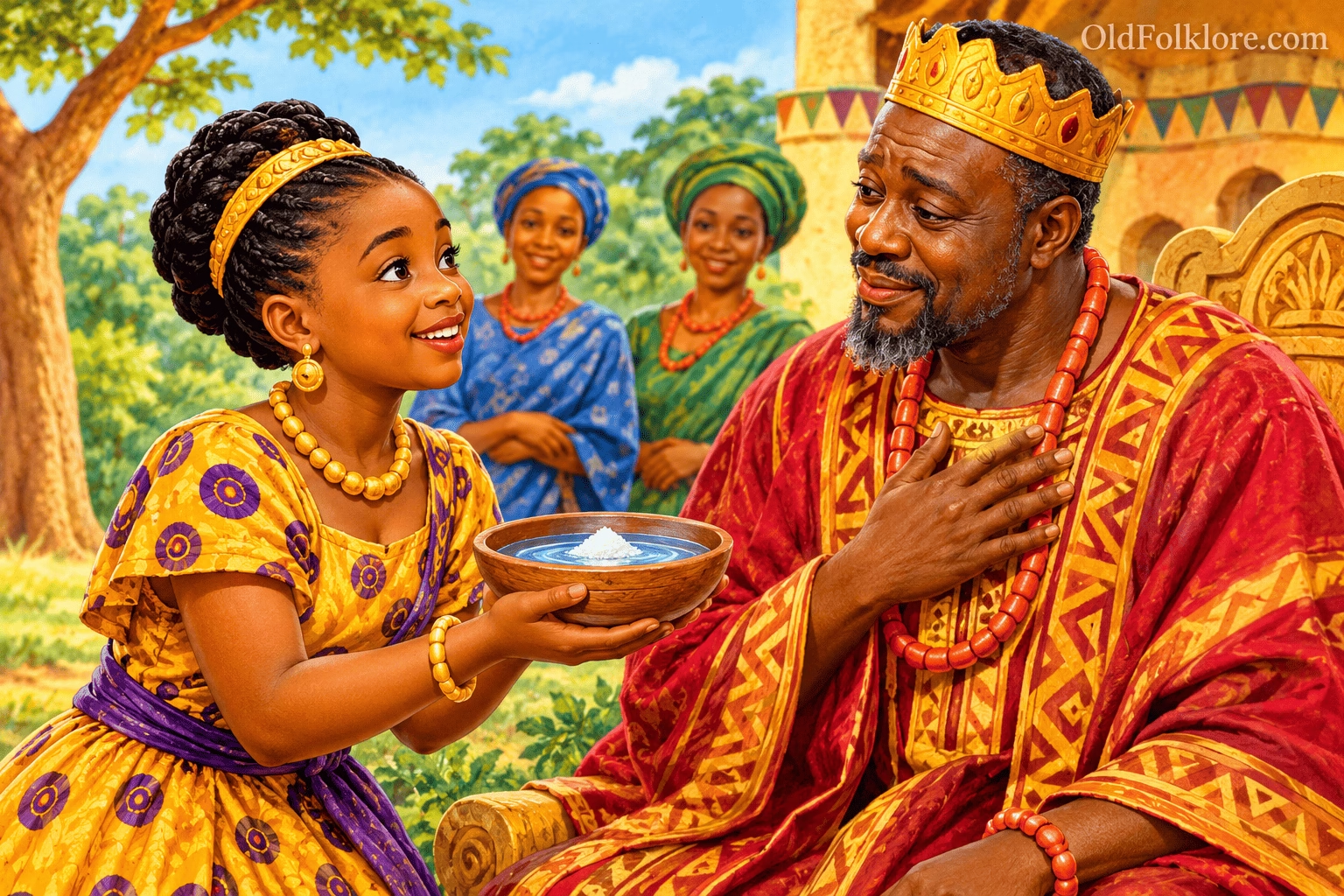
Once upon a time, a king had three daughters whom he loved dearly. One day, while they were gathered around the dining table, he decided to ask them a question.
“Tell me, my daughters,” he said, “how much do each of you love me?”
The eldest daughter answered without hesitation.
“Father, I love you as much as I love my eyes.”
The second daughter smiled and declared, “I love you as much as I love my heart.”
The king was pleased with both answers. Then he turned to his youngest daughter, eager to hear what she would say.
Explore more stories from our Italian Popular Tales collection.
“I love you as much as water and salt,” she replied.
The king’s expression immediately changed. He could not understand why his daughter would compare her love for him to such ordinary things. Surely, he thought, she considered him no more valuable than the simplest necessities of life.
“Is that all I am worth to you?” he demanded angrily. “You love me only as much as water and salt? Call the executioners! I will have her put to death at once!”
The youngest princess was terrified, but her two sisters could not bear to see her killed. They secretly approached the executioners and gave them a little dog. They instructed the men to kill the animal, tear one of the princess’s garments and leave their sister alive in a cave in the forest.
The executioners followed their instructions. They returned to the palace carrying the dog’s tongue and the torn garment, which they presented to the king as proof that his youngest daughter had been killed.
Satisfied with what he believed to be the completion of his order, the king rewarded them.
Meanwhile, the unfortunate princess remained alone in the forest. Fortunately, a magician discovered her and took her into his home. His house stood directly opposite the royal palace, and before long, the king’s son noticed the beautiful young woman.
He fell deeply in love with her, and their marriage was soon arranged.
When the wedding preparations were underway, the magician approached the prince with an unusual request.
“The day before your wedding,” he instructed, “you must have me killed. Invite three kings to the celebration, and make sure your own father is the first among them. When the guests sit down to eat, see that everyone receives water and salt except your father-in-law.”
The prince was surprised by this strange command, but the magician insisted that it must be carried out.
Meanwhile, the princess’s father had never truly recovered from losing his youngest daughter. As the years passed, his grief only grew. He often thought about her and regretted the terrible decision he had made.
When an invitation arrived from the neighbouring kingdom announcing the prince’s wedding, the king was reluctant to attend.
“How can I celebrate another person’s happiness when I am still mourning my own daughter?” he wondered.
At first, he refused the invitation. But after considering the matter, he worried that declining might offend the other king and eventually lead to hostility between their kingdoms.
Reluctantly, he accepted and prepared to attend.
The day before the wedding, the magician’s strange instruction was carried out. He was killed, and his body was divided into four portions, with one placed in each of four rooms. His blood was sprinkled throughout the rooms and along the staircase.
Then a remarkable transformation took place. The magician’s flesh and blood turned into gold and precious stones, covering the rooms and staircase with dazzling treasures.
When the three kings arrived, they were astonished by the golden staircase. None of them wished to step on something so magnificent.
“Please, go ahead,” the prince assured them. “There is nothing to worry about.”
The guests eventually entered, and that evening the prince and princess were married.
The following day, a grand banquet was held in honour of the newlyweds. Remembering the magician’s instructions, the prince ordered the servants to serve water and salt to everyone except the princess’s father.
The guests gathered around the table, and the young queen was seated close to her father. However, while everyone else enjoyed the meal, the old king barely touched his food.
His daughter noticed his strange behaviour.
“Your Majesty,” she asked politely, “why are you not eating? Is something wrong with the food?”
“Not at all,” he replied. “Everything is delicious.”
“Then why do you not eat?”
“I am simply not feeling very well,” he answered.
The bride and groom tried to encourage him by offering him pieces of meat, but he could hardly swallow them. Without salt and water, even the finest food had become unpleasant. He chewed each mouthful repeatedly, like a goat struggling with its food.
At last, the banquet ended.
As was customary at such gatherings, the guests began exchanging stories. During the conversation, the old king spoke about the daughter he had lost many years earlier. He explained how she had once declared that she loved him as much as water and salt, and how he had misunderstood her words so terribly that he had ordered her execution.
The young queen listened quietly.
When her father finished speaking, she asked him a question.
“Your Majesty, if you were to see your youngest daughter again, would you recognise her?”
The king looked at her, uncertain of what she meant.
Without another word, the queen left the room. A short while later, she returned wearing the very same dress she had worn on the day her father had condemned her to death.
The king stared at her in disbelief. Suddenly, the truth became clear. His daughter was alive, and the young queen sitting before him was the child he had believed he had lost forever.
She faced him and reminded him of the words that had once made him so angry.
“Father, you ordered my death because I told you that I loved you as much as water and salt. Now you have experienced what it means to eat without them. Do you understand at last what I meant?”
The king was overwhelmed. He could not find a single word to defend himself. Instead, he rose, embraced his daughter and begged her to forgive him.
The princess accepted his apology, and father and daughter were finally reunited.
They remained happy and contented, their sorrow replaced by joy.
And as the storyteller concludes, here we are, with nothing!
Explore our complete Historic Folklore & Fairy-Tale Collections archive.
Moral
Love should not always be measured by grand declarations or extravagant expressions. Sometimes the simplest things reveal the deepest affection. The princess understood that water and salt were essential to life, just as her father was precious to her. Her story teaches us not to dismiss another person’s expression of love simply because it differs from what we expect.
Knowledge Check
1. Why did the king become angry with his youngest daughter?
He misunderstood her declaration that she loved him as much as water and salt, believing she had compared him to something ordinary and insignificant.
2. How did the princess escape execution?
Her two older sisters secretly arranged for a little dog to be killed in her place. The executioners presented the dog’s tongue and her torn garment as evidence of her supposed death.
3. Who rescued the princess in the forest?
A magician discovered her and took her into his house, where the king’s son eventually fell in love with her.
4. Why was the princess’s father denied salt and water at the wedding banquet?
It was part of the magician’s plan to demonstrate the importance of the very things the princess had used to describe her love.
5. How did the king discover his daughter’s true identity?
She appeared before him wearing the same dress she had worn when he ordered her execution and reminded him of her original declaration.
6. What is the central message of the story?
The story teaches that ordinary necessities can possess extraordinary value and that people should seek to understand others before judging their words or intentions.
Source
Thomas Frederick Crane, Italian Popular Tales. Boston and New York: Houghton, Mifflin and Company, 1885, Chapter I, “Fairy Tales,” Tale XXIII, “Water and Salt” (Sicilian, Giuseppe Pitrè, No. 10, L’Acqua e lu Sali), pp. 333–334.
Explore More Italian Popular Tales